CCSD Code H3334: Low anterior resection billing guide
CCSD Code H3334: Definition and clinical scope CCSD Code H3334 covers an open an...

Last Updated: Oct 16, 2026
95970 is the CPT code for electronic analysis of an implanted neurostimulator without programming. It covers brain, cranial nerve, spinal cord, peripheral nerve, and sacral nerve devices, but not gastric stimulators, which use 95980 to 95982.
Bill 95970 when the visit is interrogation only, with battery status, lead impedance, and stimulation settings reviewed but left unchanged. Adjusting even one parameter moves the visit to that device's programming code. Spinal cord and peripheral nerve systems use 95971 or 95972, vagus nerve devices use 95976 or 95977, and deep brain devices use 95983 and 95984.
Let Pabau's smart automation suggest the right codes, reduce claim denials, and keep your practice compliant—effortlessly.
Automate repetitive tasks and focus on what matters most—your patients.
Reduce coding errors and ensure compliance with the latest regulations.
Clean claims, fewer denials, and faster reimbursements.
Powerful insights and reporting to help your practice thrive.
HIPAA compliant SOC 2 certified GDPR-compliant Trusted by 4,000+ clinics worldwide

CPT code 95970 covers electronic analysis of an implanted brain, cranial nerve, spinal cord, peripheral nerve, or sacral nerve neurostimulator with no programming.
Once any parameter changes, bill the programming code for that device type: 95971 (simple) or 95972 (complex) on spinal cord and peripheral nerve systems.
Vagus nerve programming uses 95976 or 95977, deep brain programming uses 95983 and 95984, and gastric devices sit outside 95970 entirely (95980 to 95982).
The note must state that parameters were reviewed and none were changed. That one statement is what defends a 95970 claim on audit.
Billing software such as Pabau keeps the analysis note, the patient’s coverage details, and the claim on one record. It submits and tracks the claim through Claim.MD.
CPT code 95970 is the electronic analysis of an implanted neurostimulator pulse generator/transmitter by a physician or other qualified health care professional, without programming.
The current descriptor names five device types: brain, cranial nerve, spinal cord, peripheral nerve, and sacral nerve neurostimulators. Gastric neurostimulators are not on that list. They have their own analysis and programming codes, 95980 through 95982.
The final clause, “without programming,” carries the compliance weight of the code. A clinician may connect to the device to check battery status, lead impedance, and stimulation settings. If no value changes, that is a 95970 encounter.
Report 95970 once per encounter. The code has no time component, so you cannot report multiple units.
CPT code 95970 covers analysis of brain, cranial nerve, spinal cord, peripheral nerve, and sacral nerve stimulators, but not gastric ones. The programming code is what changes by device. The table maps each device to 95970 and to the code that applies once settings change.
The 95970 family separates interrogation from programming. On spinal cord, peripheral nerve, and sacral nerve systems, 95971 covers one to three changed parameters and 95972 covers more than three.
Cranial nerve devices use the same simple/complex split under different codes, and brain devices are billed on time. The decision path below asks two questions: was anything changed, and on which device?
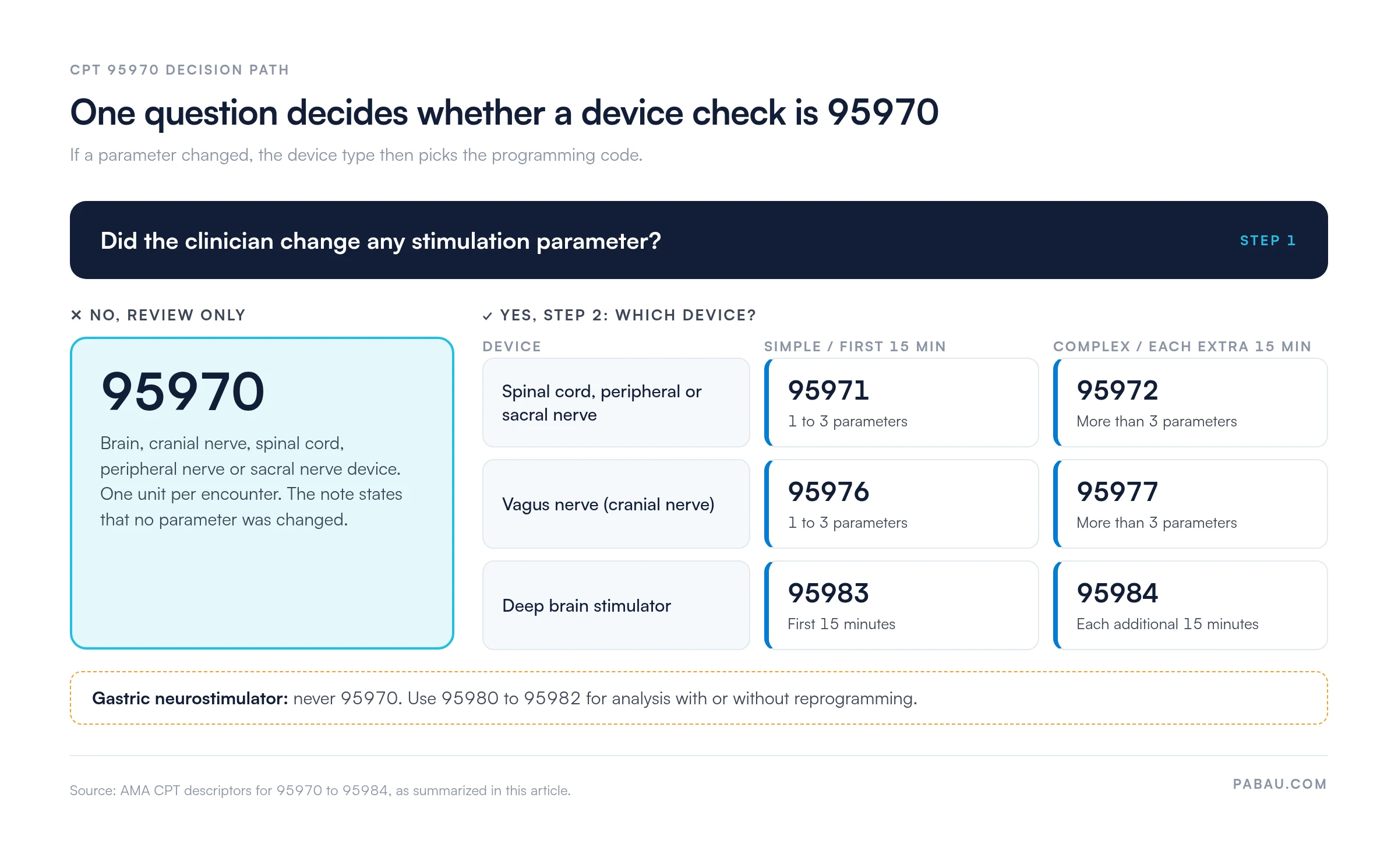
Even a single amplitude adjustment moves the encounter off 95970 and onto the programming code for that device type. On a spinal cord stimulator, that change is 95971.
A parameter adjusted several times in one session still counts once. Four or more changed parameters on a spinal cord system make it a 95972 visit. To defend a 95970 claim on audit, the note must state that parameters were reviewed and left unchanged.
The same patient can generate a different code at every visit. These examples show how the work done at the encounter, not the device, decides the claim.
Visits 1 and 6 are the only 95970 claims in that list. Visit 4 shows a common error to avoid, because a VNS adjustment never belongs on 95971 or 95972.
Knowing the boundaries of CPT code 95970 prevents both underbilling and the upcoding exposure that triggers post-payment review.
Document the phrase ‘no programming performed’ or ‘no parameter adjustments made’ explicitly in the assessment section of the clinical note. A note that describes the interrogation findings without this statement leaves the claim vulnerable to denial or downcoding on audit.
Payer medical necessity reviewers look for a structured note. It must confirm that the device interrogation was medically indicated and that no programming occurred. The following checklist covers the minimum documentation expected.
The diagnosis on a 95970 claim reflects the condition the device treats. That varies by device type, so the table groups common ICD-10-CM codes by stimulator.
Coverage follows your Medicare Administrative Contractor’s neurostimulator LCD and its billing article, and criteria vary by contractor. Check the full descriptor and coding notes for each diagnosis before you commit it to the claim. For failed back surgery patients, our M96.1 guide covers how the postlaminectomy code is assigned.
CMS publishes relative value unit (RVU) data for CPT code 95970 each year through the Medicare Physician Fee Schedule (MPFS). Payment is the total RVU multiplied by a conversion factor (CF). For CY2026, CMS uses two: $33.5675 for qualifying APM participants (QP) and $33.4009 for everyone else.
The dollar figures below are national amounts derived from RVU x CF. Actual payment also varies by geographic practice cost index (GPCI) in your locality.
Always verify current rates using the CMS Physician Fee Schedule lookup tool for the applicable calendar year and locality. The national amounts above change every year with RVU and conversion factor updates.
Medicare does not require prior authorization for CPT code 95970 analysis visits as a blanket rule. Commercial payers vary considerably, and some managed Medicaid plans require prior auth for any neurostimulator-related service after the initial implant authorization period.
Some commercial payers require a separate authorization for ongoing analysis visits, apart from the one obtained for the implant. Checking coverage at each encounter reduces the risk of billing 95970 without a valid authorization on file.
Payers scrutinize the line between analysis and programming, so this code family draws more review than a general office visit. These are the patterns behind denials in this code family.
Tracking denial reason codes (CARCs) by payer across your neurostimulator claims shows which patterns hit your practice most. Our guide to denial management in healthcare shows how to prioritize appeals by dollar value and root cause.
Modifier selection for 95970 depends on whether additional services are reported on the same date and whether bilateral device components are involved.
Under CCI edits, implant procedure codes (CPT 63650, 63655, 63685, 64555, 64561, 64590) generally bundle with 95970 when performed on the same date. An analysis visit on the same date as an implantation or revision generally cannot be billed separately. The exception needs documented clinical rationale supporting distinct medical necessity. Verify current CCI edit tables through the AAPC Codify lookup before submitting.
CPT code 95970 sits within two overlapping code families: the implant and hardware codes, and the 95970-95984 analysis and programming codes. Knowing both helps coders apply same-day billing rules and pick the right companion code.
Spinal cord, peripheral nerve, and cranial nerve programming are counted by parameters. Brain programming stays time-based with 95983 and 95984. Analysis without programming is 95970 across all of them, except gastric devices.
A neurostimulator analysis claim usually fails on the note. Either it never said whether programming happened, or nobody checked coverage before the visit.
Pabau keeps scheduling, clinical notes, and billing on one patient record. Its claims management software pulls the details already on that record into a pre-filled claim. It then submits the claim through Claim.MD, our US clearinghouse partner, and tracks its status.
Verifying coverage before the appointment (see our insurance eligibility verification guide) brings prior authorization questions up before the device check. Your coders still choose the code. A custom note template with a required “programming performed: yes/no” field answers the 95970 question before the claim goes out.
For practices with many neurostimulator patients, tracking claim status by payer shows which claims are denied or paid below the billed amount. You can then review each one against the note. That points you to appeals and to the note templates that need tightening. Review the medical billing fundamentals guide for how clearinghouse submission fits the wider revenue cycle.
Run a quarterly report of claims across 95970, 95971, and 95972. Any remittance where 95972 was billed but 95971 or 95970 was paid signals a payer downgrading programming claims. Each one is an appeal opportunity and a reason to review how your notes record the parameter count.

Pabau keeps the analysis note, coverage details, and claim on one patient record. It submits and tracks each claim through Claim.MD, so denials surface early.

The compliance risk in CPT code 95970 billing is narrow but consequential. A programming code billed on a visit where the note only supports analysis invites a post-payment audit. A 95970 claim on a visit where settings changed leaves earned revenue unbilled.
The fix is documentation discipline: an explicit statement that no programming occurred, and a parameter count whenever it did. Then match the code to the device type, because a VNS or DBS adjustment never lands on 95971 or 95972.
Pabau keeps that note, the patient’s coverage, and the claim on one record, so your team can check the code against the documentation before submission. Book a demo to see how Pabau ties each device-check note to the claim it supports.

Billing a complex reprogramming session? CPT code 95972 covers the parameter count and documentation for complex spinal cord and peripheral nerve programming.
Coding the implant itself? CPT code 63685 explains how the spinal neurostimulator pulse generator insertion is billed.
Want fewer mechanical denials? Clean claim requirements outlines the pre-submission checks that stop errors before they reach the payer.
Documenting medical necessity for repeat visits? Medical billing compliance explains how to document visits so they satisfy Medicare and commercial payers.
Need the bigger billing picture? Revenue cycle management walks through each step from scheduling to payment.
CPT code 95970 covers electronic analysis of an implanted brain, cranial nerve, spinal cord, peripheral nerve, or sacral nerve neurostimulator with no programming. It includes interrogation of battery status, lead impedance, and stimulation settings. Gastric neurostimulators are not included; they use 95980 to 95982.
Yes, a separately identifiable evaluation and management service may be billed on the same date as CPT 95970. The E&M must reflect distinct work beyond the device interrogation. Append modifier -25 to the E&M code, not to 95970, and document the separate clinical decision-making in the note.
Yes, CPT 95970 applies to vagus nerve stimulator analysis visits where no programming occurs, because VNS is a cranial nerve neurostimulator. If the clinician changes a setting, bill 95976 or 95977 instead, not 95971 or 95972. Document the VNS model, implant date, indication, and parameters interrogated, with an explicit statement that no adjustments were made.
A frequent denial reason is a mismatch between the note and the code. A claim goes out as 95970 when the note shows a setting change, or as 95971 or 95972 when the note only describes interrogation. Missing prior authorization and same-day bundling with implant codes also trigger denials.
Deep brain stimulator programming is billed with 95983 for the first 15 minutes of face-to-face programming and 95984 for each additional 15 minutes. Brain programming stays time-based, unlike the parameter counts behind 95971 and 95972. A DBS visit with analysis only is still billed as 95970.