

CCSD code G5100: Bypass of duodenum billing guide
CCSD code G5100 bills a bypass that leaves the duodenum in place CCSD code G5100...

Last Updated: Oct 16, 2026
Billable Code
95938 is the CPT code for short-latency somatosensory evoked potential study. The study stimulates any or all peripheral nerves or skin sites and records from the central nervous system, in upper and lower limbs.
That bilateral scope separates it from its closest neighbors, CPT 95925 (upper limbs only) and CPT 95926 (lower limbs only). Documentation covering only one limb pair does not support 95938 and will not pass payer review. Neurologists bill it for multiple sclerosis workups, peripheral neuropathy evaluation, and intraoperative spinal cord monitoring.
Let Pabau's smart automation suggest the right codes, reduce claim denials, and keep your practice compliant—effortlessly.
Automate repetitive tasks and focus on what matters most—your patients.
Reduce coding errors and ensure compliance with the latest regulations.
Clean claims, fewer denials, and faster reimbursements.
Powerful insights and reporting to help your practice thrive.
HIPAA compliant SOC 2 certified GDPR-compliant Trusted by 4,000+ clinics worldwide

CPT code 95938 covers SSEP testing of both upper and lower limbs in one study. Single-limb studies use 95925 or 95926 instead.
Medicare covers 95938 under Billing and Coding Article A56773 and LCD L34975, for conditions such as multiple sclerosis and spinal cord monitoring.
Medicare’s 2026 national rate for CPT 95938 is roughly $400 for the global service. That splits into about $45 for modifier 26 and $355 for modifier TC.
Documentation must include the ordering provider, clinical indication, stimulation sites, recording sites, waveform measurements, and a signed written interpretation report.
CPT code 95938 is a neurophysiology procedure code for short-latency somatosensory evoked potential study. The full descriptor covers stimulation of any or all peripheral nerves or skin sites, recording from the central nervous system, in upper and lower limbs. The American Medical Association’s CPT code set maintains that descriptor under the Evoked Potentials and Reflex Testing section, codes 95925-95941.
The phrase “upper and lower limbs” decides which code the study belongs to. Test one limb pair and the claim belongs to 95925 or 95926. Test both in the same session and 95938 is the only correct code.
The procedure applies electrical stimulation to peripheral nerves or skin sites. It then records the resulting signals as they travel through sensory pathways to the cortex. The clinician measures peak latencies, amplitudes, and conduction velocities. Prolonged latency or absent responses indicate demyelinating disease, peripheral nerve damage, or central conduction abnormalities.
CPT 95938 has no facility versus non-facility payment split. It splits by component instead: the professional component (modifier 26) and the technical component (modifier TC). Bill the code without a modifier and Medicare pays the global service, meaning both components together.
The figures below are CY 2026 national amounts, calculated from the CMS relative value file at the $33.4009 conversion factor. Check the CMS Physician Fee Schedule look-up tool for your own locality before you submit.
Relative value units set Medicare payment before the geographic adjustment is applied. Each component RVU is multiplied by the matching GPCI for your locality, then by the conversion factor. The values below are the CY 2026 national RVUs published in the CMS physician fee schedule relative value files. They are restated each quarter, so pull the current release before you model revenue.
Practice expense carries almost the whole value of this code. Work RVU sits at 0.84, while practice expense reaches 11.05, which reflects the equipment, supplies, and technician time an SSEP study consumes. The chart below sets the three payment routes against each other.
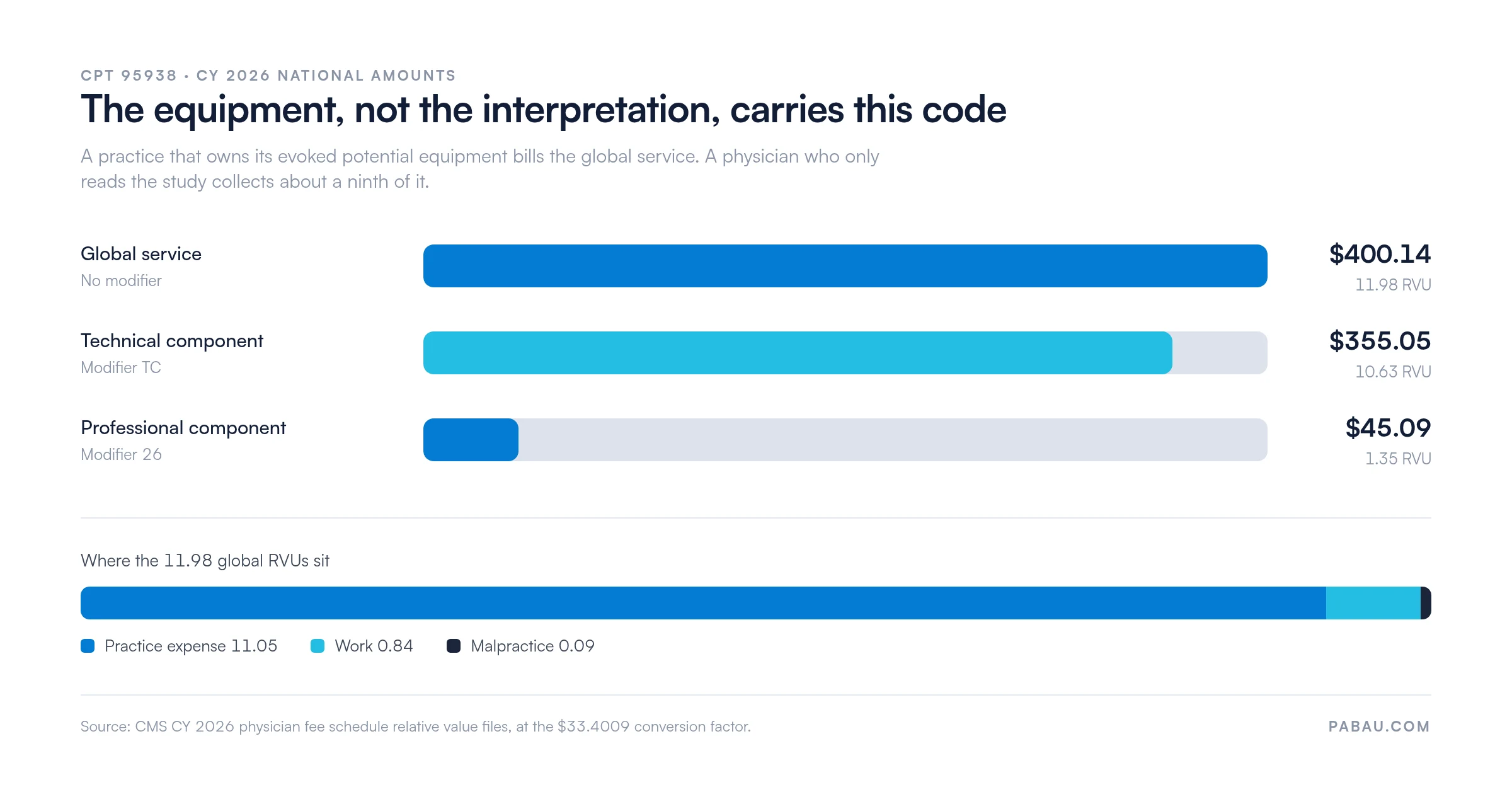
A neurology practice that owns its evoked potential equipment and reads its own studies bills the global service and keeps both components. A physician who only interprets a study run somewhere else bills modifier 26 and collects around $45.
Choosing the wrong code from the SSEP family is one of the most common billing errors in evoked potential studies. The table below maps each code by scope and by the billing difference that matters against 95938. The AAPC Codify CPT lookup carries the official descriptor for every code in the range. Neurology practices also meet the IONM codes, 95940 and 95941, in surgical monitoring.
95925 and 95926 are not simply lower-value alternatives to 95938. They describe different study scopes. A practice that defaults to 95938 when only upper limbs were tested is upcoding, which triggers audits.
The reverse error also costs money. A practice that bills 95925 and 95926 separately, when both limb pairs were tested in one session, is unbundling. 95938 is the correct single code.
Every CPT 95938 claim requires a supporting ICD-10-CM diagnosis code that establishes medical necessity. The CrossCoder crosswalk tool identifies which diagnosis codes pair with 95938 across payer policies. The table below covers the diagnoses most commonly accepted under CMS Billing and Coding Article A56773 and major commercial policies. Our ICD-10-CM code index carries the full descriptor and coding notes for each one.
Unspecified codes like G62.9 increase audit risk. Where the clinical record supports a more specific diagnosis, use it. G61.0 Guillain-Barre syndrome and G61.81 chronic inflammatory demyelinating polyneuritis are two common examples. Specificity reduces the chance of a medical necessity denial and makes any appeal easier to sustain.
Medicare covers CPT code 95938 when the medical necessity criteria in LCD L34975 and its Billing and Coding Article A56773 (Neurophysiology Evoked Potentials) are satisfied. Find out which policies your MAC applies, and which diagnoses they cover, before the claim is submitted rather than after a denial arrives.
Medicare covers CPT 95938 for the following clinical situations under Article A56773:
CMS and most MACs deny CPT 95938 claims in the following situations:
MAC jurisdiction matters here. Article A56773 sits under LCD L34975, and individual MACs such as Novitas, CGS, Palmetto, WPS, and First Coast publish their own coverage policies. Some apply stricter frequency limits or narrower covered-indication lists. Always confirm the policy that governs your MAC before billing.
Strong documentation is what separates a clean claim from a denied one. Auditors reviewing CPT code 95938 look first for bilateral limb documentation. A procedure note that references only upper limb stimulation will not support the code.
What the neurophysiologist intended to perform carries no weight on review. Building a structured SSEP report template around both limb pairs reduces that risk. The fields themselves prompt the technician to record the lower limb waveforms.
Flag any SSEP report template that omits a dedicated section for lower limb waveform data. Auditors reviewing 95938 claims look specifically for bilateral documentation. A template with fields for upper limb measurements alone is a billing compliance risk waiting to happen. Review your SSEP report template and add explicit lower limb fields before your next MAC audit cycle.
CPT 95938 can be reported on the same claim as the IONM codes (95940, 95941) in surgical monitoring contexts. Each code must describe a separate service, and the documentation must support both. NCCI edits govern what can be billed together, and bundling rules change, so verify the current edits before submission. Denial management workflows for neurology billing teams should include a specific edit for SSEP and IONM bundling rejections.
95938 should not be reported on the same claim as 95925 and 95926 for the same patient on the same date. Billing 95925 (upper) and 95926 (lower) separately on the date the bilateral study was performed risks unbundling denials. It can also create fraud exposure. Use 95938 as the single code when both limb pairs are tested in one session.
Commercial payers apply their own medical policies alongside or instead of CMS Article A56773. Where a plan’s criteria run tighter than Medicare’s, a 95938 claim that would have paid under Medicare denies without warning. Sorting SSEP rejections by payer shows which plans are the strict ones, and how far their criteria diverge.
Policy details change with each plan year. Verify current prior authorization requirements for 95938 directly with each payer before scheduling high-volume SSEP studies. A single prior-auth call can prevent a $400 claim from denying across multiple dates of service.
Billing CPT code 95938 accurately depends on three controls that software can handle directly. Two of them are code validation at claim entry and documentation completeness checks before submission. The third is payer-specific edit rules that run before the claim leaves the practice.
Practice management software like Pabau runs all three from the same record. Practices submitting SSEP claims through Pabau’s claims management software route 95938 through built-in validation. A claim missing its lower limb documentation is caught before it reaches the clearinghouse.
Pabau connects to over 4,000 US payers for electronic claims. That covers real-time eligibility verification, 837P electronic claim submission, and 835 ERA remittance processing. For neurology practices billing 95938 alongside IONM codes, bundling conflicts surface as edits before the claims go out. Secondary claims, corrected claims, and CARC denial code tracking sit in the same workflow.
Set up a dedicated 95938 denial worklist in your practice management system filtered by CARC codes 50 (non-covered), 97 (bundled), and 151 (frequency limit exceeded). Reviewing these three denial categories weekly keeps SSEP claim recovery rates high and surfaces payer policy changes before they cost significant revenue.

Pabau’s claims management software helps neurology practices validate CPT codes, check SSEP documentation before submission, and manage 95938 claims from one platform. See how it fits your practice.

CPT code 95938 is a precise, scope-defined billing code. The bilateral upper-and-lower-limb requirement is unambiguous, and payers use it as the first filter on every claim. Practices capture the full value of every study when they build SSEP report templates around that requirement.
The economics point the same way. Practice expense carries 11.05 of this code’s 11.98 RVUs. The decision that moves revenue is therefore whether the practice owns the equipment. Verify ICD-10 specificity and confirm prior authorization in advance, and the claim stays clean.
Book a demo to see how Pabau validates SSEP coding and tracks every 95938 claim through to remittance.

Need to understand what happens after a claim is submitted? Medical billing fundamentals explains the end-to-end process from claim creation through payment posting.
Want to reduce SSEP claim denials before they happen? Denial management in healthcare covers how to build systematic denial prevention and recovery workflows.
Looking for guidance on clean claim submission standards? Clean claim requirements outlines what payers check before processing any claim, including neurology codes.
CPT code 95938 is a short-latency somatosensory evoked potential (SSEP) study. It stimulates peripheral nerves or skin sites and records the responses from the central nervous system. Both upper and lower limbs are covered within a single study session. It is the billing code for bilateral SSEP testing, distinct from 95925 (upper limbs only) and 95926 (lower limbs only).
Yes, Medicare covers CPT 95938 when the medical necessity criteria in LCD L34975 and Billing and Coding Article A56773 (Neurophysiology Evoked Potentials) are met. Covered indications include multiple sclerosis, peripheral neuropathy evaluation, and intraoperative spinal cord monitoring. Coverage varies by MAC jurisdiction, so verify the policy that applies in your region before billing.
CPT 95938 covers both upper and lower limbs in a single SSEP study. CPT 95925 covers upper limbs only, and CPT 95926 covers lower limbs only. Billing 95925 and 95926 on the same date as 95938 for one patient risks an unbundling denial. Use 95938 as the single code whenever both limb pairs are tested in one session.
Claims for CPT 95938 require the ordering provider and the clinical indication on file. The record must also show stimulation and recording sites for both upper and lower limbs. Waveform measurements go in for each limb pair, alongside a signed interpretation report from the performing physician. Missing lower limb documentation is the most common reason 95938 claims are denied.
A short-latency SSEP study is medically necessary when a clinician needs objective evidence of sensory pathway integrity. Typical situations include demyelinating disease evaluation, unexplained peripheral neuropathy, preoperative spinal cord risk assessment, and monitoring during spine or brainstem surgery. Routine screening without documented neurological symptoms does not meet medical necessity criteria.
CPT 95938 can generally be reported alongside the IONM codes (95940, 95941). Each code must describe a separate, documented service within a surgical monitoring encounter. Verify the current NCCI edits for the applicable year before billing. Bundling rules change annually, and modifier requirements may apply depending on the combination billed.



