CCSD Code H3334: Low anterior resection billing guide
CCSD Code H3334: Definition and clinical scope CCSD Code H3334 covers an open an...

Last Updated: Oct 16, 2026
95870 is the CPT code for a limited needle electromyography study of muscles in 1 extremity, or of non-limb (axial) muscles. Axial muscles tested on one or both sides count as one study. It excludes thoracic paraspinal, cranial nerve supplied and sphincter muscles, which have their own codes.
A limited study tests fewer than five muscles. 95870 is reported only when no nerve conduction study is billed the same day. With one, the needle EMG moves to add-on code 95885 or 95887.
Let Pabau's smart automation suggest the right codes, reduce claim denials, and keep your practice compliant—effortlessly.
Automate repetitive tasks and focus on what matters most—your patients.
Reduce coding errors and ensure compliance with the latest regulations.
Clean claims, fewer denials, and faster reimbursements.
Powerful insights and reporting to help your practice thrive.
HIPAA compliant SOC 2 certified GDPR-compliant Trusted by 4,000+ clinics worldwide

CPT code 95870 covers a limited needle EMG study: fewer than five muscles in one extremity, or non-limb axial muscles on either or both sides.
Five or more muscles in one extremity is a complete study, coded 95860 without an NCS or add-on 95886 when billed with NCS codes 95907-95913.
95870 is the no-NCS code, so when nerve conduction studies are billed the same day, report the needle EMG with add-on 95885 or 95887 instead.
Medicare coverage now comes from each MAC’s active LCD, because billing article A54992 was retired on October 23, 2025.
Pabau’s claims management checks required claim fields before sending and tracks every claim’s status, so 95870 rejections surface early.
CPT code 95870 reports a limited needle electromyography (EMG) study of muscles in one extremity, or of non-limb axial muscles. The American Medical Association’s CPT code set holds the official descriptor.
Its first part reads: “Needle electromyography; limited study of muscles in 1 extremity or non-limb (axial) muscles (unilateral or bilateral).” It then sets the exclusions: “other than thoracic paraspinal, cranial nerve supplied muscles, or sphincters.”
The code sits in the Medicine section of CPT (90281-99607), under Neurology and Neuromuscular Procedures (95700-96020). Within that range, it belongs to the Needle Electromyography group, 95860-95872.
“Limited study” means the interpreting physician examined fewer than five muscles with a needle electrode. For non-limb axial muscles, one side (unilateral) and both sides (bilateral) are reported under the same code. Non-limb axial muscles include cervical and lumbar paraspinals, plus trunk and abdominal wall muscles.
95870 is also the code for needle EMG performed without a nerve conduction study (NCS). When an NCS is billed the same day, the EMG moves to the add-on codes covered further down.
Three muscle categories fall outside 95870 entirely, each with its own code:
Needle EMG uses a monopolar or concentric needle electrode inserted directly into muscle tissue. The physician records spontaneous electrical activity at rest, then assesses motor unit action potential morphology and recruitment patterns during voluntary contraction.
Common clinical indications include radiculopathy, peripheral neuropathy, myopathy, neuromuscular junction disorders, motor neuron disease, and plexopathy.
Needle EMG is a physician-performed procedure, so a technician cannot perform the needle portion for the service to be billable. The same physician who performs the study interprets it and reports the findings in a formal EDX report.
Two facts decide the needle EMG code: how many muscles were tested in each extremity, and whether an NCS was billed the same day. Fewer than five muscles is a limited study. Five or more muscles in one extremity is a complete study.
Without an NCS, a limited study is 95870 and a complete study of one extremity is 95860. With an NCS (95907-95913), the same studies become add-on codes: 95885 for limited and 95886 for complete. The matrix below maps each combination, including the muscle groups that never belong under 95870.
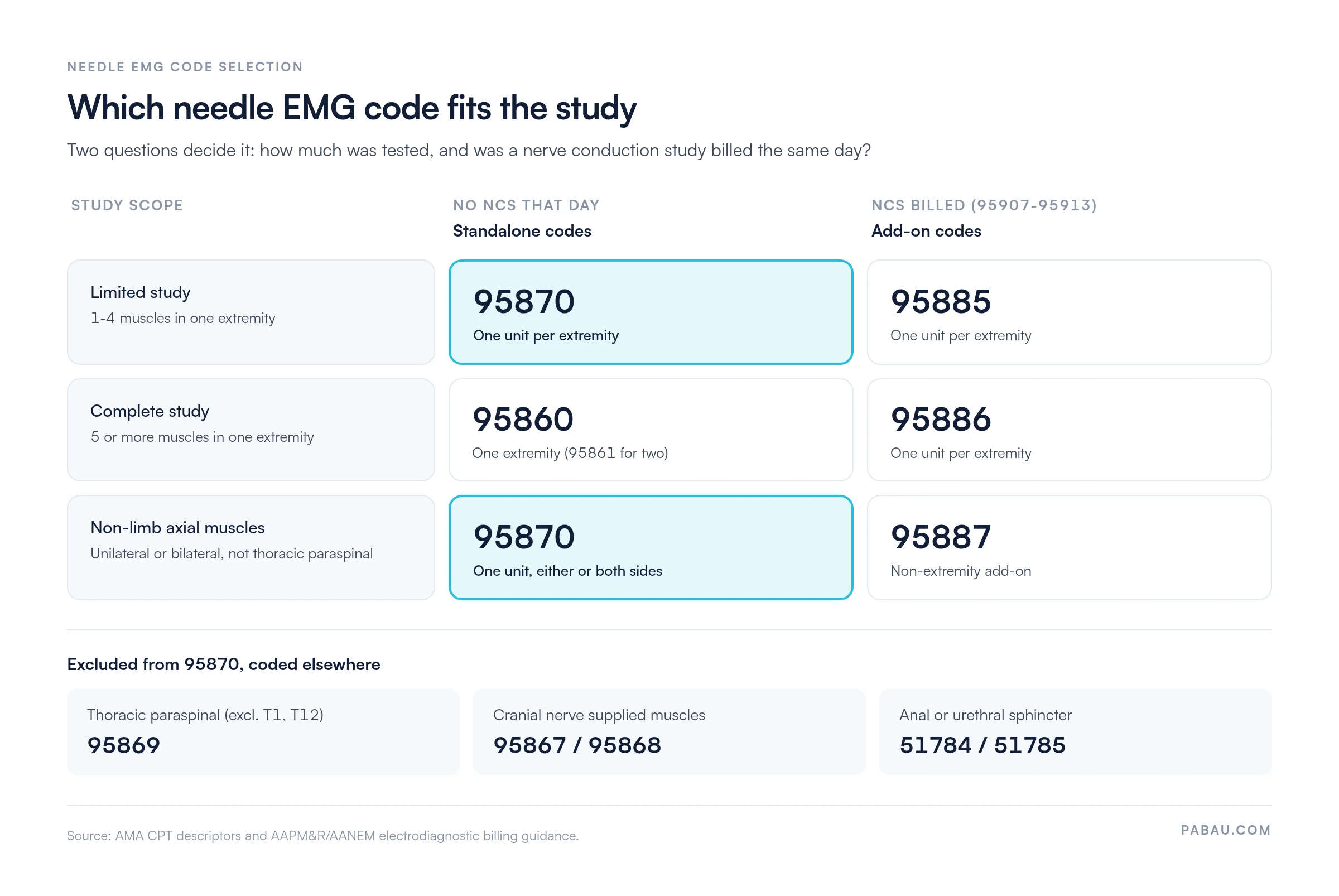
Consider a neurologist who tests the right first dorsal interosseous, abductor pollicis brevis, and flexor carpi radialis, with no NCS that day. That is three muscles in one extremity, so CPT code 95870 is correct.
If the report also lists the biceps brachii and triceps, the count reaches five and 95860 applies. Had an NCS been billed as well, those two studies would be coded 95885 and 95886.
Key distinction: 95885, 95886 and 95887 are add-on codes reported only with NCS codes 95907-95913. CPT code 95870 is a standalone code for needle EMG performed without an NCS, so it is not reported alongside those add-ons.
Electrodiagnostic billing involves two parallel code families: needle EMG codes and nerve conduction study codes. They are often performed in the same session, and the add-on rule above decides which EMG code goes on the claim.
Medicare coverage for CPT code 95870 is set by each Medicare Administrative Contractor’s (MAC’s) active Local Coverage Determination (LCD) on nerve conduction studies and EMG.
Examples include L36526 and L35098. CMS billing and coding article A54992 was retired on October 23, 2025, and no single national document replaced it.
Search the Medicare Coverage Database for your MAC’s current LCD and its companion billing article. Medical necessity must be supported by a documented clinical indication. The conditions MAC LCDs most commonly accept include:
Commercial payers follow similar indications but add their own documentation requirements. Blue Cross Blue Shield plans keep electromyography policies that broadly mirror the Medicare LCDs, and some add stricter pre-authorization rules.
Aetna and UHC policies also expect a signed, detailed EDX report from the interpreting physician. Check each payer’s current policy rather than assuming the Medicare indications carry over.
The CMS Physician Fee Schedule lookup tool is the authoritative source for 2026 payment rates. The national figures below come from the AANEM 2025-2026 RVU comparison, which uses the 2026 conversion factor of $33.42. Your payment is then adjusted by the Geographic Practice Cost Index (GPCI) for your MAC locality.
Non-facility payment for 95870 rose from $77.63 in 2025 to $86.56 in 2026, driven by the higher practice expense RVU. These are national values before GPCI adjustment, so look up your locality before quoting a patient estimate. Facility-setting payment differs, so check it separately in the CMS lookup tool.
Run your 95870 claims through your MAC’s fee schedule before setting patient cost estimates. A neurology practice in New York City will see non-facility reimbursement meaningfully above the national average, while rural MAC jurisdictions often pay below it. Build a rate card by MAC region for every commonly billed EMG code in your practice.
CPT 95870 is not reported with nerve conduction study codes 95907-95913 on the same date. When an NCS is performed, the needle EMG is reported with add-on codes instead: 95885 or 95886 for each extremity, and 95887 for non-extremity muscles.
Appending modifier 59 or an X-modifier to a 95870 and NCS pair does not make 95870 the right code. The AAPM&R electrodiagnostic billing guide sets out the with-NCS and without-NCS code sets side by side.
Modifiers still matter when 95870 shares a claim with other procedures, so check the quarterly NCCI edit files before appending one.
If the treating neurologist or physiatrist performs an E/M service on the same date as CPT code 95870, modifier -25 must accompany the E/M code. It shows the E/M was a significant, separately identifiable service beyond the pre-service work bundled into the EMG. Without modifier -25, the E/M collapses into the procedure and is denied.
The EDX report is the single document that wins or loses a 95870 claim. The AAN’s electrodiagnostic medicine reporting guidelines specify what the report must contain to be defensible on audit. Meeting these standards also supports medical billing compliance for neurology and physiatry practices.
Structured templates with muscle name fields and waveform checkboxes keep EDX reports complete and speed up clean claim submission. Free-text reports are harder to defend when an auditor asks which muscles were tested.
Bill one unit of CPT code 95870 per extremity studied. Non-limb axial muscles count as one unit whether one side or both were tested, because the descriptor reads “unilateral or bilateral.” MACs also set daily unit limits, so check yours before billing several extremities. Two units for one axial region tested on both sides is a common audit trigger.
Most CPT code 95870 denials cluster around six patterns. Knowing them in advance is the basis of effective denial management workflows for electrodiagnostic practices. When denials do land, our denial codes guide lists the remittance advice codes and appeal language to resolve them.
The denials above are set before the claim leaves the practice: the wrong code, an extra unit, a missing field. Neurology and physiatry practices billing high EDX volumes need those errors caught at submission, not weeks later on the remittance.
Pabau, the practice management platform we build, includes cleaner claims management software in the same system as the patient record. It checks required fields such as membership numbers and authorization codes in the background, and won’t send a claim until they’re complete.
US practices submit claims electronically through Claim.MD, with real-time eligibility checks and ERA posting. Every claim’s status sits on one dashboard, so you can filter 95870 claims by insurer and spot a denial pattern early. That leaves coders more time for the judgment calls: code selection, muscle counts and same-day NCS pairing.

Pabau checks required claim fields before sending, submits US claims through Claim.MD, and tracks every claim’s status. Your neurology or physiatry team spends less time on rejections and appeals.

CPT code 95870 rewards a two-step check before every EMG claim. Count the muscles in each extremity, then confirm whether an NCS was billed the same day. Those two answers settle the choice between 95870, 95860 and the add-on codes 95885-95887.
The trade-off is time at the reporting stage. A structured EDX template that names each muscle takes longer to set up than free text. In return, it removes the most common reasons a 95870 claim comes back. Book a demo to see how Pabau keeps EMG claims complete and trackable from submission to payment.

Want to understand how remittance advice codes map to denial reasons? Electronic remittance advice (ERA) guide explains how to read 835 files and action CARC denial codes efficiently.
CPT code 95870 is the needle EMG code for a limited study of fewer than five muscles in one extremity. It also covers non-limb axial muscles on one or both sides. It excludes thoracic paraspinal, cranial nerve supplied, and sphincter muscles. It is a standalone code in the CPT Medicine section, used when no nerve conduction study is billed that day.
CPT 95870 is a standalone limited EMG study of fewer than five muscles, billed without a nerve conduction study. CPT 95886 is an add-on code for a complete study of five or more muscles in one extremity, reported only with NCS codes 95907-95913. Without an NCS, a complete one-extremity study is coded 95860.
No. When nerve conduction studies (95907-95913) are billed the same day, report the needle EMG with add-on code 95885, 95886, or 95887. Appending modifier 59 or an X-modifier does not make 95870 the right code for that encounter.
Thoracic paraspinal muscles, cranial nerve supplied muscles (facial, masseter, tongue, laryngeal), and sphincter muscles are explicitly excluded from CPT code 95870 by the AMA descriptor. They are reported under 95869, 95865-95868, and 51784-51785. Lumbar and cervical paraspinals are not excluded and may be reported under 95870 as non-limb axial muscles.
CPT code 95870 is billed once per extremity studied. Non-limb axial muscles count as one unit whether one or both sides were tested, because the descriptor reads “unilateral or bilateral.” Medicare Administrative Contractors also set daily unit limits, so check your MAC’s policy before billing several units.
Each Medicare Administrative Contractor’s active LCD on nerve conduction studies and electromyography covers 95870, such as L36526 or L35098. CMS billing article A54992 was retired on October 23, 2025, with no single national replacement. Check your MAC’s LCD for the covered ICD-10 codes and documentation rules.