HCPCS Code G0163: Skilled nursing observation and assessment
What is HCPCS Code G0163? HCPCS Code G0163 is a deleted Level II code for skille...

Last Updated: Oct 15, 2026
95885 is the CPT code for limited needle electromyography of each extremity, with related paraspinal areas when performed. It is reported alongside a nerve conduction study with amplitude and latency/velocity measurement, and listed separately in addition to the primary procedure code.
As an add-on code, 95885 is reported once for each extremity studied. A claim that carries it without a primary NCS code from the 95907-95913 series denies almost automatically. On its own, 95885 cannot generate a payable claim.
Let Pabau's smart automation suggest the right codes, reduce claim denials, and keep your practice compliant—effortlessly.
Automate repetitive tasks and focus on what matters most—your patients.
Reduce coding errors and ensure compliance with the latest regulations.
Clean claims, fewer denials, and faster reimbursements.
Powerful insights and reporting to help your practice thrive.
HIPAA compliant SOC 2 certified GDPR-compliant Trusted by 4,000+ clinics worldwide

CPT code 95885 is a limited needle EMG add-on code; it cannot be billed as a standalone procedure.
It must be reported with a primary NCS code from the 95907-95913 series or claims will deny.
Each extremity tested is reported separately; paraspinal areas are included when examined.
Pabau’s claims management software enforces add-on code pairing rules before submission, reducing denials at the source.
CPT code 95885 reports limited needle electromyography of a single extremity, with related paraspinal areas when examined. The study is performed as part of a combined nerve conduction and EMG evaluation. The American Medical Association maintains the CPT code set. It classifies 95885 in the neurology and neuromuscular procedures section, alongside companion codes 95886 and 95887.
The key phrase in the descriptor is “list separately in addition to code for primary procedure.” That language identifies 95885 as an add-on code. It has no global period, no modifier 51 requirement, and no separate E&M component. Every claim for 95885 requires a billable primary NCS code on the same date of service.
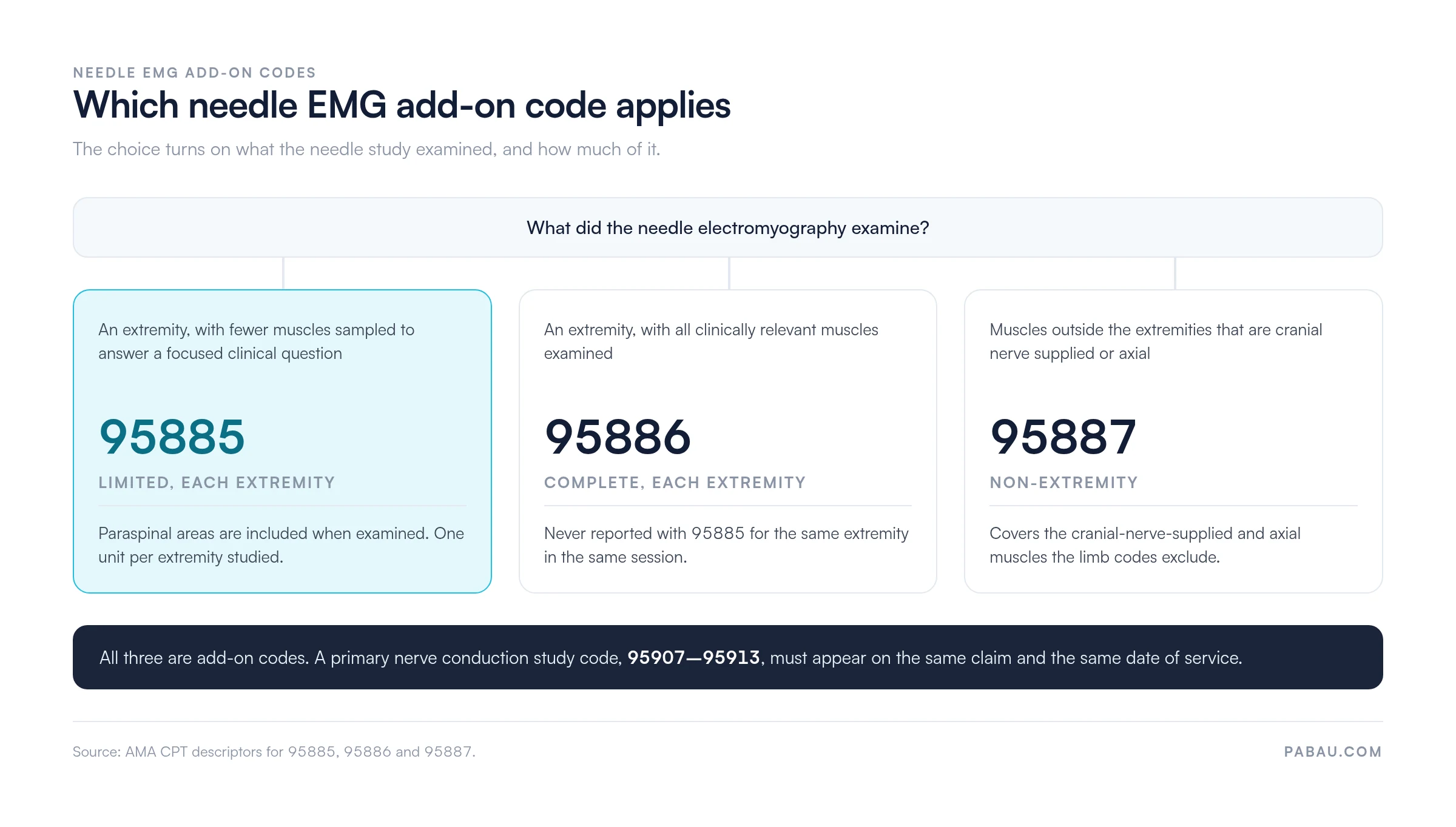
The three needle EMG add-on codes in this family cover different study scopes. Selecting the wrong one is the second most common denial reason after billing without a primary NCS code. The distinction between 95885 (limited) and 95886 (complete) hinges on the number of muscles examined per extremity.
A study that samples a small subset of muscles to screen a suspected mononeuropathy warrants 95885. A complete workup of all clinically relevant muscles in the limb to characterize a polyneuropathy or radiculopathy warrants 95886. Using 95885 when the documentation reflects a complete study downcodes revenue. Billing 95886 when only limited sampling was performed is upcoding and an audit risk. The chart below reduces the choice to a single question about what the needle examined.
CPT code 95885 follows strict add-on code rules set by both the AMA and National Correct Coding Initiative (NCCI) edits. Every submission must pair 95885 with a valid primary NCS code. Practice management software like Pabau routes claims through Claim.MD, its integrated US clearinghouse. The clearinghouse validates add-on and primary code pairings before the claim reaches the payer. Missing the primary code is the most preventable denial in electrodiagnostic billing.
The valid primary procedure codes for nerve conduction studies are 95907 through 95913. Each represents a different number of nerve conduction studies performed, ranging from one to two studies (95907) up to 13 or more (95913). The primary NCS code determines the study scope and anchors the 95885 add-on on the claim.
Medicare and most commercial payers require a covered diagnosis to establish medical necessity for electrodiagnostic testing. The CMS Physician Fee Schedule and Local Coverage Article A54992 define covered indications for needle EMG studies. The table below lists the most commonly paired ICD-10 diagnosis codes; it is not exhaustive. Verify current FY2026 ICD-10-CM code validity before billing.
Unspecified codes (e.g., G62.9) are covered but may trigger additional documentation review. Specificity in diagnosis coding reduces that risk. Always pair the most specific ICD-10-CM code the documentation supports.
CPT code 95885 carries a relatively modest RVU value because it is billed alongside, not instead of, a primary NCS code. The FastRVU 2026 lookup tool reflects current Medicare Physician Fee Schedule values. Reimbursement varies by geographic practice cost index (GPCI) and payer contract. The figures below represent national non-facility Medicare averages; verify locality-adjusted rates through the CMS MPFS search tool before projecting revenue.
A bilateral lower-extremity study with limited EMG is often billed alongside 95913, which covers 13 or more NCS studies. That combined claim can reach $300-450 or more in Medicare reimbursement, depending on locality. Tracking per-code revenue and denial rates through electronic remittance advice (ERA) processing shows whether 95885 is captured consistently or lost to unbilled encounters.
Audit your EMG billing monthly by filtering claims for 95907-95913 that do not have a corresponding 95885 or 95886 on the same date. Any NCS claim without an EMG add-on is a potential underbilling event worth reviewing against the clinical documentation.
CMS covers needle EMG under Local Coverage Article A54992, which governs nerve conduction studies and electromyography for Medicare beneficiaries. Coverage is not automatic; the claim must meet medical necessity criteria tied to a covered diagnosis and documented clinical indication. Practices should review current A54992 guidance directly through the CMS Medicare Coverage Database, as coverage policies update periodically.
Private payers follow their own policies, which may differ from Medicare’s A54992 criteria. Aetna, for example, applies its own clinical policy bulletin for electrodiagnostic studies. Confirm coverage for each payer before scheduling the study.
Thorough documentation protects 95885 claims during payer review and audit. The EMG report is the primary evidence that limited (not complete) needle EMG was performed and that the clinical indication was present. Structured EMG reports that capture the required fields reduce post-payment audit exposure. A well-organized superbill workflow captures every procedure element at the point of service.
Services performed on the same date are held to the same reporting standard. Range of motion measurements billed under 95851 need a distinct written report, not a goniometer figure logged in the visit note.
Most 95885 denials fall into a small number of repeating patterns. Identifying which error type is driving your practice’s denials shapes the corrective action. Tracking rejection reason codes per procedure surfaces those patterns before they turn into systemic revenue losses.
Practices with high electrodiagnostic volume benefit most from revenue cycle processes that enforce pairing rules at charge capture, rather than after the claim is submitted.
Most 95885 denials trace back to the handoff between the EMG report and the claim. When the report is written in one system and the charges are entered in another, the add-on pairing rule has nobody enforcing it. Joining documentation to charge capture is the highest-leverage fix available to an electrodiagnostic practice.
Pabau’s pre-submission claims management applies billing rule logic at charge entry. It flags a 95885 or 95886 add-on that appears without a paired primary NCS code, before the claim is generated. For neurology and physiatry practices, that check catches the most common denial pattern automatically.
In practices that perform electrodiagnostic testing alongside manual therapy, the same integration prevents charge leakage across multiple procedure types on one date of service.
Run a quarterly crosswalk of your 95907-95913 claim count against your 95885-95886 claim count. If your NCS claims consistently outnumber your EMG add-on claims, you are either underbilling the EMG component or the documentation does not support reporting it. Both warrant a chart review.

Pabau’s claims management tools enforce add-on pairing rules before submission and track denial patterns by procedure code. Claims go out through Claim.MD, our integrated US clearinghouse. See how neurology and physiatry practices protect electrodiagnostic billing revenue.

CPT code 95885 pays only when the claim carries a primary NCS code, muscle-level documentation, and a covered ICD-10 diagnosis. Miss one of the three and the money goes back to the payer.
The add-on status is what trips up claims, and the durable fix is enforcing the pairing rule inside the documentation workflow. Correcting claims after submission costs more and recovers less.
Pabau’s claims management tools apply the 95885 pairing rule at charge entry and submit clean claims through the Claim.MD clearinghouse. That shortens the denial cycle for neurology and physiatry practices.
Book a demo to see how Pabau keeps every 95885 add-on paired with its primary NCS code before the claim leaves your practice.

Need to understand how claims flow after submission? Medical claims clearinghouse guide explains how electronic claims reach payers and where errors are caught.
Dealing with payer rejections on multiple procedure types? Insurance eligibility verification workflows covers how to confirm coverage before the study, reducing medical-necessity denials.
Want to benchmark your billing performance? How Claim.MD clearinghouse works with Pabau details the real-time scrubbing and ERA processing that keeps electrodiagnostic claims clean.
CPT code 95885 reports limited needle electromyography of a single extremity, including related paraspinal areas when examined. The needle EMG is performed alongside a nerve conduction study. It documents the needle EMG component of a combined electrodiagnostic evaluation and must always be billed as an add-on to a primary NCS code.
Yes. CPT 95885 is an add-on code designated by the phrase “list separately in addition to code for primary procedure” in its descriptor. It cannot be billed independently; a primary nerve conduction study code from the 95907-95913 series must appear on the same claim.
CPT 95885 covers limited needle EMG of an extremity, while 95886 covers complete needle EMG of an extremity. “Limited” means fewer muscles were sampled to address a focused clinical question; “complete” means all clinically relevant muscles were examined. Both are add-on codes requiring a primary NCS code, but only one may be reported per extremity per session.
Yes, Medicare covers CPT 95885 for covered diagnoses under Local Coverage Article A54992, which includes peripheral neuropathy, radiculopathy, plexopathy, mononeuropathy, and neuromuscular junction disorders. The claim must include a covered ICD-10 diagnosis and documented clinical indication; screening studies without symptoms are non-covered.
One unit per extremity studied. A bilateral upper-extremity limited EMG bills two units of 95885. Billing more units than extremities documented in the EMG report triggers an NCCI edit. Payers typically deny the claim or cut it back to the documented extremities.
No. CPT 95885 requires a primary NCS code from the 95907-95913 series on the same date of service. Submitting 95885 without a primary NCS code is the most common reason for denial on this code. Virtually all payers reject the claim.