HCPCS Code L0472: Hyperextension TLSO billing guide
HCPCS code L0472: Official descriptor and device definition HCPCS code L0472 des...

Last Updated: Nov 5, 2026
95018 is the CPT code for allergy skin testing with drugs or biologicals, using any combination of prick and intradermal tests. It applies to immediate type reactions. The code includes test interpretation and report, and you report one unit for each test performed.
Penicillin skin testing is the most common use. Venom testing belongs to 95017, while skin tests with allergenic extracts such as pollen or dust mite use 95004 and 95024.
Let Pabau's smart automation suggest the right codes, reduce claim denials, and keep your practice compliant—effortlessly.
Automate repetitive tasks and focus on what matters most—your patients.
Reduce coding errors and ensure compliance with the latest regulations.
Clean claims, fewer denials, and faster reimbursements.
Powerful insights and reporting to help your practice thrive.
HIPAA compliant SOC 2 certified GDPR-compliant Trusted by 4,000+ clinics worldwide

CPT code 95018 reports allergy skin testing with drugs or biologicals, using any combination of prick and intradermal tests, sequential and incremental.
Venom testing uses 95017, and allergenic extracts such as pollen or foods use 95004, 95024 or 95027.
Bill one unit per prick or intradermal test performed, leave out controls, and never split one drug test between 95004 and 95018.
The CY2026 national Medicare rate is $19.04 per office test for non-QP providers, from 0.57 total RVUs.
CPT code 95018 reports allergy skin testing with drugs or biologicals, using any combination of percutaneous (prick) and intradermal tests. The AMA CPT code set describes the testing as sequential and incremental, for an immediate type reaction. The code includes test interpretation and report, and the claim must specify the number of tests.
That wording has applied since CPT 2013, when 95010 and 95015 were deleted. Their drug and venom testing was split between two combined codes. 95018 took drugs and biologicals, and 95017 took venoms. Older guides still describe 95018 as intradermal-only testing that includes venoms, and both points are now out of date.
Because the code bundles both methods, the prick step and the intradermal step of a drug test are both 95018 tests. Neither step moves to 95004 or 95024. Most 95018 unit errors come from splitting one drug test across two codes.
Choose the code by the substance first, then by the method. Drugs and biologicals go to 95018 whatever the method, and venoms go to 95017. Allergenic extracts such as pollen, mold, dust mite, animal dander and foods use 95004 for prick tests and 95024 for intradermal tests.
Every code in this table includes test interpretation and report, and each is billed per test. The usual mistake with 95018 is double reporting. A practice bills the prick step of a penicillin test as 95004 and the intradermal step as 95018.
That claim reports the percutaneous component twice, because 95018 already includes it. 95004 is also the wrong code for a drug, since it describes allergenic extracts. Report both steps of the drug test as 95018 units. A same-day 95004 panel for pollen or dust mite remains separate, because it tests different substances.
Bill CPT code 95018 when the chart documents a suspected immediate reaction to a drug or biological. The main indications are:
Venom testing for bee, wasp, hornet or yellow jacket stings is not a 95018 service. It uses CPT 95017, the venom counterpart with the same combined-method structure. Inhalant and food panels are not 95018 services either, and use 95004, 95024 or 95027.
A negative skin test is often followed by an oral drug challenge, such as a graded amoxicillin dose. That challenge is a separate service, reported with the ingestion challenge codes 95076 and 95079 rather than with more 95018 units.
The note has to show what was tested, how, and what the result means. Each test you bill needs its own trace in the chart:
The CY2026 CMS relative value file lists physician supervision indicator 09 for 95018, which means the diagnostic test supervision levels do not apply. 95004 and 95024 carry indicator 02, which requires direct supervision. Drug skin testing can provoke a systemic reaction, so record who performed and who supervised each session.
Audit your allergy testing note template before you bill 95018. Give it a field for each substance and concentration, the method of each test, both controls, the wheal and flare readings, and the signed interpretation. A missing field can lead to a denial when the payer reviews the record.
Report one unit of 95018 for each test performed, counting prick and intradermal tests alike. Controls do not count. WPS’s billing article A60391 gives this example: six penicillin allergens plus controls support six units of 95018.
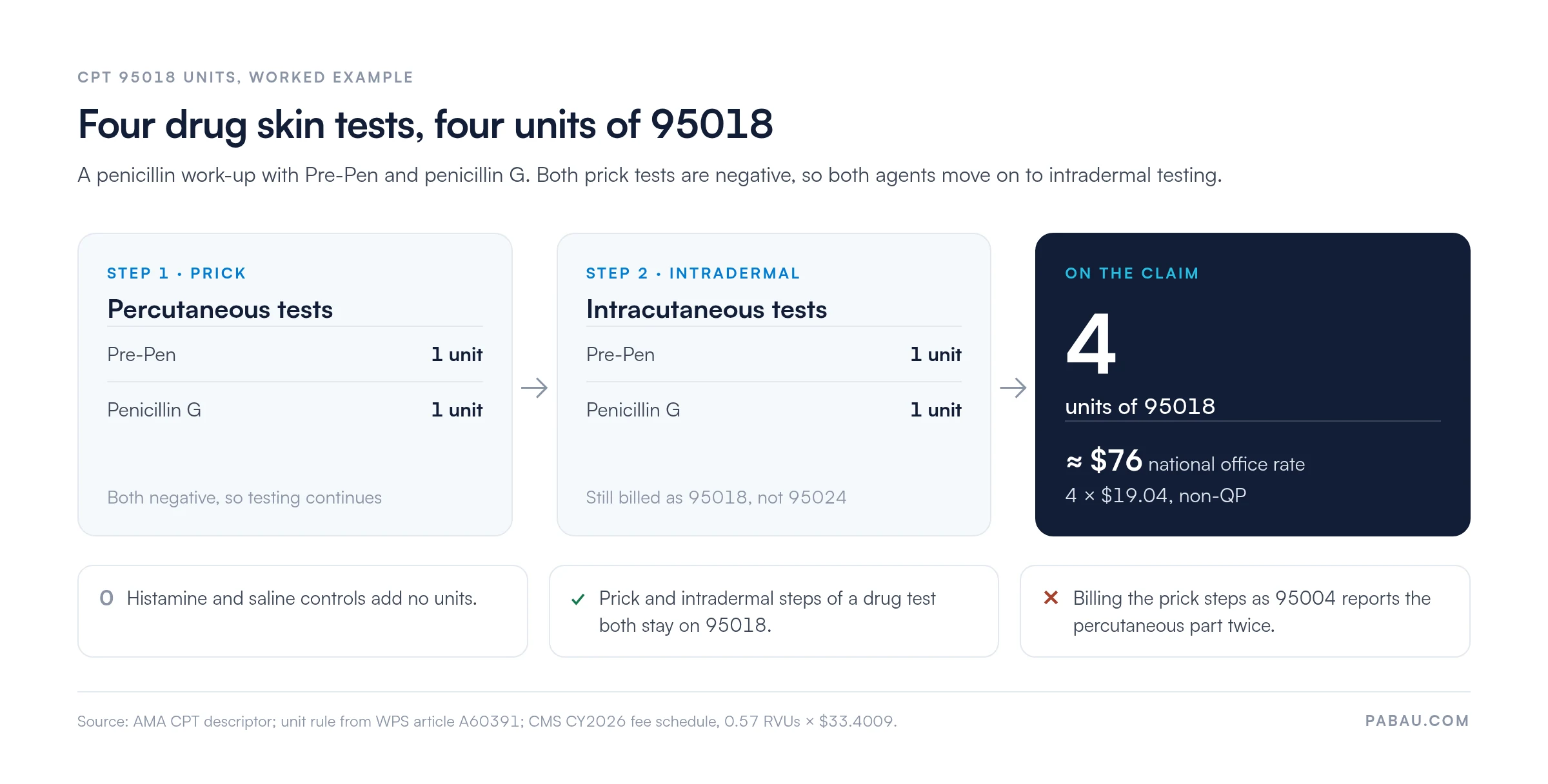
Take a patient tested with Pre-Pen and penicillin G. Both prick tests are negative, so both agents move on to intradermal testing. That is four tests, so the claim carries four units of 95018. If one prick test is positive, that agent skips the intradermal step, and the claim drops to three units. The diagram below traces the four-test version.
Most 95018 claims need no modifier. Two come up often enough to plan for.
You can bill an E/M code on the same date as 95018 when the visit includes a significant, separately identifiable service. The note and the modifier have to support each other:
The claim needs an ICD-10-CM diagnosis code that explains why drug testing was necessary. WPS’s article A60391 lists these codes in the group that supports 95018:
Status codes such as Z88.0, allergy status to penicillin, describe a history rather than a reaction under evaluation. WPS’s article does not list them in the 95018 group, so check before relying on one as the primary diagnosis. Covered lists differ between contractors, so use your own MAC’s article.
Under the CY2026 Medicare Physician Fee Schedule, 95018 carries 0.57 total RVUs in a non-facility setting and 0.18 in a facility. The work RVU is 0.14. These figures come from the CMS October 2026 relative value file.
Each rate is the total RVUs multiplied by the conversion factor, before the locality adjustment. CY2026 has two conversion factors, one for qualifying APM participants (QP) and one for everyone else. In the Pre-Pen example above, four office tests come to about $76 nationally for a non-QP provider. Use the CMS fee schedule lookup for your locality’s rate.
Medicare coverage for allergy testing is set by each MAC through local coverage documents. WPS, for example, publishes billing and coding article A60391, effective September 27, 2026. It sets the unit rules, limits on routine repeat testing, and covered diagnosis groups.
Prior authorization for 95018 depends on the plan. Some Medicare Advantage and commercial plans require it, so insurance eligibility verification should include an authorization check before the visit. A plan that requires authorization usually asks for:
A claim without a required authorization typically comes back with CARC 197. Each plan sets its own rules on retroactive authorization, so check the contract rather than counting on one.
Most 95018 denials trace back to a short list of causes, and each one has a fix that works before the claim goes out.
Remittance data shows which of these causes is costing you money. Read the denial codes on each ERA as part of your denial management workflow, and fix the cause before the next claim. A clean claim on the first submission avoids a resubmission cycle altogether.
Run a monthly 95018 denial report grouped by denial code. A cluster of CARC 50 or 167 points to diagnosis selection. A cluster of CARC 197 points to the authorization workflow. Fixing the cause is faster than appealing claims one at a time.
95017 is the venom counterpart of 95018, with the same combined prick and intradermal structure. A patient tested for both a drug allergy and a venom allergy on one date carries units of each code.
CPT 95165 covers preparing allergenic extracts for immunotherapy, billed per dose. It is a treatment service, while 95018 is a diagnostic test. Do not bill 95165 for the substances used in a 95018 skin test. The AAPC CPT range lookup lists the immunotherapy codes (95115-95199) next to the allergy testing codes.
Most 95018 problems start in the chart. Substances go unrecorded, the method of each test is unclear, and the unit count is rebuilt from memory at billing time.
Pabau, the practice management and EHR platform we build, lets you set up an allergy testing form. It has a field for each substance, method, control and reading. Its claims management pulls the details already on the patient record into a pre-filled claim. Your team checks the codes and units, then submits the claim through the Claim.MD clearinghouse.
Claim status is tracked in one place, and the 835 ERA comes back with its denial codes. Your billing team can then see which denials repeat and fix the cause in the form.

Record every substance, method and reading in one form, then send claims through Claim.MD and track each remittance in Pabau.

CPT code 95018 is the drug and biological allergy test, and the substance decides the code. Venoms belong to 95017, and allergenic extracts belong to 95004, 95024 or 95027. Get that right, count every prick and intradermal test as its own unit, and you avoid the most common 95018 denials.
A testing form that records each step is what makes the unit count defensible. To see how Pabau keeps allergy testing records and claims together, book a demo.

Need a framework for understanding claim rejections? Denial codes in medical billing explains how to read CARC and RARC codes to diagnose and appeal denied allergy claims.
Want to understand how clearinghouses process allergy claims? Medical claims clearinghouse guide covers how 837P transactions are validated before reaching the payer.
Looking for a complete overview of the revenue cycle? What is revenue cycle management explains how allergy testing billing fits into the broader practice RCM workflow.
CPT code 95018 covers allergy skin testing with drugs or biologicals, using any combination of prick and intradermal tests. It includes test interpretation and report, and you bill one unit per test. Venom testing uses 95017 instead.
95018 covers drugs and biologicals, tested by prick, intradermal or both. 95004 covers prick tests with allergenic extracts such as pollen, mold or foods. Do not bill the prick step of a drug test as 95004, because 95018 already includes it.
Bill one unit for each prick or intradermal test performed, and leave out the controls. A patient tested with Pre-Pen and penicillin G by both methods has four tests, so the claim carries four units. Some MACs also limit routine repeat testing.
Yes. Penicillin skin testing is the most common use of 95018. Each prick and intradermal test with a penicillin reagent counts as one unit. An oral challenge after a negative skin test is billed separately with 95076 and 95079.
The most common are a diagnosis outside the MAC’s covered list, a missing prior authorization and venom tests billed as 95018. Others include the prick step billed as 95004 and unit counts that do not match the record. A check against the test log before submission prevents most of them.