HCPCS code G0257: Unscheduled or emergency dialysis billing guide
HCPCS code G0257: Official descriptor and code overview HCPCS code G0257 is defi...

Last Updated: Oct 27, 2026
94761 is the CPT code for noninvasive ear or pulse oximetry with multiple determinations. It covers two or more SpO2 readings in one encounter, such as before and after a nebulizer, or at rest and on exertion.
The fact that shapes every claim is Medicare's status T rule. It pays 94761 only when no other paid service is billed that day, so it rarely pays beside an office visit. Get the code and the note right, and you avoid a steady trickle of small denials. What follows covers code choice, coverage, 2026 payment, modifiers and a checklist to run before you submit.
Let Pabau's smart automation suggest the right codes, reduce claim denials, and keep your practice compliant—effortlessly.
Automate repetitive tasks and focus on what matters most—your patients.
Reduce coding errors and ensure compliance with the latest regulations.
Clean claims, fewer denials, and faster reimbursements.
Powerful insights and reporting to help your practice thrive.
HIPAA compliant SOC 2 certified GDPR-compliant Trusted by 4,000+ clinics worldwide

CPT code 94761 reports two or more SpO2 readings in one encounter, while 94760 covers a single spot check.
Medicare gives 94761 status T, so it pays only when no other paid service is billed that day.
The note must show each reading with its time and the clinical reason for serial monitoring.
Novitas article A57205 supports LCD L35434 on oximetry, and other MACs publish their own oximetry policies.
In 2026, 94761 carries 0.13 total RVUs in every setting, about $4.34 nationally before locality adjustment.
CPT code 94761 is the code for noninvasive ear or pulse oximetry with multiple determinations. In plain terms, your team takes two or more SpO2 readings during one encounter and bills them as one service. A single spot check is 94760, and an overnight recording is 94762.
Here are the fields a biller checks before the code goes on a claim.
The zero work RVU tells you how CMS sees this code. It pays for equipment and staff time, not physician work, so the fee is small and easily bundled.
The AMA descriptor gives exercise as its example, but the list doesn’t stop there. Any visit where the clinician needs serial readings to make a decision can qualify. Typical cases look like this:
The readings must sit in the same encounter. Two readings taken at two different visits are two single readings, not one 94761.
The AMA sets no minimum beyond more than one. Some payers accept two readings, while others expect a visible trend. Recording each value with its time satisfies both.
Code choice depends on how the readings were taken, not on how sick the patient was. The table and the diagram below set out the rules.
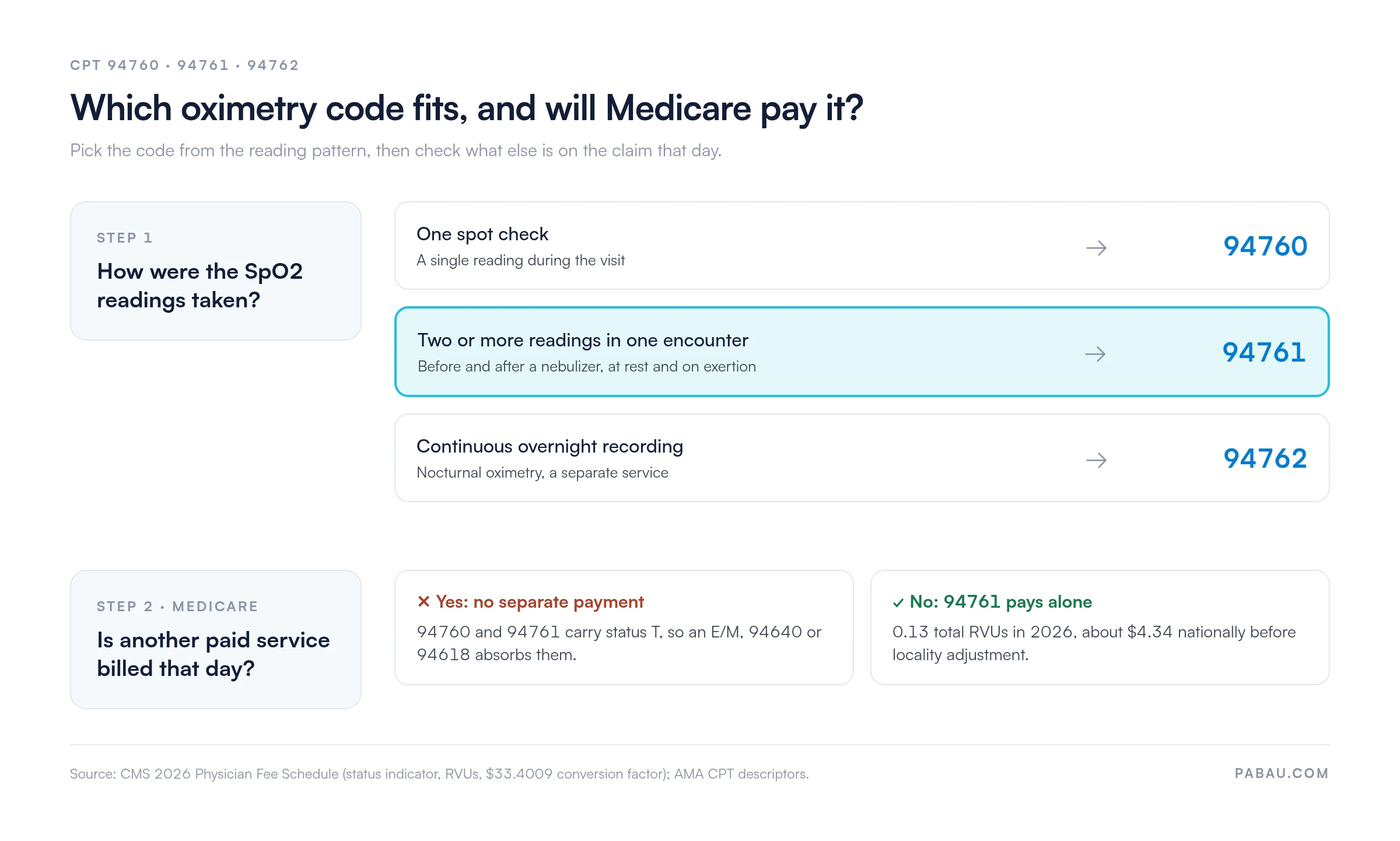
The usual slip runs both ways. Staff who chart serial readings but bill 94760 out of habit undercode commercial claims. Billing 94761 for one reading invites a denial, or a recoupment later.
Every 94761 claim needs a diagnosis that explains why one reading wasn’t enough. These are the pairings billers see most often. Check each one against your MAC’s policy, because covered lists vary by jurisdiction.
Two of these codes have their own billing guides. See J44.1 for COPD flare-ups and R09.02 for hypoxemia.
For any other diagnosis, search our ICD-10-CM code library or the CDC ICD-10-CM browser. A diagnosis missing from the MAC’s list is a leading denial trigger, even when 94761 itself is right.
Auditors look for one point first, which is proof that more than one reading happened. A note with a single final SpO2 value won’t support 94761, however long the patient was watched. Build every note around these items:
Build a short template in your EHR for 94761 visits. Give it a field for each reading, its time, the condition it was taken under and the reason for serial monitoring. Staff fill it in during the visit, so the note is audit-ready before the patient leaves.
Medicare covers 94761 when it’s medically necessary, but coverage and payment are separate questions. CMS lists 94760 and 94761 with status T on the Physician Fee Schedule. That means they’re paid only when no other paid service is billed that day.
So if the patient also had an office visit, a nebulizer treatment or spirometry, the oximetry gets no separate payment. A modifier doesn’t change a status T result.
Local policy sits on top of that. Novitas Solutions publishes article A57205, “Billing and Coding: Oximetry Services,” which supports its LCD L35434. Other MACs publish their own oximetry policies, so check the one for your jurisdiction.
Payment for 94761 comes almost entirely from practice expense, since the work RVU is zero. For 2026 the facility and non-facility values match, so the setting doesn’t change the national rate.
These figures come from the 2026 RVU file, before the geographic adjustment for your locality. Pull your own rate from the CMS Physician Fee Schedule lookup, or check the 2026 RVUs for 94761 for a quicker view. Remember that status T can still take the payment to zero on a busy day.
Two rule sets apply when 94761 shares a claim with other codes. NCCI edits pair codes that can’t be billed together, and Medicare’s status T blocks payment on top of that. Check the current NCCI edits each quarter, since the pairs change.
Nebulizer visits pair with oximetry often, so the 94640 guide is a useful next read. Overnight studies follow their own rules, set out in the 94762 guide.
Before a 94761 claim with a second code goes out, run it against the clean claim requirements. A claim that passes them rarely comes back for coding reasons.
Modifier questions on 94761 come up constantly, and most have short answers.
With a zero work RVU, there’s no physician work to split off. Adding 26 or TC without checking the fee schedule indicator usually ends in a denial and a rebill.
In 2026 the facility and non-facility RVUs for 94761 match, so place of service doesn’t move the national rate. It still has to be right. Billing an office POS for readings taken in a hospital department can lead to an overpayment finding on audit.
The simplest fix is to confirm POS when the visit is booked, not when the claim is coded.
Knowing the path helps you spot where a claim broke. A clean 94761 claim follows these steps:
Most denials trace back to one of those seven steps, and they cluster in a few spots. A steady denial management process catches each one earlier.
Once a quarter, pull every 94761 remittance and sort the denials by claim adjustment reason code. Then trace each denial type back to the coding or documentation step that caused it.
A two-minute check before submission saves weeks of rework. Tick off each item:
Pediatric practices use serial oximetry for asthma flare-ups, bronchiolitis and reactive airway disease. The same multiple-reading rule applies, and the code carries no age limit.
The catch is the well visit. Payers frequently bundle oximetry into the preventive E/M codes 99381-99397. Bill 94761 beside a preventive code only when the chart shows a separate medical reason for the readings.
In many practices, oximetry readings live on a paper flowsheet or a monitor printout. The coder then has to guess whether there was one reading or several, and the claim goes out on that guess.
Pabau, the practice management and billing platform we build, keeps the readings and the claim in one patient record. A custom treatment note template captures each SpO2 value with its time and reason. The CPT code attached to the service then pre-fills the claim, and diagnoses carry over from the record.
Before a claim can be sent, Pabau checks that the required fields are complete. US claims go through the Claim.MD clearinghouse, which applies its own claim scrubbing. Remittances post back with the claim status, so your team sees each 94761 denial and its reason. Our page on claims software for practices shows the full workflow.

Pabau captures each oximetry reading in the treatment note, pre-fills the claim from the record and posts remittances back. Your team sees every 94761 denial and its reason without switching systems.

Treat 94761 as a documentation code first and a payment code second. On Medicare claims it often pays nothing, because status T gives way to the visit or treatment billed beside it. That’s fine, as long as the claim still reflects what happened.
Where it does pay, on standalone encounters and with many commercial plans, the chart decides the outcome. Get the readings and times into the note, link a covered diagnosis and keep modifier 25 on the E/M code. Those three habits clear most 94761 denials.
If oximetry claims still eat into your week, book a demo to see how Pabau ties each reading to a clean claim.

Need to understand how clearinghouse claim submission works? Medical claims clearinghouse guide explains how 837P files route from practice to payer and where edits are applied.
Working through a high volume of denied oximetry claims? Denial codes in medical billing covers CARC and RARC code interpretation to help billing teams act on remittance data faster.
Want to confirm coverage before the visit? Insurance eligibility verification outlines how eligibility checks reduce denial exposure on diagnostic procedure claims.
Running six-minute walk tests? CPT code 94618 explains pulmonary stress testing, which already includes oximetry and oxygen titration.
Ordering spirometry at the same visit? CPT code 94010 covers spirometry billing and how it sits beside other pulmonary codes.
No. 94761 covers readings your staff take during the encounter, so home readings a patient reports aren’t billable under it. When a connected device sends daily data to the practice, the remote physiologic monitoring codes 99453 and 99454 may apply instead.
Yes, for Medicare. Diagnostic tests must be ordered by the treating physician or practitioner under 42 CFR 410.32. Record the order and the reason for serial readings in the note.
Report one unit per encounter. The code covers the whole series of readings, whether there were two or ten. If a payer questions the units, check the CMS Medically Unlikely Edits table.
Not when the titration is part of a pulmonary stress test. CPT 94618 already includes oximetry and oxygen titration, so adding 94761 duplicates it. Outside a stress test, documented serial readings during titration can support 94761.
No. Pulse oximetry measures oxygen saturation through the skin and isn’t a laboratory test. CLIA rules and modifier QW don’t apply to 94761.