HCPCS code K0552: Non-insulin infusion pump cartridge guide
HCPCS code K0552: Definition and code description HCPCS code K0552 describes sup...

Last Updated: Nov 23, 2026
94003 is the CPT code for ventilator management on each day after the first, while the patient is a hospital inpatient or under observation. It covers the provider's daily review of ventilator settings, the patient's response and any orders to adjust them.
Day one is reported with 94002, and a nursing facility patient moves to 94004. Under NCCI, 94003 isn't paid alongside an E/M or critical care code on the same date. Day-count errors and missing provider notes are common causes of 94003 rejections.
Let Pabau's smart automation suggest the right codes, reduce claim denials, and keep your practice compliant—effortlessly.
Automate repetitive tasks and focus on what matters most—your patients.
Reduce coding errors and ensure compliance with the latest regulations.
Clean claims, fewer denials, and faster reimbursements.
Powerful insights and reporting to help your practice thrive.
HIPAA compliant SOC 2 certified GDPR-compliant Trusted by 4,000+ clinics worldwide

CPT 94003 covers a provider’s ventilator management on day two onward, while the patient is a hospital inpatient or under observation.
Day one goes to 94002, and a nursing facility patient moves to 94004, so the day count and the setting pick the code.
Under NCCI, 94003 isn’t separately payable with an E/M or critical care code on the same date, and modifier 25 doesn’t change that.
Each claim needs the billing provider’s own daily note on settings, patient response and orders, linked to a diagnosis such as acute respiratory failure.
Medicare pays 94003 once per patient per day, at rates that change every year, so check the current fee schedule before quoting a figure.
CPT code 94003 reports a provider’s ventilator management for each day after the first, while the patient is a hospital inpatient or under observation. It’s paid only when it stands alone for that date. CMS’s 2026 NCCI policy manual states that ventilation management codes aren’t separately reportable with E/M codes.
The full descriptor from the American Medical Association (AMA) covers both settings and the day qualifier:
Ventilation assist and management, initiation of pressure or volume preset ventilators for assisting or controlling breathing during respiratory insufficiency or failure; hospital inpatient/observation, each subsequent day
CPT 94003 descriptor, American Medical Association
“Active management” means the provider reviewed the settings, checked how the patient responded, and adjusted parameters or confirmed orders. Co-signing a respiratory therapist’s note doesn’t meet that bar. The day qualifier is where most coding errors start.
The code pays for the provider’s ventilator oversight on that date. That means reviewing tidal volume, PEEP, FiO2 and rate, assessing the patient’s response, ordering setting changes and documenting the encounter.
Other services on the same date follow their own rules. Some absorb 94003 entirely, while others need a code of their own.
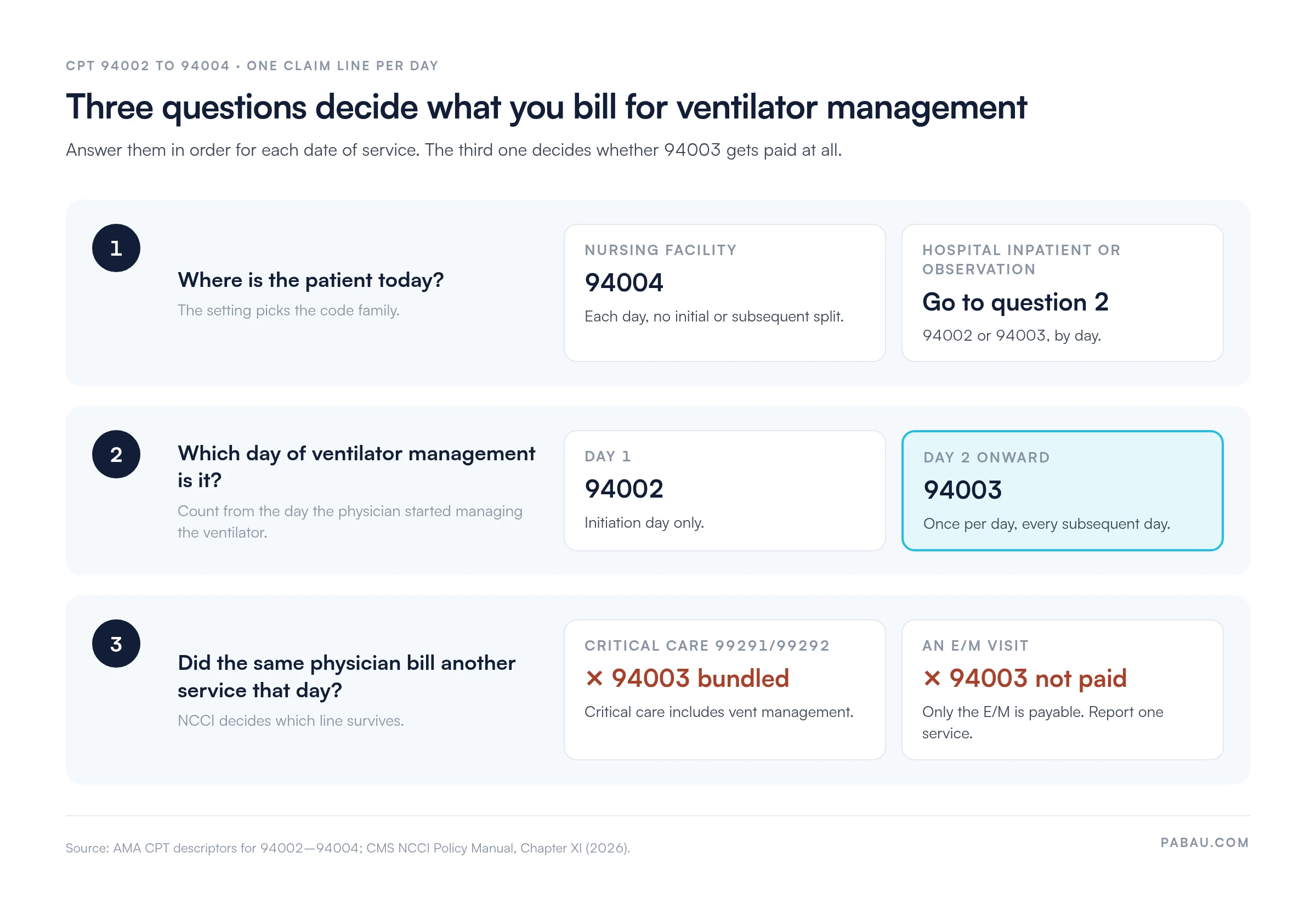
Three codes cover physician ventilator management. Two questions decide between them: which day of ventilation it is, and where the patient is.
Two day-count errors come up often. One is billing 94002 again on day two because nobody updated the code as the stay ran on. The other is billing 94003 on day one. A third slip is staying on 94003 after a patient moves to a skilled nursing facility, where 94004 applies.
Add the same-day services question, and the choice becomes a three-step check for every date of service.
Coders in pulmonology and critical care often see these four codes next to 94003. Only 94010 and 94060 are pulmonary function tests. The other two cover inhalation treatment and non-invasive ventilation, and 94640 has its own same-day rules.
Post-payment audits look for two things on each date. One is the provider’s personal involvement, and the other is a clinical reason the patient still needs the ventilator. Missing any element below can lead to recoupment.
Attestation wording matters. A line like “reviewed and agree with respiratory therapy assessment,” with no findings of the provider’s own, is a common audit flag. The note needs an independent evaluation.
The diagnosis has to justify mechanical ventilation. Typical examples are J96.01 and J80, alongside the others below. LCD coverage varies by Medicare Administrative Contractor, so confirm each pairing for your jurisdiction.
Two modifiers come up in 94003 billing, and neither works the way many coders expect.
Spot-check your 94003 claims every month. Pull the last 30 days of ventilator management encounters, and confirm every day-one claim used 94002, not 94003. A single-day mix-up repeated across 20 ICU patients becomes a significant overpayment liability on audit.
Medicare pays 94003 under the Medicare Physician Fee Schedule (MPFS), at a facility rate and a non-facility rate. The facility rate applies in a hospital setting, which is where 94003 is billed. The non-facility rate is higher because it covers overhead the facility would otherwise carry.
Rates change every year and are adjusted by a geographic practice cost index (GPCI) for each locality. For current figures, use the CMS Physician Fee Schedule lookup tool and search by code and locality. The FastRVU 2026 RVU lookup tool shows the relative value units behind the payment.
Commercial payers usually pay a percentage of the Medicare rate or a separately negotiated rate. Check 94003 in your payer contracts each year, ideally after the MPFS final rule lands.
A clean 94003 claim depends on six checks before it leaves your billing system. Work through them in order for every date of service.
Here’s how the codes play out for one illustrative patient. A pulmonologist starts ventilator management on Monday, the day of admission for acute respiratory failure with hypoxia.
Five claim lines cover the stay: 94002 once, 94003 three times and 99291 once. Adding 94003 on Thursday would only invite a bundling denial.
Most 94003 denials fall into five groups. Each one has a specific fix, and a blanket “refile with more documentation” rarely solves it.
For the CARC and RARC codes behind each of these, and how to appeal them, see our guide to medical billing denial codes.
NCCI treats ventilator management as part of an E/M service. Its Chapter XI policy says 94002-94004 aren’t separately reportable with E/M codes. When both are billed, only the E/M is payable.
Critical care works the same way. 99291 and 99292 include ventilator management, so the provider reports the critical care time and not 94003. A bypass applies only where the edit carries a modifier indicator and separate notes show distinct work. Payers such as Highmark still pay only the critical care code.
NCCI edits update every quarter, so check the current table for the date of service. CMS publishes the Medicare NCCI procedure-to-procedure edits, and the AAPC Codify CPT lookup shows edit status by code pair.
Run each 94003 line through these seven checks before it goes out. They take a minute and cover the denials above.
A line that passes all seven is a clean claim in the payer’s eyes, so it can move without a manual review hold.
Medicare’s rules for 94003 are fairly settled. Commercial payers add requirements that vary by plan and contract year, and two of them need checking before you submit.
Prior authorization. Some commercial payers require authorization for ventilation past a set number of days, for example 72 to 96 hours into an admission. The authorization covers the inpatient stay, not the code. If it lapses, days beyond the authorized period deny regardless of documentation.
Attestation language. Several payers add their own wording requirements to ventilator management policies. Some want the settings reviewed, the reason no weaning trial happened that day and the expected extubation timeline. Check the current payer policy manual, not last year’s contract addendum.
For the compliance rules that apply across payer types, see our guide to medical billing compliance.
Before billing 94003 to a new commercial payer, request their respiratory services billing policy, not just their fee schedule. Prior authorization thresholds, attestation wording and bundling rules often differ from Medicare. Payers rarely send those addenda to providers unprompted.
Most 94003 errors start before submission. A coder carries 94002 into day two, a same-day E/M slips through, or an authorization lapses mid-stay.
Pabau, a practice management platform with built-in claims management software, sends US claims through Claim.MD. That clearinghouse connects to thousands of US payers. Eligibility checks run before the claim goes out, so coverage problems surface while you can still fix them.
Remittances come back as ERAs, so a bundling denial shows up against the line it hit. Secondary claims go out from the same record. Prior authorization codes, dates and sessions sit on the patient’s case, with a warning when one is missing.

Pabau’s claims management sends 94003 claims through Claim.MD with eligibility checks, ERA remittances and prior authorization tracking. Coverage and authorization problems show up before the payer sees the claim.

CPT 94003 rewards a simple daily habit. Before each claim goes out, confirm the day count, the setting and whether anything else was billed for that date.
Get those three right and most 94003 denials never happen. The trade-off to remember is that 94003 often gives way to an E/M or critical care code. Pick the one service the day’s note supports, and bill it with confidence.
Book a demo to see how Pabau checks eligibility and tracks authorizations before your ventilator management claims reach the payer.

Need a broader overview of how claims move through the system? What is medical billing covers the full claim lifecycle from service delivery to payment posting.
Seeing recurring 835 remittance denials for 94003? Electronic remittance advice explains how to read ERA files and map denial reason codes to the right fix.
Want to understand how the Claim.MD clearinghouse works within Pabau? Claim.MD clearinghouse guide covers payer enrollment, 837P submission and secondary claims.
Billing critical care time past the first hour? CPT code 99292 explains the add-on code for each additional 30 minutes of critical care.
Coding respiratory failure without a stated type? ICD-10 code J96.90 covers unspecified respiratory failure and when a more specific code fits.
94002 covers the first day of ventilator management in a hospital inpatient or observation setting. 94003 covers each day after that. The documentation is the same, so the initiation date decides the code. Billing 94003 on day one and 94002 on day two are both frequent errors.
No. Under NCCI, 94002-94004 are not separately reportable with E/M codes. If both are reported, only the E/M is payable, and modifier 25 doesn’t change that.
The usual reasons are billing it on day one, a missing provider note, or the wrong setting for the code. Bundling is the other big one. 94003 isn’t paid alongside a same-day E/M or critical care code from the same provider.
Yes, where state scope of practice and the payer allow it. They report it under their own NPI, and Medicare pays their services at 85% of the physician fee schedule amount. The same daily documentation rules apply.
One. Medicare pays 94003 once per patient per day, however many times the provider adjusts the ventilator. Some commercial payers set their own limits, so check the policy before billing more.
No. It’s a ventilator management code for a patient already on mechanical ventilation. Pulmonary function tests such as 94010 and 94060 measure lung volumes and airflow, and they’re billed separately.