HCPCS code J3471: Hyaluronidase ovine injection billing guide
HCPCS code J3471: Descriptor, code type, and quick-reference data HCPCS code J34...

Last Updated: Oct 14, 2026
Billable Code
CPT code 93882 is the billing code for a unilateral or limited duplex scan of the extracranial arteries. It covers B-mode imaging plus spectral Doppler analysis of the carotid and vertebral arteries on one side, or a study limited for a documented reason.
A complete bilateral study is billed with 93880 instead, and NCCI edits bar reporting both codes for the same patient on the same date. Intracranial arteries are assessed with transcranial Doppler codes 93886 and 93888, not with this code.
Let Pabau's smart automation suggest the right codes, reduce claim denials, and keep your practice compliant—effortlessly.
Automate repetitive tasks and focus on what matters most—your patients.
Reduce coding errors and ensure compliance with the latest regulations.
Clean claims, fewer denials, and faster reimbursements.
Powerful insights and reporting to help your practice thrive.
HIPAA compliant SOC 2 certified GDPR-compliant Trusted by 4,000+ clinics worldwide

CPT code 93882 covers a unilateral or limited extracranial duplex scan, while 93880 requires a complete bilateral study of the carotid and vertebral arteries.
A valid duplex scan needs real-time B-mode imaging and spectral Doppler analysis. A report missing either component will not support the code.
NCCI edits bar billing 93880 and 93882 together for the same patient on the same date, and no modifier bypasses that edit.
In 2026, 93882 carries 3.71 total RVUs against 5.66 for 93880, so billing the bilateral code for a one-sided study is an audit target.
Pabau’s claims management software supports eligibility checks, claim submission, and denial tracking for vascular labs billing the 93880 code family.
CPT code 93882 is the billing code for a unilateral or limited duplex scan of the extracranial cerebrovascular arteries. It applies when only one side is studied, or when the study is limited for a documented clinical reason. The code needs both real-time B-mode imaging and spectral Doppler analysis, and a report missing either component will not support it.
The American Medical Association’s CPT code set defines 93882 as Duplex scan of extracranial arteries; unilateral or limited study. Each part of that descriptor affects how the claim is coded.
The procedure typically takes 20 to 40 minutes. On the affected side, the sonographer images the common, internal, and external carotid arteries plus the vertebral artery. At each segment, they record B-mode morphology, plaque characterization, lumen diameter, and spectral waveforms with peak systolic and end-diastolic velocities. The interpreting physician then reviews the images and dictates a formal report.
A study that covers both sides completely goes to 93880. Intracranial studies are billed with transcranial Doppler (TCD) codes, which are not duplex codes. Use 93886 for a complete TCD study and 93888 for a limited one. Billing 93882 for a study that covered both sides misrepresents the service and is a common audit target.
93880 and 93882 describe the same extracranial cerebrovascular duplex procedure at different levels of completeness. Laterality and coverage decide the code, whatever equipment was used or however long the scan took. The bilateral code has its own billing guide under 93880. The chart below maps each documented study to its code and its 2026 RVUs.
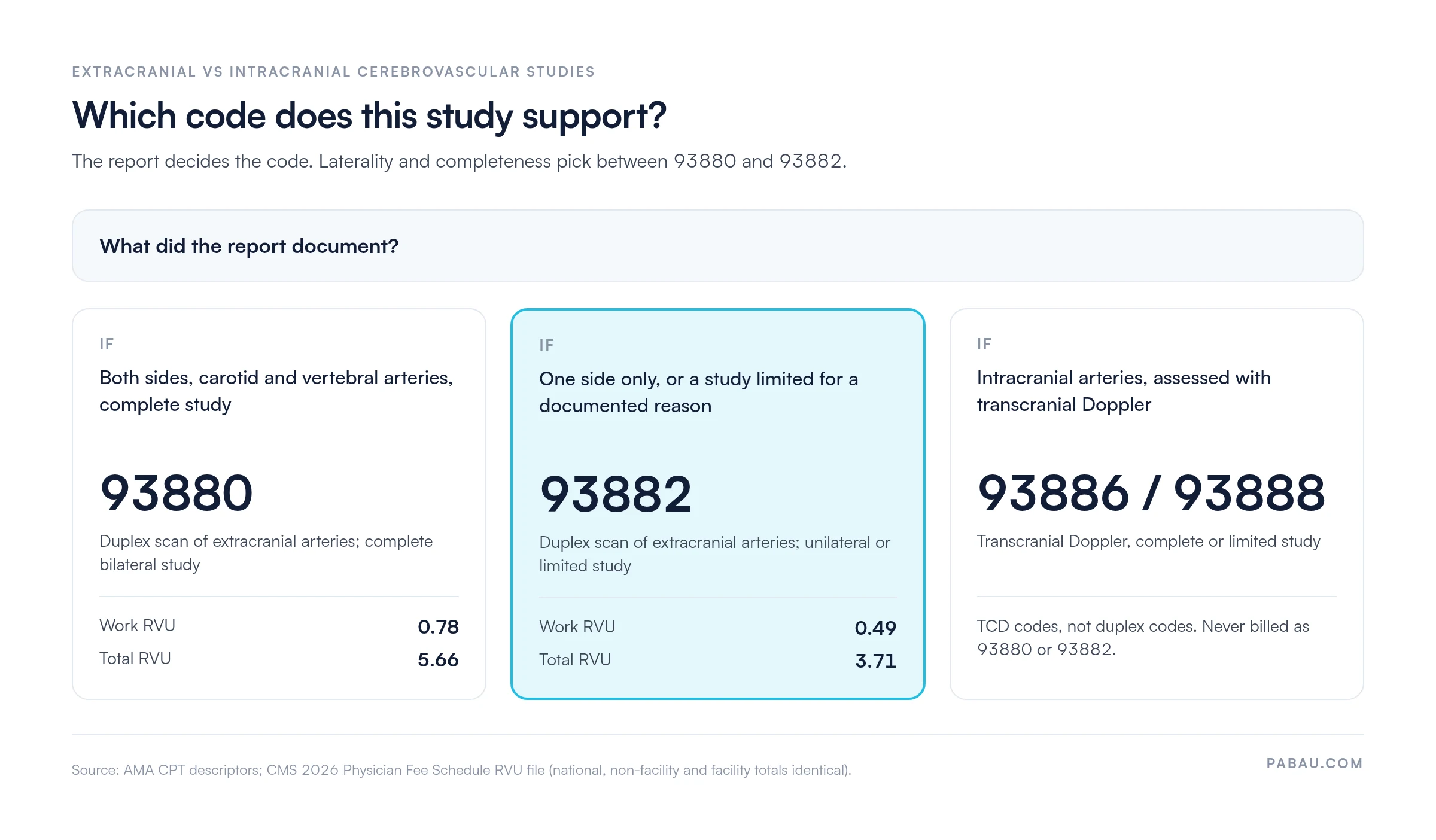
The most frequent coding error starts at the scanner. The sonographer images only the left carotid because the right side was technically obscured, and the report documents a limited study. The biller still submits 93880 because that is the default for carotid studies. NCCI edits catch 93880 and 93882 on the same claim, and payer medical review catches 93880 on a chart that documents one side.
The extracranial duplex codes sit beside the transcranial Doppler codes and the extremity duplex codes. Coders who bill CPT code 93882 regularly will meet all of these.
Medicare Administrative Contractors (MACs) publish Local Coverage Determinations (LCDs) that list the ICD-10 codes accepted for extracranial duplex studies. Novitas LCD L35397 (Non-invasive Cerebrovascular Arterial Studies) and CGS LCD L34045 (Non-Invasive Vascular Studies) are the main references. Covered codes vary by MAC jurisdiction, so check the LCD for your region before submitting.
Confirm each diagnosis code’s full descriptor in our ICD-10-CM codes library before you pair it with 93882. Commonly accepted diagnosis codes include:
Asymptomatic screening with only a cardiovascular risk factor, such as hypertension alone, is frequently denied unless the LCD specifically includes it. Document the specific symptom or clinical finding that prompted the study, not just the chronic condition list.
Before submitting, cross-reference your ICD-10 code against the applicable MAC’s LCD in the CMS Medicare Coverage Database. Novitas L35397 and CGS L34045 list slightly different covered indications. A code accepted by Novitas may not be covered under CGS jurisdiction, so check every claim against the right policy.
The report is the claim. Every element below must appear in the dictated interpretation or the accompanying order before you submit CPT code 93882. Missing any one of them is grounds for denial or recoupment on audit.
Many payers also require the performing lab to hold Intersocietal Accreditation Commission (IAC) accreditation for vascular testing as a condition of reimbursement. The requirement is not universal, but it is common among Medicare Advantage and commercial plans. Verify it with each payer before the study, not after the denial arrives.
The CMS Physician Fee Schedule lookup tool is the definitive source for current payment rates. Rates change with each annual update, so recheck them every January. The figures below are the national 2026 RVUs from the CMS Physician Fee Schedule.
Non-facility and facility totals are identical for both codes in 2026. Billing 93880 for a one-sided study raises the work RVU by about 59% and the total RVU by about 53% (5.66 against 3.71). CMS medical review and Recovery Audit Contractors look for that differential when they flag vascular lab claims for review.
Modifiers change the payment calculation or signal a billing circumstance to the payer. These are the ones most relevant to 93882.
Do not use modifier 50 (bilateral procedure) with 93882. The correct code for a bilateral study is 93880. Using 50 with 93882 to bill two sides would misrepresent the study and create a bundling conflict with 93880.
Medicare does not publish a single universal frequency rule for 93882. MAC LCDs typically expect documented clinical justification for repeat studies beyond one per year. One study per year per side is generally presumed reasonable for surveillance of known carotid stenosis. A second study within 12 months requires a new or changed clinical indication documented in the chart.
These are the denial patterns that vascular billing teams meet most often on 93882 claims. Each one has a preventable root cause.
Denial management workflows in vascular labs track these denial reasons by code. That way, a pattern surfaces after a handful of claims instead of repeating across hundreds before anyone notices.
Run a quarterly audit of your 93882 denials sorted by denial reason code. If medical necessity accounts for more than 30% of denials, look first at charge entry, where the wrong ICD-10 code usually gets selected. Fix the charge capture screen before you rewrite the report template.
Traditional Medicare does not universally require prior authorization for 93882, but Medicare Advantage plans frequently do. PA requirements vary by plan, plan year, and even geographic market. Confirm requirements at scheduling, not after the study is complete.
When PA is denied, the ordering physician usually submits a letter of medical necessity. It should state the clinical findings that make the study necessary, the ICD-10 codes, and any relevant prior imaging results. A peer-to-peer review with the payer’s medical reviewer often overturns the initial denial, particularly when TIA or symptomatic carotid stenosis is the indication.
For practices managing high volumes of vascular study authorizations, insurance eligibility verification at scheduling catches PA requirements before the study is performed.
The denials above trace back to three checks: laterality, the diagnosis code, and prior authorization. In many vascular labs, those checks only happen once the remittance comes back and the claim is already denied.
Pabau, the practice management and billing platform we build, moves those checks to the front of the workflow. Its claims management software runs pre-submission eligibility checks, so PA status is confirmed when the study is scheduled. The Claim.MD clearinghouse integration returns electronic remittance advice with CARC denial reason codes, so each 93882 denial arrives as sortable data.
The outcome is fewer resubmissions and a clean claim rate you can measure by code. Your billing team sees whether denials cluster around laterality, medical necessity, or authorization, then fixes the step that caused them.

Pabau’s claims management software supports eligibility checks, claim submission, and denial tracking for practices billing CPT 93882 and related vascular codes. See how it fits your workflow.

Code 93882 from the report, not from habit. When the report documents one side or a limited study, 93882 is the only defensible code. Billing 93880 instead adds about 53% in total RVUs, and an auditor can recover every cent of it.
The trade-off is front-end discipline. Confirming laterality, an LCD-listed diagnosis, and prior authorization before the claim leaves takes minutes. Working the denial afterward takes far longer and still ends in a corrected claim.
Book a demo to see how Pabau catches laterality and diagnosis errors before your 93882 claims reach the payer.

Need a framework for managing claim rejections across your vascular lab? Denial codes in medical billing explains how CARC codes map to corrective action steps across common denial categories.
Billing the bilateral study instead? CPT code 93880 covers the complete bilateral extracranial duplex scan and its documentation rules.
Following a patient after carotid stenting? CPT code 37215 covers carotid stent billing, modifiers, and the fee schedule.
Want to understand how clearinghouse submission works for outpatient studies? Medical claims clearinghouse covers how electronic claim routing works between practice, clearinghouse, and payer.
New to the billing side of a vascular lab? Medical billing fundamentals walks through how a claim moves from coding to payment.
CPT code 93882 covers a unilateral or limited duplex scan of the extracranial cerebrovascular arteries. The study combines real-time B-mode imaging with spectral Doppler analysis of the carotid and vertebral arteries on one side. It does not cover bilateral studies, which are billed with 93880. Intracranial vessels use transcranial Doppler codes 93886 and 93888, which are not duplex codes.
93880 is the complete bilateral study of both carotid and vertebral artery systems. 93882 is the unilateral or limited version, covering one side or a study limited for a documented reason. NCCI rules bar billing them together for the same patient on the same date, and no modifier bypasses that edit.
Rates change each year with the Medicare Physician Fee Schedule update. In 2026, the total RVU for 93882 is about 3.71, compared with about 5.66 for 93880. Use the CMS Physician Fee Schedule lookup tool for payment amounts adjusted to your locality.
Traditional Medicare does not universally require prior authorization for 93882, but many Medicare Advantage plans and commercial payers do. PA requirements vary by plan and plan year, so confirm with each payer at the time of scheduling rather than after the study is performed.
No. Modifier 50 does not apply to 93882. If both sides were examined completely, the correct code is 93880. Appending modifier 50 to 93882 to capture bilateral coverage misrepresents the procedure and creates a bundling conflict with 93880.
The most frequent reason is an ICD-10 code not covered under the applicable MAC LCD. Billing 93880 when only one side was studied comes next. Other common causes are spectral analysis missing from the report, a frequency limit exceeded without a new indication, and prior authorization not obtained.