HCPCS code P9058: Red blood cells, leukocytes reduced, CMV-negative, irradiated
HCPCS code P9058: Official descriptor and key attributes HCPCS code P9058 report...

Last Updated: Oct 26, 2026
93799 is the CPT code for an unlisted cardiovascular service or procedure. It closes the 92920-93799 cardiovascular range and covers any service there without a specific CPT descriptor.
Coders use it for novel interventions, investigational techniques, and hybrid procedures the CPT code set doesn't yet describe. The code has no fixed fee schedule rate, so every claim needs a special report naming a comparable code.
Let Pabau's smart automation suggest the right codes, reduce claim denials, and keep your practice compliant—effortlessly.
Automate repetitive tasks and focus on what matters most—your patients.
Reduce coding errors and ensure compliance with the latest regulations.
Clean claims, fewer denials, and faster reimbursements.
Powerful insights and reporting to help your practice thrive.
HIPAA compliant SOC 2 certified GDPR-compliant Trusted by 4,000+ clinics worldwide

CPT code 93799 covers a cardiovascular service in the 92920-93799 range with no specific CPT descriptor. Treat it as a last resort, never a default.
Every 93799 claim needs an AMA special report sent with the claim. A missing or thin report is the most common cause of denial.
93799 has no fixed RVU or national Medicare fee schedule rate. Payers price it case by case, using a comparable specific code as the benchmark.
Pabau’s practice management software tracks prior authorizations as cases, checks claims for errors before submission, and reconciles ERA remittances for unlisted cardiovascular claims.
CPT code 93799 is the unlisted code for a cardiovascular service or procedure. The American Medical Association’s CPT code set places it as the last code in the 92920-93799 cardiovascular section.
Its official descriptor is “Unlisted cardiovascular service or procedure.” The code exists because CPT can’t anticipate every new or experimental cardiovascular technique.
The 92920-93799 range runs from coronary angioplasty (92920) through echocardiography (93306), cardiac catheterization (93458), and electrophysiology studies. When a service fits this clinical domain but matches no descriptor, 93799 applies. Outside this range, a different unlisted code governs the service.
AMA CPT guidelines set one firm rule. If a specific code within 92920-93799 describes the procedure performed, 93799 must not be used. Coders exhaust every specific code before turning to the unlisted option.
93799 applies when a cardiovascular procedure has no specific CPT descriptor and falls within the cardiovascular section’s clinical domain. Three scenarios legitimately call for the code.
Before assigning 93799, coders should run three checks in sequence:
Only when all three checks fail does 93799 apply. At that point the claim needs four supporting pieces, as the decision path below shows.
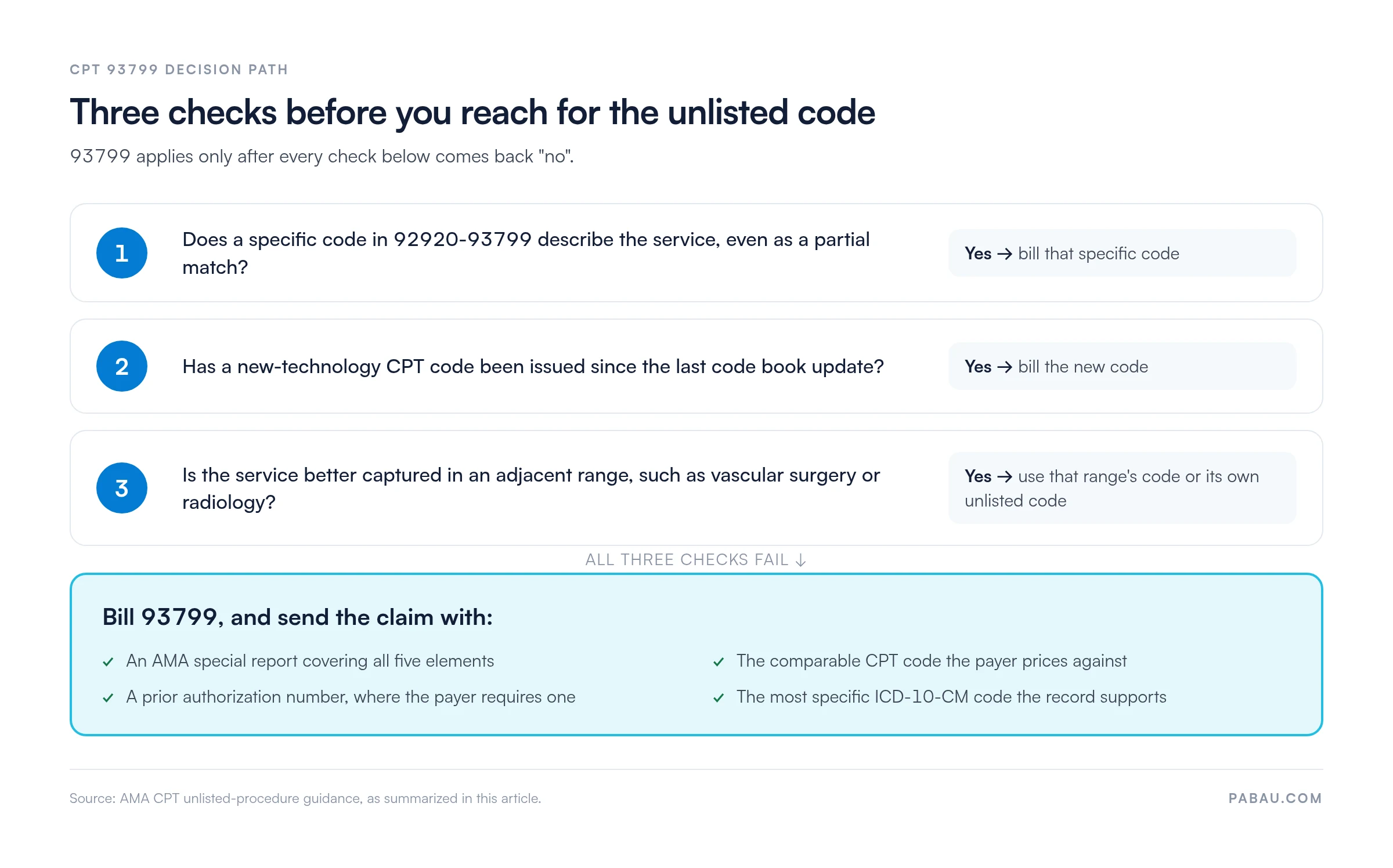
Every 93799 claim needs two documentation components. The first is an operative or procedure note that fully describes the service. The second is an AMA special report that gives payers the clinical justification to price and adjudicate the claim. Strong medical billing compliance starts with knowing what each one must contain.
The AMA requires a special report whenever an unlisted code is submitted. The report must let the payer judge the nature, extent, and need for the procedure without relying on the coder’s word. AMA CPT guidelines call for five elements:
Missing element 4, the comparable code, is the most common special report deficiency. Without it, payers have no pricing anchor and typically deny because reimbursement can’t be determined.
93799 accepts standard CPT modifiers, though payer acceptance varies. The three most relevant modifiers and their documentation requirements are listed below.
Modifier -22 carries specific audit risk. Unlisted codes already draw extra scrutiny, so -22 appended without documented extra work invites an audit. Check each payer’s modifier policy before submission.
Most payers require prior authorization for unlisted cardiovascular procedures before they’ll consider a 93799 claim. Specific requirements vary by plan, so confirm them before each case. A clean claim submission for 93799 almost always begins weeks before the procedure date.
A typical prior auth packet for 93799 includes:
Medicare has no single national prior auth rule for 93799. Each Medicare Administrative Contractor (MAC) issues its own Local Coverage Determinations (LCDs). Some procedures billed as 93799 fall outside any LCD’s scope, which can require an Advance Beneficiary Notice (ABN).
Submit your prior auth request at least 10-14 business days before the scheduled procedure. Attach the full draft special report, not a summary. The payer’s medical director can then review the comparable code and clinical justification in one pass. Incomplete packets are the main cause of prior auth delays for 93799 claims.
CPT code 93799 has no fixed relative value unit (RVU) or national Medicare fee schedule rate. The CMS Physician Fee Schedule sets rates for codes with established RVUs. Unlisted codes are priced by individual payer review, case by case.
Practices can use the FastRVU 2026 RVU lookup tool to find the work, practice expense, and malpractice RVUs for the comparable code. Those values are the starting point for negotiating reimbursement.
Payers use two main pricing methods for 93799:
Practices get paid more reliably when they name the comparable code in the special report themselves. Left out, that choice falls to a payer auditor.
93799 denials follow predictable patterns, so knowing the top causes speeds up both prevention and appeals.
Robust denial management workflows for 93799 include a pre-bill checklist covering all five causes above. For what each denial code means, see our guide to medical billing denial codes.
Build a 93799 checklist into your billing workflow: special report attached, prior auth number entered, comparable CPT documented, ICD-10 codes reviewed for specificity, modifier checked. Making it a mandatory step before billing catches the omissions that cause first-pass denials on unlisted cardiovascular claims.
A successful appeal for a denied 93799 claim follows four steps. Complete them within the payer’s appeal window, typically 60-180 days from the denial date, depending on the plan.
Major payers handle 93799 differently. The table below summarizes the key policy positions practices should verify before billing.
Practices billing 93799 to several payers should keep a per-payer cheat sheet. Track prior auth rules, submission portals, and known LCD restrictions. Payer policies for unlisted codes change often, so a payer that accepted 93799 without prior auth in 2025 may require it in 2026.
Pairing the right ICD-10-CM code with 93799 matters as much as the special report. Payers run automated medical necessity edits. A diagnosis that doesn’t support the described procedure triggers a denial before a human reviewer sees the claim.
The diagnosis code must reflect the patient’s documented condition. Choosing one to match a payer’s coverage policy, without clinical documentation to back it, is fraudulent billing.
Use the most specific code available, not an unspecified category code. For a novel coronary intervention, check whether the record documents angina, because I25.10 applies only when it doesn’t.
93799 claims fail more often than specific cardiovascular CPTs because they depend on manual steps. Prior auth tracking, special report preparation, and pre-submission checks often sit outside a standard billing workflow. Practice software that builds these steps into the claim means fewer of them slip through.
Pabau stores each insurer authorization as a case. Attach the case when booking, and the authorization code follows the appointment through to the claim. Pabau’s error-catching claims management then scrubs every claim for missing or invalid details before it leaves the system.
US claims go out through Claim.MD, a medical claims clearinghouse that connects to thousands of payers and checks eligibility before the visit. ERA remittances come back through the same channel. They show how each payer priced the unlisted code, so you can settle payment straight from the remittance.
To see how these stages connect, read our guide to revenue cycle management.
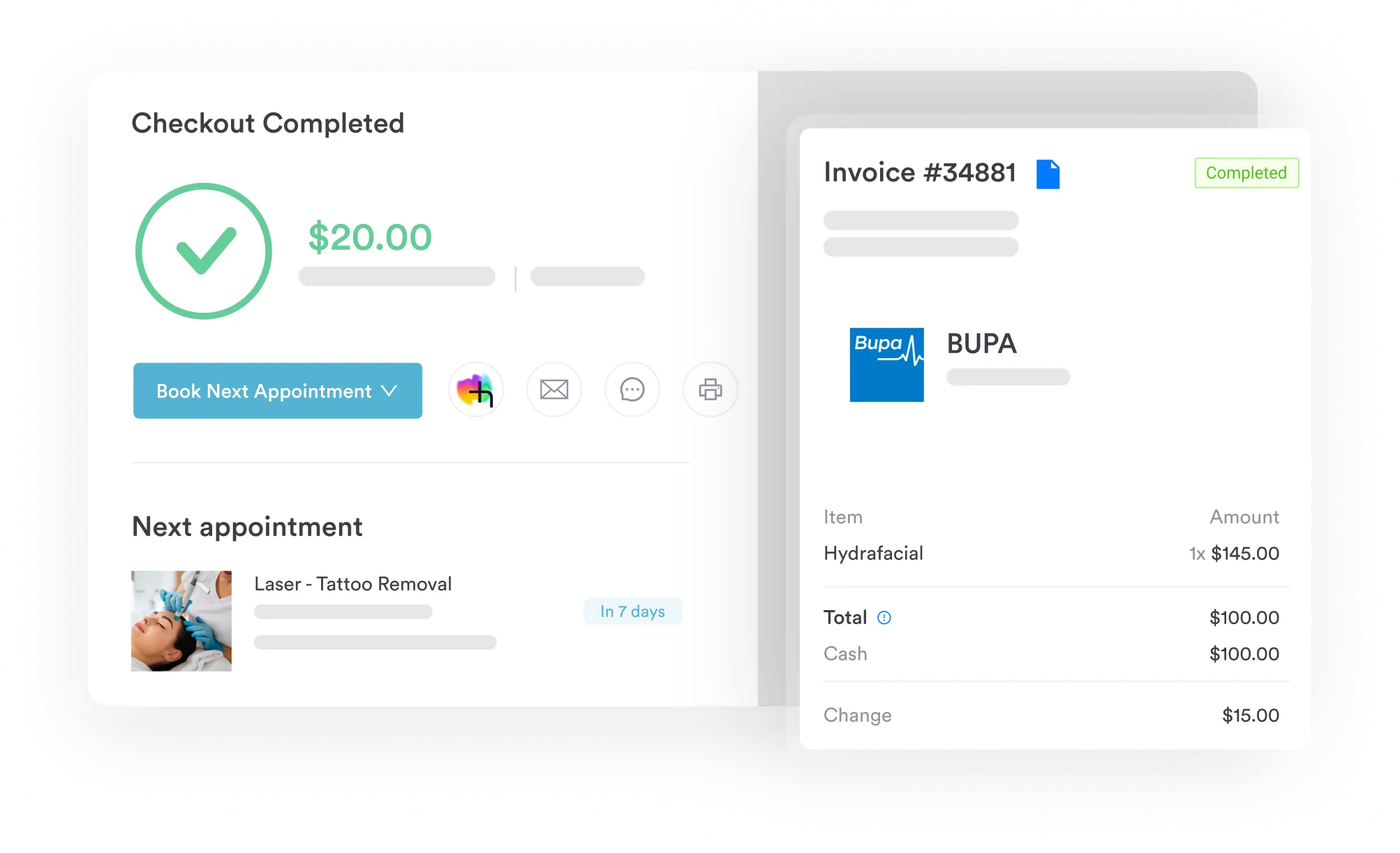

Pabau tracks prior authorizations as cases and checks every claim for errors before submission. ERA remittances then show exactly how each payer priced your unlisted cardiovascular claims.

93799 rewards preparation more than any other code in the cardiovascular range. Payers price it by hand, so the claim stands or falls on the special report, the comparable code, and the authorization behind it.
Run the three checks, then build the packet before the procedure date rather than after the denial. Name the comparable code yourself, because that choice sets the price you’re paid. The trade-off is time up front, which costs far less than a resubmission and appeal.
Book a demo to see how Pabau tracks prior authorizations and checks 93799 claims before they reach the payer.

Want to understand how clearinghouses process cardiovascular claims? Electronic remittance advice explains how ERA files return payer pricing decisions and CARC denial codes after 93799 submission.
CPT code 93799 covers an unlisted cardiovascular service or procedure in the 92920-93799 range with no specific matching descriptor. It’s used for novel, investigational, or hybrid services that no single CPT captures. It can’t be used when a specific code exists for the procedure performed.
Medicare can reimburse CPT code 93799, but there is no fixed national rate. Each Medicare Administrative Contractor prices it by individual review, based on a comparable code’s RVUs. Coverage also depends on whether a Local Coverage Determination covers the underlying procedure. If none does, an Advance Beneficiary Notice may be required.
Use CPT code 93799 only after confirming no specific code in the 92920-93799 range accurately describes the service performed. If a specific code exists, it must be used. 93799 is appropriate for genuinely novel procedures, FDA-approved interventions that postdate the current CPT edition, and hybrid techniques that no existing code combination captures.
The most common causes are a missing or inadequate special report and missing prior authorization. Payers also deny 93799 when a specific CPT exists, or when the ICD-10 code doesn’t support medical necessity. A pre-submission checklist prevents each of these.
Billing CPT code 93799 requires a full operative or procedure note plus an AMA special report. The report covers five elements: procedure narrative, clinical indication with ICD-10-CM code, complexity and time, a comparable CPT code, and physician attestation. It must accompany the claim as an attachment, not be available on request.
ICD-10 codes paired with CPT 93799 must directly support the procedure described in the special report. Common pairings include I25.10 (native coronary atherosclerosis), I48.91 (unspecified atrial fibrillation), and I35.0 (nonrheumatic aortic stenosis). Others are I42.0 (dilated cardiomyopathy) and Q21.1 (atrial septal defect). The diagnosis must reflect documented clinical findings, never a payer’s coverage policy.