



CCSD code G5100: Bypass of duodenum billing guide
CCSD code G5100 bills a bypass that leaves the duodenum in place CCSD code G5100...

Last Updated: Oct 16, 2026

CPT code 93312 covers a complete diagnostic transesophageal echocardiogram, including probe placement, real-time 2D acquisition, and a written interpretation.
Continuous intraoperative monitoring with no separate formal report belongs under CPT 93318, not under 93312.
One physician cannot bill 93312 alongside 93313 or 93314, because NCCI edits bundle the component codes together.
CY2026 Medicare pays roughly $105 for the professional component, $135 for the technical component, and $241 for the global service.
Practice management software like Pabau pre-fills 93312 claim details from the client record and submits them through the Claim.MD clearinghouse.
CPT code 93312 reports a complete diagnostic transesophageal echocardiogram, or TEE, performed and interpreted by one physician. One fact decides most of these claims. The study needs a formal written report, and without one the service usually belongs under 93318 instead.
That single line trips up cardiology and anesthesia billers constantly, because intraoperative TEE often involves two physicians and two separate codes. Pick the wrong one and the rework takes weeks.
Below you will find the AMA descriptor, the split-service rules, and the modifiers that apply. The CY2026 Medicare rates and the documentation an auditor asks for come after that.
CPT code 93312 covers a complete, discrete transesophageal echocardiography study performed by one physician.
The American Medical Association’s CPT codebook describes it as real-time transesophageal echocardiography with 2D image documentation, with or without M-mode recording. It then names three inclusions.
Those are probe placement, image acquisition, and interpretation with a written report.
All three components sit inside one code, so a single physician has to perform all of them. Surgical settings often split the work. An anesthesiologist places the probe while a cardiologist reads the images, and the component codes 93313 and 93314 apply instead.
TEE differs from transthoracic echocardiography, code 93306, in one respect. The ultrasound probe travels down the esophagus instead of resting on the chest wall.
That position removes lung and rib interference, so the physician gets a clearer view of posterior structures. The left atrium, the aortic valve, and the descending aorta all read better this way.
Three settings account for most 93312 studies:
So the formal written report is what separates 93312 from continuous monitoring under 93318. Code selection follows the purpose of the service, not the technical steps at the bedside.
Medical necessity for 93312 lives in the record, and it has to be specific. Coverage runs through each Medicare Administrative Contractor’s local coverage determination for echocardiography, alongside CMS coverage article A56505.
The indications below appear most often in MAC policies. Check your own jurisdiction before you submit.
When TEE guides a transcatheter structural intervention, such as TAVR or mitral repair, the guidance service is 93355 rather than 93312. A separate diagnostic study can still stand on its own alongside it.
Documentation should state why this patient needed this study on this day. A generic indication such as “cardiac surgery” is a standing audit finding.
Modifier choice is where most 93312 billing errors begin. The split-service pattern is routine in teaching hospitals and large cardiac centers. An anesthesiologist places the probe, a cardiologist reads the images, and the modifiers have to match who did what.
The split-service rule: when two physicians each perform part of what would be 93312, neither one bills 93312. The probe-placing physician bills 93313, and the interpreting physician bills 93314. A single physician also cannot bill 93312 with 93313 or 93314, because NCCI bundles them.
The most common reason a 93312 claim fails on audit is a missing or thin written report. The claim itself is only a summary. Behind it, the medical record has to carry every element CMS and the MAC policies ask for.
Template reports that repeat the same boilerplate without patient-specific findings draw attention fast. Each report has to reflect what the physician saw in that patient, on that date.
Flag any 93312 claim where the written report was generated more than 24 hours after the procedure. Late reports without a documented reason for the delay are a common Medicare audit trigger. Build a same-day report attestation step into your cardiology billing workflow.
Payment for 93312 depends on where the service happens and on which components you bill. A hospital or ambulatory surgery center splits it, so the physician bills the professional component and the facility is paid separately. In an office, one global charge covers the work and the overhead.
Rates shift every year and by locality, so verify before you submit. The CMS Physician Fee Schedule Look-Up Tool returns the current figure for your carrier area.
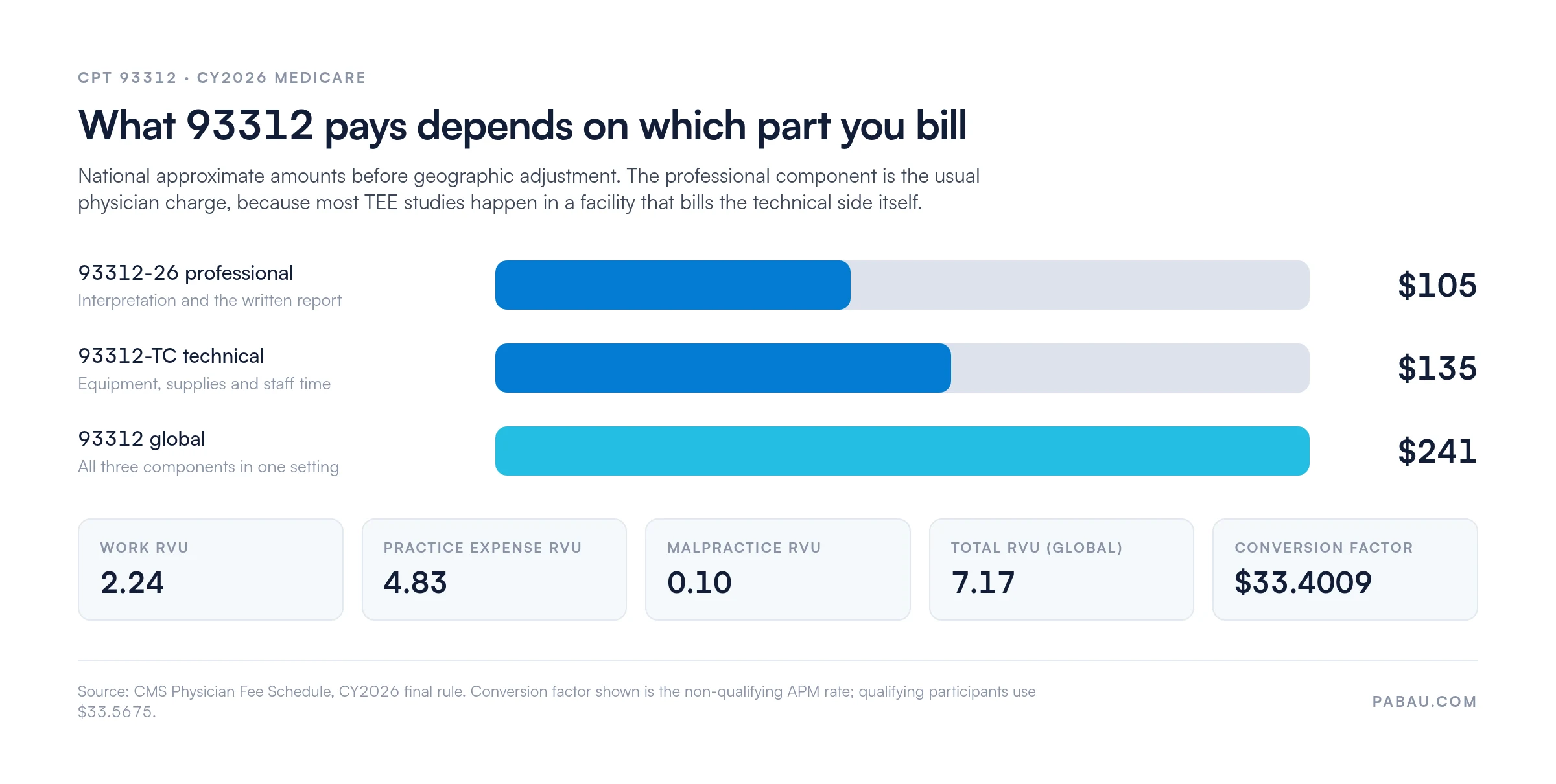
Medicare builds the payment from three relative value unit components, then multiplies the total by the annual conversion factor. For CY2026 that factor is $33.4009, rising to $33.5675 for clinicians who qualify as advanced APM participants.
The practice expense figure above is the balance of the global total after work and malpractice. Geographic practice cost index adjustments then move the dollar amount by locality, so treat these as national values.
Use place of service 21 or 22 on a hospital claim and 11 on an office claim. The professional component is the usual physician charge, because most TEE studies happen in a facility that bills the technical side itself.
Billing teams see the same five failures over and over. Each one is preventable at the point of claim creation. Fixing it there costs far less than reworking a denial three weeks later.
Four things have to line up before a 93312 claim counts as a clean claim submission. The right code and the right modifier come first. You also need a place of service that matches the note, and a written report already on file.
Sorting rejections by denial codes tells you which of the four broke. Track those patterns quarterly. You will soon see whether the problem sits with one surgeon, one payer, or one documentation habit.
Run a monthly denial report filtered to CPT 93312 and sort by reason code. CO-4 points at a modifier problem. CO-B7 means the provider was not certified or eligible to bill that service on that date. That is an enrollment or CLIA issue, not a coding one. Fix the root cause and the rework disappears across every similar claim.
The codes sitting around 93312 are close neighbors, and picking the wrong one costs more than most coding slips. Bundling rules between them are strict and audit detection is high.
The American Society of Echocardiography publishes detailed guidance on the family. Work down the ladder below and stop at the first row that matches your service.
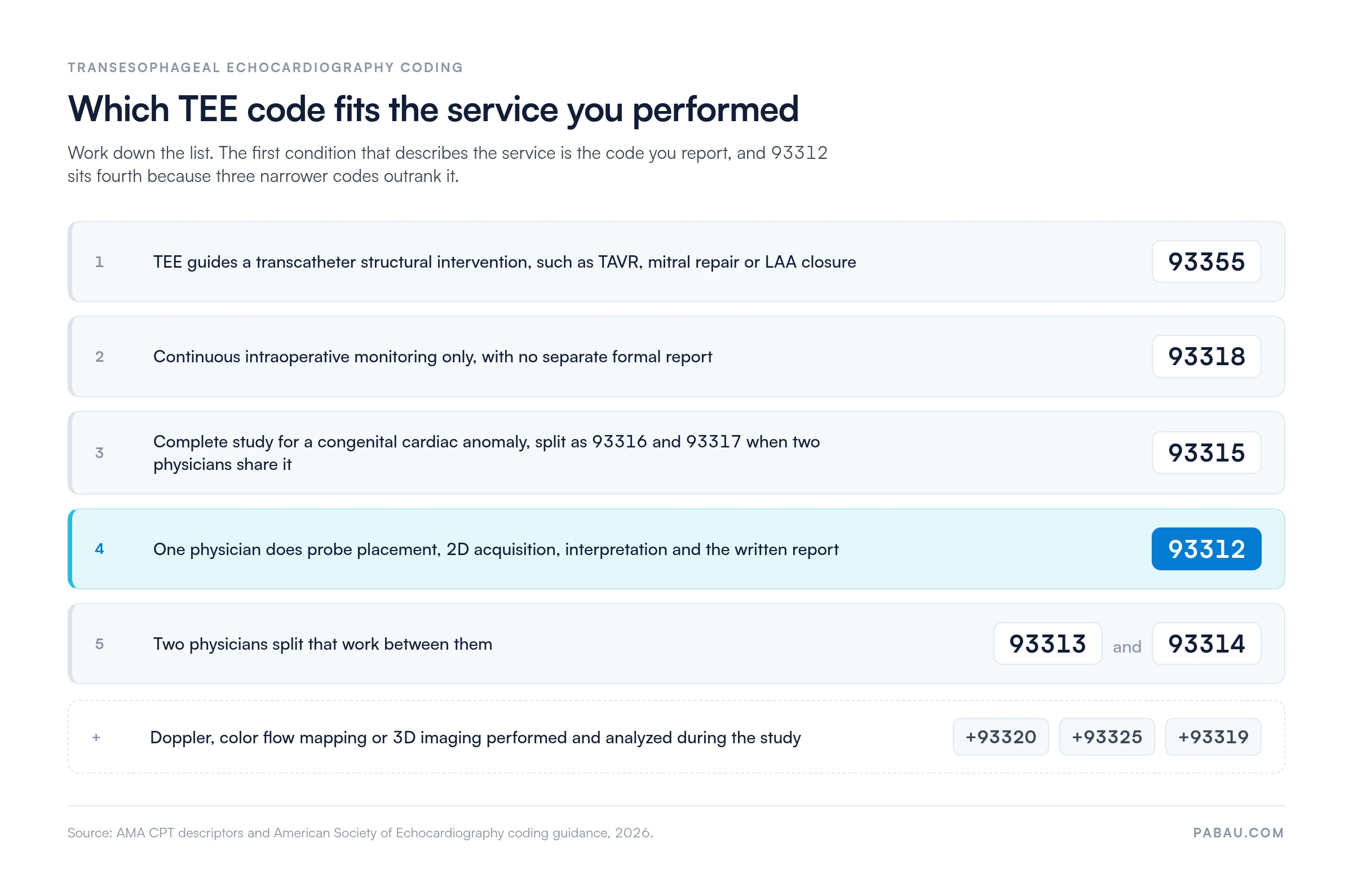
One note on 93318, because it is the code coders reach for last. When an anesthesiologist runs TEE purely for hemodynamic surveillance and writes no structured report, 93318 is correct. Billing 93312 for that service claims a report that does not exist, which is exactly what an auditor looks for.
The two spectral Doppler add-ons divide by scope, not by the patient’s history. A complete Doppler study alongside the TEE is 93320, and a limited or follow-up Doppler assessment is 93321. Report whichever one the written interpretation supports.
Coders mix up 93312 and 93306 more often than any other pair in this family. The approach differs, and so does the billing profile. Reading both correctly protects the practice when one patient record shows a TTE and a TEE within days.
Before a 93312 claim leaves the practice, walk the same six questions every time. Each one maps to a denial pattern from the sections above.
Six questions take about a minute. A denied 93312 claim takes three weeks and a rebill.
Cardiology teams that bill high volumes of intraoperative TEE run into the same friction. The documentation sits in the anesthesia record, the coding sits with a biller, and the two rarely meet before the claim goes out. Most 93312 errors get caught at claim creation or not at all.
Practice management software like Pabau closes that distance. Pabau’s claims management software pre-fills the claim form from the client record. The CPT code attached to the service lands on the charge line, and the recorded diagnoses seed the ICD-10 fields.
Built-in CPT and ICD-10 lookup libraries sit behind a search icon, refreshed with each official release. Before the send button unlocks, the system checks that claim-required fields are complete.
On the US pipeline, claims go out through Claim.MD, with real-time eligibility checks, remittance posting and claim-status tracking.
It will not choose your modifier for 93312, and it will not read the operative note for you. What it does is stop a claim leaving with a field missing. It also gives the billing team one place to watch what came back. A pattern of 93312 denials then shows up in a week rather than a quarter.

Pabau’s claims management software pre-fills the claim from the client record and checks required fields before you submit. Claims go out through Claim.MD, and your team tracks what came back in one place.

93312 rewards a practice that has one clear protocol, and punishes one that improvises. The deciding facts sit outside the coder’s reach, in the operative record and in who did what in the room.
So settle three questions in advance and the rest follows. Decide who performs each component, who writes the report, and how quickly that report reaches the chart. Apply the same answers to every TEE case, and the denial rate falls without anyone chasing individual claims.
Book a demo to see how Pabau pre-fills cardiology claims and flags missing fields before a 93312 claim ever reaches the payer.

Coding a congenital echo instead? CPT code 93303 covers the complete transthoracic study for congenital anomalies, the sibling of the 93315 to 93317 family.
Billing strain imaging with an echo? CPT code 93356 explains how the myocardial strain add-on is reported and documented alongside a base echo code.
Need the wider denial picture? Denial codes in medical billing maps the common CARC codes back to root causes in documentation, coding or enrollment.
Wondering how the claim reaches Medicare? Claim.MD clearinghouse review walks the submission path from practice to payer, and how remittance advice closes the loop.
Coding a stress test in the same practice? CPT code 93015 covers the global cardiovascular stress test and its own professional and technical split.
Yes. Add-on code +93319 covers 3D echocardiographic imaging and post-processing during a TEE. Report it with 93312, 93314, 93315 or 93317, and only when the 3D images were used and analyzed in the diagnosis. The written report has to describe that work.
The physician bills 93312-26 for the professional component. Under the hospital outpatient prospective payment system, the facility reports its own code, and C8925 replaces 93312 when contrast is used. Check your MAC’s TEE billing and coding article before you split the claim.
There is no single national list. Each Medicare Administrative Contractor publishes covered diagnoses in its own TEE billing and coding article, such as A56505. Pull the article for your jurisdiction, match the diagnosis to what the report documents, and keep the two consistent.
93355 covers TEE used to guide a transcatheter structural intervention, such as TAVR or mitral repair. It is reported once per intervention, and only by a physician who is not performing the intervention. 93312 covers a standalone diagnostic study with its own written report.
Use the CMS Physician Fee Schedule Look-Up Tool and enter 93312 with your carrier or locality. Select the modifier you plan to bill, because the professional, technical and global amounts differ. The tool returns a geographically adjusted figure rather than the national one.



