CCSD Code L1880: Repair of leaking aneurysm of arch of aorta
CCSD Code L1880: Definition and clinical description CCSD Code L1880 is the Clin...

Last Updated: Oct 23, 2026
93503 is the CPT code for insertion and placement of flow directed catheter (e.g., Swan-Ganz) for monitoring purposes. It covers placing a balloon-tipped pulmonary artery catheter so the care team can track hemodynamics, usually in the ICU.
The code pays for the placement itself, billed once per insertion. Later monitoring days and data interpretation are reported separately. A right heart catheterization done to answer a diagnostic question is coded from the 93451-93453 family instead.
Let Pabau's smart automation suggest the right codes, reduce claim denials, and keep your practice compliant—effortlessly.
Automate repetitive tasks and focus on what matters most—your patients.
Reduce coding errors and ensure compliance with the latest regulations.
Clean claims, fewer denials, and faster reimbursements.
Powerful insights and reporting to help your practice thrive.
HIPAA compliant SOC 2 certified GDPR-compliant Trusted by 4,000+ clinics worldwide

CPT code 93503 covers Swan-Ganz catheter insertion for monitoring only, not diagnostic catheterization.
The code carries a 0-day global period, which includes same-day pre- and post-procedure work, so a same-day E/M visit needs modifier 25.
NCCI edits prohibit billing 93503 on the same date as certain diagnostic right heart catheterization codes.
Modifiers 26 and TC don’t apply to 93503, because it is a single-priced physician service with no professional and technical split.
Pabau’s claims management software submits claims through Claim.MD, tracks their status, matches ERAs, and flags denials.
In the AMA CPT code set, the official descriptor for 93503 reads: Insertion and placement of flow directed catheter (e.g., Swan-Ganz) for monitoring purposes.
Three facts follow directly from that descriptor and matter for every claim.
The code sits within the Cardiac Catheterization section (93451-93572) of the AMA CPT codebook. Even so, it works as a monitoring-setup code rather than a diagnostic procedure code. That difference drives the billing and bundling rules that follow.
The Swan-Ganz catheter is a balloon-tipped, flow-directed catheter inserted through a central vein, typically internal jugular, subclavian, or femoral. It is advanced through the right atrium and right ventricle into the pulmonary artery. Knowing the steps tells coders what the procedure note has to confirm.
These parameters give the clinical team continuous data on left-heart filling pressures, pulmonary vascular resistance, and cardiac output. The procedure is performed almost exclusively in ICUs or cardiac catheterization laboratories. Patients are typically hemodynamically unstable and need active management rather than a diagnostic workup.
A frequent billing error with 93503 is treating it as an all-inclusive catheterization code. The table below maps what the code includes, what needs a separate code, and what isn’t separately billable at all.
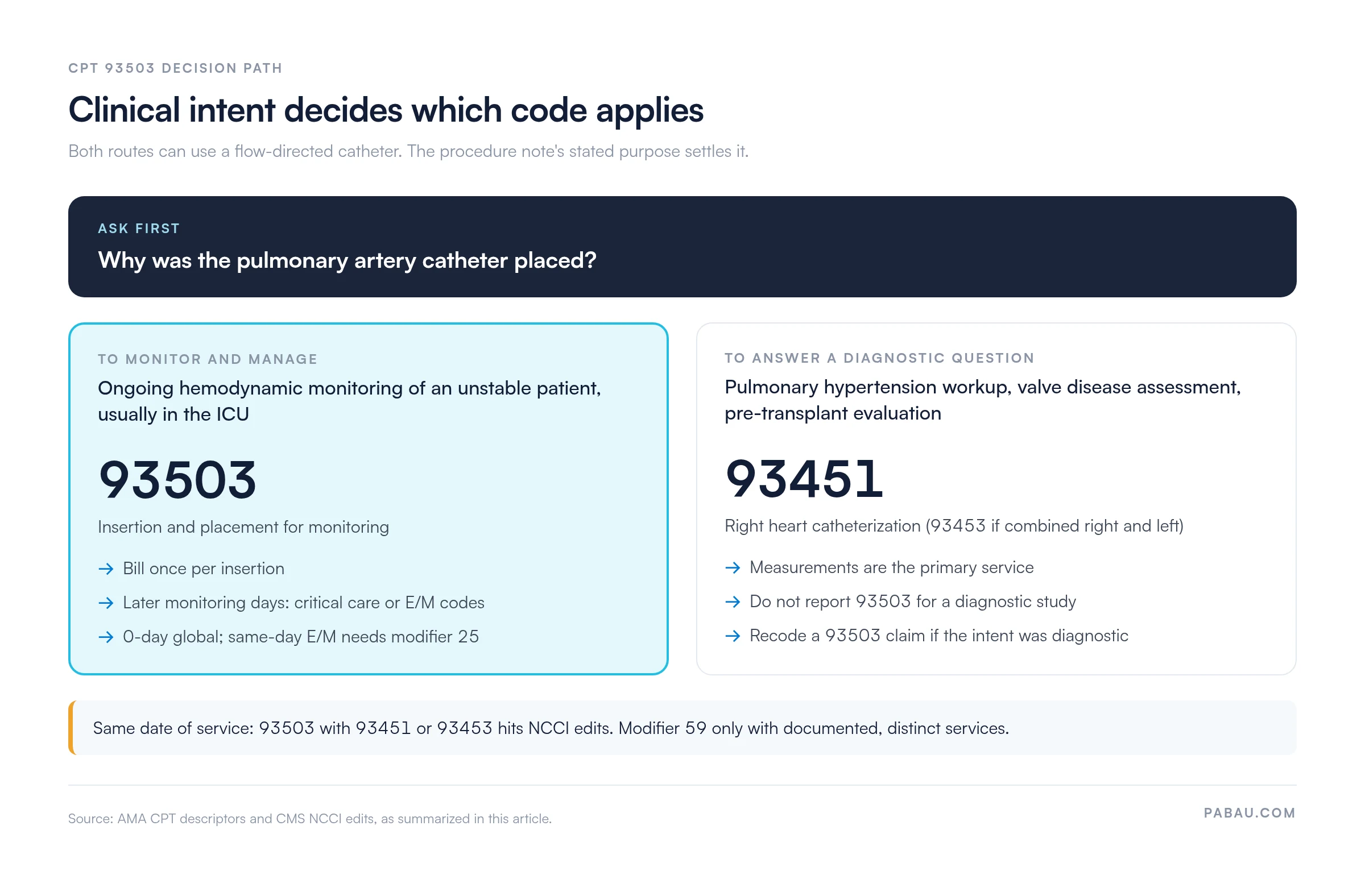
Clinical intent decides between 93503 and the diagnostic catheterization codes. Billing 93503 when the intent was diagnostic, or pairing it with a diagnostic catheterization code on the same date of service, triggers NCCI edits. Verify current NCCI edit tables via the CMS Physician Fee Schedule lookup tool before submitting claims, as edit pairs are updated quarterly.
The practical rule is simple. If the physician placed the Swan-Ganz to manage an unstable patient’s hemodynamics over time, use 93503. If the catheter was placed to answer a diagnostic question, the correct code comes from the diagnostic catheterization family, typically 93451. The decision path below lays out both routes side by side.
Payers audit 93503 claims for a short, specific list of documentation elements. Missing any one of them is sufficient grounds for denial. Structure the procedure note around these elements before submission. Building them into a standard clean claim workflow keeps them from being missed at billing time.
The procedure note should be distinct from the daily progress note. Auditors look for a dedicated procedure note, not a sentence buried in an ICU daily note. Sound medical billing compliance practice keeps this separation so the claim holds up in post-payment review.
The ICD-10 diagnosis code must establish hemodynamic instability or a condition where continuous pulmonary artery monitoring is clinically necessary. Coverage criteria come from your Medicare Administrative Contractor (MAC), so check its current LCD or billing article in the Medicare Coverage Database. The diagnoses below are the ones that most often support placement.
Payers look for the diagnosis code to be clinically consistent with the procedure note. A diagnosis of stable hypertension (I10) does not support medical necessity for Swan-Ganz catheter placement.
Medicare has no single national coverage document for 93503, so coverage rules come from your MAC. Older references cite L30719, a 2011-2012 Wisconsin Physicians Service billing and coding guideline that predates ICD-10. Check your own MAC instead.
The Part A versus Part B split matters because 93503 is almost always a hospital inpatient procedure. The billing pathway depends on who submits the claim.
For current Medicare criteria, search the Medicare Coverage Database for your MAC’s LCD or article on cardiac catheterization. Criteria are condition-specific and change over time, so check the version in effect for the date of service.
Before submitting 93503 claims, confirm the procedure note names the catheter type (flow-directed or Swan-Ganz). It should also record the access site and waveform confirmation of pulmonary artery position. Each one answers a question an auditor asks when reviewing medical necessity for this code.
CPT code 93503 carries a 0-day global period. That global includes same-day pre- and post-procedure work. A same-day E/M visit is billed only when it is significant and separately identifiable, with modifier 25. The Medicare Physician Fee Schedule (MPFS) pays 93503 as a single physician service. FastRVU’s 2026 RVU lookup lists current work RVU, practice expense RVU, and malpractice RVU values by geographic locality.
Because rates change annually, always use the CMS Physician Fee Schedule lookup for the payment year matching the date of service. A dollar figure hardcoded into a billing guideline goes stale every January.
Modifier selection for 93503 depends on the clinical circumstances. A wrong modifier is a known audit trigger, so each one needs documentation that matches its meaning. Modifiers 26 and TC don’t apply, because 93503 has no professional and technical component split.
93503 denials cluster around a few recurring issues. A denial management workflow that routes cardiac catheterization claims to a coding specialist before submission catches them early.
Knowing the medical billing denial codes, such as CARC CO-50 and CO-97, helps billing teams prioritize appeals and spot systemic errors. If your practice submits cardiac claims regularly, add a pre-submission review for codes in the 93451-93572 range.
Track CPT 93503 denial patterns by payer over 90-day rolling periods. If the same payer repeatedly denies on NCCI bundling grounds, audit your claim templates for that payer. One template fix then corrects every future claim built from it.
Billing teams handling 93503 often check claim status payer by payer, post remittances by hand, and spot denials late. A CO-50 or NCCI denial that sits unnoticed can run past the appeal window.
Pabau, the practice management platform we build, sends claims electronically through Claim.MD, our US clearinghouse partner, which connects to thousands of US payers. Its claims management software tracks each claim’s status, matches electronic remittance advice (ERA) to the claim, and flags denials for follow-up.
For a 93503 claim, that means your team sees a denial as soon as it comes back. The coder can pull the procedure note and request an addendum while the case is still fresh.

Pabau submits claims through Claim.MD to thousands of US payers, tracks their status, and matches ERAs. Your team sees denials early enough to appeal them.

Before you submit 93503, settle one question from the procedure note: was the catheter placed to manage the patient, or to answer a diagnostic question? If the note says monitoring, bill 93503 once per insertion and code the following days as critical care or E/M.
If the note can’t answer that question, fix the note before the claim goes out. An addendum takes minutes today, while a CO-50 appeal means a second round of paperwork weeks later.
Pabau then supports the medical billing steps that follow, from claim submission through status tracking and ERA matching. Book a demo to see how it tracks your 93503 claims and surfaces denials while they can still be appealed.

Need a framework for handling cardiac claim denials? Denial management in healthcare covers the end-to-end process for identifying, appealing, and preventing recurring claim rejections.
Want to understand how clearinghouse submission works? How Claim.MD clearinghouse works explains real-time eligibility checks, 837P claim transmission, and ERA processing.
Looking for the full picture on US medical billing? Revenue cycle management explained maps the complete journey from patient encounter to collected payment.
Need a cleaner hand-off from encounter to claim? What a superbill is and how to use it walks through the fields a superbill carries and how it feeds the claim.
CPT code 93503 covers the insertion and placement of a flow-directed catheter, such as a Swan-Ganz, for hemodynamic monitoring. It includes advancing the balloon-tipped catheter into the pulmonary artery and confirming its position. It does not cover diagnostic measurements, data interpretation, imaging, or later days of monitoring.
CPT code 93503 has a 0-day global period. The payment includes same-day pre- and post-procedure work, with no post-operative days. A significant, separately identifiable E/M service on the same day is billed with modifier 25. Later monitoring days are billed with critical care or E/M codes.
Generally no. NCCI edits restrict billing CPT 93503 with diagnostic right heart catheterization codes such as 93451 on the same date of service. If the monitoring insertion and a diagnostic catheterization were separate and distinct procedures, modifier 59 may apply with clear documentation. Check the current NCCI edit pairs each quarter, because the tables change.
Modifier 59 (distinct procedural service) applies when documentation supports a challenge to an NCCI edit. Modifier 52 (reduced services) covers a catheter not fully advanced to the pulmonary artery. Modifiers 76 and 77 cover a repeat procedure by the same or a different physician. Modifiers 26 and TC don’t apply, because 93503 has no professional and technical component split. Each modifier needs procedure note documentation that directly supports its use.