93462 is the CPT add-on code for left heart catheterization by transseptal puncture through intact septum or by transapical puncture. It is reported only with a listed primary procedure code, never on its own.
The code covers reaching the left heart across the interatrial septum or through the left ventricular apex. Listed primary codes include left heart catheterization (93452, 93453, 93458-93461) and SVT or VT ablation (93653, 93654).
Automate repetitive tasks and focus on what matters most—your patients.
Improve accuracy
Reduce coding errors and ensure compliance with the latest regulations.
Get paid faster
Clean claims, fewer denials, and faster reimbursements.
Grow with confidence
Powerful insights and reporting to help your practice thrive.
HIPAA compliant•SOC 2 certified•GDPR-compliant•Trusted by 4,000+ clinics worldwide
Key takeaways
CPT code 93462 is an add-on code, so it is reported only with a listed primary code such as 93452, 93453, 93458-93461, 93653 or 93654.
The procedure note must document the transseptal puncture as its own step, with the needle used, how septal crossing was confirmed, and left atrial pressure.
Procedures that already include the septal puncture, such as AF ablation (93656), LAAC (33340) and transcatheter mitral repair (33418), don’t take 93462.
Common denials come from billing without a listed primary code, thin transseptal documentation, or a diagnosis that doesn’t match the clinical indication.
Pabau, the practice management platform we build, validates claims before they go out through Claim.MD and brings ERA remittances back into billing.
CPT code 93462: Official descriptor and add-on status
CPT code 93462 describes left heart catheterization by transseptal puncture through intact septum or by transapical puncture. The full descriptor adds “List separately in addition to code for primary procedure.” The AMA publishes it in the Medicine section of CPT, under Cardiovascular and Cardiac catheterization. The AMA CPT code set marks it with the + add-on symbol, so it can’t be reported on its own.
The code covers the act of reaching the left heart, either across the interatrial septum or through the left ventricular apex. The diagnostic or interventional work that follows is captured by the primary code. When the left heart is reached by the standard retrograde aortic approach, 93462 does not apply.
Procedure: Transseptal puncture of the interatrial septum, or transapical puncture, to reach the left atrium or left ventricle
Cannot be billed alone: Must accompany a listed primary code
Global period: ZZZ, the MPFS indicator for an add-on code whose global period follows the primary procedure
Approved primary codes to pair with CPT 93462
The CPT parenthetical lists the primary codes that 93462 may be reported with. They are 33477, 33741, 33745, 93452, 93453, 93458-93461, 93582, 93595-93597, 93653 and 93654. The table covers the catheterization and closure codes, and the EP ablation codes appear in the EP lab table further down.
CPT Code
Descriptor
Clinical context
93452
Left heart catheterization including intraprocedural injection(s) for left ventriculography
Left heart study where the transseptal route replaces a retrograde approach that isn’t feasible
93453
Combined right and left heart catheterization including left ventriculography
When both sides are assessed, 93462 adds the transseptal left-sided access
93458
Catheter placement in coronary artery(s) for coronary angiography with left heart catheterization
Coronary angiography plus left heart pressures, with the left heart entered across the septum
93459
Coronary angiography with left heart catheterization, including left ventriculography, with bypass graft angiography
Same as 93458 in a patient with bypass grafts
93460
Catheter placement in coronary artery(s) for coronary angiography with right and left heart catheterization
Full combined study; 93462 is reportable when transseptal access is documented
93461
Coronary angiography with right and left heart catheterization, including left ventriculography, with bypass graft angiography
Full combined study in a patient with bypass grafts; same pairing rules as 93460
93582
Percutaneous transcatheter closure of patent ductus arteriosus
Congenital closure case where left-sided access is gained by transseptal puncture
Coronary angiography with left heart catheterization, 93458, is the parent when coronary imaging and left heart pressures are done in one session. The remaining listed codes cover congenital and structural work. 93595-93597 report catheterization for congenital heart defects.
33477 is transcatheter pulmonary valve implantation, 33741 is transcatheter atrial septostomy, and 33745 is intracardiac shunt creation by stent placement. Confirm the list against the current AMA CPT edition each year, because the parenthetical instructions can change with new codes.
The transseptal puncture procedure: What coders need to know
Transseptal catheterization reaches the left heart chambers from the venous side, typically through the femoral vein, rather than by the arterial retrograde route. Knowing the steps helps coders match the operative note to the code.
Femoral vein access: The procedure begins with venous access, usually at the right femoral vein, using the Seldinger technique.
Catheter advancement: A long transseptal sheath and dilator are advanced through the inferior vena cava into the right atrium.
Septal identification: The fossa ovalis, the thinnest part of the interatrial septum, is identified under fluoroscopy, with or without intracardiac echocardiography (ICE).
Brockenbrough needle puncture: A curved Brockenbrough needle is advanced through the sheath and used to puncture the interatrial septum at the fossa ovalis.
Left atrial access confirmed: Pressure waveform change and oximetry confirm left atrial entry. ICE imaging may also confirm the septal crossing.
Sheath advancement: The sheath is advanced into the left atrium, providing stable access for the diagnostic or therapeutic procedure that follows.
Each of these steps should appear, in substance, in the procedure note. A general reference to a “transseptal approach” without the needle type, guidance modality and pressure confirmation won’t survive a medical necessity audit.
Clinical indications and ICD-10-CM codes for CPT 93462
Medical necessity for CPT 93462 is established when the planned procedure requires the transseptal approach. An optional alternative to retrograde access doesn’t qualify. The common indications and their ICD-10-CM codes are listed below.
Indication
Common ICD-10-CM codes
Notes
Atrial fibrillation / flutter ablation
I48.0, I48.11, I48.19, I48.20, I48.3, I48.4
Pulmonary vein isolation (93656) already includes the puncture, so 93462 is not added. It applies to left-sided ablation reported with 93653 or 93654.
Mitral regurgitation / stenosis
I34.0, I05.0, I05.1, I05.2
Diagnostic transseptal catheterization to measure the mitral gradient. Valvuloplasty (92987) is not a listed primary code for 93462, and transcatheter repair (33418) already includes the puncture.
Left atrial appendage closure
I48.0, I48.11, I48.19, I48.20 (non-valvular AF)
Watchman and Amulet closures are coded 33340, which is not paired with 93462 (see the structural section).
When retrograde crossing of a stenotic aortic valve is not feasible or safe
The diagnosis on the claim must reflect the condition documented in the medical record. Choosing a diagnosis only because it meets payer coverage criteria is improper coding under the ICD-10-CM Official Guidelines published by CMS and NCHS.
CPT 93462 vs. CPT 93463: Key differences
CPT 93462 and CPT 93463 are both add-on codes in the cardiac catheterization family, but they describe different services and are not interchangeable.
Feature
CPT 93462
CPT 93463
Descriptor
Left heart catheterization by transseptal puncture through intact septum or by transapical puncture
Pharmacologic agent administration (such as a vasodilator or inotrope), including hemodynamic measurements, during cardiac catheterization
Clinical service
A specific access technique (needle puncture of the interatrial septum or the left ventricular apex)
Administration of a pharmacologic agent and hemodynamic reassessment
Can be co-reported?
Yes, 93462 and 93463 can be reported together when both services are performed
Yes, 93463 may accompany an approved primary cath code, including one that also carries 93462
Documentation trigger
Brockenbrough needle puncture, septal crossing confirmation, left atrial pressure
Drug name, dose, route, timing, and hemodynamic response measurements
Common denial pattern
Bundled into primary cath; documentation of transseptal puncture missing
Hemodynamic reassessment not documented
Exercise during catheterization is reported with a separate add-on code, 93464, not with 93463.
How EP lab codes interact with CPT 93462
In electrophysiology, whether 93462 can be added depends on the ablation code. The table shows which EP codes can sit on the same claim as 93462 and which already include the puncture. Intracardiac echocardiography, 93662, is an add-on with its own list of primary codes.
Co-code
Description
Co-coding note
93653
Comprehensive EP evaluation with SVT ablation, including 3D mapping
Listed primary code; 93462 is reportable when the transseptal puncture is documented
93654
Comprehensive EP evaluation with VT ablation, including 3D mapping
Listed primary code; 93462 is reportable when left-sided access by transseptal or transapical puncture is documented
93656
Comprehensive EP evaluation with AF ablation by pulmonary vein isolation, including transseptal puncture
Not reportable with 93462 per CPT parenthetical
93657
Additional ablation of AF remaining after pulmonary vein isolation (add-on)
Add-on to 93656 only, so it cannot be paired through 93462
93662
Intracardiac echocardiography (ICE) during a therapeutic or diagnostic procedure (add-on)
Reportable only with its own listed primary codes; check the CPT parentheticals and NCCI edits before billing it
93613
Intracardiac 3D electroanatomic mapping (add-on)
Included in 93653 and 93654, so not separately reportable with them
93621
Left atrial pacing and recording from the coronary sinus or left atrium (add-on)
Add-on to 93620 only; included in 93653 and 93654 and excluded with 93656
Check the current National Correct Coding Initiative (NCCI) procedure-to-procedure edit tables before billing any combination. CMS updates them quarterly.
Pro Tip
Before submitting an EP claim that includes CPT 93462, download the current CMS NCCI PTP edit table. Check the modifier indicator for each code pair. An indicator of ‘0’ means the bundle cannot be overridden with a modifier. An indicator of ‘1’ means modifier 59 or XU may apply, but only when a distinct, separate service is documented.
NCCI bundling rules for CPT code 93462
CPT code 93462 is an add-on code, and most add-on codes are not subject to the same procedure-to-procedure (PTP) bundling edits that affect standalone codes. The primary catheterization and EP codes performed after transseptal access still carry their own NCCI edits, and those shape how the encounter is billed.
Three CMS rules matter most for encounters where 93462 appears:
PTP edits: Check the CMS NCCI PTP table for 93462 against each co-submitted code. Where an edit carries modifier indicator 1, modifier 59 or the more specific XU modifier may go on the column-two code. Use it only when a separate service is performed and documented, since an unsupported modifier is improper billing under OIG guidance.
Medically Unlikely Edits (MUEs): CMS sets an MUE value for each code. For add-on codes like 93462, the MUE is typically 1 unit per date of service, so billing two units triggers an automated edit.
Global period: 93462 carries the MPFS global indicator ZZZ, which marks an add-on code whose global period follows the primary procedure. Assess post-procedure services against the primary code’s global period, not 93462’s.
Medicare and payer reimbursement for CPT code 93462
Medicare reimburses CPT 93462 under the CMS Physician Fee Schedule. Add-on codes are paid per MPFS RVUs and do not carry their own global period, so 93462 is paid on top of the primary code. Current Work, Practice Expense and Malpractice RVUs for 93462 are in the FastRVU 2026 lookup tool or the CMS MPFS data file.
Don’t rely on dollar amounts published in educational articles. Geographic Practice Cost Indices (GPCIs) adjust payment by locality, and the conversion factor changes each calendar year. Use the CMS fee schedule look-up tool to confirm the current rate for your MAC jurisdiction before billing.
Prior authorization: Medicare does not routinely require prior authorization for 93462 as a standalone item. Commercial payers may require it for the primary ablation or structural procedure, so confirm with each payer, because requirements vary by plan and contract.
Superbill preparation: When preparing the superbill for an EP procedure, list the primary code first and 93462 directly below it, noting its add-on status. Some clearinghouses reject add-on codes that appear before the parent code in the claim line sequence.
Charge entry checks: Checking each add-on against its primary code at charge entry stops the most common submission errors before claims reach the payer.
Documentation requirements: What the procedure note must include
Documentation drives more 93462 denials than any other factor. Payers and auditors look for a discrete transseptal puncture narrative, not a passing mention of a “transseptal approach” inside the primary procedure description. The note must stand on its own as evidence of a separate service.
Explicit statement of transseptal puncture: The note must state that a transseptal puncture was performed as a separately identifiable step. Describing left atrial access only implies it.
Needle type documented: Name the Brockenbrough needle (or equivalent transseptal needle system) used for the puncture.
Guidance modality: Document whether fluoroscopy, intracardiac echocardiography (ICE), or both confirmed the septal crossing. If ICE is billed as 93662 under its own listed primary code, the note must support it as a distinct service.
Confirmation of left atrial entry: Record the pressure waveform change confirming left atrial access. Note oximetry confirmation and ICE findings where applicable.
Separate paragraph or section: The transseptal puncture narrative should appear as its own section, not merged into the description of the primary catheterization or ablation.
Indication stated: Briefly state why the transseptal approach was needed instead of the retrograde aortic approach. Aortic stenosis, a mechanical aortic valve and a failed retrograde attempt are typical reasons.
Practices with high EP volumes benefit from a standard procedure note template that captures all six elements as discrete fields. Missing even one, usually the separate paragraph or the indication statement, is enough for an auditor to flag the claim. Following billing compliance requirements for documentation protects revenue and holds up in retrospective review.
Top denial reasons for CPT 93462 claims and how to fix them
CPT 93462 denials follow a predictable set of patterns. Knowing the root cause of each lets coders fix the problem at charge entry rather than during appeals.
Denial reason
Root cause
Correction step
Add-on code without primary
93462 submitted without a listed parent code on the same claim date
Confirm the primary code is on the claim; resubmit with both codes
Bundled into primary cath
Payer automated edit treats transseptal puncture as integral to the primary procedure
Appeal with records showing the puncture as a distinct service. Add modifier 59 or XU only where a PTP edit with indicator 1 exists.
Missing transseptal documentation
Procedure note does not separately describe the transseptal puncture
Ask the physician for an addendum covering needle type, guidance modality and septal crossing confirmation. Resubmit with the amended note.
Diagnosis mismatch
ICD-10-CM code on the claim does not match payer’s covered indications for 93462
Review the payer’s coverage policy. Appeal with clinical notes if the documented diagnosis is correct, or correct the code and resubmit.
Prior authorization missing
Commercial payer required auth for the primary ablation or structural procedure and denied the full encounter
Request retroactive authorization where the payer allows it. Otherwise, appeal on clinical urgency grounds with a physician attestation.
Sorting denials into denial management workflows by CARC denial codes shows whether a 93462 pattern is systemic or documentation-driven. A payer that edits the add-on every time needs a payer conversation, while thin notes need physician education.
Special scenarios: CPT 93462 in structural heart procedures
Several structural heart and congenital procedures use transseptal access but carry their own primary codes. Whether 93462 can be added depends on the CPT parenthetical for that primary code, not on payer preference.
Left atrial appendage closure (Watchman / Amulet): Coded 33340. Its descriptor already includes transseptal puncture, and 33340 is not a listed primary code, so 93462 is not separately reportable.
MitraClip (transcatheter mitral valve repair): Coded 33418, not 0345T. The descriptor includes transseptal puncture, and CPT lists 93462 as a do-not-report code with 33418, 0345T and 0544T. The exception is a case where a transapical puncture is performed.
Balloon mitral valvuloplasty: Coded 92987, while 92986 is the aortic valve code. 92987 is not a listed primary code for 93462, so the transseptal access is not separately reportable.
Patent foramen ovale (PFO) or atrial septal defect closure: Coded 93580, which is not a listed primary code, so 93462 is not separately reportable. The closure code on the list, 93582, describes patent ductus arteriosus closure instead.
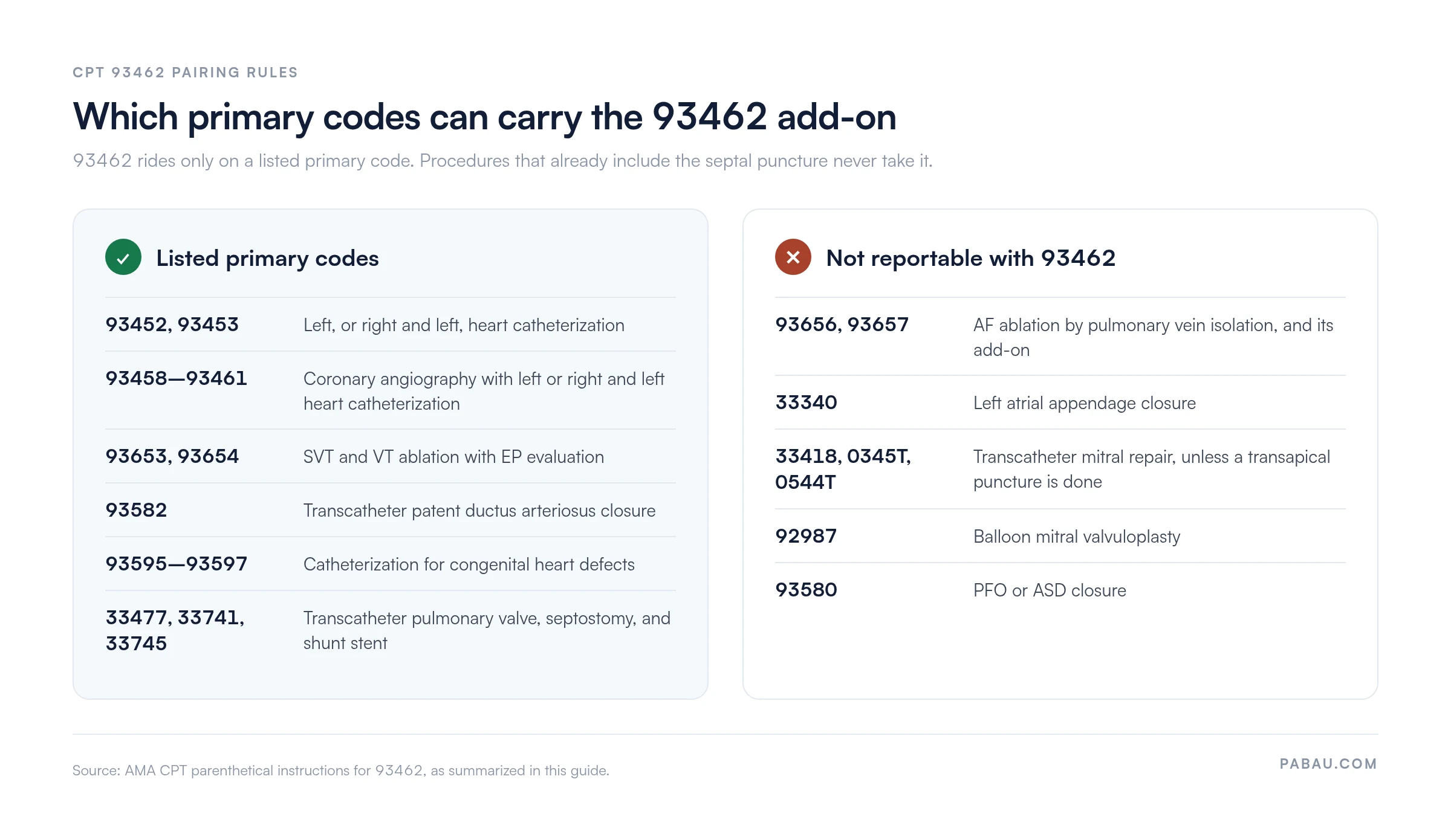
Set side by side, the listed primary codes and the codes that can’t carry 93462 look like this.
Each code in the right-hand column either includes the septal puncture or is not a listed primary, so adding 93462 invites a denial. Source: AMA CPT parenthetical instructions for 93462.
For practices with a high structural heart volume, your own claim history shows how each payer handles these cases faster than published summaries do. Claims management software that tracks claim status and brings ERA remittances back into billing shows which claims were paid, denied or adjusted.
Pro Tip
When billing 93462 with a listed primary code outside the catheterization family, such as 33477 or 93582, attach the procedure note to the initial claim. Sending it up front saves waiting for a records request during an appeal.
How Pabau keeps CPT 93462 claims clean
Without a claim check before submission, a missing primary code or a thin transseptal note usually surfaces only when the denial arrives. By then the team is chasing an addendum and resubmitting weeks after the procedure.
Pabau submits CMS-1500 claims to thousands of US payers through Claim.MD, validates claims before submission, and brings ERA remittances back into the billing workflow. Claim validation scrubs each claim for missing or invalid details, so incomplete claims are caught before the payer sees them.
With remittances in the same system, your team can see which 93462 claims were paid and which need an appeal. That makes clean claim submission the default instead of a rework cycle.
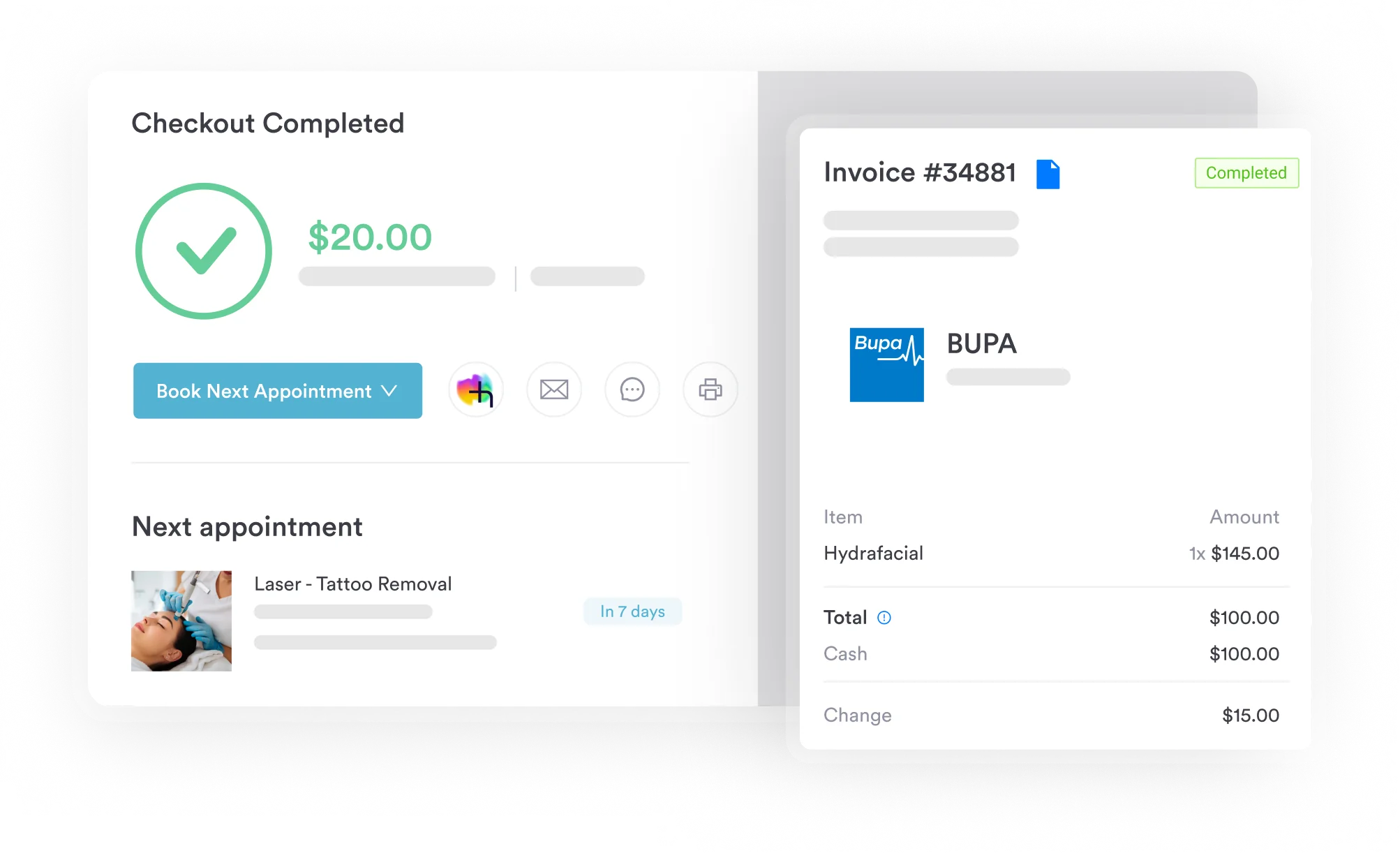
Pabau’s checkout links each invoice to the patient’s insurer, so your billing team can spot an unpaid 93462 add-on line and follow it up.
Simplify cardiology billing across your practice
Pabau validates claims before submission, sends them to thousands of US payers through Claim.MD, and brings ERA remittances back into billing. That means fewer denials and less rework for your billing team.
CPT code 93462 pays only when three conditions line up. A listed primary code is on the claim and the note treats the puncture as its own step. The diagnosis also has to support the transseptal or transapical route.
The error to guard against is adding 93462 to a procedure that already includes the puncture. AF ablation, LAAC and transcatheter mitral repair are the usual culprits. Check the parenthetical before the claim leaves, and the add-on stops being a denial magnet. Book a demo to see how Pabau validates cardiology claims before they reach the payer.
Continue your research
Need guidance on claim denial patterns across cardiac procedures?Denial management in healthcare covers structured workflows for categorizing and resolving denials by CARC code.
Want to understand how the 837 transaction works for EP claims?Electronic claims via the 837 file explains the EDI format, required data elements, and common submission errors.
Wondering where claim errors enter the pipeline?Medical claims clearinghouse explains how payers, clearinghouses, and providers exchange claims data.
Billing coronary angiography with a left heart cath?CPT code 93458 covers the most direct parent code for a transseptal left heart study.
Using ICE to guide the septal puncture?CPT code 93662 explains when intracardiac echocardiography is separately reportable.
Frequently asked questions
What is CPT code 93462?
CPT code 93462 is an add-on code for left heart catheterization by transseptal puncture through intact septum or by transapical puncture. It sits in the cardiac catheterization family of the CPT Medicine section. It can’t be reported without a listed primary code.
Is 93462 a standalone code or an add-on code?
CPT 93462 is an add-on code, marked with the + symbol in the AMA CPT codebook. It must be reported with a listed primary code: 33477, 33741, 33745, 93452, 93453, 93458-93461, 93582, 93595-93597, 93653 or 93654. Claims submitted without a parent code are denied.
Can CPT 93462 be billed with 93503 (Swan-Ganz catheter placement)?
No. CPT 93503, insertion and placement of a flow-directed catheter for monitoring, is not on the AMA list of primary codes for 93462. It is a right heart monitoring code, not one of the listed catheterization, closure or ablation codes.
How does CPT 93462 interact with intracardiac echocardiography code 93662?
CPT 93662 is an add-on code reportable only with its own listed primary codes, so adding 93462 does not make it billable. Check the CPT parentheticals for 93662 and the current NCCI edits before you put it on an encounter.
What documentation is required to bill CPT 93462?
The note should state that a transseptal puncture was performed as a distinct step and name the needle used, such as a Brockenbrough needle. It should record the guidance modality and how left atrial entry was confirmed. Keep the puncture in its own paragraph, and state why the transseptal approach was used instead of retrograde access.