



CCSD code G5100: Bypass of duodenum billing guide
CCSD code G5100 bills a bypass that leaves the duodenum in place CCSD code G5100...

Last Updated: Oct 16, 2026
CPT code 92285 is the billing code for external ocular photography with interpretation and report. It documents and diagnoses conditions of the external eye, including the eyelids, conjunctiva, cornea, iris, and anterior segment. Ophthalmologists and optometrists bill this code when photographs are captured to support clinical decision-making, not simply for routine documentation.
In the American Medical Association (AMA) CPT code set, 92285 sits in the Special Ophthalmological Services range, codes 92015 through 92287. That range belongs to the broader Ophthalmology Services and Procedures section, which runs from 92002 to 92499.
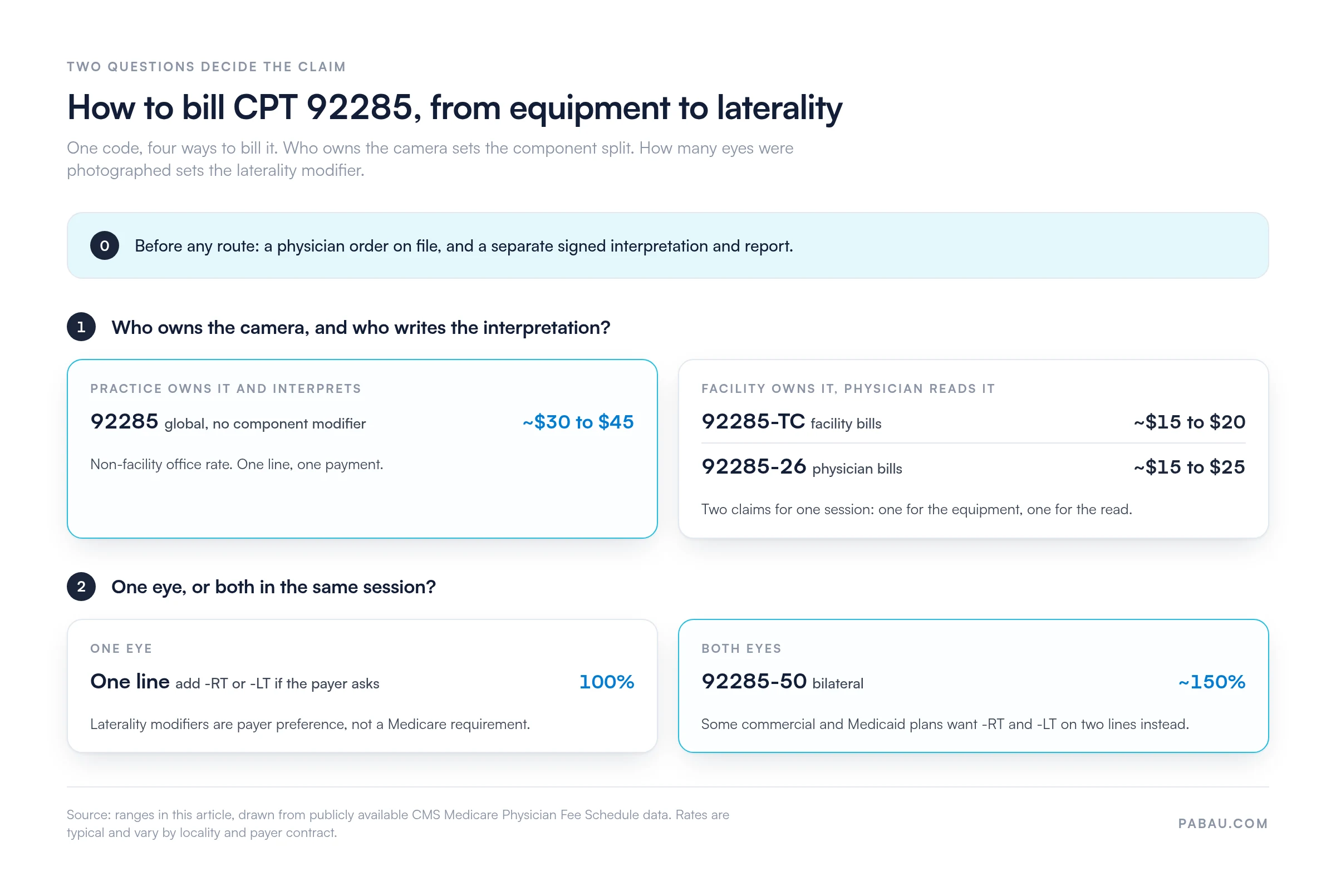
Coverage turns on three elements. The record needs a physician order, a documented clinical indication, and a signed interpretation and report. Medicare pays roughly $30 to $45 for the global office service. Splitting the technical and professional components between a facility and the reading physician pays less on each line.

CPT code 92285 covers external ocular photography with a written interpretation and report, not standalone image capture.
Medicare coverage requires a physician order and documented medical necessity, governed by LCD L34393.
Modifier -50 covers bilateral photography in one session, while -26 and -TC split the professional and technical components.
Practice management software like Pabau pairs ICD-10 codes to procedures automatically, which cuts 92285 denials.
CPT code 92285 describes external ocular photography with interpretation and report. The procedure captures photographic images of one or more external eye structures. The billing unit also requires a separately documented interpretation and report, authored by a physician or qualified healthcare professional.
Structures covered by this code include the eyelids, conjunctiva, cornea, iris, and anterior segment. It does not cover posterior segment imaging (fundus photography, which is CPT 92250) or scanning diagnostic imaging of the posterior pole (CPT 92133).
The AMA descriptor reads in full: “External ocular photography with interpretation and report.” The phrase “with interpretation and report” is not decorative. A photograph on its own does not satisfy the code. A clinician must author a written clinical interpretation and link it to the image.
The interpretation must be a distinct, separately identifiable written statement. It should reference the specific photograph, describe the clinical findings observed, and connect those findings to the patient’s diagnosis or treatment plan. A brief note saying “photos taken” does not qualify.
Medical necessity is the primary coverage trigger for CPT code 92285. Payers require the photography to serve a clinical purpose the record can show. It should document the baseline appearance of a condition, track disease progression, or support a treatment decision. Routine, protocol-based photography with no documented clinical indication does not meet the threshold.
The conditions most commonly accepted as covered clinical indications include:
The clinical record must state why photography was medically necessary for this patient at this visit. A listed diagnosis on its own is not enough. Take a patient with corneal dystrophy, seen for a routine check-up with no new findings. That visit typically does not justify repeat photography.
Pairing CPT code 92285 with a supported ICD-10 diagnosis code is a hard requirement for claim approval. The following codes are among those recognized under Medicare LCD L34393 and accepted by most commercial payers.
Verify the current covered list against the active version of LCD L34393 in the CMS Medicare Coverage Database. Codes change with every annual ICD-10-CM revision cycle. A code valid in one fiscal year may be retired or restructured the next.
Medicare covers CPT code 92285 when the service meets the medical necessity criteria set out in Local Coverage Determination L34393. That LCD, “Ocular Photography – External”, is maintained by CGS Administrators, LLC for Jurisdiction 15, which covers Kentucky and Ohio. Other MACs publish their own LCDs or coverage articles on ocular photography, so confirm the rules with your own contractor.
Eligibility should be verified before each visit. For Medicare patients that also means checking whether an active LCD applies. Then confirm the diagnosis on the claim sits on the covered list for that MAC region.
Key Medicare coverage requirements under LCD L34393:
Check your MAC’s website before billing CPT 92285. LCD L34393 is a CGS Administrators document, and it applies to Jurisdiction 15, meaning Kentucky and Ohio. If your practice sits in another jurisdiction, search the CMS Coverage Database under your own MAC’s name. That tells you which LCD, Local Coverage Article, or Billing and Coding Article governs external ocular photography where you are.
Medicare reimbursement for CPT code 92285 varies by geographic location, place of service, and whether the claim is billed globally or split between components. Pull the national and locality-adjusted rates for your own MAC jurisdiction before quoting an expected payment to a patient or a partner.
General reimbursement benchmarks for planning purposes (rates change annually and vary by locality; always verify against the current MPFS):
The ranges above are indicative benchmarks derived from publicly available MPFS data, not definitive billing figures. Commercial payer contracts differ significantly from Medicare rates. Check your own numbers against your payer agreements and the CMS MPFS lookup tool before forecasting revenue.
Electronic submission through a clearinghouse reaches thousands of US payers and returns remittance data per claim. That gives billing staff the amount paid for each 92285 line, rather than an estimate carried forward from last year.
Documentation failures drive more CPT 92285 denials than incorrect coding. The record must demonstrate that the service was ordered, medically necessary, performed, and interpreted, in that sequence. A missing physician order or a vague interpretation note is enough for a MAC auditor to recoup the payment.
Required documentation elements for each CPT 92285 claim:
A superbill that pre-populates the diagnosis code and the procedure linkage cuts the administrative burden at billing time. Practices using digital clinical records can tag each photograph to the encounter it belongs to, so the audit trail builds itself. External ocular photographs usually show identifiable patient features, so store and transmit them under the same HIPAA safeguards you apply to the chart.
Compliance on ophthalmology imaging codes comes from consistent documentation templates used across the practice. Individual clinician habits are what audits tend to find first.
Three modifiers see regular use with CPT code 92285. Selecting the wrong one, or omitting a required one, changes how payers price the claim and can trigger an edit or denial.
When both eyes are photographed and interpreted in the same session, modifier -50 is the standard approach for most payers. Medicare typically reimburses bilateral procedures at 150% of the unilateral rate. How that applies depends on the code’s bilateral indicator under the MPFS.
Some payers, particularly commercial insurers and certain Medicaid plans, prefer RT/LT modifiers on two separate claim lines rather than a single -50 line. Check your payer’s billing guidelines before choosing the approach. Submitting with -50 to a payer that requires RT/LT will trigger an edit, and so will the reverse. The chart below runs both decisions in order.
Most payers impose frequency limits on CPT code 92285 to prevent routine use for stable, non-progressive conditions. These limits are payer-specific and are not universal, so stating a single rule for all payers would be inaccurate.
General patterns seen across Medicare and major commercial payers:
When frequency is questioned on a claim, the record must show what the repeat photography added. It has to have captured new or changed information that affected the management decision. Documentation that simply records the photography without explaining why repeat imaging was needed at that visit is unlikely to survive a medical necessity review.
CPT 92285 claims denied at first submission almost always fail for one of a handful of reasons. Most are preventable with front-end workflow controls rather than back-end appeals.
Denial prevention on ophthalmology imaging codes starts before the claim is submitted. Reading the denial codes that most often accompany 92285 rejections tells billing staff what belongs on the pre-submission checklist. Practices with consistently high clean claim rates embed those checks into the documentation workflow rather than the billing workflow.
CPT code 92285 is frequently confused with or billed alongside other ophthalmology imaging codes. Understanding the distinctions prevents unbundling errors and helps coders select the correct code when multiple imaging services are performed.
The AAPC CPT code lookup database includes crosswalk data showing which codes carry Correct Coding Initiative (CCI) edits against 92285. That crosswalk is what pre-submission claim scrubbing rules are built from.
Billing CPT code 92285 accurately depends on two steps happening in the right order. Clinical documentation is completed at the point of care, then the claim is built correctly before submission. When those steps live in separate systems that share no data, errors accumulate between them.
Pabau’s claims management software connects the clinical encounter directly to the claim. When a clinician documents an external ocular photography session, the ICD-10 code and the procedure code are linked in the same record. Before the claim leaves the practice, automated checks flag missing documentation, frequency concerns, and modifier inconsistencies. Fewer denials reach the payer, so fewer of them come back needing an appeal.

For practices billing across multiple payers, tracking electronic remittance advice in one platform makes denial patterns visible across the whole patient population. A pattern such as “payer X denies 92285 without modifier -26” shows up in the data rather than in a stack of paper EOBs. Pabau’s clearinghouse integration reaches thousands of US payers and supports both CMS-1500 and 837P claim formats. Eligibility verification and ERA processing are built in.
Revenue cycle work on ophthalmology imaging codes gets easier when the billing system already knows what each code requires. Rather than training every staff member on every modifier rule, the system enforces them at the claim-building stage.
Run a 90-day audit on all 92285 claims before your next MAC audit cycle. Pull every claim billed with this code and check: Was a physician order documented? Is there a separate interpretation and report? Does the ICD-10 code match the covered diagnosis list? Claims that fail all three checks are your highest refund risk. Fixing the workflow now costs less than returning payments later.

Pabau connects clinical documentation to claims submission, automatically pairing ICD-10 codes to procedures, flagging incomplete records before submission, and tracking reimbursement across payers. See how ophthalmology and optometry practices use Pabau to clean up their billing workflows.

CPT code 92285 asks for three things in one visit. Photograph the external eye, interpret the findings, and write both into the record. Denials follow when the order is missing, when the interpretation is thin, or when the modifier does not match what the payer wants.
One documentation template that captures the order, the clinical indication, the interpretation, and the diagnosis linkage removes most of those failure points. Building it costs an afternoon. Returning a year of recouped payments after a MAC audit costs considerably more.
Pabau helps ophthalmology and optometry practices build that workflow into their clinical and billing systems, so 92285 claims go out complete and come back paid. To see it run against your own codes, book a demo.

Need to understand how clearinghouse submissions work for imaging codes? Medical claims clearinghouse guide explains how electronic claims move from practice to payer and where rejections happen.
Struggling with claim denials across your ophthalmology billing? Denial management in healthcare covers systematic approaches to tracking, appealing, and preventing claim rejections.
Want to understand the 837P electronic claim format for 92285 submissions? 837 EDI file guide breaks down the electronic claim transaction format used by all US clearinghouses.
Not sure what belongs on the superbill behind a 92285 line? What a superbill is and what it must contain walks through each field payers expect to see.
Building documentation standards across a multi-provider practice? Medical billing compliance sets out the controls that keep imaging claims audit-ready.
CPT code 92285 is the billing code for external ocular photography with interpretation and report. It documents and diagnoses conditions of the external eye, including the eyelids, conjunctiva, cornea, iris, and anterior segment. The code requires both the photographic capture and a separately authored written interpretation by a physician to be billable.
Medicare reimbursement for CPT 92285 typically runs $30 to $45 for the non-facility global rate, and $10 to $20 for the facility rate. Exact amounts vary by MAC region and are updated annually. Always verify the current rate using the CMS Medicare Physician Fee Schedule lookup tool for your specific locality before forecasting revenue.
Covered ICD-10 codes for CPT 92285 include cornea diagnoses (H17.10, H18.10) and conjunctiva diagnoses (H11.019, H11.229). Eyelid (H02.409), iris (H21.209), and traumatic anterior segment injuries (S05.90XA) also appear. CGS Administrators publishes the definitive covered list in LCD L34393 for Jurisdiction 15. Check it against the current version before billing.
Yes, CPT 92285 can be billed for bilateral procedures when both eyes are photographed and interpreted in the same session. Most payers accept modifier -50 for bilateral billing, typically reimbursing at 150% of the unilateral rate. Some commercial payers prefer two separate line items with RT and LT modifiers instead of a single -50 line, so check payer-specific billing guidelines first.
Frequency limits for CPT 92285 are payer-specific and not universal. Medicare sets no hard annual cap under LCD L34393, but each session must be independently medically justified. Repeated photography for stable, unchanged conditions is a documented audit trigger. Commercial payers commonly limit coverage to 1 to 2 sessions per year per eye for monitoring diagnoses.
CPT 92285 covers external ocular photography of the anterior structures, including the eyelids, conjunctiva, cornea, and iris. CPT 92250 covers fundus photography of the posterior segment, meaning the retina, optic disc, and macula. The two codes image entirely different anatomical regions and are not interchangeable. Billing 92250 when the photographs document anterior segment structures is a coding error.



