CPT code 87510: Gardnerella vaginalis nucleic acid probe billing
CPT code 87510: Official descriptor and clinical definition CPT code 87510 is th...

Last Updated: Nov 25, 2026
92230 is the CPT code for fluorescein angioscopy with interpretation and report. The physician injects fluorescein dye and watches its transit through the retinal vessels directly, without recording multiframe images.
Recorded fluorescein angiography is a different code, 92235. 92230 is billed per eye, takes no 26 or TC modifier, and NCCI bundles it into 92235, 92240, 92242 and 92137.
Let Pabau's smart automation suggest the right codes, reduce claim denials, and keep your practice compliant—effortlessly.
Automate repetitive tasks and focus on what matters most—your patients.
Reduce coding errors and ensure compliance with the latest regulations.
Clean claims, fewer denials, and faster reimbursements.
Powerful insights and reporting to help your practice thrive.
HIPAA compliant SOC 2 certified GDPR-compliant Trusted by 4,000+ clinics worldwide

CPT code 92230 is fluorescein angioscopy, a direct view of the dye transit with a written report. Recorded fluorescein angiography is a different code, 92235.
92230 is reported per eye, up to two units a day, and Medicare pays each eye at up to 100% of the fee schedule amount.
Modifiers 26 and TC can’t be used with 92230, because CMS lists it as a physician service that has no split.
NCCI bundles 92230 into 92235, 92240, 92242 and 92137, so it does not pay alongside any of them for the same eye.
The 2026 national Medicare rate is $132.94 per eye in the office, or $26.72 in a facility, at the standard conversion factor.
CPT code 92230 is fluorescein angioscopy with interpretation and report. The physician injects fluorescein dye, watches it move through the retinal vessels, and writes up the findings. CMS’s October 2026 relative value file lists it as an active, per-eye code, separate from recorded fluorescein angiography.
The difference is how the dye transit is captured. In angioscopy the physician views the circulation directly, through an ophthalmoscope or slit lamp with a blue filter. Fluorescein angiography records multiframe images of the same transit, and it is billed as 92235.
That split drives every billing rule on this page. 92230 is a per-eye code with no professional or technical split, while 92235 covers one or both eyes in a single unit.
92230 is often confused with the angiography codes that sit next to it. The table compares them on descriptor, capture method, laterality and the NCCI edit that links each one to 92230.
Two imaging codes without dye also come up. Fundus photography is 92250, and OCT of the retina is 92134. Neither one carries an active NCCI edit against 92230 in the October 2026 practitioner tables. OCT angiography, 92137, is the exception, because NCCI bundles 92230 into it on the same date.
When a practice performs both fluorescein and ICG angiography at one encounter, the combined code is 92242. It replaces separate 92235 and 92240 lines, and 92230 bundles into it as well.
NCCI lists the injection and vascular access codes as column 2 codes under 92230. They are part of the service and do not go on the claim beside it.
The dye has no fee schedule amount of its own under the physician fee schedule. Confirm with your MAC whether it pays A9612 in your setting. Check the code in the current HCPCS quarterly file before you build the charge.
CMS assigns 92230 bilateral indicator 3. The usual 150% bilateral adjustment does not apply, and each eye is paid on its own at up to 100% of the fee schedule amount.
The practitioner MUE allows two units on one date of service. When both eyes are examined, most MACs expect two lines with RT and LT, while some accept modifier 50. Check your MAC’s instructions before you choose a format.
The recorded angiography codes work the other way. 92235, 92240 and 92242 each say unilateral or bilateral in the descriptor, so one unit covers both eyes. Billing them with modifier 50 or RT and LT does not raise the payment.
Audit the claim template for 92230 before the next charge run. A template that appends 26 or TC, or bills one unit for both eyes, repeats that error on every claim built from it.
The NCCI procedure-to-procedure tables put 92230 in column 2 under four codes. When the column 1 code is billed for the same patient on the same date, the 92230 line is denied.
Modifier indicator 1 means a modifier such as XS can bypass the edit, but only when the services are distinct. Angioscopy of one eye and angiography of the other is the usual case, and the record must show it.
Medicare’s ophthalmic angiography policies do not list 92230. Palmetto’s billing and coding article A56774 covers 92235, 92240 and 92242 only, and CGS article A57069 covers 92235 and 92240.
Without a covered-diagnosis list for 92230, payers review it under the general reasonable and necessary standard. The record has to explain why the physician viewed the dye transit directly instead of recording it.
The codes below are common retinal indications, shown with laterality as the tabular list requires. Each one was checked against the FY2027 ICD-10-CM code files.
Swap the laterality character for the eye you examined. E11.359, H35.32, H34.81 and H34.83 are not billable on their own, because each needs its final characters.
An auditor reads the record for the eye, the dye and the report. Each element below should be in the chart before the claim leaves, which is the first rule of a clean claim.
The method note matters most on this code. A report that describes captured frames or an image series points to 92235, and an auditor will recode it that way.
The national rates below come from the October 2026 relative value file. Each one is the total RVUs times the 2026 conversion factor. CMS publishes two factors this year, $33.4009 for most clinicians and $33.5675 for qualifying APM participants.
Two eyes of 92230 pay more than one unit of 92235, which covers both eyes. That difference draws payer attention, so the method note has to support angioscopy whenever both eyes are billed.
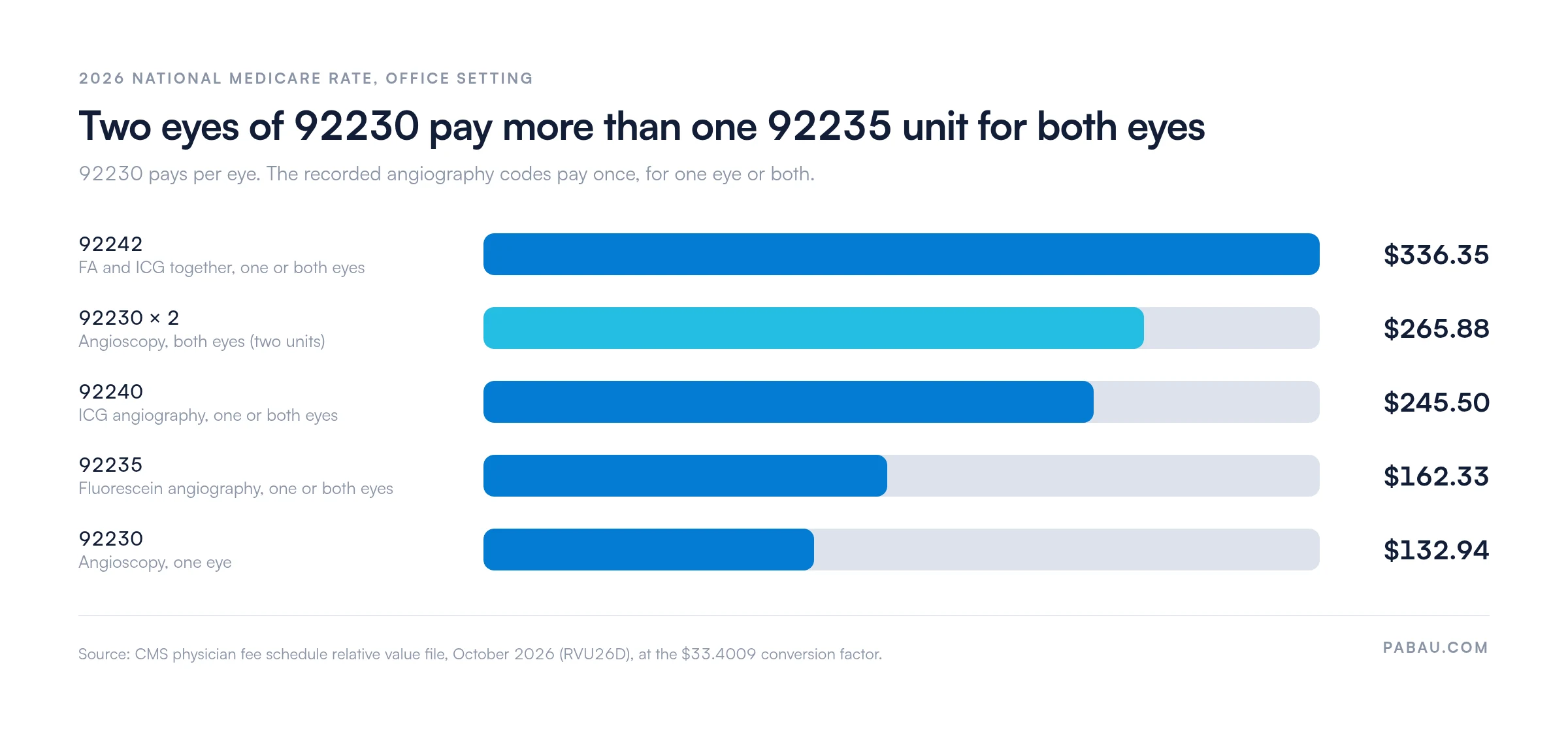
Your locality adjusts each figure through its geographic practice cost index. Look up the local amount in the CMS physician fee schedule search, and expect Medicare Advantage and commercial contracts to differ.
Traditional Medicare does not require prior authorization for 92230. Medicare Advantage and commercial plans set their own rules, so check the plan during insurance eligibility verification at scheduling.
Most 92230 denials trace back to the code choice, the eye count or a bundled pair. The CARC on the remittance names the cause, and a list of common denial codes maps each one to its fix. Sorting them by root cause at posting is the core of denial management.
NCCI bundles 99211 into 92230, so a minimal staff visit is not paid on the same date. A higher-level E/M or eye exam code, such as 92014, can be billed when it covers a separate decision.
Append modifier 25 to the E/M code, not to 92230. The chart note should show the exam that led to the order apart from the angioscopy and its report.
A clean 92230 claim depends on the record behind it: the eye examined, the dye given, the consent and the signed report. Pabau, a practice management platform, keeps those notes and forms on one patient record.
For US practices, Pabau’s claims management software submits claims through Claim.MD. It runs eligibility checks before the visit and posts ERA remittances back to the patient account.
Your billers see each claim’s status in one place, so a denied 92230 line gets worked the day the remittance arrives.
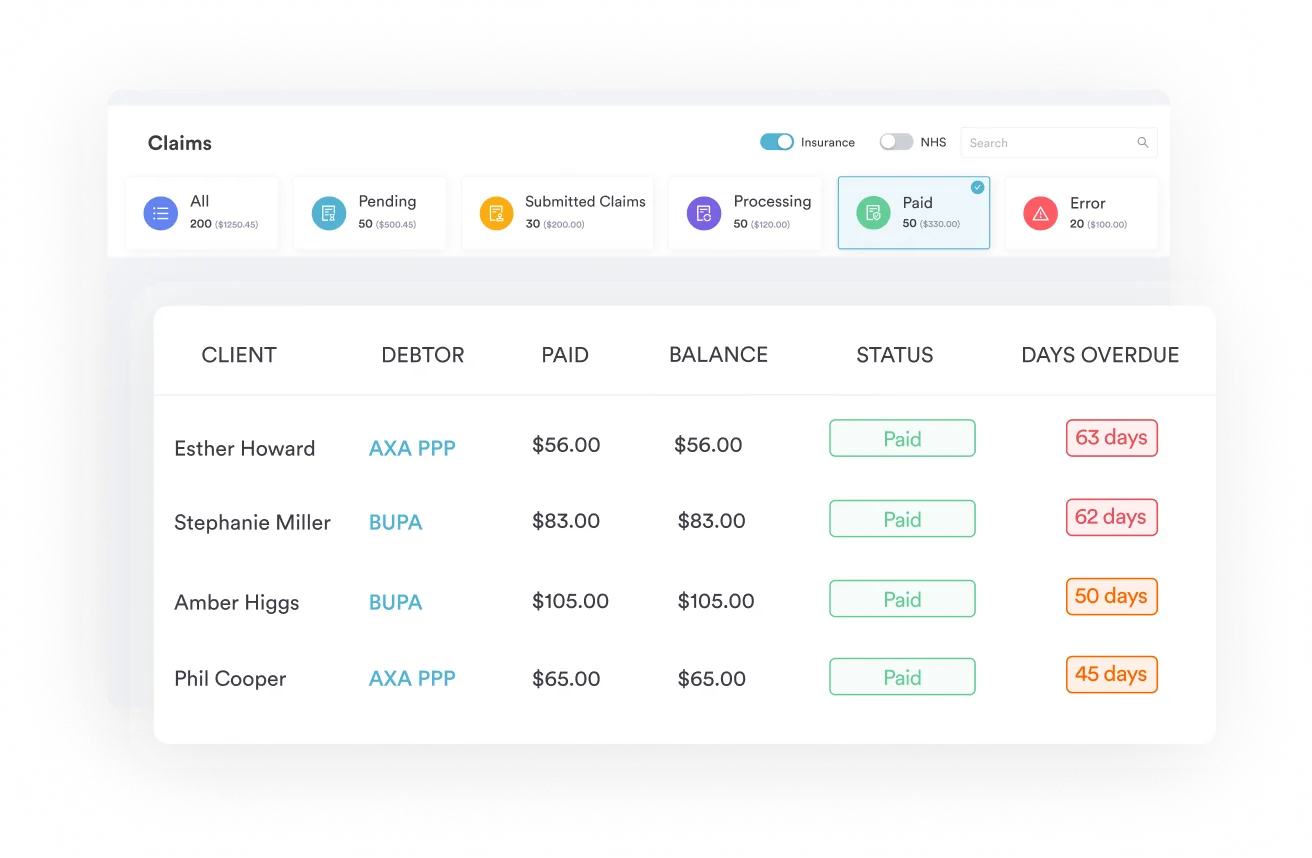

Pabau submits claims through Claim.MD, runs eligibility checks before the visit, and posts ERA remittances back to the patient account. Consent forms and the signed report stay on the same record.

CPT code 92230 pays for a physician watching the fluorescein transit directly and reporting on it. Once the transit is recorded, the service becomes 92235.
Get that call right and the rest follows. Bill one unit per eye, leave off 26 and TC, and drop 92230 whenever a recorded angiogram of the same eye is on the claim.
Book a demo to see how Pabau keeps the report, the consent and the claim on one patient record.

Need a full picture of how claim submission works end to end? What is revenue cycle management explains every stage from eligibility check to payment posting.
Seeing recurring denials across your ophthalmology claims? Denial codes in medical billing maps the most common CARC codes to corrective actions.
Looking to benchmark your practice’s billing performance? Best medical billing software for US practices covers the tools and benchmarks most ophthalmology practices use.
CPT code 92230 covers fluorescein angioscopy with interpretation and report. The physician injects fluorescein, observes the dye transit through the retinal vessels directly, and writes a signed report. The IV injection is bundled into the code.
92230 is angioscopy, where the physician views the dye transit directly without recording it. 92235 is fluorescein angiography, which records multiframe images and covers one or both eyes in one unit. NCCI bundles 92230 into 92235.
Yes. CMS gives 92230 bilateral indicator 3 and an MUE of two units a day, so each eye is billed and paid on its own. Use RT and LT on two lines, or modifier 50 if your MAC asks for it.
It can be. Since October 1, 2025, the HCPCS file includes A9612, Injection, fluorescein, 1 mg, with coverage left to carrier judgment. Confirm with your MAC or payer whether it pays the dye separately in your setting.
Yes, when the E/M is a separate service. NCCI bundles 99211 into 92230, but a higher-level E/M or eye exam code can be billed with modifier 25 on the E/M code.