



CCSD code G5100: Bypass of duodenum billing guide
CCSD code G5100 bills a bypass that leaves the duodenum in place CCSD code G5100...

Last Updated: Oct 16, 2026
CPT code 91110 is the billable procedure code for gastrointestinal tract imaging by capsule endoscopy, esophagus through ileum, with physician interpretation and report. Billed globally from an office, it pays roughly $750 to $800 under the 2026 Medicare Physician Fee Schedule. In a hospital or ASC the physician bills 91110-26 for the interpretation alone, which pays far less. Gastroenterology practices file the code for obscure GI bleeding and suspected Crohn’s disease. Most denials come from a missing prior authorization, or from an ICD-10 code the payer does not accept.
In the American Medical Association’s CPT code set, 91110 opens the Gastrointestinal Imaging, Pressure Measurement and Manometric Studies subsection. That subsection runs from 91110 to 91125. Below are the descriptor, the 2026 rates, the facility split, the modifiers, the covered diagnoses, and the rest of the capsule endoscopy family.

CPT code 91110 covers small bowel wireless capsule endoscopy with physician interpretation, not esophageal (91111) or colon (91113) imaging.
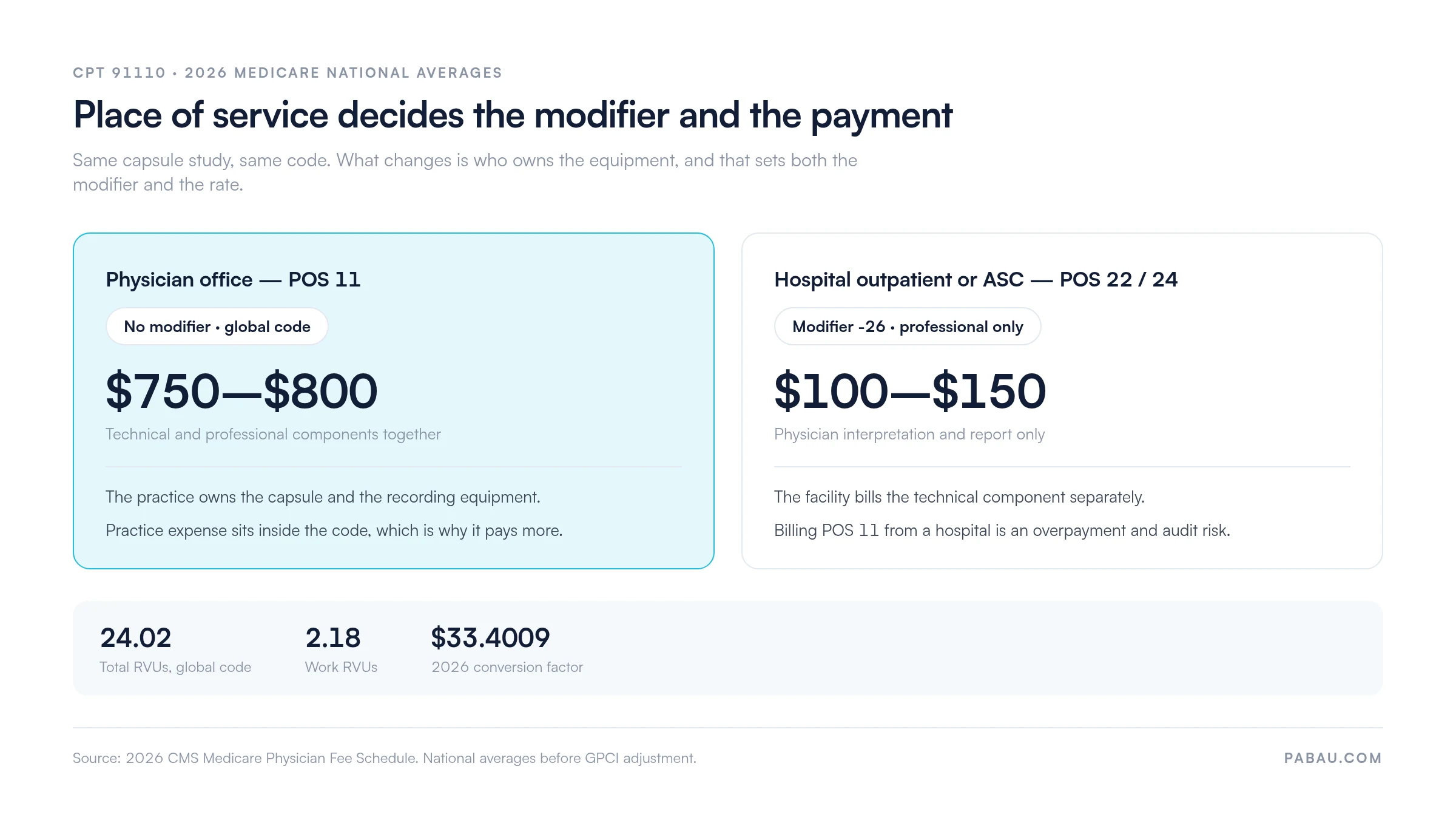
The 2026 Medicare global rate is roughly $750 to $800 nationally, built from 24.02 total RVUs at the $33.4009 conversion factor.
A capsule study read in a hospital or ASC is billed 91110-26, which pays the interpretation only and is worth far less.
Most commercial payers and Medicare Advantage plans require prior authorization; traditional Medicare Parts A/B requires medical necessity documentation but not prior auth.
Pabau’s claims management tools automate ICD-10 pairing, prior authorization tracking, and pre-submission documentation checks for GI practices billing 91110.
CPT code 91110 describes “gastrointestinal tract imaging; intraluminal (eg, capsule endoscopy), esophagus through ileum, with physician interpretation and report.” In practice, the patient swallows a capsule that holds a miniature wireless camera. The camera photographs the small bowel as it travels through, and transmits the images to a recorder worn on the patient’s belt. The physician then reviews the recorded footage, interprets findings, and produces a written report.
The procedure is device-agnostic: 91110 applies regardless of whether the practice uses Given Imaging’s PillCam SB, Olympus EndoCapsule, or another cleared capsule system. Payers do not differentiate reimbursement by device brand under this code.
Capsule endoscopy gives physicians a non-invasive view of the small intestine. Conventional upper and lower endoscopy cannot routinely reach that segment of the GI tract. Covered indications per Medicare Local Coverage Determinations (LCDs) and major commercial payer policies include:
Medical necessity documentation must tie each study to one of these accepted indications. Medicare Administrative Contractors (MACs) such as Novitas and CGS are explicit about the limits. A capsule study ordered for non-specific abdominal pain, with no prior workup, is typically denied on medical necessity grounds.
Pairing 91110 with the correct ICD-10-CM diagnosis code is one of the most critical steps in claim preparation. An unsupported or non-specific ICD-10 code is among the top three denial causes for this procedure. The table below lists the most frequently accepted pairings; always verify against the applicable MAC’s LCD before submitting.
Confirming the covered diagnosis at scheduling costs a phone call. Discovering the mismatch after the payer denies the claim costs an appeal and a rebill.
The figures below come from the 2026 Medicare Physician Fee Schedule (MPFS) and are national averages. Verify your own locality against the CMS Physician Fee Schedule lookup tool. Geographic Practice Cost Indices (GPCIs) adjust every rate by locality, so Manhattan, San Francisco, and Chicago all pay above the national average.
Check each remittance against the rate the claim should have earned as soon as it processes. A systematic underpayment on 91110 shows up within the first few claims, long before a year-end audit would find it.
Track expected versus received payment for 91110 separately by facility and non-facility setting. When remittances keep landing below the expected Medicare rate, check the modifier before you challenge the payer’s contract.
Where the capsule endoscopy is performed determines which billing scenario applies. This distinction is one of the most frequent sources of coding confusion for 91110.
A physician who owns the capsule equipment and works in an office bills 91110 with no modifier. That claim earns the non-facility rate, which carries the practice expense for the equipment. The same physician reading images at a hospital bills 91110-26 and is paid the professional component alone. The difference between the two is worth several hundred dollars per study.
Getting the billing rules right before submission prevents the most common rejections. Practice management software like Pabau routes US claims through Claim.MD, our clearinghouse partner. That clearinghouse runs edits against the CPT and ICD-10 catalogs before the payer sees the claim. Key billing rules to enforce:
Incomplete documentation is the most common reason capsule endoscopy claims are denied on audit. A compliant claim needs each of these elements in the patient record before submission.
Attaching the full package to the claim cuts audit exposure. A pre-procedure checklist held in the patient’s record flags a missing consent or referral before the capsule is dispensed.
Prior authorization requirements vary by payer type. Traditional Medicare (Parts A/B) does not require it for 91110. Medical necessity still has to be documented and aligned with the applicable MAC’s LCD. Most commercial payers and Medicare Advantage plans do require authorization before the procedure. Run insurance eligibility verification early in scheduling, so each patient’s plan rule is known before a date is set.
Verify requirements directly with each payer for the current plan year. Prior auth policies change annually, and they vary by plan tier inside the same insurer network.
Five scenarios account for most rejected 91110 claims. Each one has a fix that belongs upstream of the claim, in scheduling or in documentation, rather than in the appeal.
Pull a monthly report of your denial codes, sorted by procedure code and by reason category. A repeat pattern on 91110 points at the workflow feeding the claim, rather than at one coder’s slip.
Run a monthly pull of all 91110 claims by denial reason code. If CO-50 (medical necessity not established) shows up more than once, examine the ICD-10 pairing and the documentation workflow feeding those claims. Fix the cause before resubmitting the same claim pattern.
The gastrointestinal CPT codes for capsule endoscopy break down by anatomical site. Choosing the wrong code is a common mistake when a patient has multiple GI complaints. The AAPC CPT code lookup can be used to verify current descriptors for each code in this family before billing.
None of these three codes covers esophageal pH testing. A capsule attached to the esophageal mucosa records acid exposure and is reported under CPT code 91035. The 91110 to 91125 subsection ends with the manometry codes. CPT 91122 was deleted effective January 1, 2026, and anorectal manometry now bills as 91125.
Three checks decide whether a 91110 claim gets paid. The authorization has to be confirmed at scheduling. The ICD-10 code has to match the MAC’s LCD, and the interpretation report has to be signed before release. In a busy GI practice those three checks sit with three different people, and no single record holds all three.
Pabau’s medical claims management tools hold all three against the same appointment record. The authorization number, the diagnosis pointer, and the signed report travel with the claim instead of living in three inboxes.
Claims then go out through Claim.MD, our US clearinghouse partner, which validates the CPT and ICD-10 codes and builds the 837P file. A capsule study with a mismatched diagnosis or a missing -26 is flagged while you can still correct it.

Pabau connects your GI practice’s claims workflow to Claim.MD, automating ICD-10 code pairing, prior auth tracking, and pre-submission documentation checks. See how it works for gastroenterology billing teams.

CPT code 91110 is simple to select and awkward to get paid for. Denials trace back to the authorization, the diagnosis pointer, or the signed report. All three are settled long before anyone opens the claim.
Two habits protect the revenue. Confirm the payer’s authorization rule while the study is being scheduled, and check every remittance against the rate your place of service earns. An underpayment then surfaces within days instead of at a year-end audit.
Book a demo to see how Pabau keeps the authorization, the diagnosis, and the interpretation report attached to one GI appointment record.

Need to understand how denials get resolved once they happen? Denial management in healthcare walks through the investigation and appeal process for high-complexity procedure codes.
Want to see how the 837 claim file works end to end? 837 electronic claim file guide explains the EDI transaction format used to submit claims to clearinghouses and payers.
Evaluating your current billing software? Best medical billing software for US practices compares platforms by claims workflow, clearinghouse integration, and denial management features.
CPT code 91110 covers gastrointestinal tract imaging by ingestion of a wireless capsule endoscope, with physician interpretation and report. It applies to the small intestine, from the esophagus through the ileum. Billed globally from an office, the code includes the technical component (capsule device and recording equipment) and the professional component (physician review and written report).
Under the 2026 Medicare Physician Fee Schedule, 91110 billed globally pays roughly $750 to $800 nationally, before GPCI adjustment. That figure comes from 24.02 total RVUs at the $33.4009 conversion factor. In a hospital or ASC the physician bills 91110-26 and is paid the professional component only, closer to $100 to $150. Verify your locality-specific rate with the CMS Physician Fee Schedule lookup tool.
Traditional Medicare Parts A/B does not require prior authorization for CPT 91110, but medical necessity documentation tied to the applicable MAC LCD is mandatory. Most commercial payers and Medicare Advantage plans do require prior authorization. Common prerequisites are an upper and lower endoscopy workup that came back negative, plus a covered ICD-10 diagnosis. Verify requirements with each specific payer and plan before scheduling the procedure.
CPT 91110 covers capsule endoscopy of the small bowel, esophagus through ileum, for indications such as obscure GI bleeding and Crohn’s disease. CPT 91111 covers capsule endoscopy of the esophagus only, primarily for Barrett’s esophagus screening. The two codes should not be billed on the same date of service, as NCCI edits likely apply. The non-facility Medicare rate for 91110 is generally higher than for 91111. The small bowel study runs a longer recording session and covers a broader clinical scope.
Required documentation includes a physician order with a medical necessity statement, a prior authorization approval number where applicable, and a patient consent form. You also need a signed, dated interpretation report and evidence of prior workup for obscure GI bleeding. Missing the interpretation report is the single most common documentation-related denial trigger for 91110.
Yes, modifier -52 (reduced services) may apply when the capsule fails to complete small bowel transit before the battery expires. The study is then incomplete. Payer acceptance of -52 on 91110 varies; some payers deny the claim entirely while others accept a reduced payment. Document the reason for incomplete transit clearly in the interpretation report before appending this modifier.



