

CCSD code G5100: Bypass of duodenum billing guide
CCSD code G5100 bills a bypass that leaves the duodenum in place CCSD code G5100...

Last Updated: Oct 16, 2026
CPT code 91122 was the code for anorectal manometry, a test that measures anal sphincter pressures, rectal sensation, and pelvic floor muscle function. The test is used mainly to evaluate fecal incontinence, chronic constipation, and pelvic floor dysfunction.
The AMA deleted 91122 and its companion code 91120 effective January 1, 2026. Anorectal manometry is now reported with 91125, and rectal sensation, tone, and compliance testing with 91124. Claims that report 91122 for dates of service on or after that date will be denied.
Let Pabau's smart automation suggest the right codes, reduce claim denials, and keep your practice compliant—effortlessly.
Automate repetitive tasks and focus on what matters most—your patients.
Reduce coding errors and ensure compliance with the latest regulations.
Clean claims, fewer denials, and faster reimbursements.
Powerful insights and reporting to help your practice thrive.
HIPAA compliant SOC 2 certified GDPR-compliant Trusted by 4,000+ clinics worldwide

CPT code 91122 described anorectal manometry, a study of anal sphincter pressures, rectal sensation, and the rectoanal inhibitory reflex.
The AMA deleted 91122 and 91120 effective January 1, 2026. Anorectal manometry is now 91125, and rectal sensation, tone, and compliance testing is 91124.
A claim that reports 91122 for a date of service on or after January 1, 2026 is invalid and will be denied.
Claims need a physician order, a documented indication such as K59.0x or R15.x, a manometry report with pressure values, and a signed interpretation.
In Pabau’s practice management software, claims go out through Claim.MD and their status is tracked, so a denied manometry line shows up early.
CPT code 91122 was the code for anorectal manometry until the AMA deleted it effective January 1, 2026. Its official descriptor was simply “Anorectal manometry.” In fact, the code sat in the gastroenterology section, 91010-91299, of the AMA’s CPT code set.
First, the study measures internal and external anal sphincter pressures, rectal sensation, and the rectoanal inhibitory reflex. As a result, anorectal manometry is reported with 91125 from January 1, 2026. That code may also include rectal sensation testing and a balloon expulsion test. In contrast, rectal sensation, tone, and compliance testing, such as a barostat study, moved from deleted 91120 to the new code 91124.

Anorectal manometry (ARM) evaluates four measures that coders should look for in the report:
In short, a complete ARM report documents all four measures. Payers reviewing the claim look for numeric pressure values and a physician interpretation, so a report missing either one invites a documentation denial.
The AMA deleted CPT 91122 and its companion code 91120 effective January 1, 2026. Indeed, the AMA RVS Update Committee found the two were reported by the same physician on the same date more than 75% of the time.
Two new Category I codes replace the pair. First, code 91124 reports rectal sensation, tone, and compliance testing, such as a barostat study. Second, code 91125 reports anorectal manometry and may include rectal sensation testing and balloon expulsion. However, the new codes do not split by catheter type or by conventional versus high-resolution technology, as the crosswalk below shows.
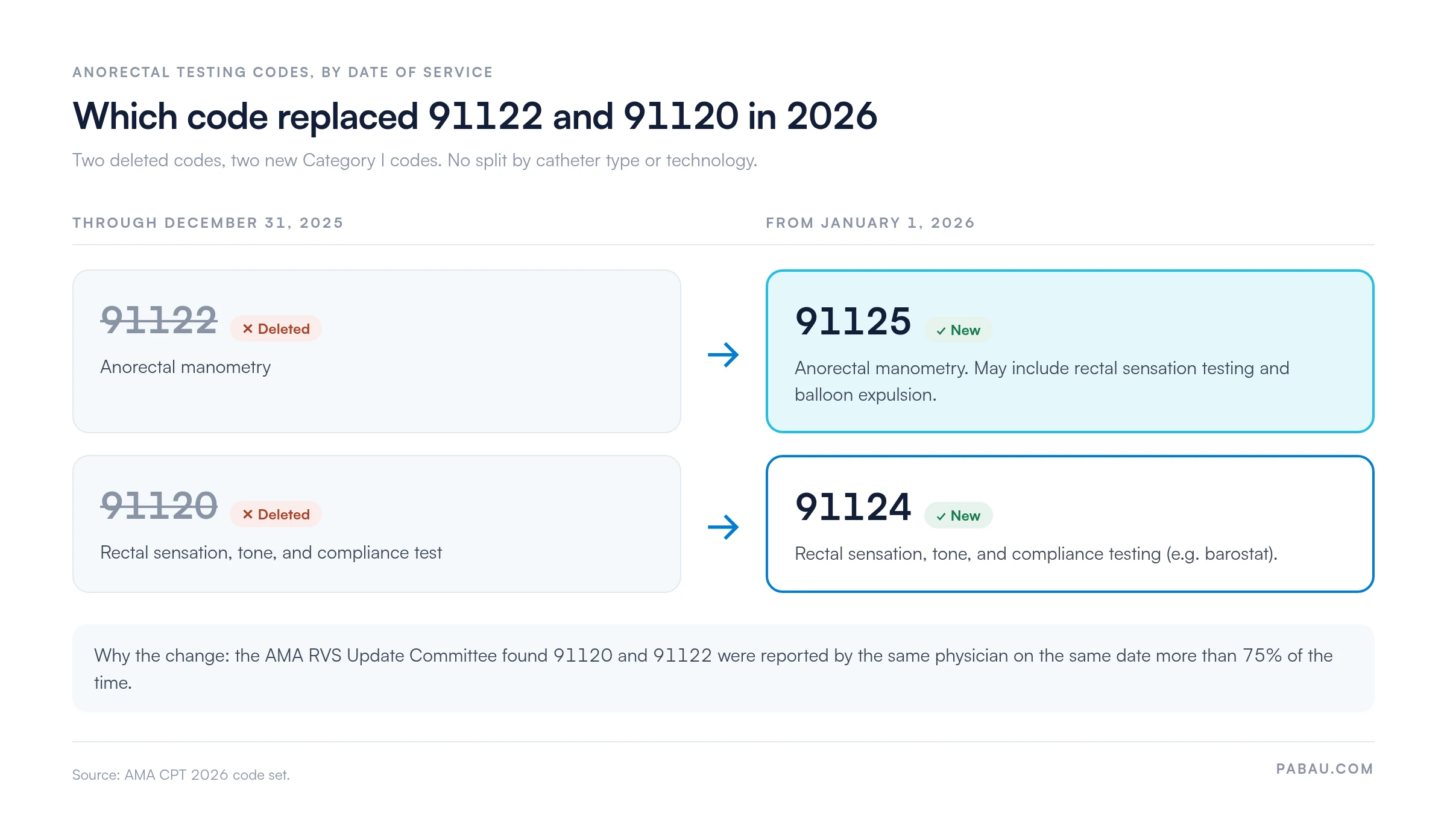
As a result, a 91122 claim for a date of service on or after January 1, 2026 is rejected at the clearinghouse or denied by the payer. Payers do not convert the deleted code on their own, so the practice selects the successor code from the study documented.
The AMA added two codes to the 2026 CPT code set to replace 91120 and 91122. Therefore, confirm the full descriptors in the AMA CPT 2026 manual or the AAPC entry for CPT 91125 before billing.
Payers require a linked ICD-10-CM diagnosis code to establish medical necessity for anorectal manometry. The codes below are commonly documented indications. In addition, the code on the claim must match the symptom documented in the record and the payer’s own policy.
A specific code such as K59.02 (outlet dysfunction constipation) states the indication more clearly than K59.00 (constipation, unspecified). However, use it only when the record documents outlet dysfunction, along with the treatment already tried.
Flag constipation claims for medical necessity review before submission. Many payers expect documentation that conservative therapies (dietary modification, fiber supplementation, osmotic laxatives) were tried and failed before anorectal manometry. A single sentence in the ordering note confirming prior treatment failure can prevent a lengthy appeal.
Medicare coverage for anorectal manometry is set locally by each Medicare Administrative Contractor (MAC). Therefore, search the Medicare Coverage Database for your MAC’s local coverage determination (LCD) or billing article on anorectal manometry.
That policy lists the covered indications, the documentation the contractor expects, and any frequency limits. In contrast, commercial payers write their own policies and may add prior authorization, so confirm each plan’s rules through insurance eligibility verification before scheduling the study.
Run a benefit and eligibility check before scheduling every anorectal manometry study. Even when CMS covers the procedure, a patient’s supplemental or Medicare Advantage plan may require prior authorization that Medicare fee-for-service does not. Catching this before the appointment avoids a post-service denial that is difficult to overturn.
In short, strong documentation protects claims from medical necessity audits and supports appeals when initial denials occur. For solid medical billing compliance, the clinical record supporting an anorectal manometry claim should contain the following elements.
For example, a tracing or raw data printout without physician commentary does not support the professional component. So, check for the signed interpretation before the claim goes out.
Modifier selection depends on the practice setting, who owns the equipment, and whether other services were performed on the same date. Overall, the table covers the modifiers most often used with 91122 for dates of service through December 31, 2025. Before applying 26 or TC to 91124 or 91125, confirm each code’s PC/TC indicator in the CY2026 Medicare Physician Fee Schedule.
When the physician owns the equipment and performs the study in a non-facility setting, bill the global code with no modifier. The payer then pays both professional and technical components in a single payment. In contrast, billing -26 and the global code on the same claim is a duplicate billing error that payers deny.
The CMS Physician Fee Schedule sets national payment for 91122, adjusted by locality and by facility or non-facility setting. Look up the CY2025 relative value units and rates there for dates of service through December 31, 2025.
From January 1, 2026, the fee schedule prices 91124 and 91125 instead. As a result, rate lookups for new services should move to those two codes.
Anorectal manometry sits across gastroenterology, colorectal surgery, and pelvic floor rehabilitation, and payer expectations differ between them. In addition, the 2026 deletion adds a new denial risk for any claim still carrying 91122.
Indeed, a denial management workflow that sorts denials by root cause will surface “deleted code” rejections quickly after January 1, 2026. The billing team can then correct and resubmit those claims with the successor codes. In addition, a clean claim checklist for anorectal manometry should cover diagnosis specificity, modifier logic, and prior authorization.
In fact, each rejection carries CARC and RARC codes that explain the payer’s reason. Our denial codes reference decodes them, so staff can tell a deleted-code rejection from a medical necessity denial.
Several GI motility and pelvic floor codes are billed alongside or confused with CPT code 91122. Therefore, knowing where each one stops helps prevent unbundling and upcoding. Esophageal motility testing, for example, is billed as 91010 and covers a different organ system entirely.
In addition, use CrossCoder for bidirectional procedure-to-diagnosis crosswalk verification when billing multiple motility codes on the same date.
After the 2026 deletion, a manometry claim can fail on the retired code, a weak diagnosis link, or a missing interpretation. As a result, billing teams working from spreadsheets and payer portals often see those problems only when the remittance arrives.
Pabau, the practice management platform we build, keeps the order, the manometry report, and the claim in the same patient record. In addition, its streamlined claims management submits claims through Claim.MD, our US clearinghouse partner, and tracks the status of each one.
Denied claims are visible alongside the patient record. Instead, the billing team can correct a 91122 line to 91125 and resubmit it without chasing paper remittances.

Pabau submits claims through Claim.MD, tracks their status, and shows denials alongside the patient record. See how it handles motility and pelvic floor billing in a live demo.

For any date of service on or after January 1, 2026, 91122 is no longer a valid code, and neither is 91120. Therefore, move the charge master to 91124 and 91125 now, and make sure staff know which study each successor covers.
However, claims from late 2025 still bill under 91122, so keep the old codes available until those claims close. After that, a single 91122 on a new claim is a guaranteed denial.
Book a demo to see how Pabau tracks manometry claims from submission to payment across the 2026 code change.

Need to understand clearinghouse submission for GI claims? Medical claims clearinghouse guide explains how 837P files route from practice to payer and where claims fail in transit.
Working through a post-deletion denial appeal? Electronic remittance advice explained covers how to read ERA 835 files and identify the CARC denial reason for deleted-code rejections.
Looking for the superbill structure for procedures? Superbill guide covers how to structure a compliant superbill with procedure and diagnosis codes.
Yes. CPT 91122 was deleted effective January 1, 2026, together with 91120. As a result, claims that report 91122 for dates of service on or after that date are invalid and will not be paid by Medicare or commercial payers.
Anorectal manometry is now reported with CPT 91125, which may include rectal sensation testing and balloon expulsion. In contrast, rectal sensation, tone, and compliance testing, such as a barostat study, is reported with 91124, which replaces deleted 91120.
Modifier 26 applies when the physician interprets but does not own the equipment, and TC applies to the equipment owner’s separate bill. In addition, modifier 52 applies when the study is terminated early, though payer rules for it vary. Finally, modifier 59 applies when manometry is distinct from another GI procedure on the same date. However, never bill the global code and modifier 26 on the same claim.
Common indications include K59.02 (outlet dysfunction constipation), R15.2 (fecal urgency), and R15.9 (full incontinence of feces). In addition, the code must match the symptom documented in the record and the payer’s policy. For Medicare claims, check your MAC’s local coverage determination in the Medicare Coverage Database.



