

CCSD code G5100: Bypass of duodenum billing guide
CCSD code G5100 bills a bypass that leaves the duodenum in place CCSD code G5100...

Last Updated: Oct 16, 2026
90876 is the CPT code for 45 minutes of individual psychophysiological therapy that combines biofeedback training, by any modality, with psychotherapy delivered face to face. CPT 90875 reports the 30-minute version, and CPT 90901 reports biofeedback training without psychotherapy.
Neurofeedback has no code of its own, so an EEG-based session with psychotherapy is reported with 90875 or 90876. Medicare covers biofeedback only for muscle re-education and urinary incontinence, so most 90876 claims depend on commercial or Medicaid policy.
Let Pabau's smart automation suggest the right codes, reduce claim denials, and keep your practice compliant—effortlessly.
Automate repetitive tasks and focus on what matters most—your patients.
Reduce coding errors and ensure compliance with the latest regulations.
Clean claims, fewer denials, and faster reimbursements.
Powerful insights and reporting to help your practice thrive.
HIPAA compliant SOC 2 certified GDPR-compliant Trusted by 4,000+ clinics worldwide

CPT code 90876 reports 45 minutes of individual psychophysiological therapy that pairs biofeedback training, by any modality, with psychotherapy.
CPT 90875 is the 30-minute version, and CPT 90901 reports biofeedback training without psychotherapy.
Neurofeedback has no CPT code of its own, so EEG-based sessions are reported with 90901, or with 90875 or 90876 when psychotherapy is also provided.
Psychotherapy is built into 90876, so a separate psychotherapy code for the same service is a billing error.
Medicare covers biofeedback only for muscle re-education and urinary incontinence, so most 90876 claims depend on commercial or Medicaid policy.
CPT code 90876 reports 45 minutes of individual psychophysiological therapy that combines biofeedback training with psychotherapy, delivered face to face. The American Medical Association descriptor has three parts, quoted here in order:
Two parts of that descriptor decide most coding questions. Biofeedback by any modality means the code covers EEG, EMG, heart rate variability, skin conductance, temperature or breathing feedback. With psychotherapy means the clinician delivers insight-oriented, behavior-modifying or supportive psychotherapy in the same session.
Three codes cover biofeedback training in behavioral health, and two questions pick between them. Was psychotherapy delivered in the session, and how long did the face-to-face service last? CPT code 90901 carries no psychotherapy component and no time element in its descriptor.
Selection rule: Biofeedback plus psychotherapy for about 45 minutes is 90876, and for about 30 minutes it is 90875. Biofeedback alone, with no psychotherapy, is 90901 whatever the modality. The decision path below applies to every modality, EEG included.
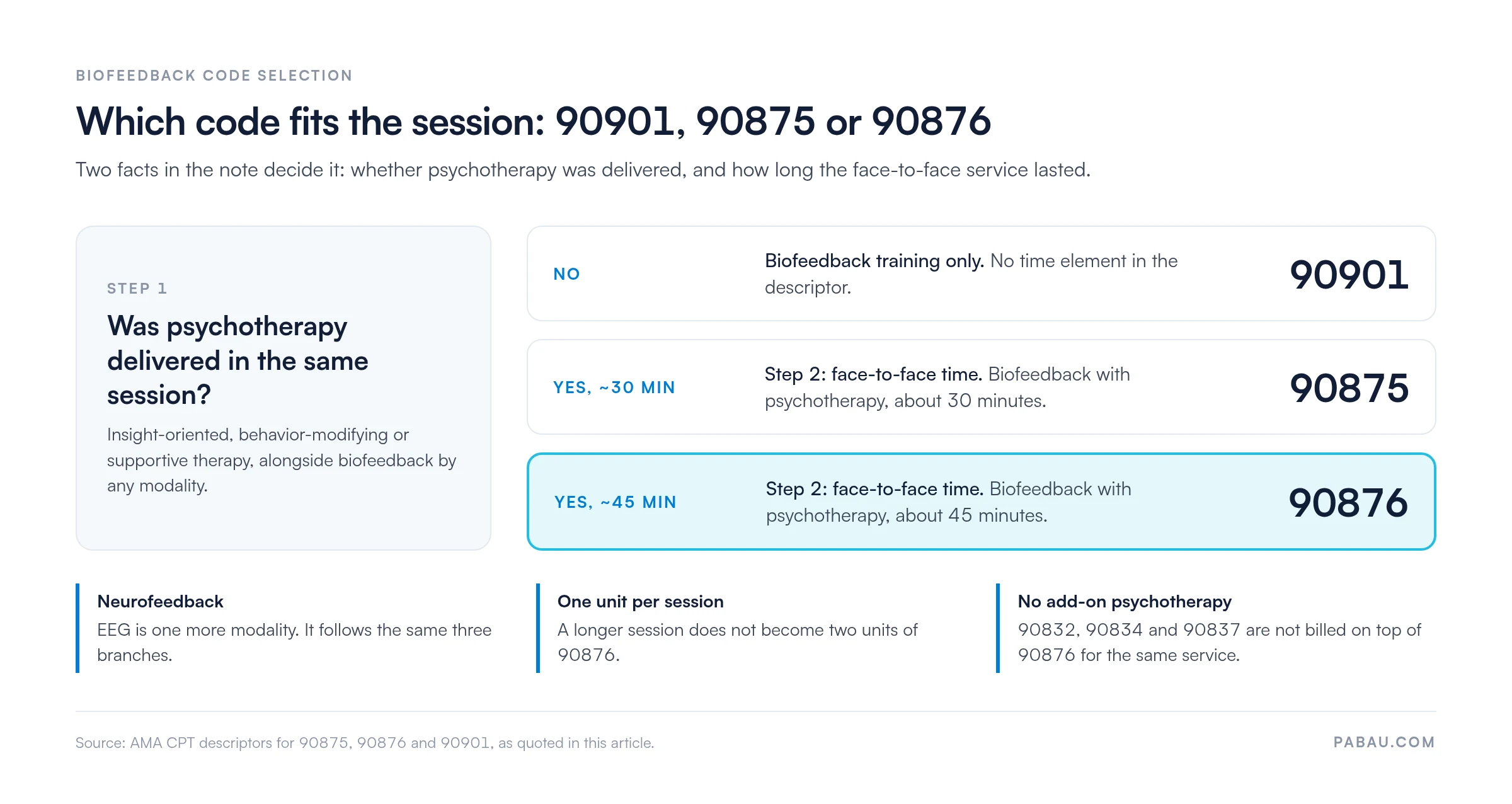
Neurofeedback, or EEG biofeedback, has no dedicated CPT code. An EEG signal is one more biofeedback modality, so the same three codes apply to it.
Payers often review neurofeedback on its own terms, even though it shares these codes. Some policies cover it for a short list of diagnoses and class it as investigational for the rest, so record the modality in the note.
A quantitative EEG (QEEG) brain map is a separate diagnostic service and is not part of 90876.
CPT 90876 is a timed code, so the documented face-to-face time decides whether 90876 or 90875 is correct. Count only the minutes the clinician spends with the patient delivering biofeedback training and psychotherapy. Set-up done without the patient, report writing and scoring time do not count.
CPT’s general time rule treats a timed service as met once its midpoint is passed. Report the code whose stated time sits closest to the time you documented. Some commercial and Medicaid payers read 90876 more strictly and expect close to the full 45 minutes. Check the payer’s policy before you schedule shorter sessions.
Bill one unit of 90876 per session. A longer session does not turn into two units, because the code describes a single 45-minute service.
A 90876 note has to prove three things: that biofeedback training happened, that psychotherapy happened alongside it, and how long the face-to-face service lasted. Notes that describe only the device readings, or only the talk therapy, support a different code.
Structured note templates keep these fields consistent from one session to the next, which makes it easier to submit a clean claim the first time.
Psychotherapy is part of 90876, so it cannot be billed again on its own for the same service. These are the combinations that cause most bundling problems:
Separate services on the same date, such as a diagnostic evaluation with 90791, need their own documentation and their own time. Check the National Correct Coding Initiative (NCCI) procedure-to-procedure edits before you report another psychiatric code with 90876 on one claim.
No national covered-diagnosis list exists for 90876, so each payer sets its own. One published example is Louisiana Healthcare Connections policy LA.CP.BH.300, a Centene Medicaid policy last revised in January 2023. It lists 90875 and 90876 with the anxiety, panic and post-traumatic stress codes below. Treat the table as a starting point and confirm each payer’s own list.
Code to the highest specificity the record supports. Post-traumatic stress disorder sits under F43.1, and F43.10 fits when the note does not say whether symptoms are acute or chronic. Once the note says which, use F43.11 or F43.12.
A payer list may also name diagnoses outside this table. Look each one up in the full set of ICD-10-CM codes before you add it to a claim.
Medicare covers biofeedback under two national coverage determinations, and neither reaches psychiatric conditions. NCD 30.1 covers biofeedback for muscle re-education of specific muscle groups, or for spasticity, incapacitating muscle spasm or weakness, when conventional treatments have failed. It excludes ordinary muscle tension states and psychosomatic conditions. NCD 30.1.1 covers biofeedback for urinary incontinence.
Neither of those uses is a 90876 service, so Medicare generally denies 90876 for behavioral health diagnoses, neurofeedback included. Give Medicare patients an Advance Beneficiary Notice (ABN) before treatment so they can agree to pay if Medicare denies the claim.
Neurofeedback draws the closest scrutiny. LA.CP.BH.300 calls it experimental or investigational for any behavioral health diagnosis outside the policy’s list, and many commercial policies take a similar line. Read the policy before the first session, while there is still time to request prior authorization.
Confirm benefits, prior authorization rules and session limits up front as part of standard insurance eligibility verification. That step matters more for 90876 than for most behavioral health codes.
The 90876 descriptor requires the service to be face to face with the patient. Whether real-time audio-video counts as face to face depends on the payer.
Confirm telehealth coverage for 90876 with each plan in writing before you schedule remote sessions.
Most 90876 denials trace back to coverage, coding or documentation, and each one has a fix you can build into the workflow. A steady denial management routine shows which of these causes is driving your rejections.
Biofeedback billing usually runs across a scheduling tool, a notes system and a clearinghouse portal, and details get lost between them. Pabau, the practice software we build for mental health practices, keeps the appointment, the session note and the claim on the same patient record. Claims reach US payers through the Claim.MD clearinghouse, which Pabau connects to.
Your clinicians still choose the code and the diagnosis. Pabau’s claims management software handles the submission and tracking around that decision, so fewer claims stall between the session and payment.

Pabau checks eligibility before the session, sends your claims through Claim.MD and tracks each remittance, so your team spends less time chasing biofeedback claims.

Treat 90876 as a coverage decision before you treat it as a coding decision. Picking the code is simple once the note records the psychotherapy, the modality and the start and stop times. Whether anyone pays for it depends on the payer’s biofeedback policy, and that answer is available before the first session.
So put the policy check first. Confirm the diagnosis is on the payer’s list, then secure prior authorization or an ABN before treatment starts. Self-pay is then agreed with the patient up front, instead of surfacing months later as an unpaid claim. To see how Pabau handles eligibility, claim submission and remittance tracking, book a demo.

Need to track neurofeedback session eligibility before billing? Insurance eligibility verification explains the real-time checks that prevent coverage denials before a claim is submitted.
Receiving denial codes you don’t recognize? Denial codes in medical billing maps CARC and RARC codes to their root causes and recommended next steps.
Want to reduce claim rejections across your whole practice? Revenue cycle management covers the end-to-end billing workflow from patient intake through payment posting.
Waiting on a payer before the first session? The prior authorization process walks through each step from request to approval.
Treating self-pay patients who want to claim later? What a superbill is covers the fields a patient needs to file with their own plan.
CPT code 90876 covers 45 minutes of individual psychophysiological therapy that combines biofeedback training, by any modality, with psychotherapy delivered face to face. The psychotherapy is part of the code, so it is not billed separately for the same session.
Generally, no. Medicare covers biofeedback only for muscle re-education under NCD 30.1 and urinary incontinence under NCD 30.1.1, and NCD 30.1 excludes psychosomatic conditions. Give Medicare patients an Advance Beneficiary Notice before treatment.
CPT 90876 is biofeedback training with psychotherapy for 45 minutes. CPT 90901 is biofeedback training by any modality without psychotherapy. Both cover any modality, including EEG, so the deciding question is whether psychotherapy was delivered.
Yes, when psychotherapy is delivered in the same session for about 45 minutes. Neurofeedback has no dedicated CPT code. Use 90901 for neurofeedback alone and 90875 for the 30-minute version with psychotherapy.
No. Psychotherapy is already included in 90876, so 90832, 90834 or 90837 cannot be added for the same service. CPT limits add-on 90785 to 90791, 90792, 90832-90838 and 90853, so it does not attach to 90876.
Each payer sets its own list. One Centene Medicaid policy, LA.CP.BH.300, lists F41.1, F41.0 and F43.10 to F43.12 for anxiety, panic and PTSD. ADHD codes F90.0 to F90.2 are often requested, but many payers class neurofeedback for ADHD as investigational.



