CPT code 90947: Billing PD and CRRT evaluations
CPT code 90947 covers repeated evaluations during non-hemodialysis dialysis CPT ...

Last Updated: Nov 19, 2026
88361 is the CPT code for morphometric analysis of tumor immunohistochemistry, quantitative or semiquantitative, per specimen and each antibody, using computer-assisted technology. Pathology labs report it when image-analysis software scores a stain such as HER2, ER, PR or Ki-67.
The software step sets it apart from its neighbors. A manual morphometric score is 88360, and a qualitative IHC read is 88342. The pathology report has to name the computer-assisted method, or the claim won't support 88361.
Let Pabau's smart automation suggest the right codes, reduce claim denials, and keep your practice compliant—effortlessly.
Automate repetitive tasks and focus on what matters most—your patients.
Reduce coding errors and ensure compliance with the latest regulations.
Clean claims, fewer denials, and faster reimbursements.
Powerful insights and reporting to help your practice thrive.
HIPAA compliant SOC 2 certified GDPR-compliant Trusted by 4,000+ clinics worldwide

CPT code 88361 reports tumor IHC that image-analysis software scores, one unit per antibody stain procedure per specimen.
It replaces 88342 for that antibody, because 88361 already includes the staining and the qualitative slide review.
A manual morphometric score is 88360, so the pathology report must name the computer-assisted method and the platform.
A second, separate specimen is a second unit of 88361, and modifier 91 doesn’t apply to anatomic pathology.
Pabau sends 88361 claims electronically through Claim.MD, checks eligibility and posts ERA remittances.
CPT code 88361 reports morphometric analysis of tumor immunohistochemistry (IHC) when image-analysis software produces a quantitative or semiquantitative score.
CMS’s 2026 NCCI policy manual says computer-assisted IHC of this kind is reported with 88361, and manual quantitation with 88360. The pathologist still reviews the software output and signs the result.
The AMA descriptor reads: Morphometric analysis, tumor immunohistochemistry (e.g., Her-2/neu, estrogen receptor/progesterone receptor), quantitative or semiquantitative, per specimen, each antibody; using computer-assisted technology. It sits in the AMA CPT code set under Pathology and Laboratory, in the Surgical Pathology range.
“Per specimen, each antibody” drives the unit count. Each antibody stain procedure on each specimen is one unit, as long as the software quantitation is performed and documented for it.
The code covers the whole computer-assisted workflow. That means staining, image capture, software quantitation and the pathologist’s review of the score. Typical results are an Allred score for ER/PR, a Ki-67 index or a HER2 IHC score (0, 1+, 2+, 3+).
Other methods have their own codes, so check the method before the code:
88342 is the qualitative IHC code, covering the stain and a read without a morphometric score. 88361 is the quantitative alternative for that antibody. It already includes the staining and the qualitative slide exam, so it replaces 88342 rather than adding to it.
Both codes can sit on one claim when different antibodies justify each one. A cytokeratin read qualitatively and a HER2 scored by software is a fair pair. Billing both for one antibody on one specimen is duplicate billing. Check the current NCCI edit table, because edit pairs change every quarter.
Before billing 88361 and 88342 on the same case, list each antibody separately in the pathology report. Give its name, the method (software or manual) and its own result. One paragraph covering every stain is the documentation defect auditors flag most on combined claims.
88360 covers the same morphometric IHC performed manually. 88361 covers it when computer-assisted technology produces the score. The staining, the antibodies and the pathologist’s sign-off are the same.
So the billing question is narrow. A pathologist estimating percent positivity by eye is manual, which is 88360. A pathologist reviewing a score from a validated or FDA-cleared image-analysis platform is computer-assisted, which is 88361.
Coverage is less uniform. Some payers limit when they pay for 88361, so check the Local Coverage Determination (LCD) from your Medicare Administrative Contractor (MAC) and each commercial policy.
Most coding errors in this family come from skipping a question. Work through them in order, and the code follows from the slide and the report.
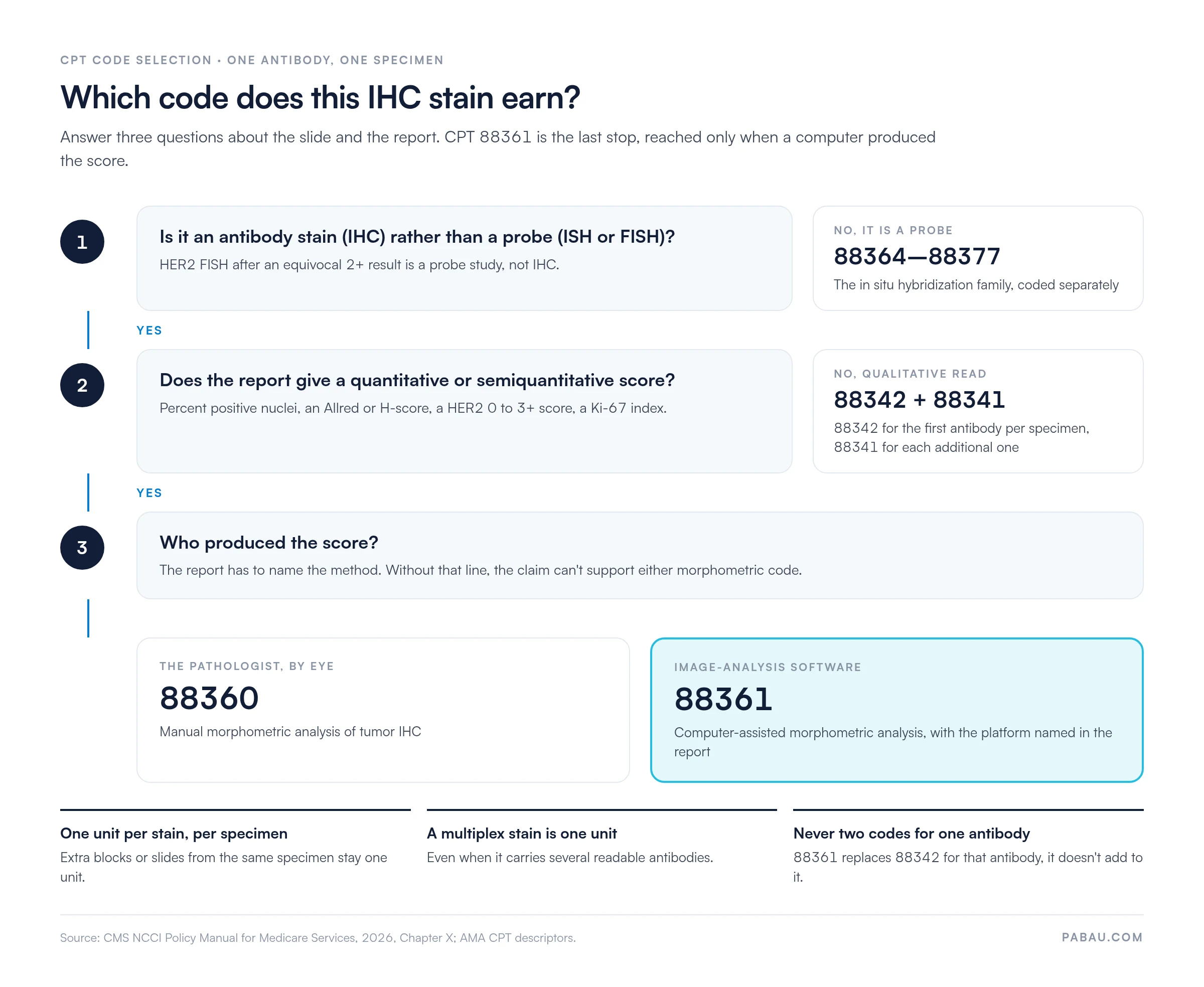
The table below sets the neighboring codes side by side.
The report carries the claim, so most 88361 denials are won or lost before coding starts. Medical billing compliance for this code means the report states each of these steps:
If step 4 is missing, code what the report does support before the claim goes out. That’s 88360 for a manual score, or 88342 for a qualitative read.
A core biopsy from the upper-outer quadrant of a right breast arrives as one specimen. The lab stains it for ER, PR, HER2 and Ki-67, and the image-analysis platform scores all four.
That’s four units of 88361, one per antibody stain on one specimen. The diagnosis on the signed report drives the ICD-10 code, here C50.411 for a malignancy of the upper-outer quadrant of the right female breast.
HER2 comes back 2+, so the case reflexes to HER2 in situ hybridization. That test is billed from the ISH range, not as another unit of 88361. When software scores a multiplex HER2 probe stain, that service is 88374. If the pathologist also reads a cytokeratin stain qualitatively, it goes on the claim as 88342, because it’s a different antibody.
Report 88361 once per antibody stain procedure per specimen. Two specimens, such as a core biopsy and a later excision, each stained for HER2 by software, make two units. Extra blocks or slides from one specimen don’t add units, and a clean claim shows the unit count per line.
Modifier 91 doesn’t belong on 88361. It covers repeat lab tests on the same specimen to obtain later results, and Medicare doesn’t accept it for anatomic pathology. Modifier 59 tells the payer two services that look bundled are distinct. Used without a documented reason, it’s a compliance risk rather than a fix.
Here’s the path a typical claim takes, and where it tends to stall:
Medicare pays 88361 from the Medicare Physician Fee Schedule (MPFS), and the rate changes each calendar year and by locality. Pull current facility and non-facility rates from the CMS Physician Fee Schedule lookup or the FastRVU 2026 RVU lookup.
Commercial rates vary by contract, so check each payer agreement. Prior authorization rules also sit with each plan, so read the plan’s medical policy before the test is ordered.
Most 88361 denials trace back to five mistakes. Each one maps to familiar denial codes, and each is cheaper to catch before submission than to appeal.
Run a quarterly audit of the 88361 claims from the past 90 days. Sort the denials by reason code. If CO-97 or CO-236 sits in the top three, update the modifier protocol. Fixing the protocol takes one meeting, while appeals take weeks per claim.
88361 applies whenever software scores a tumor IHC stain and a pathologist reviews the result. These cases come up most:
Use the AAPC Codify CPT lookup for current descriptor text across the 88341 to 88377 range.
On most pathology teams, the signed report and the claim live in different systems. Coders rekey units, payer IDs and diagnoses, and remittances get matched by hand.
Pabau, a practice management platform, handles that through its claims management software. The CMS-1500 is pre-filled from the patient record, and required fields are checked before the claim can be sent.
Pabau supports electronic claims through Claim.MD, sending them to thousands of US payers. It runs real-time eligibility checks and posts ERA remittances, so your team can work an 88361 denial the day it lands.
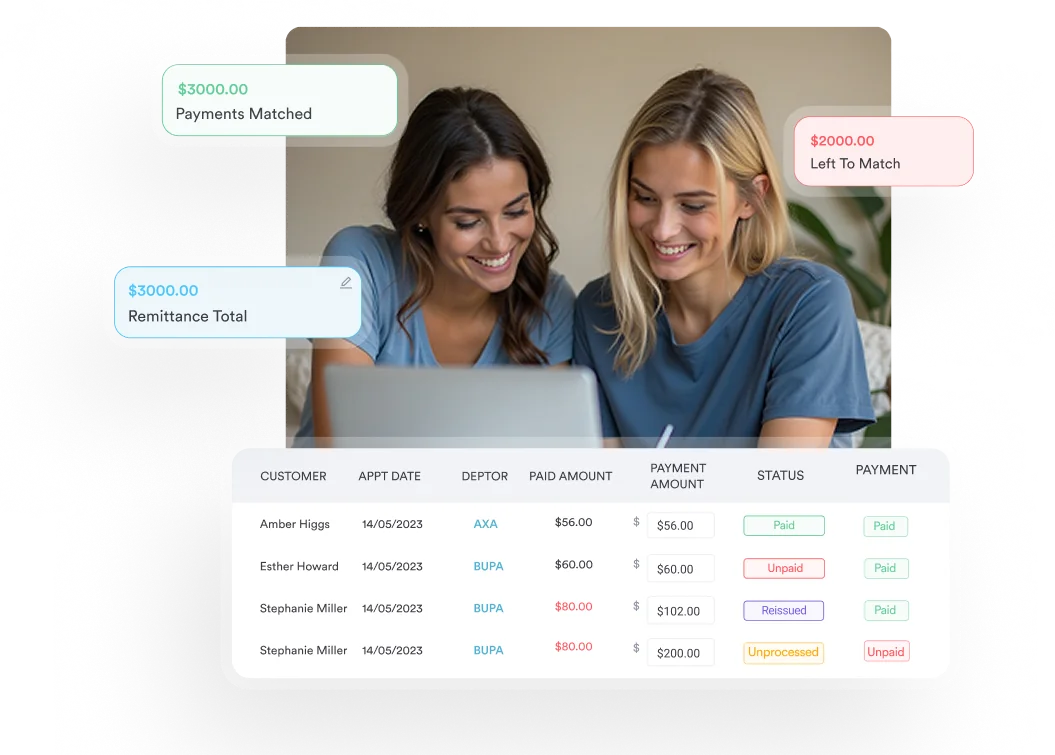

Pabau connects to Claim.MD so you can submit 88361 claims electronically, verify eligibility in real time and track remittances without switching systems. See how the workflow fits your lab.

Treat 88361 as a documentation code first. When the report names the software and gives each antibody its own score, the coding is simple: one unit per stain, per specimen.
When that statement is missing, code what the report supports before the claim leaves. Correcting a line yourself takes minutes, and appealing a denial takes weeks.
Remember that 88361 replaces 88342 for an antibody. Billing both looks like extra revenue, but a payer reads it as duplicate billing. Book a demo to see how Pabau sends 88361 claims through Claim.MD and posts the remittance when it arrives.

Choosing a clearinghouse for lab claims? Claim.MD clearinghouse guide explains how electronic claim submission works for pathology and specialty practices.
Confused by remittance codes after an 88361 denial? Electronic remittance advice explained breaks down how to read 835 files and act on CARC/RARC codes.
Building a denial workflow for your lab? Denial management in healthcare sets out how to track, sort and work denials before they age.
Comparing billing platforms? Best medical billing software for US practices reviews platforms by specialty, claim volume and denial handling.
Yes, when the work is split. The pathologist who reviews and signs the result bills 88361-26, and the lab that stains and runs the software bills 88361-TC. When one entity does both, it bills 88361 globally, with no modifier.
No. CMS describes digital cellular imaging as software analysis of the stained slide. A pathologist scoring a whole-slide image by eye is still doing a manual read, which is 88360.
Yes, if the stain is tumor IHC and software produces the score. The unit rule stays the same. Several slides from one cytologic or hematologic specimen still count as one unit per antibody.
The diagnosis code for the tumor the stain characterizes, taken from the signed report. A HER2 stain on a right breast cancer pairs with a C50 code for the site, for example. Payer policies may list the diagnoses they accept.
No. It’s a standalone code reported per specimen for each antibody stain procedure. Unlike 88341, it doesn’t need a primary code on the claim to be paid.