HCPCS Code Q4175: Billing, coverage, and documentation guide
HCPCS Code Q4175: Code Description and Product Identity HCPCS Code Q4175 is the ...

Last Updated: Nov 20, 2026
87177 is the CPT code for an ova and parasites exam of stool: direct smears, concentration and identification. It covers the direct smear, the concentration step, and the microscopic identification of any eggs, cysts, larvae or trophozoites found.
The permanent trichrome or iron-hematoxylin stained smear is not part of 87177. Labs report it separately with 87209, and never add the concentration code 87015.
Let Pabau's smart automation suggest the right codes, reduce claim denials, and keep your practice compliant—effortlessly.
Automate repetitive tasks and focus on what matters most—your patients.
Reduce coding errors and ensure compliance with the latest regulations.
Clean claims, fewer denials, and faster reimbursements.
Powerful insights and reporting to help your practice thrive.
HIPAA compliant SOC 2 certified GDPR-compliant Trusted by 4,000+ clinics worldwide

CPT Code 87177 is the stool ova and parasites exam: direct smears, concentration and identification of eggs, cysts, larvae and trophozoites.
Medicare pays 87177 from the Clinical Laboratory Fee Schedule, at $8.90 in 2026, with no facility split and no patient coinsurance.
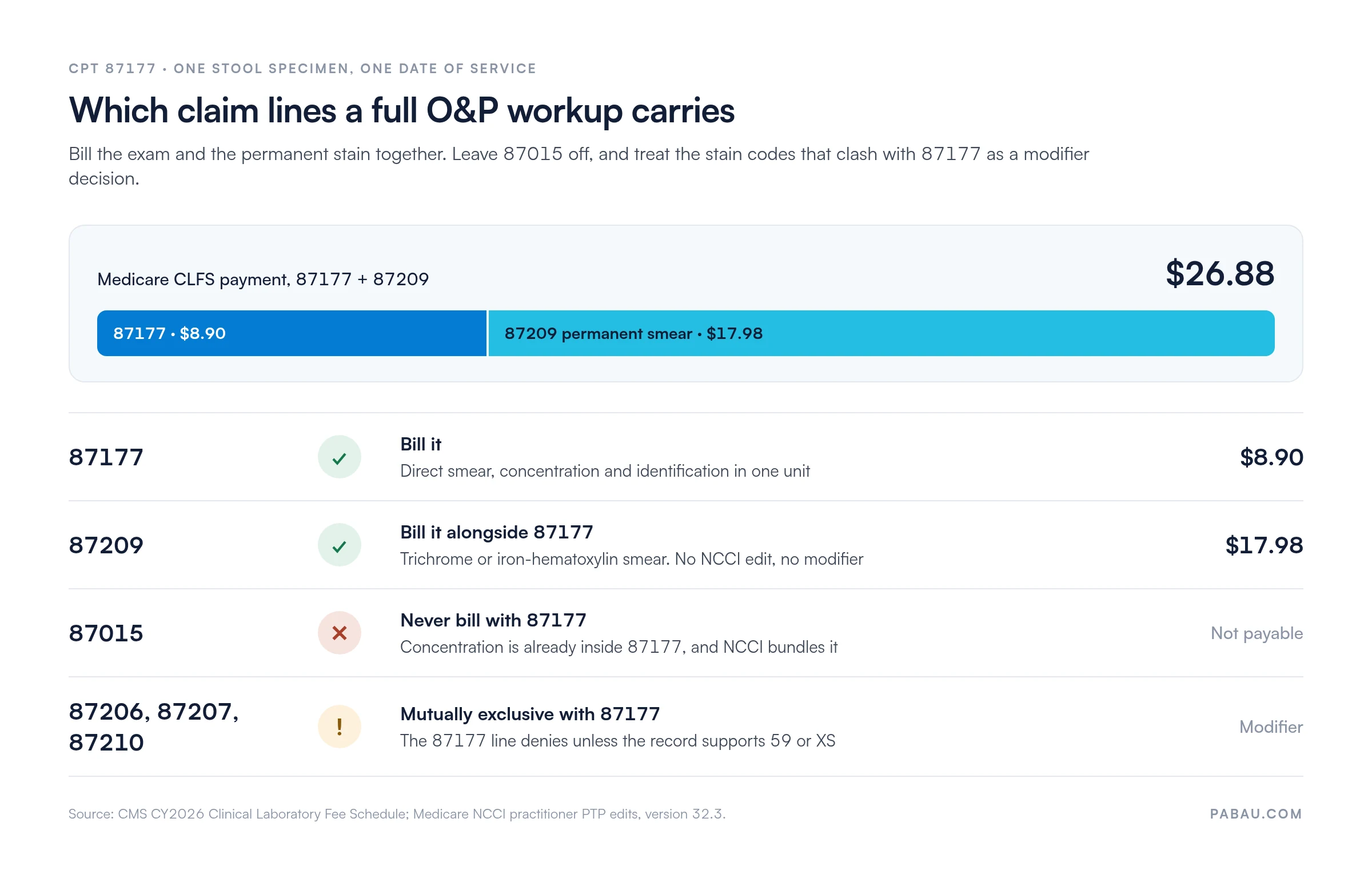
The permanent trichrome or iron-hematoxylin smear is a separate code, 87209, and no NCCI edit blocks billing it with 87177.
Never add 87015 for the concentration step, because it is already part of 87177 and NCCI bundles it.
Watch the NCCI pairs with 87206, 87207 and 87210, where the 87177 line is the one that denies without a modifier.
CPT Code 87177 reports a stool ova and parasites (O&P) exam, and its descriptor reads “Ova and parasites, direct smears, concentration and identification.” Coding guidance in AAPC’s Pathology/Lab Coding Alert quotes that descriptor and pairs the code with 87209 for the trichrome smear.
The descriptor names three parts of one exam. The lab examines a direct smear, concentrates the specimen, and identifies any eggs, cysts, larvae or trophozoites it finds. All three sit inside one unit of 87177.
The permanent stained smear is not one of those parts. A trichrome or iron-hematoxylin stain is reported with its own code, 87209, and most labs bill the two together for a full O&P workup.
The direct smear is a wet preparation of fresh stool, usually in saline and iodine. Its main job is to show motile trophozoites, such as those of Giardia or Entamoeba, before they break down. Many labs skip it on preserved specimens, because preservatives kill the organisms it is meant to catch.
The concentration step separates parasite elements from fecal debris so they are easier to find under the microscope. Labs use sedimentation, most often formalin-ethyl acetate, or flotation, usually zinc sulfate. Concentration recovers eggs, cysts and larvae well, but it distorts or destroys trophozoites.
The permanent smear fixes a thin layer of stool on a slide and stains it with trichrome or iron hematoxylin. It is the best way to identify intestinal protozoa, which is why labs rarely run an O&P without it. That stain is coded as 87209, so a full O&P workup usually produces two claim lines.
Knowing the scope of 87177 prevents two opposite errors. One is billing a separate code for work already inside 87177, and the other is leaving a separately payable stain off the claim.
The last column reflects the Medicare NCCI practitioner PTP edits, version 32.3, effective October 1, 2026.
The pair that matters most is 87177 plus 87209. The trichrome smear pays $17.98 on the 2026 CLFS, about twice the $8.90 for 87177. A lab that folds the stain into 87177 leaves the larger payment off the claim.
The pairs to watch are 87206, 87207 and 87210. NCCI lists each with 87177 as mutually exclusive, with 87177 in column 2 and a modifier indicator of 1. Billed together on one date without a modifier, the 87177 line is the one that denies. A wet mount ordered on its own belongs under 87210, not as a second O&P line.
A full O&P workup on one specimen sorts like this.
Medicare pays clinical lab tests from the Clinical Laboratory Fee Schedule (CLFS), not the Physician Fee Schedule. The CLFS sets one national rate per code, so there is no facility or non-facility split and no RVU calculation.
Medicare pays the lower of the billed charge or the CLFS amount. The figures above come from the CMS 2026 CLFS public use file, October release. Commercial and Medicaid rates are set by each contract or state fee schedule, so check those separately.
Medical necessity for 87177 rests on an ICD-10-CM code that explains why the O&P exam was ordered. A payer may deny the claim when the linked diagnosis does not point to a suspected parasite. The codes below are common examples, not a coverage list.
The diagnosis has to match the clinical reason documented in the record. Travel history or a known exposure belongs in the encounter note, where it supports the symptom code on the claim. Until the exam identifies an organism, R19.7 is the usual code for unexplained diarrhea.
Run a diagnosis-to-procedure check before you send 87177. If the order documents only routine screening with no symptom or exposure, expect a medical necessity denial. The indication, such as diarrhea, travel or immunosuppression, has to appear in the encounter note and not only on the claim.
A clean 87177 claim needs records that cover both the clinical reason and the lab work. Review what makes a clean claim so your lab billing passes payer edits the first time.
Most 87177 claims go out with no modifier, including the standard pairing with 87209. Three modifiers come up in specific situations.
Denials on 87177 follow a few patterns. Fix the cause before you resubmit, and see these denial management workflows for a broader process.
For CARC and RARC meanings, see the guide to medical billing denial codes.
Coverage for 87177 turns on medical necessity with every payer, but the details differ.
Before you bill a second O&P exam to a commercial payer within 12 months, read that payer’s lab policy. Some ask for proof that treatment failed or that a new exposure occurred. Build the check into pre-claim review instead of waiting for the denial.
Most 87177 denials start before the claim is built. The order lacks an indication, the stain never makes it onto its own line, or the ordering NPI is missing. In Pabau, a practice management platform with built-in billing, the order, the diagnosis and the claim sit on one patient record.
Pabau’s claims management sends 837P claims through Claim.MD and runs eligibility checks before the visit. Remittances come back as ERA files and post against the original claim. Your team sees a short-paid 87177 line next to the order that explains it.
That turns denial work into a quick review. Billers can see whether the diagnosis, the NPI or a missing 87209 line caused the problem, and fix it in one place.

Pabau sends 837P claims through Claim.MD, checks eligibility before the visit, and posts ERA remittances back to the patient record. Your billing team sees a denied 87177 line next to the order that explains it.

The most expensive mistake on 87177 is believing the code already pays for the permanent smear. It does not. The trichrome or iron-hematoxylin stain is 87209, and it pays about twice what the base exam does.
Bill 87177 for the direct smear, concentration and identification, and add 87209 when the lab ran the stain. Leave 87015 off every time. Treat a same-day 87206, 87207 or 87210 as a modifier decision the record has to support.
Book a demo to see how Pabau links lab orders, diagnoses and remittances, so each 87177 claim goes out with the right lines.

Need a full reference for medical billing denial codes? Denial codes in medical billing covers CARC and RARC reason codes so your team can triage rejections faster.
Submitting claims electronically? 837 file format guide explains the 837P transaction structure and the loop segments that carry lab code and ordering provider data.
Want to understand how remittances post after a lab claim? Electronic remittance advice (ERA) explains how to read 835 remittance files and match ERA data to outstanding claims.
CPT Code 87177 covers an ova and parasites exam of a stool specimen. Its descriptor is ova and parasites, direct smears, concentration and identification. That includes the direct smear, the concentration step and the microscopic identification of any parasites found. The permanent stained smear is not part of it and is reported with 87209.
Medicare pays 87177 from the Clinical Laboratory Fee Schedule, not the Physician Fee Schedule. The CY2026 CLFS rate is $8.90 per test, with no facility or non-facility split. Medicare pays the lower of your charge or that amount, and patients owe no coinsurance or deductible for clinical lab tests.
Most 87177 claims need no modifier. Modifier 91 applies when the same test is repeated on the same day to get a new result. A modifier such as 59 or XS matters only when 87177 is billed with 87206, 87207 or 87210. Those pairs are mutually exclusive in NCCI, and the modifier needs a separate specimen or distinct service in the record. QW does not apply, because 87177 is not a CLIA-waived test.
The usual causes are a diagnosis that does not support parasite testing, an NCCI edit, or a missing CLIA number or ordering NPI. The NCCI denials come from adding 87015, or from billing 87206, 87207 or 87210 on the same date without support for a modifier. Payer frequency limits on repeat exams are a less common trigger.