



HCPCS code E0198: Water pressure pad billing guide
HCPCS code E0198 is a water pad for a standard mattress HCPCS code E0198 is the ...

Last Updated: Oct 13, 2026
CPT code 87507 is the billing code for gastrointestinal pathogen panel testing that detects 12 to 25 targets by nucleic acid amplification. One unit covers the whole multiplex run, whatever mix of bacteria, viruses, and parasites the assay looks for.
Medicare covers it narrowly. LCD L38229 pays for the 12-25 target tier only when an immunocompromised patient has acute or persistent diarrhea. The claim also carries two diagnosis codes rather than one.
This guide covers the official descriptor, the 2026 Medicare rate, the ICD-10 pairing rule, documentation, modifiers, and the workflow that keeps the claim clean.

CPT code 87507 covers GI pathogen panels detecting 12 to 25 targets, so a 22-target BioFire panel is never billed as 87506.
The 2026 Medicare rate varies by facility placement and MAC jurisdiction, so pull it from the CMS Physician Fee Schedule lookup before you submit.
R19.7, diarrhea unspecified, is the only supporting diagnosis, and it never travels alone. Pair it with an immunosuppression code from Table 3 of Article A56642.
LCD L38229 restricts the 12-25 target tier to immunocompromised patients, and it denies any repeat panel within seven days of the same episode.
Practice management software like Pabau ties the test order, the ICD-10 pairing, and the modifier check to one claim record.
CPT code 87507 sits in the infectious agent detection section of the AMA CPT code set. The descriptor covers detection of an infectious agent by nucleic acid technique for a gastrointestinal pathogen panel of 12 to 25 targets.
It is a per-panel code, not a per-target code. The lab bills one unit for the full multiplex run, however many pathogens the assay interrogates inside that range.
The code took effect in 2013 as part of a three-code family split by target count. CPT code 87507 sits at the top of that family, because no GI panel code covers a higher count.
The right code depends on how many targets your laboratory’s assay detects. CPT 87505 covers panels of 3-5 targets, CPT 87506 covers 6-11 targets, and CPT code 87507 covers 12-25 targets.
Most commercial GI panel platforms land in the top tier. The BioFire FilmArray GI Panel runs 22 targets and the Luminex xTAG GPP runs 15, so both bill as 87507. The ladder below shows where each tier starts and what its claims need.
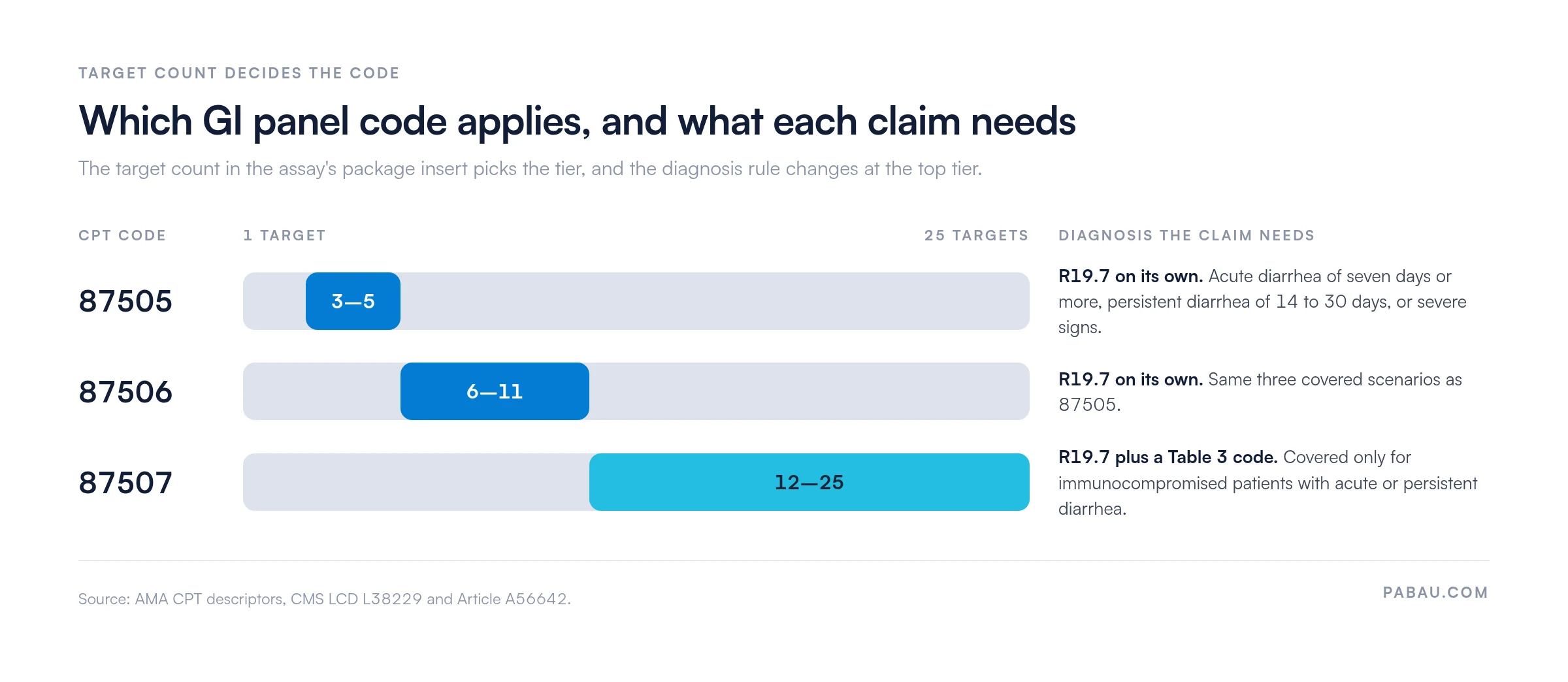
Selecting 87506 when the assay interrogates 14 targets is a mis-tier error. Payers cross-reference the test report’s target count against the billed code during adjudication. A mismatch produces either a denial or a down-coded payment.
Verify the exact target count in your lab’s test catalog or the panel package insert before coding. When the manufacturer updates the assay to a different number of targets, re-validate your code choice.
Medicare reimbursement for CPT code 87507 is set annually through the CMS Physician Fee Schedule lookup tool. Rates vary by facility versus non-facility placement and by Medicare Administrative Contractor (MAC) jurisdiction. Geographic practice cost index (GPCI) adjustments mean your local rate may differ from the national amount.
CMS finalizes each year’s rates in November, so pull the current figure from the fee schedule rather than an aggregator site. Private payers negotiate separately, and their rates for molecular panels often sit well above the Medicare amount.
Run the CMS Physician Fee Schedule lookup with CPT 87507 and your locality code before your next claim cycle. Cross-check the non-facility rate against your lab’s contract rates. If your contracted rate falls below the Medicare rate, that is worth raising in your next payer negotiation.
Pairing CPT code 87507 with a covered ICD-10-CM diagnosis is required for the claim to pass medical necessity review. The supporting list is shorter than most coders expect.
CMS Article A56642 is the billing and coding companion to LCD L38229. It names exactly one code that supports medical necessity for CPT code 87507, and that code is R19.7, diarrhea, unspecified.
R19.7 does not carry the claim on its own. Article A56642 attaches a dual-diagnosis instruction to it. When R19.7 is reported with CPT code 87507, one of the immunosuppression codes in Table 3 must also be reported.
Table 3 runs to 59 codes, and none of them are stand-alone diagnosis codes either. Both codes have to appear on the claim.
The five Table 3 entries above are illustrative, not the whole list. The full set of 59 covers B20 and the D80 to D84 primary immunodeficiencies. It also covers the D89 disorders of the immune mechanism and the Z94 transplant status codes.
Article A56642 publishes the full list, so pull the current version before your next coding cycle. Each Table 3 entry is defined in the ICD-10-CM code library, which is worth checking when the documentation names a transplant or an immune disorder.
Jurisdiction decides which document you cite. For Jurisdictions H and L, Novitas Solutions publishes Article A56642 alongside LCD L38229. For Jurisdiction N, First Coast Service Options publishes the matching Article A56638 under LCD L38227. Other MACs write their own policy, so confirm the supporting diagnosis list for yours.
Medicare covers CPT code 87507 only for immunocompromised patients who present with acute or persistent diarrhea. The coverage rules sit in LCD L38229, and Article A56642 is its billing and coding companion. Cite the LCD itself when you argue coverage.
That restriction is what separates 87507 from the rest of the family. The broader scenarios below support panels of 11 or fewer targets, billed as 87505 or 87506.
A 12-25 target panel does not qualify under those three scenarios on its own. For CPT code 87507, LCD L38229 narrows coverage to immunocompromised patients, and the claim also needs a Table 3 immunosuppression or transplant status code.
Non-covered indications include routine wellness screening and surveillance testing in asymptomatic individuals. LCD L38229 also denies repeat NAAT testing within seven days during the same episode of diarrhea. That holds whether the repeat comes from the same provider or a different one.
Medicare allows one GI panel per day per beneficiary across CPT codes 87505, 87506, and 87507. MAC policies still vary, so check the LCD that applies to your jurisdiction before submitting.
Inadequate documentation is the second most common reason CPT code 87507 claims are denied, behind mis-tiering. Novitas Solutions guidance asks the medical record to support both the clinical indication and the choice of a 12-25 target panel over a smaller one.
The required documentation elements are listed below.
Practices running automated claims management software can attach the lab result document straight to the encounter record. That keeps the target count, the order, and the diagnosis pairing in one place when an auditor asks for them.
Structured notes that capture symptom onset, duration, and ordering rationale make the medical necessity case on their own. The auditor does not have to assemble it from several records.
Modifier use on CPT code 87507 is simple compared with many molecular diagnostic codes. Three modifiers come up, and two of them cause most of the errors.
The costliest modifier error is applying QW without checking CLIA waiver status first. Multiplex PCR panels of 12-25 targets are high-complexity tests, and they generally require a CLIA-certified laboratory.
Claiming waived status the assay does not hold exposes the practice on audit. Check your platform’s CLIA complexity category against the CMS CLIA database before you append QW.
Four billing patterns account for most CPT code 87507 denials and audit flags. Recognizing them before submission is cheaper than resolving them through appeals.
Billing individual nucleic acid detection codes for each pathogen on a 14-target panel, instead of CPT code 87507, is improper unbundling. CMS NCCI edits and Novitas MAC guidance both prohibit it when a panel code describes the assay.
The appeal costs more than submitting the panel code correctly would have. A clean claim process with built-in NCCI edit checks stops the unbundled line at data entry.
Billing 87506 for a 22-target BioFire panel is a coding error, not a rounding judgment. The tier thresholds are fixed, and 12-25 targets means CPT code 87507. If your lab’s platform changes its target count, update the code the same week.
Across high-volume GI panel ordering, a single mis-tier compounds into lost reimbursement or overpayment liability.
Ordering a comprehensive GI panel without documenting why 12-25 targets were needed leaves the claim unsupported. The encounter note must explain the clinical rationale. A note reading only “diarrhea, order GI panel” will not survive review. Documentation written at the point of ordering settles the question long before an appeal does.
LCD L38229 lists testing of asymptomatic patients among the services that are not reasonable and necessary. CPT code 87507 is therefore non-covered as a screening test, and a panel submitted for a patient with no GI symptoms will be denied.
For surveillance in a long-term care outbreak, confirm the criteria with your MAC before ordering. Some MACs carry specific outbreak investigation provisions.
Coding knowledge only pays off if the workflow carries it through to the claim. The five steps below run from the test order to payment posting.
Practices with high GI panel volume gain the most from a dedicated order type. It populates CPT code 87507, prompts for both diagnosis codes, and flags the claim for a documentation check before release.
Flag CO-97 (bundled service) and CO-B15 on every 87507 remittance the day it posts. Those two reason codes drive most GI panel disputes, and a corrected claim with the lab report attached usually settles them.
Most practices split this work across three systems. The order lives in the lab portal, the diagnosis codes in the EHR, and the claim in a separate billing tool. The target count that decides the tier rarely travels with any of them.
Practice management software like Pabau keeps the order, the note, and the claim on one patient record. You can hold the assay name and target count on the order itself. Claim validation then runs before submission, so a missing Table 3 code is caught in the practice rather than by the payer.
The outcome is a shorter loop between the lab result and the payment. When a remittance comes back down-coded, the report that proves the target count is already on the record. The corrected claim can go out the same day.

Pabau’s claims management workflow connects test orders, ICD-10 pairing, modifier selection, and clearinghouse submission in one place. Your GI panel claims go out clean the first time.

The denials on CPT code 87507 come from two decisions made before the claim exists. The target count in the package insert picks the tier, and the patient’s immune status decides whether Medicare will cover it at all.
So the work belongs at the order, not at the appeal. Record the platform and target count at ordering, pair R19.7 with a Table 3 code, and keep the lab report on the encounter. Claims that arrive that way rarely come back.
The trade-off worth remembering is that a 12-25 target panel pays more and is scrutinized more. Book a demo to see how Pabau ties the test order, the diagnosis pairing, and the claim together.

Need to understand how claims reach your payer? Medical claims clearinghouse guide explains how clearinghouses validate and route 837 files before adjudication.
Getting denials and need a systematic approach? Claim.MD clearinghouse overview covers how eligibility checks and claim validation reduce first-pass denial rates.
Want to benchmark your billing efficiency? Best medical billing software in the US reviews the tools practices use to reduce days in A/R and automate claim submission.
CPT code 87507 covers gastrointestinal pathogen panel testing that detects 12 to 25 targets by nucleic acid amplification. One panel of bacteria, viruses, and parasites is billed as one unit, not once per pathogen detected.
Pull the 2026 figure from the CMS Physician Fee Schedule lookup tool, because CMS finalizes rates each November. The amount varies by facility versus non-facility placement, by MAC jurisdiction, and by geographic practice cost index adjustment.
The codes are tiered by target count: CPT 87505 covers 3-5 targets, CPT 87506 covers 6-11 targets, and CPT 87507 covers 12-25 targets. The package insert’s target count decides the code, not the number of pathogens a given specimen turns out to carry.
No modifier is required on a standalone CPT 87507 claim in most circumstances. Modifier 59 applies only when another service on the same date shares an NCCI edit and the services are genuinely distinct. Modifier QW applies only if the specific assay platform has received CLIA-waived status from CMS, which most 12-25 target multiplex PCR panels have not.
No. Billing individual nucleic acid detection codes for each pathogen on a panel that qualifies as CPT 87507 is improper unbundling. CMS NCCI edits and MAC guidance from Novitas Solutions prohibit this practice. The panel code must be used when it accurately describes the assay performed.
CMS Article A56642 lists one supporting diagnosis for CPT 87507, R19.7, diarrhea, unspecified. It is not a stand-alone code. An immunosuppression or transplant status code from the article’s Table 3, such as B20 or Z94.0, must be reported with it. Table 3 holds 59 codes, and none of those stand alone either.
Yes, but narrowly. LCD L38229 covers CPT 87507 for immunocompromised outpatients with acute or persistent diarrhea, and denies it as asymptomatic screening. The claim needs R19.7 reported with an immunosuppression code from Table 3 of Article A56642.



