

HCPCS code E0198: Water pressure pad billing guide
HCPCS code E0198 is a water pad for a standard mattress HCPCS code E0198 is the ...

Last Updated: Oct 13, 2026
86695 is the CPT code for antibody; herpes simplex, type 1. It reports a serology test that detects antibodies to herpes simplex virus type 1 (HSV-1), usually IgG, IgM or both.
The code is type-specific. Type 2 antibody testing is billed with 86696, and a non-specific HSV order needs a provider query before either code is assigned. Claims pay most reliably when the requisition names the type and the diagnosis reflects a documented lesion site, symptom or exposure.
Let Pabau's smart automation suggest the right codes, reduce claim denials, and keep your practice compliant—effortlessly.
Automate repetitive tasks and focus on what matters most—your patients.
Reduce coding errors and ensure compliance with the latest regulations.
Clean claims, fewer denials, and faster reimbursements.
Powerful insights and reporting to help your practice thrive.
HIPAA compliant SOC 2 certified GDPR-compliant Trusted by 4,000+ clinics worldwide

CPT code 86695 covers HSV type 1 antibody serology only. Type 2 serology is billed with the companion code 86696.
B00.9, Z11.59 and Z20.828 are the most common ICD-10-CM pairings, but Z11.59 on an asymptomatic Medicare patient carries a high denial risk.
Medicare pays 86695 under the Clinical Laboratory Fee Schedule, and coverage rules come from your MAC’s local coverage determination.
Modifier -91 covers clinically indicated repeat testing on the same date of service, and modifier -59 separates 86695 from bundled codes.
CPT code 86695 is an immunology serology code in the 86000-86849 range. It is published by the American Medical Association (AMA) as part of the annual CPT code set.
The official descriptor reads: Antibody; herpes simplex, type 1. The test measures HSV-1-specific antibodies, typically IgG, IgM, or both. Labs run it by ELISA, chemiluminescent microparticle immunoassay (CMIA), or indirect fluorescent antibody (IFA) methods.
The code covers antibody testing on serum, or less often on cerebrospinal fluid. It does not cover direct viral detection methods such as PCR or culture, which use separate codes. A CLIA-certified laboratory must perform and report the test, and the requisition must carry the ordering physician’s name and NPI.
86695 covers HSV type 1 antibody testing, and 86696 covers HSV type 2. The two codes are not interchangeable. Billing 86695 for a type-2-specific order is a coding error, and it draws a CO-4 denial however well the test is justified.
Both codes may be reported on the same date of service when the physician explicitly orders type-specific testing for both HSV-1 and HSV-2. That happens most often in STI baseline panels, TORCH workups, and immunocompromised patient evaluations. Document the clinical indication for each type separately in the requisition.
Accepted clinical indications drive medical necessity and determine which ICD-10-CM code supports the claim. The most commonly covered situations in sexual health and general practice include:
Asymptomatic general screening, without any of the indicators above, is typically not a covered Medicare indication. The Centers for Disease Control and Prevention (CDC) does not recommend routine HSV serology for the general population.
Most Medicare Administrative Contractor (MAC) local coverage determinations (LCDs) follow the same line. Claims paired with Z11.59 alone on an asymptomatic patient carry high denial risk.
In medical billing, the diagnosis code is what proves a lab test was necessary. Each code paired with CPT 86695 must reflect the documented clinical indication, not a default placeholder.
Verify accepted diagnosis codes against the applicable MAC Local Coverage Determination before billing. LCD coverage lists change annually, and a code accepted under one MAC’s policy may not be accepted under another’s.
CPT code 86695 is reportable under Medicare’s Clinical Laboratory Fee Schedule (CLFS). Coverage is governed by the LCD of the MAC that serves the laboratory, not the one where the patient receives care.
Meeting medical billing compliance requirements for this code means checking that the ordering indication falls within that active LCD before the claim goes out.
The Medicare Clinical Laboratory Fee Schedule (CLFS) sets one national payment rate for CPT code 86695. Unlike the physician fee schedule, the CLFS has no locality adjustment.
Download the current rate from the CMS clinical laboratory fee schedule files. Avoid hardcoding it in your billing system, because CMS republishes the CLFS file every quarter.
Commercial payers typically price HSV-1 serology at or near the Medicare CLFS rate as a benchmark. Some managed care contracts pay a percentage of Medicare, such as 110% of the CLFS rate. Place of service also affects reimbursement.
Documentation must support both the test order and the diagnosis code on the claim. A clean claim submission for 86695 requires each of these elements to be present before the claim leaves the practice or lab.
For send-out tests, Medicare generally requires the performing laboratory to bill the test itself. If a commercial payer lets the ordering practice bill, the claim must carry the performing lab’s CLIA number. It must also identify that lab, not the ordering office.
Modifier selection for 86695 depends on the clinical scenario. Using the wrong modifier, or omitting one that the payer requires, is a common denial trigger for laboratory claims.
Verify NCCI edit pairs for 86695 quarterly using the current CMS NCCI table. Edit pairs change, and an edit that did not exist last quarter may bundle 86695 with a panel code this quarter. See the AAPC Codify CPT lookup for modifier compatibility references.
The typical 86695 denial starts with an “HSV panel” order. A coder assigns 86695 without checking which type the physician meant, then pairs it with Z11.59 on an asymptomatic Medicare patient.
The result is a CO-4 (incorrect code) or CO-11 (diagnosis inconsistent with procedure) denial, sometimes both on one claim. Structured denial management workflows stop both with the two checks below.
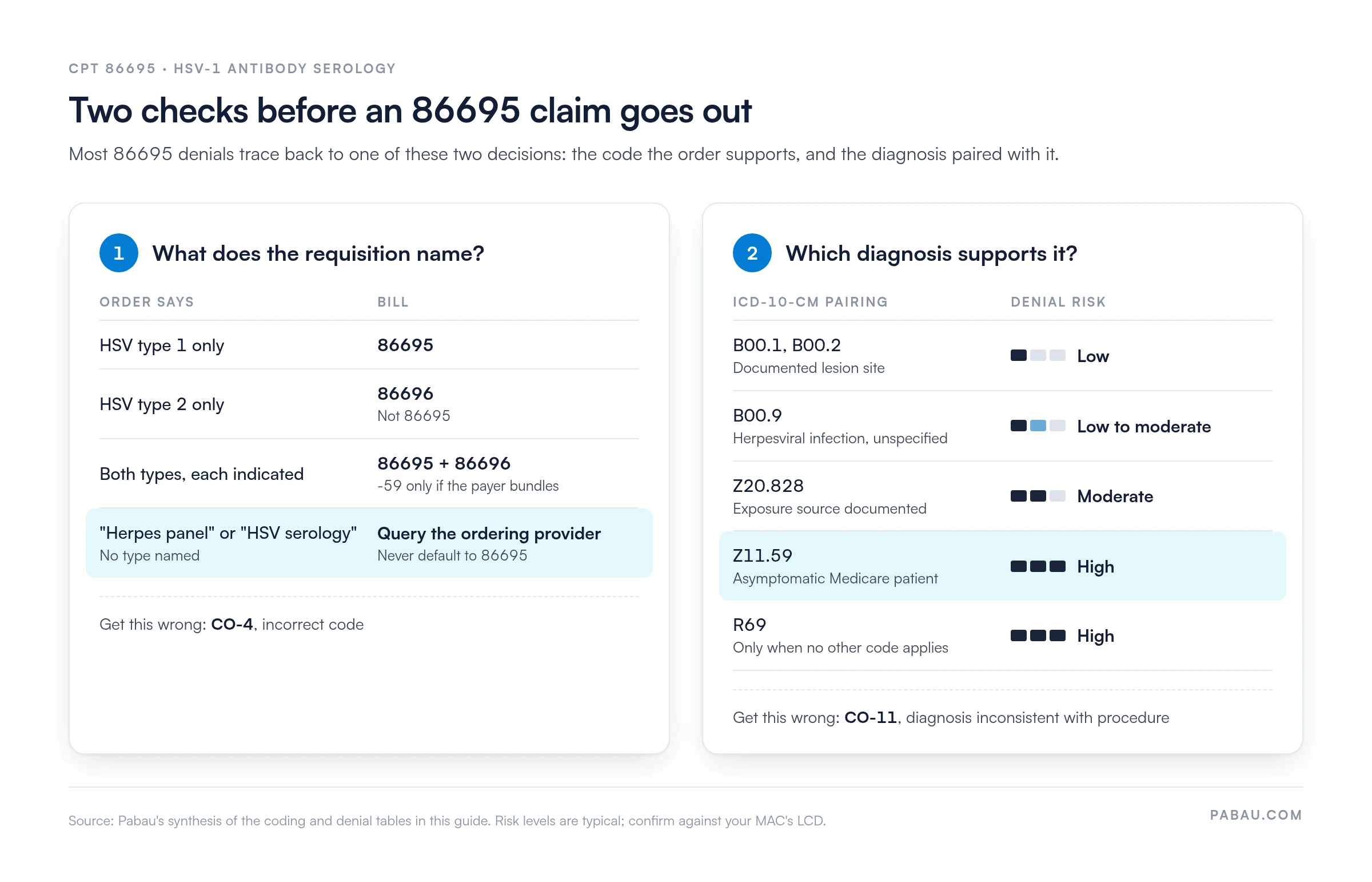
Our guide to medical billing denial codes maps each CO code to its root cause and resolution path. On 86695, CO-4 and CO-11 are the two to watch.
Before billing any HSV antibody order, confirm the requisition explicitly names type 1, type 2, or both. Vague orders that say only ‘herpes panel’ or ‘HSV serology’ are the single most common root cause of CO-4 denials on 86695. Query the ordering provider and update the requisition before the specimen ships to the lab.
Medicare does not require prior authorization for CPT code 86695 as a matter of national policy. Commercial payers vary significantly. Prior authorization is most likely when HSV-1 serology is ordered as a standalone test outside a recognized panel. It is also common when the patient’s plan routes lab benefits through a carve-out laboratory benefit manager.
PA requirements change annually with plan year updates. Verify requirements directly with the patient’s payer before ordering, not after the specimen is collected.
Co-billing scenarios for 86695 require attention to NCCI edits, which the Centers for Medicare and Medicaid Services (CMS) updates quarterly. Check the current NCCI table against any codes billed on the same date of service.
Submitting through a medical claims clearinghouse adds a scrubbing step that flags NCCI edit conflicts before claims leave the practice. That cuts co-billing denials at the source rather than at appeal.
Without a check before submission, an 86695 coding error usually surfaces when the remittance comes back with CO-4 or CO-11. By then the specimen has shipped, and the fix means a provider query plus a resubmission.
Pabau, the practice management platform we build, moves that check to the front. Its claims management software connects to Claim.MD, our integrated US clearinghouse, for 837P submission, real-time eligibility checks and ERA posting.
Claims are scrubbed before they reach the payer. A mismatch between code, diagnosis and place of service gets flagged while it is still cheap to fix. Your team spends less time reworking lab claims and gets paid faster on the ones that were right first time.

Pabau connects with Claim.MD for electronic lab claim submission, real-time eligibility checks and ERA posting. Your team spends less time on rework and more time on patient care.

Treat every HSV antibody order as unbillable until the requisition names a type and the chart supports the diagnosis. That single habit protects 86695 claims from both of the denials that hit this code hardest.
The trade-off is a slower handoff on vague requisitions, since someone has to query the ordering provider. That delay costs far less than an appeal, and it teaches providers to write type-specific orders from the start.
Book a demo to see how Pabau catches code and diagnosis mismatches on lab claims before they reach the payer.

Need to understand denial codes on lab claims? Common denial codes in medical billing maps every CO and PR code to its root cause and resolution path.
Want to see how clearinghouse submission works end-to-end? How the Claim.MD clearinghouse works explains the 837P workflow, ERA reconciliation, and payer enrollment process.
Exploring revenue cycle efficiency for your practice? What is revenue cycle management covers the end-to-end process from eligibility through payment posting.
Billing another antibody serology code? CPT code 86803 walks through the same type-specific documentation and diagnosis checks for hepatitis C antibody testing.
CPT code 86695 covers serological testing for herpes simplex virus type 1 (HSV-1) antibodies. The test measures HSV-1-specific IgG or IgM using immunoassay methods such as ELISA or CMIA. It does not cover PCR, culture, or type 2 HSV antibody testing.
CPT 86695 covers HSV type 1 antibody testing, while CPT 86696 covers HSV type 2 antibody testing. They are distinct codes and cannot be used interchangeably. Both may be billed together on the same date when the ordering physician explicitly requests type-specific testing for both HSV-1 and HSV-2.
The most commonly accepted ICD-10-CM pairings are B00.9, B00.1, B00.2, Z11.59 and Z20.828. They cover unspecified herpes infection, vesicular dermatitis, gingivostomatitis, viral screening and exposure to viral disease. Z11.59 on an asymptomatic Medicare patient carries high denial risk, so check it against the applicable MAC LCD first.
Yes, Medicare covers CPT code 86695 under the Clinical Laboratory Fee Schedule. The testing must meet the medical necessity criteria in the applicable MAC local coverage determination. Asymptomatic general screening is typically not covered. For any non-covered indication, a signed ABN is required before the specimen is collected.
Modifier -91 applies when repeat HSV-1 serology is clinically ordered on the same date of service for serial monitoring. Modifier -59 applies when 86695 is billed alongside 86696 or other immunology codes and the payer incorrectly bundles the services. Modifier QW does not apply because HSV antibody assays are not CLIA-waived tests.
Yes, both codes may be billed on the same date of service when the ordering physician explicitly requests type-specific testing for both HSV-1 and HSV-2. Append modifier -59 to 86696 if the payer bundles the two codes, and document the separate clinical rationale for each test in the requisition.



