CCSD code L6530: Revision femoral bypass graft
CCSD code L6530: Definition and clinical scope CCSD code L6530 carries the offic...

Last Updated: Nov 13, 2026
86618 is the CPT code for antibody; Borrelia burgdorferi (Lyme disease). It reports an immunoassay, usually an EIA or ELISA, that detects IgG and IgM antibodies to the bacterium that causes Lyme disease.
It is the first-tier screening test in the CDC two-tier protocol. A reactive or equivocal result leads to the second-tier immunoblot, which is billed separately as CPT 86617.
Let Pabau's smart automation suggest the right codes, reduce claim denials, and keep your practice compliant—effortlessly.
Automate repetitive tasks and focus on what matters most—your patients.
Reduce coding errors and ensure compliance with the latest regulations.
Clean claims, fewer denials, and faster reimbursements.
Powerful insights and reporting to help your practice thrive.
HIPAA compliant SOC 2 certified GDPR-compliant Trusted by 4,000+ clinics worldwide

CPT code 86618 reports an enzyme immunoassay (EIA or ELISA) for Borrelia burgdorferi antibodies. It is the first-tier Lyme screening test, not the confirmatory immunoblot (CPT 86617).
Under the CDC two-tier protocol, 86617 is billed only after a reactive or equivocal 86618 result. Billing both without that documented result is a leading denial cause.
A69.20 (Lyme disease, unspecified) is the diagnosis most often paired with 86618. A pairing outside the MAC’s LCD covered-diagnosis list is denied at adjudication.
Pabau’s claims management software sends 837P claims through Claim.MD, runs eligibility checks, and posts ERA remittances against the patient record.
CPT code 86618 reports an immunoassay for antibodies to Borrelia burgdorferi, the spirochete that causes Lyme disease. The American Medical Association places it in the Immunology subsection of the Pathology and Laboratory chapter (codes 86000-86849). The test detects IgG and IgM antibodies in a serum specimen, using an EIA or ELISA method.
The test is not CLIA-waived, so only a CLIA-certified laboratory may bill it. Medical billing compliance for lab services also requires the CLIA certificate details on file before any claim goes out.
Use the AAPC Codify CPT lookup to verify the current code descriptor and any annual updates before submitting claims.
The test requires a serum specimen. A red-top or gold-top (serum separator) tube is collected by venipuncture and centrifuged, and the serum goes to the CLIA-certified laboratory. Some reference labs accept EDTA plasma, but serum is the standard. Confirm specimen requirements with the performing lab before collection.
The EIA measures whether patient antibodies bind to Borrelia burgdorferi antigens. A reactive or equivocal result triggers the second tier of the CDC protocol. A negative EIA result, in a patient with low pretest probability, ends the workup without 86617 being ordered or billed.
CPT 86618 is the first-tier EIA screening test. CPT 86617 is the second-tier immunoblot (Western blot) confirmatory test. The two codes describe different procedures and are not interchangeable.
Ordering 86617 without a reactive or equivocal 86618 result, and billing both on the same claim, is a frequent denial trigger. Document the first-tier result in the chart note before the second tier is ordered.
The Centers for Disease Control and Prevention recommends a sequential two-tier algorithm for laboratory confirmation of Lyme disease. The first-tier result decides which codes are billable on a given date of service, as the chart below sets out.
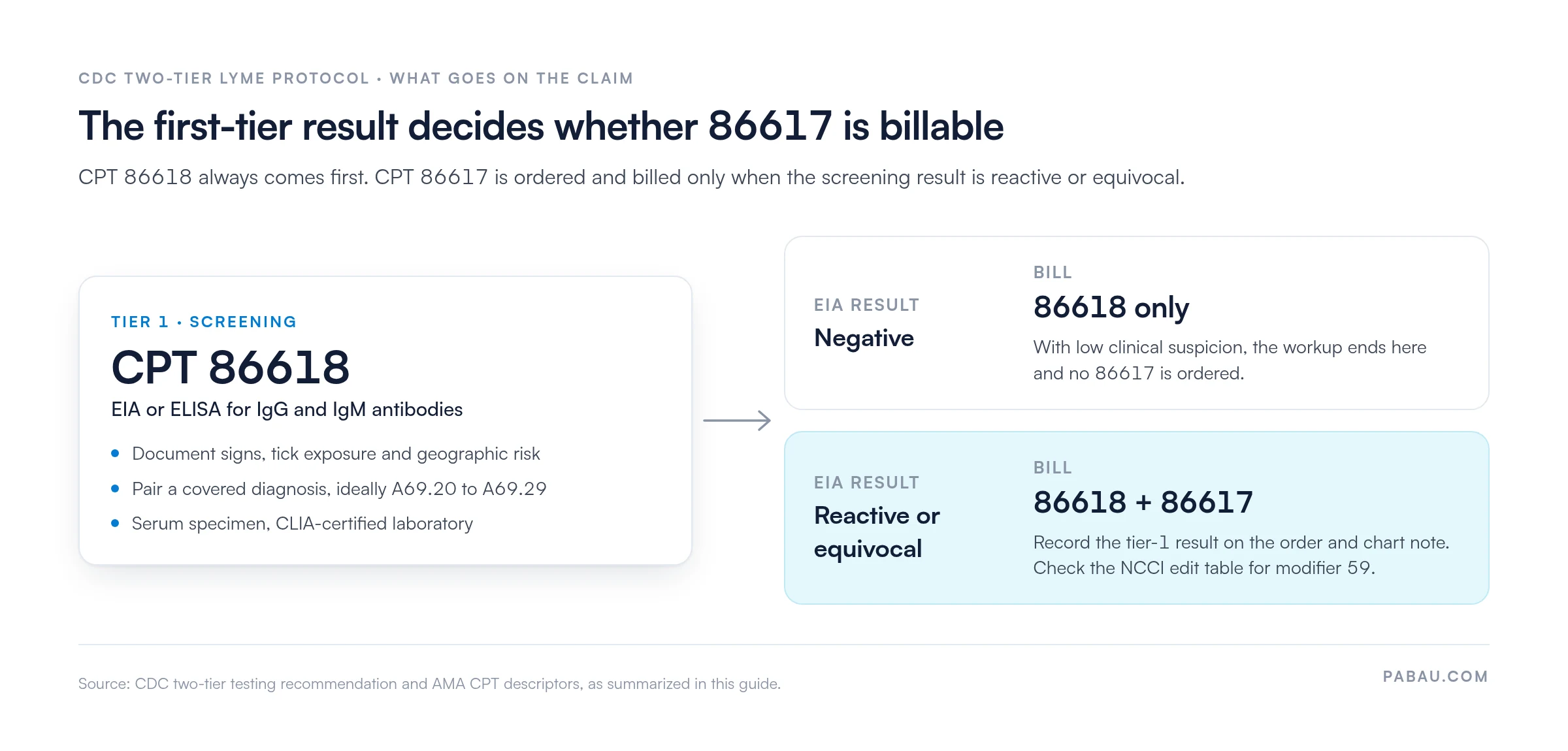
Before billing both 86618 and 86617 on the same date of service, confirm the current NCCI edit status for this code pair. CMS updates NCCI edits quarterly. An edit that did not exist last quarter may now require a modifier or trigger an automatic bundling denial.
The ICD-10-CM code on the claim must establish medical necessity for the Lyme antibody test. Using a code that falls outside the payer’s covered-indication list under the applicable LCD is the most common reason 86618 claims are denied at adjudication.
Verify the covered-diagnosis list in the applicable Medicare Administrative Contractor (MAC) LCD before billing. Z20.818 and R68.89 draw closer scrutiny.
Where the documentation supports it, leading with A69.20 through A69.29 gives the claim the strongest medical necessity case. Use the CDC/NCHS ICD-10-CM web tool to confirm current code descriptions and any exclusion notes.
Medicare Part B covers CPT 86618 as a clinical laboratory service when medical necessity is established under the applicable MAC’s LCD. Coverage varies by jurisdiction.
Noridian, Palmetto GBA, and Wellpoint Federal (formerly National Government Services) each maintain their own Lyme serology LCDs, and covered ICD-10 pairings may differ between them.
Run an eligibility check when the test is ordered, so an inactive policy surfaces before the specimen is drawn. Our Claim.MD clearinghouse guide explains how 837P electronic claims move from practice to payer.
Medical necessity for CPT 86618 rests on what the ordering provider documents before the test is drawn. Payers audit these elements on post-payment review and pre-payment edits for high-volume Lyme jurisdictions.
Weak documentation sits behind most 86618 medical necessity denials. Build these four elements into the visit note template, and a missing one is caught while the patient is still in the room.
Five denial patterns recur on 86618 claims. Each has a specific fix that can be built into the pre-submission workflow.
A structured denial management workflow catches these patterns before they become write-offs. Track denial reason codes from remittance advice by CPT code to see which of the five issues hits your practice most.
Corrective action can then target the highest-volume cause first. Our denial codes reference explains how to read the CARC and RARC codes on an EOB or ERA.
Four modifiers come up on 86618 claims. Three can apply in common billing scenarios, and the fourth (QW) is a frequent coding error.
Appending QW to CPT 86618 is a compliance error, because the test runs in a CLIA-certified lab rather than a CLIA-waived point-of-care setting. Submitting a clean claim for Lyme serology means verifying that the modifier field is populated correctly (or left blank) before each batch is released.
Modifier 90 (reference lab) is frequently missed when a primary care office sends blood to LabCorp or Quest for Lyme serology. If your practice collects the specimen but bills under the physician NPI rather than the lab’s NPI, modifier 90 must appear on the claim. Missing it on a physician-billed reference lab test is a common audit finding.
The CMS Clinical Laboratory Fee Schedule (CLFS) sets the Medicare Part B allowable for CPT 86618. The national limitation amount is published annually in the CLFS update and applies to independently billing laboratories.
Physician fee schedule rates and geographic adjustments apply in some billing contexts. Check the current rate with CMS each year rather than relying on prior-year figures.
A grounding in medical billing fundamentals helps billing staff see how CLFS and PFS allowables differ. It also makes a short payment easier to spot against the contracted rate.
Most 86618 denials start before anyone opens the billing queue. A wrong ICD-10 pairing, a missing tier-1 result, or an absent modifier is set in motion when the test is ordered and documented.
Pabau, the practice software we build, keeps the visit note, the lab order, and the claim in one patient record. Practices with Labs switched on order Quest tests from that record, and the results import automatically. Billing staff then build the claim from the documented findings, with no re-keyed summary in between.
Pabau’s medical claims management software sends 837P claims through Claim.MD, runs eligibility checks, and posts ERA remittances against the same record. A denied 86618 claim then sits beside the chart note that explains it, so the fix starts from the documentation.
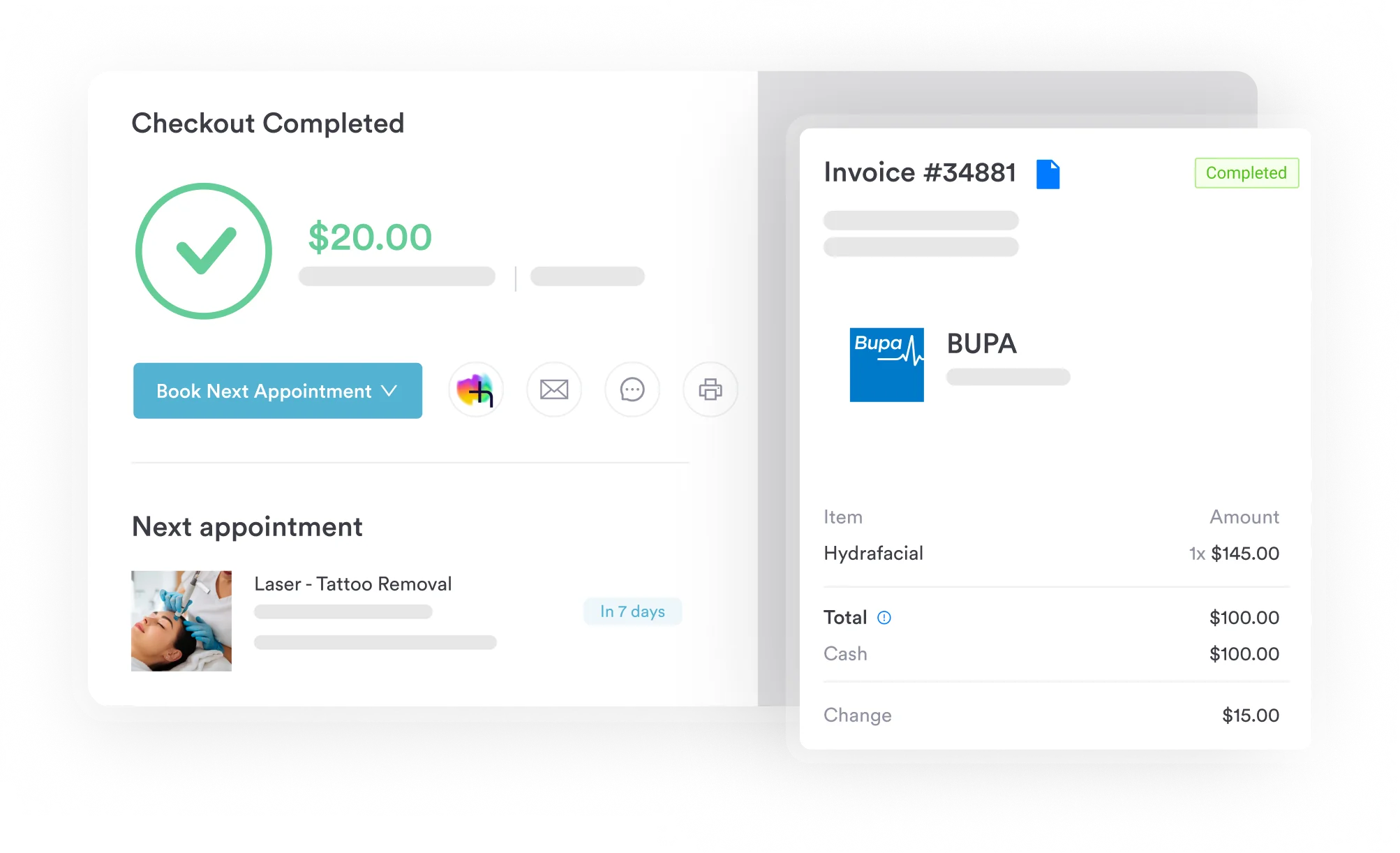

Pabau keeps the chart note, the lab order, and the claim in one patient record. Claims go out through Claim.MD with eligibility checks and ERA remittances, so billing staff work from the documented findings.

Two facts decide whether an 86618 claim pays on the first pass. The diagnosis code must sit on the MAC’s covered list, and the chart must show why Lyme disease was suspected. If 86617 follows, the tier-1 result has to be on record before the second test is ordered.
Put both checks into the ordering workflow, where they cost a minute, instead of the appeals queue, where they cost weeks. Book a demo to see how Pabau keeps Lyme serology orders, documentation, and claims in one record.

Unfamiliar with the 837P electronic claims process? How 837 files work in medical billing explains the EDI transaction format that carries your CPT and ICD-10 codes to the payer.
New to clearinghouse submission? Medical claims clearinghouse guide walks through how claims are validated, scrubbed, and forwarded before reaching the MAC.
CPT code 86618 is an enzyme immunoassay that detects IgG and IgM antibodies to Borrelia burgdorferi, the bacterium that causes Lyme disease. It is the first-tier screening test in the CDC two-step diagnostic algorithm and is performed on a serum specimen in a CLIA-certified laboratory.
CPT 86618 is an enzyme immunoassay used as the first-tier screening test. CPT 86617 is an immunoblot (Western blot) used as the second-tier confirmatory test. The CDC protocol requires 86618 first, and 86617 is only ordered and billed if the 86618 result is reactive or equivocal. Billing 86617 without a reactive first-tier result is a denial trigger.
Medicare Part B typically covers CPT 86618 when medical necessity is established through a covered ICD-10 pairing under the applicable MAC’s local coverage determination (LCD). There is no national coverage determination (NCD) for this code. Coverage rules vary by jurisdiction, so verify the covered-diagnosis list in your MAC’s LCD before billing.
The ICD-10-CM codes most often used on 86618 claims are A69.20, A69.21, A69.22, and A69.29. They cover unspecified Lyme disease, Lyme meningitis, neurological disorders, and other Lyme-associated conditions. Z20.818 (bacterial exposure) and R68.89 (general symptoms) may be used but carry higher denial risk under most MAC LCDs.
Serum is the standard specimen for CPT 86618, collected via venipuncture into a red-top or serum separator tube. Some reference laboratories accept EDTA plasma. Confirm specimen type, volume requirements, and transport conditions with the performing lab before collection, as requirements vary by laboratory and analyzer.
Yes, both codes can appear on the same claim when the two-tier sequence is followed. 86618 is performed first, the result is reactive or equivocal, and 86617 is then ordered. Document the first-tier result in the chart note and the lab requisition. Modifier 59 may be required depending on current NCCI edit status. Check the quarterly edit table before submitting.