CPT Code 99509: Home health aide visit for ADL assistance
CPT code 99509: official descriptor and service definition The AMA’s CPT c...

Last Updated: Oct 27, 2026
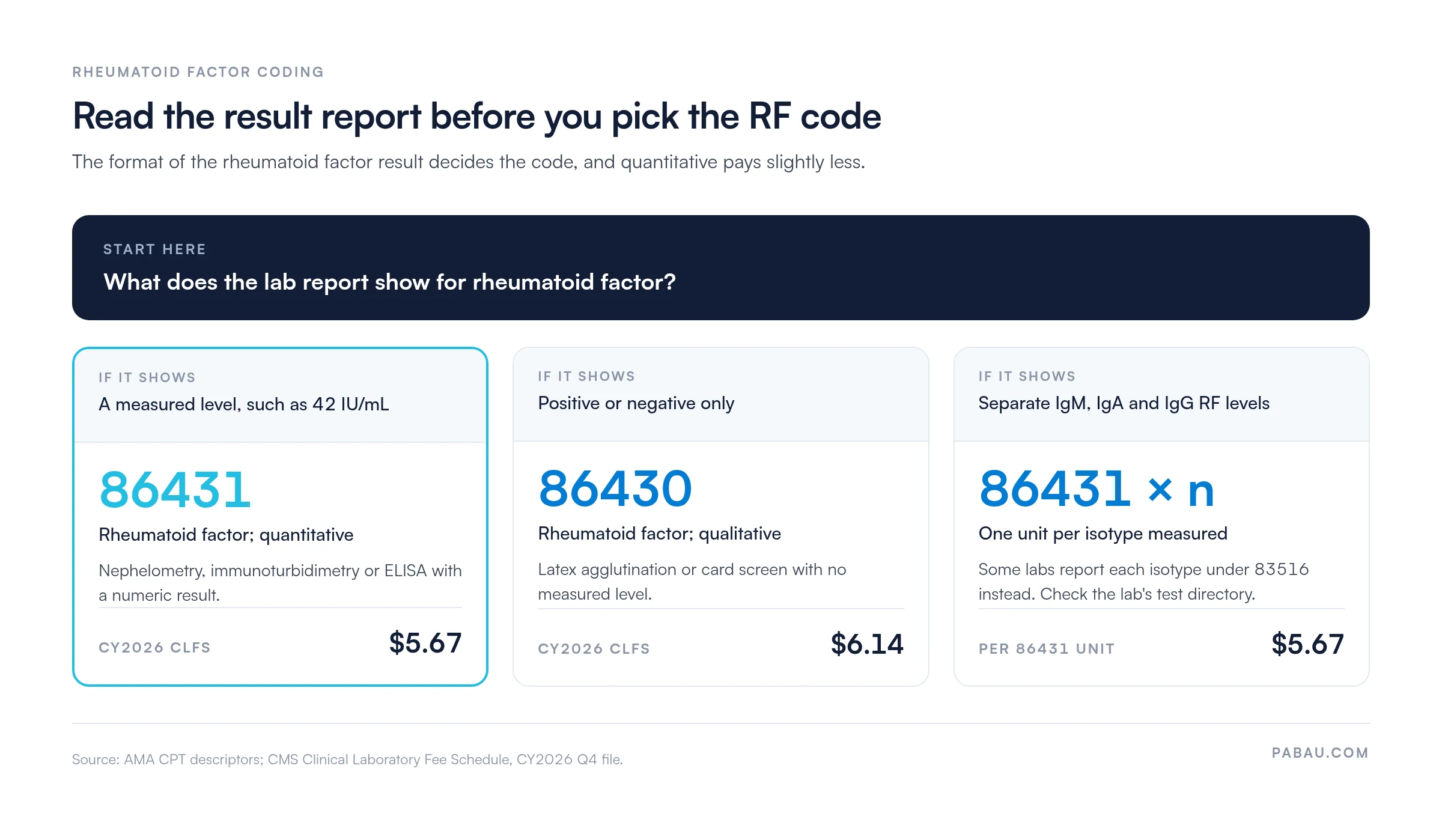
86431 is the CPT code for rheumatoid factor, quantitative: the blood test that reports RF as a measured level, such as IU/mL. Labs run it by nephelometry, immunoturbidimetry or ELISA, and a positive or negative screen is coded 86430 instead.
The code sits in the Immunology subsection (86000-86849) of the Pathology and Laboratory section. Medicare pays it under the Clinical Laboratory Fee Schedule, and medical necessity usually rests on an M05 or M06 rheumatoid arthritis diagnosis.
Let Pabau's smart automation suggest the right codes, reduce claim denials, and keep your practice compliant—effortlessly.
Automate repetitive tasks and focus on what matters most—your patients.
Reduce coding errors and ensure compliance with the latest regulations.
Clean claims, fewer denials, and faster reimbursements.
Powerful insights and reporting to help your practice thrive.
HIPAA compliant SOC 2 certified GDPR-compliant Trusted by 4,000+ clinics worldwide

CPT code 86431 reports rheumatoid factor as a measured level, while a positive or negative screen is coded 86430.
M05 (rheumatoid arthritis with rheumatoid factor) and M06 (other rheumatoid arthritis, including seronegative RA) give 86431 its strongest medical-necessity support.
Check that the lab report shows a numeric result before you bill, because a descriptor mismatch is the leading denial cause on RF claims.
Pabau, the practice software we build, submits claims through Claim.MD, runs eligibility checks, tracks claim status and flags denied claims for rework.
CPT code 86431 is the AMA CPT procedure code for rheumatoid factor (RF) testing reported as a measured level. The official descriptor is Rheumatoid factor; quantitative, and it names no antibody isotype.
Specifically, standard assays mainly detect IgM-class RF, the antibody that targets the Fc region of IgG. In addition, a quantitative result gives the clinician a titer, typically in IU/mL, that can be tracked over time to monitor disease activity. The qualitative screen (86430) returns only positive or negative.
ARUP Laboratories, Quest Diagnostics, and Mayo Clinic Laboratories all bill their standard quantitative RF assays under CPT code 86431. When a reference lab performs the test, billing follows the reference lab’s supplier number, not the ordering practice’s NPI.
Therefore, knowing the scope of 86431 prevents the most common bundling and unbundling errors. The code covers one analyte, rheumatoid factor, reported as a measured level by any quantitative method.
If the rheumatologist orders “RF panel, all isotypes,” the lab reports one result per isotype and bills one unit per isotype. Whether those units are 86431 or 83516 depends on the performing lab, so match the claim to the lab’s own coding. Each unit still needs ICD-10 linkage to a supported diagnosis.
Billing 86430 when the test was quantitative is the most common error on RF claims. The two codes sit next to each other in the CPT book but describe different results, methods and clinical purposes.
Most rheumatology practices send blood to a reference lab that runs quantitative nephelometry. If the lab report shows a number with a reference range, the code is 86431. If it shows only “Positive” or “Reactive,” the code is 86430. Because a wrong code misrepresents the service on the claim, it can create false-claim exposure.
However, the two codes pay almost the same on the CY2026 Clinical Laboratory Fee Schedule, with 86431 at $5.67 and 86430 at $6.14. Picking the code for its rate gains a practice nothing, so the result format is the only test that matters, as the chart below shows.
Rheumatoid factor is rarely ordered alone. Instead, rheumatologists build autoimmune panels, and each added test is billed under its own CPT code. Thus, knowing which pairs can be billed together prevents NCCI edit denials.
The anti-CCP test (CPT 86200) and 86431 are routinely ordered at the same encounter in an RA workup. Most payers permit same-date billing because they are distinct analytes with separate clinical purposes. A small number of commercial plans apply NCCI-style bundling edits, so check your payer’s policy before billing both.
Besides the procedure code, every 86431 claim needs a diagnosis code that the payer’s policy accepts as justifying a quantitative RF test. The wrong ICD-10 code is the second most frequent denial trigger on this code, after wrong code selection.
M05.x and M06.x carry the strongest medical-necessity support for 86431 across Medicare Administrative Contractors. When the chart documents RA with rheumatoid factor and no further detail, the code is M05.9. Rheumatoid arthritis documented without that detail is M06.9.
Codes at the M25.5x or M79.0 level are acceptable at initial presentation but may draw extra LCD scrutiny for repeat testing. Verify accepted codes for your MAC region using the CDC ICD-10-CM web tool alongside your payer’s LCD.
Run a CPT-to-ICD-10 crosswalk before submitting RF quantitative claims. Tools like the AAPC crosswalk or CrossCoder show which ICD-10 codes your MAC accepts for 86431. A mismatch caught before submission saves a full appeals cycle.
Thin chart notes sit behind many 86431 denials. A correctly coded claim can still be denied if the chart note does not support medical necessity. Also, payers audit lab claims against the ordering note, especially for repeat tests.
In addition, these documentation standards feed directly into medical billing compliance requirements. In fact, a structured rheumatology encounter template captures each of the five elements more reliably than a free-text note.
Medicare reimburses CPT code 86431 under the Clinical Laboratory Fee Schedule (CLFS), not the Physician Fee Schedule. In other words, Medicare pays the CLFS rate, set nationally under PAMA and updated through CMS’s annual CLFS file. Thus, it is not a locality-adjusted fee. The CY2026 rate for 86431 is $5.67.
Medicare Part B does not require prior authorization for CPT code 86431 under standard clinical indications. Where medical necessity is uncertain, issue an Advance Beneficiary Notice of Noncoverage (ABN) before the specimen is drawn. Without an ABN, the practice cannot bill the patient if Medicare denies on medical-necessity grounds.
Four modifiers apply to 86431 in specific billing scenarios. Yet the wrong modifier, or a missing required one, triggers automatic claim edits that delay payment.
The -91 modifier is for a repeat test that is clinically necessary on the same date. A test rerun because of a lab error does not qualify. Still, CMS is explicit on this distinction. For commercial payers, modifier rules for -91 vary; confirm with the specific plan before applying.
Six denial patterns recur on 86431 claims. Moreover, each has a specific fix and a specific appeal argument.
The lab ran nephelometry and reported a titer, but the biller submitted 86430. The payer can deny the claim for descriptor mismatch once the result report is reviewed. Fix: rebill with 86431 and attach the lab result report showing the numeric value. Reference the official AMA CPT descriptor in the appeal letter.
The diagnosis code on the claim is not on the payer’s accepted list for RF testing. For example, common offenders are non-specific pain codes, such as M54.x back pain, submitted without a documented inflammatory indicator. Fix: pull the LCD, identify an accepted code that the chart supports, and rebill with the corrected ICD-10. Use the CrossCoder crosswalk tool to verify CPT-to-ICD-10 pairings before resubmission.
A second 86431 on the same date without modifier -91 triggers an automatic duplicate edit. Fix: if the repeat test was clinically legitimate, append -91 and resubmit with chart documentation explaining why a same-day repeat was necessary. Read Pabau’s overview of denial management in healthcare for a broader framework.
Some payers and LCDs set frequency limits on RF testing, so check your MAC or plan policy. Thus, a test inside the payer’s limitation window is denied. Fix: document a change in clinical status that justifies out-of-cycle testing, and submit a letter of medical necessity with the appeal. Your payer’s LCD or policy sets the window that applies.
Yet this denial is easy to overlook. The claim shows a CLIA number for a certificate that covers only waived testing, but the test performed was moderate-complexity (nephelometry). The CLIA certificate type on file with the MAC must match the complexity of the test performed. Fix: confirm the performing lab’s CLIA certificate level covers the test methodology, then resubmit with the correct CLIA number. See the denial codes in medical billing reference for CARC codes associated with this error.
Medicare denies on medical-necessity grounds, and no ABN was issued beforehand. As a result, the practice cannot bill the patient and must absorb the cost. Fix: for future claims, issue an ABN whenever the clinical indication is borderline. On the current denied claim, submit an appeal with the chart documentation supporting medical necessity. If the appeal fails, the loss is the practice’s. There is no fix after the fact without an ABN.
Build a pre-submission checklist for 86431. Confirm the lab result shows a numeric titer rather than positive or negative. Confirm the ICD-10 code is on your MAC’s accepted list and that no prior 86431 falls inside the payer’s frequency window. Then confirm the performing lab’s CLIA certificate covers moderate-complexity testing.
Most RF billing work happens after the claim leaves the practice: checking coverage, chasing status and reworking denials. Pabau, the practice management platform we build, handles those steps in its claims management software, so billers stop switching between payer portals.
Pabau submits lab claims, including 86431, through its Claim.MD clearinghouse integration. Next, real-time eligibility checks (270/271) show coverage and benefits before the visit. Finally, electronic remittance advice returns to Pabau and matches to claims.
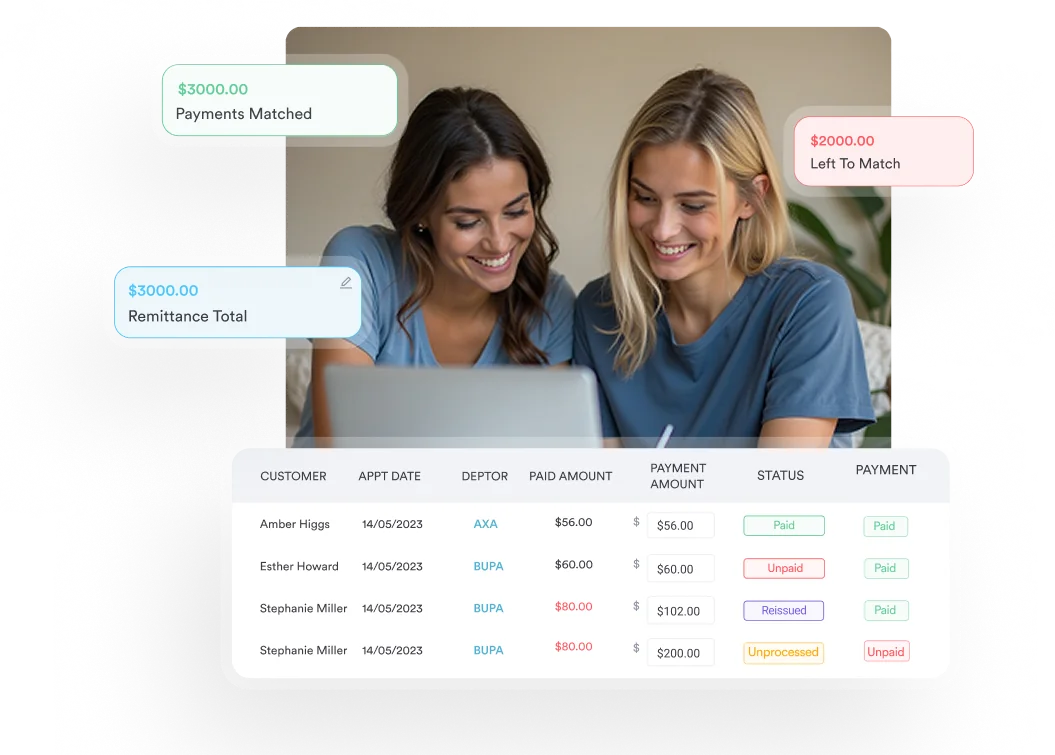
Claim status tracking shows where each claim sits, and denied claims are flagged for rework. Add the descriptor, ICD-10 and CLIA checks from our clean claim guide. A denied 86431 then gets corrected and resubmitted while it is still fresh.

Pabau submits lab claims through Claim.MD, runs eligibility checks, tracks claim status and flags denied claims for rework. Book a demo to see how it fits your rheumatology or primary care billing.

Code 86431 from the result report, not from the order. A measured RF level is 86431, a positive or negative screen is 86430, and an isotype panel bills one unit per isotype. At $5.67 and $6.14 for CY2026, the two codes pay almost the same, so the wrong one only adds denial risk.
Three checks prevent most of the rework. First, look for a numeric result in the chart, an M05 or M06 diagnosis your payer accepts, and a CLIA certificate that matches the method. Then build them into the requisition and the pre-submission review, and appeals on this code become rare.
Book a demo to see how Pabau tracks lab claims from submission to remittance, so a denied 86431 claim gets reworked before it ages.

Want to understand how clean claims are built? Clean claim best practices walks through the pre-submission steps that prevent the most common lab billing denials.
Need a deeper look at clearinghouse workflows? Medical claims clearinghouse guide explains how electronic claim routing and 835 ERA processing reduce billing rework.
Handling a high volume of immunology denials? Revenue cycle management overview covers the end-to-end workflow from lab order to payment posting.
CPT code 86431 covers a quantitative rheumatoid factor (RF) test that reports a numeric titer, such as IU/mL. Labs perform it with nephelometry, immunoturbidimetry, or quantitative ELISA on a serum specimen. However, it does not cover qualitative RF screening (CPT 86430) or anti-CCP antibody testing (CPT 86200). RF isotype panels bill one unit per isotype, as 86431 or 83516 depending on the lab.
CPT 86430 is the qualitative rheumatoid factor test, returning a positive or negative result by latex agglutination. In contrast, CPT 86431 is the quantitative version, returning a numeric titer by nephelometry or immunoturbidimetry. If your lab report shows a number with units (e.g., 42 IU/mL), the correct code is 86431. Billing 86430 for a quantitative result is the leading denial cause on RF claims.
The strongest-supported ICD-10 codes for CPT 86431 are M05.x (rheumatoid arthritis with rheumatoid factor) and M06.x (other rheumatoid arthritis, including seronegative RA). For initial workup, most MACs also accept M13.x (other arthritis), M79.0 (rheumatism, unspecified), and M25.5x (pain in joint) with documented inflammatory signs. Verify the current accepted list in your MAC’s LCD for RF testing.
Four modifiers can apply. QW marks a CLIA-waived test and applies only when the specific device is on the FDA/CMS CLIA-waived list. Modifier -91 marks a same-day repeat test for a separate clinical reason, never a rerun after a test failure. GA shows an ABN is on file when a medical-necessity denial is expected. Modifier -59 applies when a payer bundles 86431 with a genuinely distinct same-day lab code.