

CPT code 48152: Whipple procedure without pancreatojejunostomy
CPT code 48152: Official description and procedure overview CPT code 48152 descr...

Last Updated: Nov 13, 2026
86200 is the CPT code for a cyclic citrullinated peptide (CCP) antibody test, the anti-CCP blood test used to diagnose rheumatoid arthritis.
The code sits in the immunology range (86000-86849) of the Pathology and Laboratory section. Medicare pays it under the Clinical Laboratory Fee Schedule. Published studies put the test's specificity for RA above 95%, so it often settles a diagnosis when rheumatoid factor is negative. Most denials on this code come from ICD-10 pairings the payer's LCD does not accept.
Let Pabau's smart automation suggest the right codes, reduce claim denials, and keep your practice compliant—effortlessly.
Automate repetitive tasks and focus on what matters most—your patients.
Reduce coding errors and ensure compliance with the latest regulations.
Clean claims, fewer denials, and faster reimbursements.
Powerful insights and reporting to help your practice thrive.
HIPAA compliant SOC 2 certified GDPR-compliant Trusted by 4,000+ clinics worldwide

CPT code 86200 reports the cyclic citrullinated peptide (CCP) antibody test, a high-specificity marker for rheumatoid arthritis. Rheumatoid factor is coded separately, with 86430 or 86431.
Common ICD-10 pairings are M05.x for seropositive RA, M06.x for seronegative RA, and M12.3x for palindromic rheumatism.
Medicare pays 86200 under the Clinical Laboratory Fee Schedule, at a national rate of $12.95 in both 2025 and 2026.
CO-50 (not medically necessary) is the leading denial, so the chart needs joint findings, the prior RF result, and the reason for ordering.
Pabau’s claims management software sends 86200 claims as 837P files through the Claim.MD clearinghouse and checks eligibility before the specimen is drawn.
CPT code 86200 is the code for a cyclic citrullinated peptide (CCP) antibody test, with the official descriptor “Cyclic citrullinated peptide (CCP), antibody”.
Rheumatology, primary care, and internal medicine practices order it to confirm or rule out rheumatoid arthritis. The exact descriptor matters because rheumatology lab billing often goes wrong when this code is confused with neighboring immunology codes.
The 86200 descriptor names no antibody class. Most laboratories run an IgG anti-CCP assay, and some run a combined IgG/IgA assay instead. Neither version has a CPT code of its own.
Ask the laboratory’s billing department which code it reports for its assay before you code the order. A practice that bills one test under two codes faces a compliance finding as well as a denial.
Anti-CCP testing is ordered when a clinician suspects inflammatory arthritis and needs to distinguish early rheumatoid arthritis from other conditions. The American College of Rheumatology recognizes anti-CCP positivity as one of the classification criteria for RA. When the history includes a tick bite, Lyme arthritis is one of those other conditions. Its first-tier antibody screen is billed under its own code, CPT 86618.
Payer Local Coverage Determinations (LCDs) generally accept the following clinical scenarios as medically necessary indications for CPT code 86200:
Documentation must connect the clinical scenario directly to the order. A note that records joint involvement, symptom duration, and prior test results gives auditors the evidence trail payers require.
Repeat anti-CCP testing to track treatment response is a different matter. Titers do not follow disease activity, so payers rarely accept a monitoring order.
The ICD-10 diagnosis code decides whether an 86200 claim meets the payer’s medical necessity policy. Use the most specific code that reflects the patient’s current clinical status. Refer to the CDC/NCHS ICD-10-CM lookup tool to confirm code validity for the billing year.
The most common coding error on anti-CCP claims is selecting rheumatoid factor codes instead of, or in addition to, CPT code 86200. The table below sets 86200 against the antibody codes it is most often ordered with.
Key distinction: Anti-CCP (86200) tests for antibodies specific to citrullinated proteins. Rheumatoid factor (86430/86431) tests for antibodies against the Fc region of IgG. They answer different diagnostic questions and are routinely ordered together on initial RA workups.
CMS National Correct Coding Initiative (NCCI) edits do not currently bundle 86200 with 86431. Edits change quarterly, so check the current AAPC code reference before you bill both on the same day.
Run a quarterly NCCI edit check for CPT code 86200 paired with 86430 and 86431. Edits update every January, April, July, and October. A bundling edit that did not exist last quarter may now deny your same-day claims without warning. Build this check into your coding audit calendar.
CPT code 86200 is reimbursed under the Medicare Clinical Laboratory Fee Schedule (CLFS), not the Physician Fee Schedule. The CLFS sets one national payment amount for the code, and for 86200 it is $12.95 in both 2025 and 2026. CMS republishes the file each quarter, so check the CMS Clinical Laboratory Fee Schedule before you build it into a fee schedule.
Commercial payers typically cover CPT code 86200 when medical necessity is established, but rates vary significantly from Medicare’s CLFS rate. A few practical points for billing teams:
Prior authorization is not universally required for CPT code 86200, but medical necessity documentation is always required. Verify insurance eligibility and coverage before ordering. A covered test still goes unpaid when the chart cannot show why it was ordered.
To survive a payer audit on CPT code 86200, the medical record must contain all of the following:
A chart missing any of these elements is the leading cause of CO-50 (not medically necessary) denials. Under standard medical billing compliance requirements, the chart has to stand on its own, without letters written after the fact.
Denials on CPT code 86200 cluster around four root causes. Knowing the CARC code the payer sends tells you exactly which fix to apply. For a broader view of medical billing denial codes, review the full CARC reference before building your appeals workflow.
Effective denial management workflows catch CO-50 patterns early. Repeated CO-50 denials on 86200 with the same ICD-10 code mean the payer’s LCD does not accept that code for anti-CCP testing. Update your code-to-indication crosswalk accordingly.
Modifier selection on CPT code 86200 is straightforward in most cases but becomes a compliance issue when applied incorrectly. The three modifiers billing teams encounter most often are:
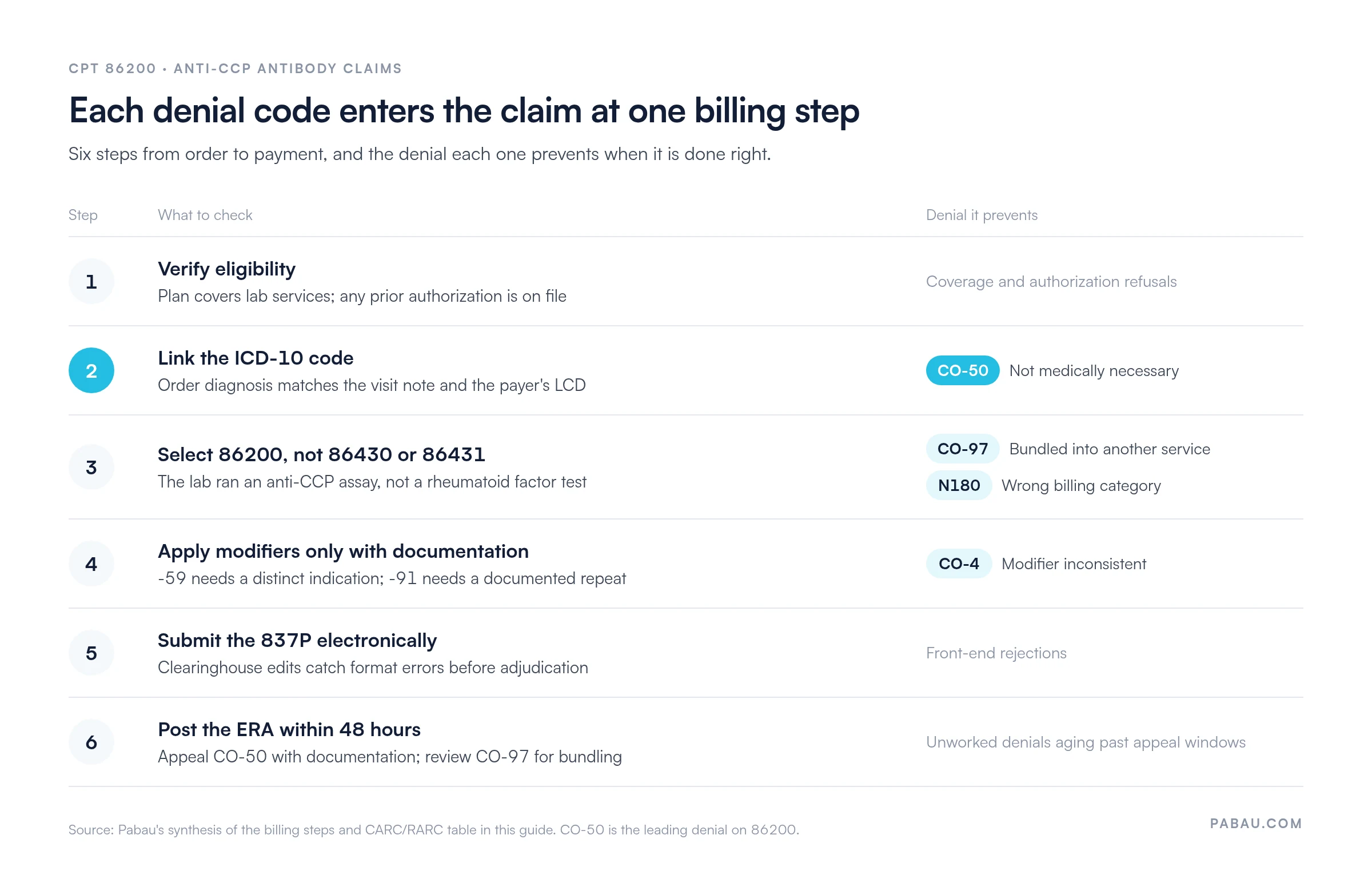
A clean claim for CPT code 86200 follows six steps from order entry to payment posting. Pabau, the practice management platform we build, runs two of them through its claims management software and its Claim.MD clearinghouse integration. Those are eligibility checks and electronic 837P submission.
Each step heads off a specific denial code, which is why a rejected 86200 claim usually points back to one step. The chart maps them.
Build a one-page CPT 86200 charge capture crosswalk. Map the five most common clinical presentations to the correct ICD-10 code, any modifier that applies, and the payer-specific LCD link. Post it at the lab order entry workstation. Coders who reference a printed crosswalk make fewer ICD-10 pairing errors than those relying on memory.
Most anti-CCP denials start before the claim exists. The diagnosis on the requisition drifts from the visit note, or the RF result that justified the test never reaches the billing team.
In Pabau, the lab order, the visit note and the claim share one patient record. Practices with Labs switched on order Quest tests from that record, and results import automatically. Labcorp results sync back from Labcorp Link the same way.
The billing team then codes 86200 from the note that justified it. Claims go out as 837P files through Claim.MD, with eligibility checked before the draw and ERA remittances posted against the same record. A CO-50 denial lands next to the documentation that answers it.

Pabau keeps the lab order, the visit note and the claim on one patient record. Claims go out through Claim.MD with eligibility checks and ERA posting, so CO-50 appeals start from the note.

An 86200 claim is decided in the exam room. A note that records the joint findings, the RF result and the reason for ordering anti-CCP survives an LCD review. A note that leaves those for the coder to infer draws a CO-50.
The payment is small, at $12.95 on the 2026 CLFS, so a denied 86200 rarely justifies a long appeal. Get the pairing right on the first submission and save appeal time for the claims that pay more. Book a demo to see how Pabau keeps lab orders, notes and claims on one record.

Looking to benchmark your 837P claim format? 837 file format guide covers the EDI transaction set structure used for all professional lab claims including CPT 86200.
Want to reduce claim denials practice-wide? Revenue cycle management guide breaks down each stage from charge capture through payment posting and where immunology lab claims most often leak revenue.
CPT code 86200 covers a laboratory test for cyclic citrullinated peptide (CCP) antibodies in a patient’s serum, used mainly to diagnose rheumatoid arthritis. Medicare pays it under the Clinical Laboratory Fee Schedule.
CPT 86200 measures anti-CCP antibodies, a marker for rheumatoid arthritis. CPT 86235 reports extractable nuclear antigen (ENA) antibodies, billed once for each antibody tested, in workups for lupus and mixed connective tissue disease. An ANA screen has its own code, 86038. Both 86200 and 86235 can be billed on the same date when each is clinically indicated and documented.
Yes, Medicare covers CPT code 86200 under the Clinical Laboratory Fee Schedule when medical necessity is established. That takes an appropriate ICD-10 diagnosis code and supporting clinical documentation. Coverage specifics, including which ICD-10 codes are accepted, vary by MAC jurisdiction and are governed by each MAC’s Local Coverage Determination for autoimmune testing.
CO-50 (not medically necessary) is the most common denial. It usually follows an ICD-10 code the payer’s LCD does not list, or thin documentation of the clinical indication. CO-97 (bundled service) occurs when 86200 is submitted on the same date as a code the payer bundles it with. Corrective actions include adding clinical documentation for CO-50 appeals and verifying current NCCI edits before resubmitting CO-97 denials.
Generally yes, because anti-CCP (86200) and quantitative rheumatoid factor (86431) test for different analytes and serve distinct diagnostic purposes. However, check the current CMS NCCI Procedure-to-Procedure (PTP) edit table before billing both on the same date. NCCI edits update quarterly, and bundling rules can change. When both are separately documented and clinically indicated, modifier -59 may be applicable if an edit is active.



