CPT code 34812: Open femoral artery exposure for endovascular repair
CPT code 34812: Official descriptor and procedure overview CPT code 34812 is off...

Last Updated: Nov 19, 2026
86039 is the CPT code for antinuclear antibodies (ANA); titer. It reports the titer, the dilution endpoint a lab measures after a positive ANA screen.
86039 does not replace the screen. The screen is reported with 86038, and 86039 is added when the lab goes on to titer a positive result. Both codes are paid under the Medicare Clinical Laboratory Fee Schedule and are commonly billed together on the same date of service.
Let Pabau's smart automation suggest the right codes, reduce claim denials, and keep your practice compliant—effortlessly.
Automate repetitive tasks and focus on what matters most—your patients.
Reduce coding errors and ensure compliance with the latest regulations.
Clean claims, fewer denials, and faster reimbursements.
Powerful insights and reporting to help your practice thrive.
HIPAA compliant SOC 2 certified GDPR-compliant Trusted by 4,000+ clinics worldwide

CPT code 86039 reports the antinuclear antibody (ANA) titer, the dilution endpoint a lab measures after a positive ANA screen.
86038 reports the ANA screen itself, and 86039 is reported in addition to it when the lab titers a positive screen.
Both codes are paid under the Medicare Clinical Laboratory Fee Schedule and are commonly billed together on the same date of service.
Neither descriptor names a test method or requires a staining pattern, so the screen reports as 86038 whether the lab used IFA or an immunoassay.
Follow-up antibodies carry their own codes, such as 86225 for anti-dsDNA and 86235 for each extractable nuclear antigen like SSA or SSB.
CPT code 86039 describes antinuclear antibodies (ANA); titer. It is the code a lab reports when it dilutes a positive ANA specimen to find the endpoint titer. Quest Diagnostics’ ANA reflex test shows the usual pairing: the screen bills as 86038, and a positive screen adds 86039 at an additional charge.
The American Medical Association maintains the descriptor. The semicolon matters. It makes 86039 an indented child of 86038, so “titer” is the extra work 86039 describes on top of the ANA test itself.
86039 covers one piece of work: measuring how far a positive specimen can be diluted before the ANA result turns negative. The lab reports that endpoint as a ratio, such as 1:160 or 1:640.
What the code includes:
Many labs titer by indirect immunofluorescence (IFA) on HEp-2 cells and report a staining pattern at the same time. The descriptor asks only for a titer. A pattern adds clinical detail to the report, and 86039 is reportable without one.
86039 does not report the ANA screen, and it does not report antibodies to specific nuclear antigens. A lab that runs those tests bills each one under its own code, alongside 86038 and 86039 where they apply.
Two code mix-ups recur on ANA claims. Anti-dsDNA is 86225, not 86200, which reports CCP antibody in a rheumatoid arthritis workup. SSA and SSB are 86235 per antibody, not 86431, which is rheumatoid factor.
86038 and 86039 work as a pair. 86038 reports the ANA test itself, and 86039 reports the titer the lab adds when that test is positive. A titered result normally puts both codes on the claim.
Older guides describe 86039 as the complete IFA test and 86038 as a screen to drop when a titer is run. That framing does not match the descriptors. Following it removes a payable 86038 line from the claim and leaves the screen unbilled.
We found no NCCI edit or payer policy that bundles 86038 into 86039. Neither code needs a modifier to be paid alongside the other, so check your payer’s own edits before you add one.
A lab report with a positive ANA and a titer needs two codes on the claim. Use 86038 for the screen and 86039 for the titer. A claim with only 86039 is usually missing the screen, not avoiding a bundling edit.
Knowing the lab sequence helps coders match each claim line to a step on the report. A typical IFA reflex workflow runs like this:
Some labs screen by immunoassay and titer by IFA. The coding stays the same: the screen reports as 86038 whatever the method, and the titer reports as 86039.
Proper documentation protects an 86039 claim from first submission through post-payment review. It starts with the order and the lab report, and both need to agree with the claim.
Elements the record should carry:
A clean claim submission for 86039 rests on that titer ratio. If the report shows a positive screen with no titer, 86039 has nothing to support it, and only 86038 belongs on the claim.
Medical necessity for 86039 rests on an ICD-10-CM code that explains why the clinician ordered ANA testing. No diagnosis code guarantees coverage, so the clinical notes must support the order. Check for an applicable LCD in the CMS Medicare Coverage Database for your jurisdiction.
Use the most specific code the documentation supports. Where lupus is diagnosed but its type is not documented, M32.9 tells the payer why the titer was ordered. R68.89 is a catch-all, and payers scrutinize claims that carry only nonspecific symptom codes without findings that point to an autoimmune process.
Medicare pays 86039 under the Clinical Laboratory Fee Schedule (CLFS), not the Medicare Physician Fee Schedule. 86038 sits on the same schedule. Look up the current rate in the CMS CLFS files rather than relying on figures from prior years.
The rate that applies is the one in effect on the date of service. CLFS rates are national limitation amounts, so the physician fee schedule lookup will not price either code.
Medicare Administrative Contractors (MACs) decide local coverage. Where a MAC publishes an LCD or billing article for ANA testing, it can list covered diagnoses, frequency limits and documentation standards. Billing teams that serve patients in several states should track those rules by jurisdiction.
Commercial payers usually follow the same pairing of 86038 and 86039. Some set their own frequency or diagnosis rules, so insurance eligibility verification before a reflex panel avoids surprises.
Most labs sell ANA testing as a reflex panel. The screen runs first, and a positive result triggers the titer automatically. The claim then mirrors what the lab performed.
Three common scenarios decide which lines go on the claim:
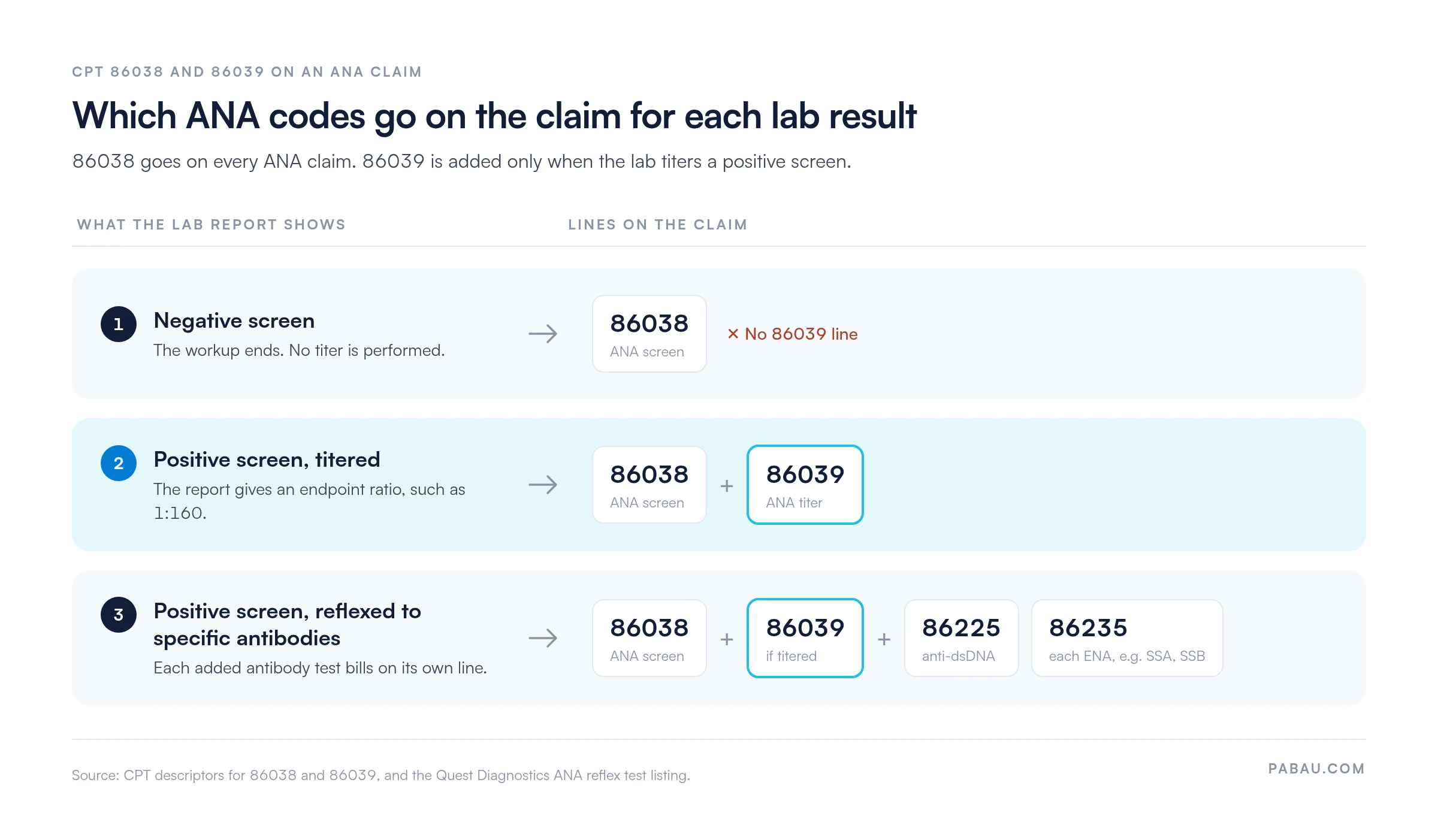
Reference labs assign their own order codes to ANA panels and set the CPT codes and units behind them. Check the lab’s test directory for each panel you order, because that mapping can change between CPT updates.
Most 86039 denials fall into a few repeatable patterns. A structured denial management workflow and a reference list of medical billing denial codes speed up root-cause analysis. The table below maps the most common problems to corrective actions.
Audit ten recent ANA claims against their lab reports. Every positive, titered result should carry both 86038 and 86039, and every negative result should carry 86038 alone. A mismatch points to a charge capture rule that needs fixing.
An ANA claim is only as accurate as the lab report it is built from. A biller drops a screen line, or a titer goes out on a negative result. Pabau, a practice management platform with built-in claims, keeps the order, the report and the claim on the same patient record.
Pabau’s claims management software submits claims through Claim.MD, the clearinghouse integration for US practices. Your team can then track each 86038 and 86039 claim until the payer responds.
When a denial comes back, the lab report sits on the same record as the claim. Your biller can check the titer, correct the line and resubmit without searching another system.
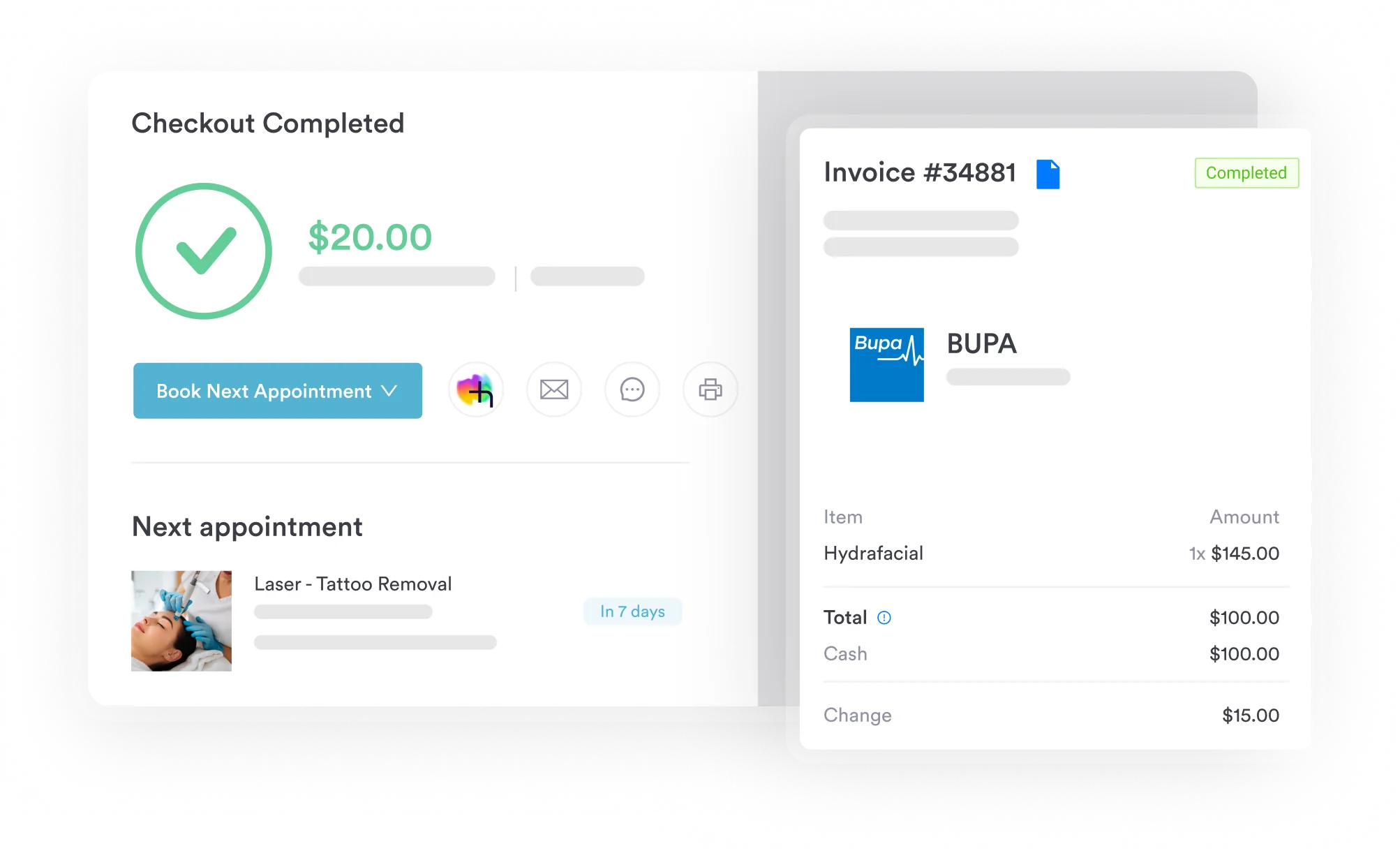

Pabau submits your claims through Claim.MD and tracks each one until the payer responds. Your team keeps the order, the lab report and the claim on one patient record.

The fix for most 86039 errors is to read the code as the descriptor writes it. 86039 is the titer, and it rides on top of the 86038 screen. A titered positive result bills both, and a negative result bills 86038 alone.
Practices that still strip 86038 from titered claims are giving up a payable line for a bundling rule that does not exist. Fix the charge capture rule once, and every future ANA claim goes out complete.
Book a demo to see how Pabau helps your team submit and track lab claims through Claim.MD.

Need to understand how the claims pipeline works? Claim.MD clearinghouse guide explains how electronic claims flow from practice to payer and back.
Want a faster route to clean submissions? Clean claim checklist covers the fields and documentation that prevent ANA and other lab claims from rejecting on first pass.
Dealing with high denial volumes across your lab panel? Revenue cycle management guide maps the full billing lifecycle from order through payment posting.
Coding the screen that comes before the titer? CPT code 86038 covers the ANA test itself and the documentation behind it.
CPT code 86039 covers the antinuclear antibody (ANA) titer. Its descriptor reads Antinuclear antibodies (ANA); titer. The lab reports it when it dilutes a positive ANA specimen to find the endpoint, such as 1:160. The descriptor names no test method and does not require a staining pattern.
86038 reports the ANA test itself, positive or negative. 86039 reports the titer the lab adds when that test is positive. The two codes are not alternatives. A positive, titered result is normally billed with both codes, and a negative result with 86038 alone.
Yes. 86039 is reported in addition to 86038 when the lab titers a positive screen. Reference labs such as Quest bill the screen as 86038 and add 86039 for the titer. We found no NCCI edit or payer policy that bundles the two, so no modifier is needed to pair them.
The lab report should state the titer as a dilution ratio, such as 1:160 or 1:640. It should also show the positive screen that led to the titer, and the record should carry the order or reflex authorization. A staining pattern is useful clinical detail, but the code does not require it.
Yes. Medicare pays 86039 under the Clinical Laboratory Fee Schedule when the test is medically necessary. Local coverage rules, such as accepted diagnoses and frequency limits, can vary by MAC jurisdiction. Check the CMS Medicare Coverage Database for any LCD that applies in your region.
Common denials include a titer billed on a negative screen and a nonspecific or uncovered ICD-10 code. Others include a lab report with no titer ratio and repeat testing beyond the payer frequency limit. Dropping 86038 from a titered claim does not cause a denial, but it leaves the screen unpaid.