ICD-10 Code J81.1: Chronic pulmonary edema
ICD-10 Code J81.1: Definition and code details ICD-10 Code J81.1 is a billable d...

Last Updated: Nov 16, 2026
Billable Code Specific Code
R77.8 is the billable ICD-10-CM code for other specified abnormalities of plasma proteins. It covers an abnormal plasma protein result that no confirmed diagnosis explains and that R77.0, R77.1, R77.2 or R77.9 does not describe.
Use it while the workup is still open. Once the clinician confirms what caused the finding, that diagnosis code replaces R77.8 on the claim.
Let Pabau's smart automation suggest the right codes, reduce claim denials, and keep your practice compliant—effortlessly.
Automate repetitive tasks and focus on what matters most—your patients.
Reduce coding errors and ensure compliance with the latest regulations.
Clean claims, fewer denials, and faster reimbursements.
Powerful insights and reporting to help your practice thrive.
HIPAA compliant SOC 2 certified GDPR-compliant Trusted by 4,000+ clinics worldwide

R77.8 covers a specified plasma protein abnormality that R77.0 (albumin), R77.1 (globulin) and R77.2 (alphafetoprotein) do not describe.
The code is billable in the FY 2027 ICD-10-CM code set, under Chapter 18 (R00-R99), the chapter for signs, symptoms and abnormal findings.
R77.8 should not be the primary diagnosis once a definitive etiology has been established.
A confirmed plasma-protein metabolism disorder (E88.0-) is never coded with R77.8, because category R77 carries an Excludes1 note for it.
In Pabau’s billing software, the lab result, the clinician’s note and the claim sit in one patient record, so the coder works from the source.
ICD-10 code R77.8 is the billable code for other specified abnormalities of plasma proteins. It is a valid code in CMS’s FY 2027 ICD-10-CM files, which took effect on October 1, 2026. Coders use it when a named plasma protein is abnormal and no confirmed diagnosis explains the finding.
Because R77.8 sits in Chapter 18, the ICD-10-CM Official Guidelines for Coding and Reporting treat it as a sign or symptom code. So it is not assigned as an additional code when a confirmed diagnosis already explains the protein abnormality.
R77.8 is the residual code for abnormal plasma protein findings. It applies when no more specific R77 subcode or confirmed disease code fits. These are the most common clinical triggers.
Each scenario shares one condition: The finding is still under investigation. Once a definitive diagnosis explains it, the confirmed condition’s code takes over and R77.8 drops off the claim.
Category R77 carries one Excludes1 note, for disorders of plasma-protein metabolism (E88.0-). An Excludes1 note means the two codes are never reported together. Four sibling codes and three neighbors outside R77 also take findings that R77.8 does not, and payer edits can flag the mismatch.
The Excludes1 note matters most for albumin. A low albumin that the clinician documents as hypoalbuminemia is coded E88.09, a plasma-protein metabolism disorder, rather than R77.0 or R77.8.
R79.89 is the most common source of confusion. Both R77.8 and R79.89 are residual “other” codes, but they cover different findings. R77.8 is specifically for plasma proteins. R79.89 covers other abnormal blood chemistry findings that no code in the R70-R79 block describes more precisely.
Category R77 holds five codes: R77.0, R77.1, R77.2, R77.8 and R77.9, the unspecified code. Picking the right one means matching the protein the note names to the descriptor, not to the broader clinical picture. The decision map below puts the three questions in the order a coder should ask them.
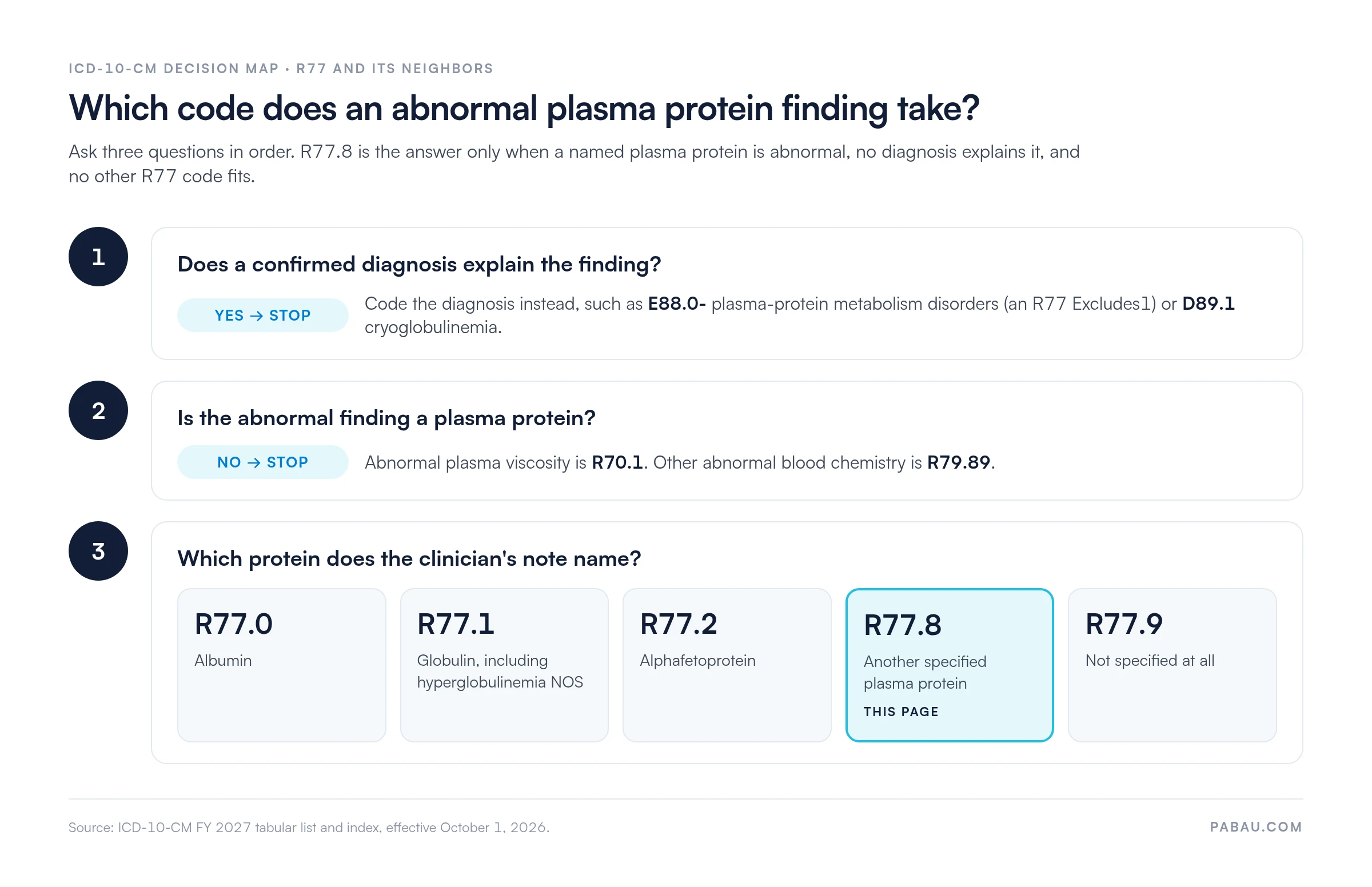
When more than one R77 code could plausibly apply, document the specific fraction that is abnormal. The clinical note should name the protein, such as albumin, globulin or alphafetoprotein, so the coder can match it to the most specific code.
The FY 2027 ICD-10-CM Official Guidelines say abnormal lab findings are not reported as additional diagnoses unless the provider indicates their clinical significance. CMS publishes the guidelines with its ICD-10 code files. Payers reviewing medical necessity look for more, so a defensible R77.8 claim rests on four elements in the record.
Primary vs. secondary sequencing: In outpatient settings, R77.8 can be the primary diagnosis when the encounter exists to evaluate the abnormal protein result. That holds only while no definitive diagnosis has been established. In inpatient settings, the Uniform Hospital Discharge Data Set (UHDDS) rules make the condition established after study the principal diagnosis. R77.8 rarely qualifies as the inpatient principal diagnosis once workup is complete.
Run a documentation checklist at the point of encounter: Lab result attached, clinician notation present, clinical context stated, confirmed diagnosis absent. A payer can deny R77.8 on medical necessity grounds when any one of the four is missing. Building the checklist into the intake workflow surfaces the missing item before the claim leaves the practice.
Medicare treats R77.8 like other Chapter 18 sign and symptom codes. Coverage depends on whether the laboratory test ordered is itself covered. Local Coverage Determinations (LCDs) govern the specific tests, such as SPEP and immunofixation electrophoresis, rather than the diagnosis code.
Payer policies on this code vary and change with annual updates. Verify coverage against the current MAC LCD and commercial plan policy before submitting.
Denials tied to this code cluster around four correctable documentation and sequencing problems, and each has a straightforward fix. The reason code on the remittance usually shows which one applies, and our guide to claim denial codes decodes it.
Most workups start with a total serum protein test billed as 84155. An abnormal band on electrophoresis then leads to immunofixation, billed as 86334. The table below lists the codes most often paired with R77.8, along with the clinical scenario that drives each.
Pairing these CPT codes with R77.8 is clinically logical, but each test may carry its own LCD requirements for medical necessity. Confirm that the documentation supporting R77.8 also satisfies the LCD criteria for the specific CPT code billed.
Immunoglobulin quantification under 82784 needs the most care, because it is billed once for each class measured. Practices that send claims through the Claim.MD clearinghouse also get its claim edits applied before the claim reaches the payer.
Verify CPT-to-ICD-10 medical necessity crosswalks before submitting SPEP (84165) or IFE (86334) with R77.8. Some MACs require the ordering note to document specific symptoms or prior test results before accepting these CPT codes under a Chapter 18 sign/symptom diagnosis. Flag this in your pre-authorization workflow rather than discovering it at denial.
Four patient contexts change how R77.8 applies. In each one, assigning the code without checking that context leads to errors.
Reference ranges for serum total protein and individual protein fractions differ significantly in children under 12. A value flagged as abnormal on an adult reference range may be normal for the patient’s age. The ordering clinician’s note must confirm that the finding is abnormal for the patient’s age group before R77.8 can be assigned. Relying on the adult range printed on the lab report, without that confirmation, is a shortcut auditors flag.
Total protein levels fall physiologically during pregnancy due to hemodilution. A result that looks low against a standard reference range may be expected in a pregnant patient.
When an obstetric provider orders a protein panel and the result is flagged, the note must say whether the finding is pregnancy-related or pathological. If it is pregnancy-related and not clinically significant, R77.8 is not assigned. If it is pathological, an obstetric complication code from Chapter 15 may fit better than a Chapter 18 sign code.
Plasma protein abnormalities are a common early finding in patients evaluated for hematologic malignancies. R77.8 fits the diagnostic workup phase, before any malignancy code has been established. Once a diagnosis such as multiple myeloma, Waldenström macroglobulinemia or amyloidosis is confirmed, that diagnosis code replaces R77.8. Coders supporting oncology practices should flag R77.8 claims for re-review once pathology results return.
In the outpatient setting, R77.8 can be the reason for the encounter if the visit exists to evaluate the abnormal protein result. In the inpatient setting, UHDDS rules make the condition established after study the principal diagnosis.
Inpatient stays for protein abnormalities usually end with a confirmed diagnosis, so R77.8 rarely survives as the principal inpatient code. Facilities using R77.8 as a DRG-driving principal diagnosis should expect scrutiny during internal audits and RAC reviews.
In many practices, the abnormal protein result, the clinician’s note and the claim live in three different places. The coder rebuilds the link between them days later, and that is where the sequencing and medical necessity errors above start.
Pabau keeps all three in the patient record. Practices can switch on US lab ordering, so Quest and Labcorp results import into the record automatically. The clinician’s review note sits beside the result, and single-record claims management sends US claims through Claim.MD, with eligibility checks and ERA remittances.
For SPEP or immunofixation orders that need prior authorization, the auth code, dates and sessions are tracked on the case. Pabau warns staff when an authorization is missing, so the problem surfaces before the test is billed. The result is an R77.8 claim that matches the note and the lab result it came from.

Pabau keeps lab results, clinician notes and insurance claims in one patient record. Your coders sequence R77.8 from the evidence instead of rebuilding it weeks later.

R77.8 is a holding code. It belongs on a claim only while a named plasma protein is abnormal and the workup has not produced a diagnosis. Once the clinician confirms a cause, the code should leave the claim.
That makes the clinician’s note the deciding document. A good note names the protein, says why the test was ordered and records whether a diagnosis exists. With that, the coder can choose across R77.0 to R77.9 with confidence. A note that skips those details leaves the claim exposed, however carefully it is coded.
Book a demo to see how Pabau keeps the lab result, the note and the claim together for every R77.8 encounter.

Need to understand denial workflows for Chapter 18 codes? Denial management in healthcare covers how to build a systematic denial prevention and appeals process for sign and symptom codes.
Submitting claims through a clearinghouse for the first time? Medical claims clearinghouse explains how clearinghouse validation works and what to look for when evaluating a clearinghouse partner.
Want to understand what a clean claim looks like before submission? Clean claim requirements details the documentation and formatting standards that prevent front-end rejections across payers.
Is the abnormal result a protein at all? ICD-10 code R79.89 covers coding for abnormal blood chemistry findings that fall outside the plasma protein codes.
Quantifying immunoglobulins after an abnormal SPEP? CPT code 82784 explains billing for IgA, IgD, IgG and IgM quantification, one class at a time.
ICD-10 code R77.8 is a billable diagnosis code for other specified abnormalities of plasma proteins. It is assigned when a lab result shows a named plasma protein abnormality that no confirmed diagnosis explains. The abnormality must also fall outside R77.0 (albumin), R77.1 (globulin) and R77.2 (alphafetoprotein).
Yes, R77.8 is a valid billable ICD-10-CM code in the FY 2027 code set, effective October 1, 2026. It appears in Chapter 18 (R00-R99). It can be the primary diagnosis in outpatient settings when no confirmed etiology has been established.
R77.0 is specific to an abnormality of albumin, so it applies when the note names albumin as the abnormal protein. R77.8 is the residual code for other specified plasma protein abnormalities that R77.0, R77.1 and R77.2 do not describe. A documented hypoalbuminemia goes to E88.09 instead of either code.
Use R77.8 only when the abnormal protein does not match R77.0, R77.1 or R77.2, and no confirmed disease diagnosis has been established. If the globulin fraction is abnormal, R77.1 applies. If albumin or alphafetoprotein is the abnormal protein, R77.0 or R77.2 applies. If the record names no protein at all, R77.9 is the code.
Four denial triggers come up most often. The lab documentation is missing from the chart, or R77.8 leads the claim after a diagnosis was confirmed. R77.8 is assigned where a more specific R77 code applies, or no clinician note acknowledges the finding. Each is correctable at the documentation stage before submission.
The most common pairings are CPT 84155 (total serum protein), CPT 84165 (serum protein electrophoresis), CPT 86334 (immunofixation electrophoresis), and CPT 82784 (individual immunoglobulin quantification). Each may carry its own LCD medical necessity requirements separate from R77.8.