



CCSD code G5100: Bypass of duodenum billing guide
CCSD code G5100 bills a bypass that leaves the duodenum in place CCSD code G5100...

Last Updated: Oct 16, 2026
CPT code 86003 covers allergen-specific immunoglobulin E (IgE) testing, billed as one unit for each allergen tested. Allergy, immunology, and primary care practices use it for blood-based sensitization workups. Medicare prices the test on the Clinical Laboratory Fee Schedule, so 2026 payment runs roughly $3 to $6 per allergen.
Two mistakes cause most denials on this code. The first is a diagnosis code that does not support medical necessity. The second is a unit count that does not match the lab report. This guide covers the 2026 rates, the ICD-10-CM pairings, documentation, and the payer rules that decide whether a claim survives.

CPT code 86003 describes allergen-specific IgE testing, quantitative or semiquantitative, billed as one unit per allergen tested.
Medicare prices 86003 on the Clinical Laboratory Fee Schedule, so 2026 rates run roughly $3 to $6 per allergen.
Clinical lab codes carry no RVUs and no facility or non-facility split, unlike codes paid under the Physician Fee Schedule.
An ICD-10-CM diagnosis code must support medical necessity on every claim, and missing linkage is the top denial reason.
CMS article A56558 treats in vitro IgE testing as a substitute for skin testing rather than an addition to it.
CPT code 86003 describes allergen-specific IgE, quantitative or semiquantitative, each allergen. The test measures a patient’s immune response to one named allergen by detecting IgE antibodies in a blood sample. Skin prick testing uses separate codes in the 95000 series, because that method challenges the patient directly rather than a serum sample.
The American Medical Association maintains the code through its annual CPT update cycle. Each allergen tested generates one unit, so a panel covering 15 allergens is reported as 15 units.
CPT code 86003 is used when a clinician orders blood-based allergen-specific IgE testing to assess sensitization to named allergens. It applies whenever a laboratory runs the test on a serum sample rather than challenging the patient’s skin.
Common clinical scenarios that justify ordering allergen-specific IgE testing include:
CMS Local Coverage Article A56558 treats in vitro IgE testing as a substitute for skin testing, not an addition to it. Coverage rests on a documented reason that skin testing is unsuitable or unreliable for this patient. Antihistamine use, severe dermatographism, and extensive eczema are the usual ones. Write that reason into the order, because a general allergy evaluation request will not support the claim.
Medicare prices CPT 86003 under the Clinical Laboratory Fee Schedule, not the Physician Fee Schedule. Clinical lab codes carry no work, practice expense, or malpractice RVUs, and there is no facility versus non-facility split. Payment is a single amount per test, set by carrier, and 2026 rates run roughly $3 to $6 per allergen.
West Virginia pays $5.22 per unit in 2026, while Florida pays $3.20. Check your own carrier in the CMS Clinical Laboratory Fee Schedule before you quote a figure to a patient.
Because the billable unit is the allergen, panel size decides what the claim is worth.
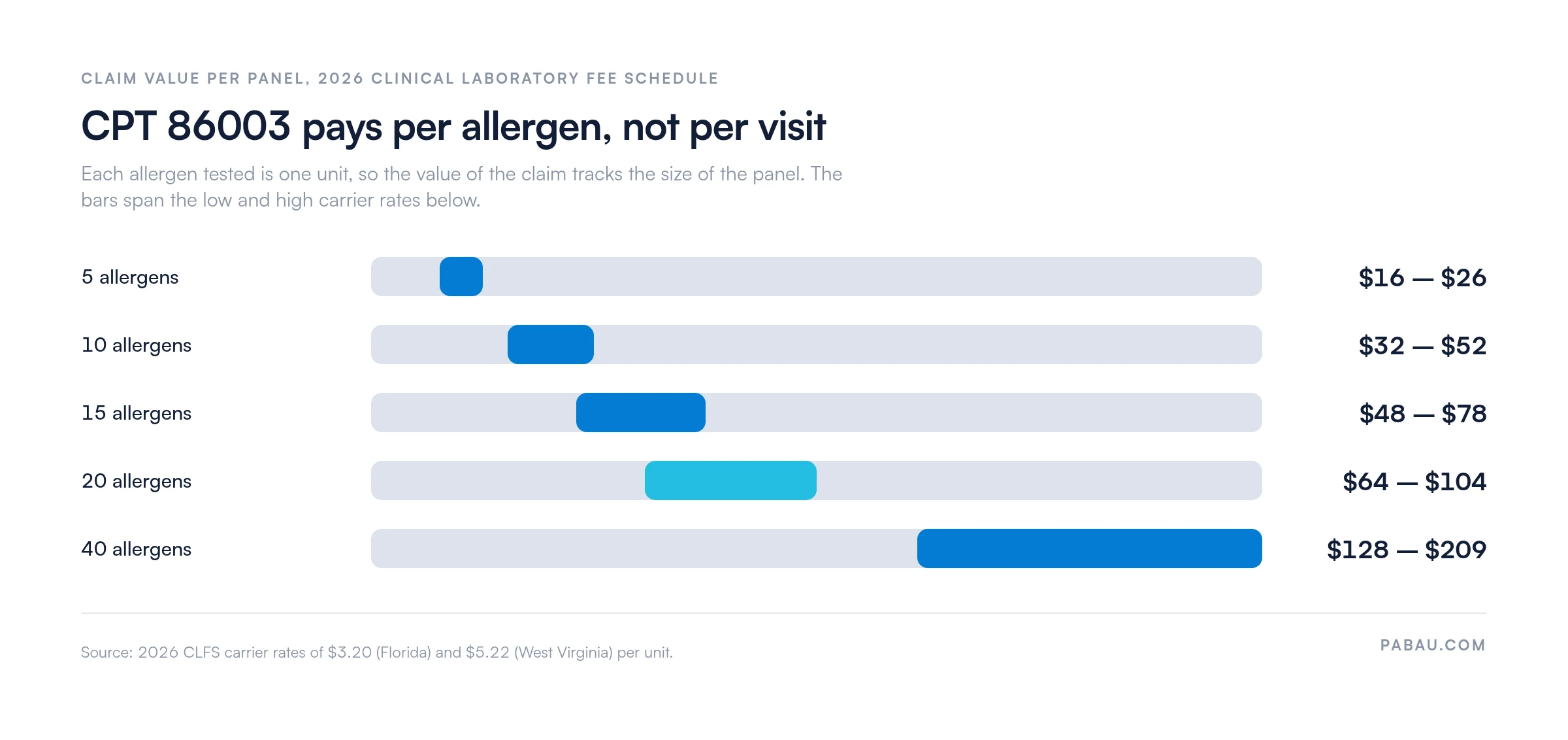
Reconciling each remittance against the units you billed matters more here than on a single-unit code. One missing unit is small on its own, and it repeats on every panel the practice sends.
Rates quoted here are approximate and move with each annual CLFS update. Private payer amounts come from your own contract, and they often sit well above or below Medicare.
Check the patient’s allergen testing benefit before the blood draw, not after the laboratory reports. Practice management software like Pabau runs eligibility through its Claim.MD connection, so a coverage limit shows up while you can still adjust the panel.
Every 86003 claim needs an ICD-10-CM diagnosis code that supports medical necessity. CMS Local Coverage Article A56558 lists the covered diagnoses, and a code outside that list is a common, correctable denial cause. Re-check the applicable codes against current CDC ICD-10-CM guidance each October 1, when the code set updates.
Pick the most specific code the chart supports, because an unspecified diagnosis is the leading cause of 86003 denials. Our ICD-10-CM code library carries the full descriptors for the respiratory and dermatologic codes in the table above.
Every CPT 86003 claim needs supporting clinical documentation in the patient chart. CMS Local Coverage Article A56558 sets the minimum standard, and most private payers apply the same criteria. Putting the chart in order before submission prevents most medical-necessity denials.
Required elements per CMS A56558 guidance:
Audit a random sample of 86003 charts every month. A missing physician order, and an IgE result that never reached the chart, are the two failures payers find most often in post-payment review.
CPT code 86003 uses a per-allergen unit structure, and that is the part practices most often get wrong.
Each allergen tested is one billable unit of CPT 86003. A patient tested for 20 allergens in a single laboratory encounter generates 20 units on one claim line. The AMA sets no cap on allergens per encounter. Individual payers and Medicare Administrative Contractors do apply their own limits through coverage policy or prior authorization.
Run insurance eligibility verification before the panel, so benefit limits and prior authorization requirements surface early. A 40-allergen panel submitted without that check is the most expensive version of this mistake.
Knowing where CPT 86003 sits among its siblings prevents miscoding and supports complete allergy testing billing. The AAPC CPT code lookup carries full descriptors for each code below.
CPT 86003 and CPT 86008 both measure allergen-specific IgE, and they differ in what the laboratory puts into the assay. 86003 reports testing against a whole allergen extract, billed once per allergen. 86008 reports testing against a single recombinant or purified molecular component, billed once per component.
Component testing usually follows a positive extract result, so the two codes often appear on separate dates rather than the same claim. Confirm which assay the laboratory ran before you pick the code.
One older sibling no longer exists. CPT 86006 was deleted from the code set in 1998, so any claim carrying it will reject as an invalid code. Coders who learned the mixture-panel rule under 86006 should treat 86008 as the current second code in this family.
Usually not. CMS Local Coverage Article A56558 states that total IgE testing is not appropriate in most general allergy testing. Pairing 82785 with a routine specific-IgE panel will therefore not hold up.
Report both codes only where the chart documents a separate, specific reason for measuring total IgE, and name that reason in the note. Check National Correct Coding Initiative edits and the payer’s own policy before you assume separate payment.
CPT code 86003 produces a predictable set of errors, and workflow changes fix them more reliably than coder training does.
Verify each of these elements before the claim leaves the practice. Correcting a denial afterwards costs far more staff time than the review would have taken.
Audit CPT 86003 claims monthly by matching billed unit counts against the laboratory reports in the chart. A one-unit mismatch on a 20-allergen panel is easy to miss on the day, and it compounds across a high-volume allergy practice.
An allergy practice running large panels has to keep three records in step: the order, the lab report, and the claim. When those live in separate systems, the unit count gets retyped, and retyping is where it drifts.
Practice management software like Pabau connects clinical documentation directly to claim submission. Digital forms capture the ordered allergens in a structured field, so the claim carries the count the clinician recorded. Pabau’s approach to cleaner claims management keeps the order, the documentation, and the submitted units in one system.
Claims go out electronically through the Claim.MD connection, and remittances post back against the units billed. Denied 86003 claims land in a worklist instead of a paper remittance stack. Billing staff can correct and refile from there, without rebuilding the claim from scratch.

Pabau connects clinical documentation to claim submission for CPT 86003 and related allergy codes. Eligibility checks, electronic claims, and automated remittance posting help your billing team get panels paid the first time.

Getting CPT 86003 right comes down to three habits. Match the units to the lab report, link a covered diagnosis the chart genuinely supports, and record why blood testing replaced a skin test.
Payment per unit is small, so the cost of an error shows up in volume rather than in any single claim. A practice running weekly panels recovers more from a tight pre-submission check than from any appeal it files later.
Book a demo to see how Pabau keeps allergen orders, documentation, and claim units in step for an allergy practice.

Need help understanding how claims move from submission to payment? Medical claims clearinghouse guide explains the full lifecycle from 837P file to remittance posting.
Want to reduce payer rejection rates before claims leave the practice? How Claim.MD clearinghouse works covers claim edits, payer enrollment, and eligibility checks.
Not yet enrolled with the payers your allergy patients use? Getting credentialed with insurance companies covers the provider enrollment steps that decide whether a panel gets paid at all.
CPT code 86003 describes allergen-specific immunoglobulin E (IgE) testing, quantitative or semiquantitative, reported once per allergen tested. It covers blood-based allergy sensitization testing, and it sits in the Pathology and Laboratory section of the AMA CPT code set, within the Immunology subsection.
One unit of CPT 86003 is billed per allergen tested, so a 15-allergen panel generates 15 units on a single claim line. The AMA sets no cap per encounter. Medicare Administrative Contractors and private payers do impose their own unit limits, so verify payer rules before submitting large panels.
Common ICD-10-CM codes paired with CPT 86003 include J30.1 for allergic rhinitis due to pollen and J45.20 for mild intermittent asthma. L20.9 covers atopic dermatitis unspecified, and T78.1XXA covers adverse food reactions. The linked diagnosis must be documented in the chart, and it must match a covered diagnosis in CMS article A56558.
Medicare pays CPT 86003 under the Clinical Laboratory Fee Schedule, at roughly 3 to 6 dollars per allergen unit in 2026. West Virginia pays 5.22 dollars per unit and Florida pays 3.20 dollars, so the amount depends on the carrier. Confirm the current figure in the CMS Clinical Laboratory Fee Schedule before billing.
No. CPT 86003 is a clinical laboratory test priced on the Clinical Laboratory Fee Schedule, so it carries no work, practice expense, or malpractice RVUs. There is also no facility or non-facility split. An RVU lookup tool will not return a usable rate for this code.



