ICD-10 Code S42.444P: Medial epicondyle fracture, right humerus
ICD-10 Code S42.444P: full descriptor and code validity ICD-10 Code S42.444P car...

Last Updated: Oct 13, 2026
Billable Code Specific Code
M35.1 is the billable ICD-10-CM code for other overlap syndromes.
Let Pabau's smart automation suggest the right codes, reduce claim denials, and keep your practice compliant—effortlessly.
Automate repetitive tasks and focus on what matters most—your patients.
Reduce coding errors and ensure compliance with the latest regulations.
Clean claims, fewer denials, and faster reimbursements.
Powerful insights and reporting to help your practice thrive.
HIPAA compliant SOC 2 certified GDPR-compliant Trusted by 4,000+ clinics worldwide

ICD-10 Code M35.1 (other overlap syndromes) is a billable ICD-10-CM diagnosis code valid for FY2026, effective October 1, 2025.
MCTD (also called Sharp syndrome) is the only official Applicable To inclusion term for M35.1; SLE, systemic sclerosis, and inflammatory myopathy overlaps are common clinical scenarios but are not separately listed.
M35.1 carries one Excludes1 note (M30.8) and the parent M35 category carries another (L87.1); M35.1 has no official Code Also instruction, though secondary manifestation codes are still best practice on complex claims.
Practice management software like Pabau connects ICD-10 diagnosis codes directly to billing workflows, reducing manual re-entry errors on complex rheumatology claims.
ICD-10 Code M35.1 is a billable ICD-10-CM diagnosis code for other overlap syndromes, connective tissue disease presentations that span two or more autoimmune diseases at once without meeting the full diagnostic criteria for any single one.
ICD-10 Code M35.1 is a billable ICD-10-CM diagnosis code under the official description “Other overlap syndromes.” It sits within the M35 block (Other systemic involvement of connective tissue), which is part of Chapter 13 of the ICD-10-CM tabular list: Diseases of the musculoskeletal system and connective tissue (M00-M99). The code is valid for FY2026, effective October 1, 2025, according to the CMS ICD-10-CM annual update.
Coders confuse M35.1 with the disease-specific codes in M32.x, M33.x, and M34.x more often than any other pattern in this block. The distinction comes down to whether the physician has documented a single primary connective tissue disease or a genuine multi-disease overlap.
The table below provides a quick-reference summary of ICD-10 Code M35.1 for coders and clinical documentation staff.
The “Applicable to” notes in ICD-10-CM are official inclusion terms, not guidelines. Per the CDC/NCHS ICD-10-CM official code tool and the official FY2026 tabular list, M35.1 carries exactly one Applicable To inclusion term:
Three other overlap presentations are commonly coded to M35.1 in practice, even though none of them appear as separate Applicable To entries in the tabular list:
The term “other overlap syndromes” in the code title is an NEC designation. It applies when a patient has documented overlap between two or more CTDs and no more specific code in ICD-10-CM captures the combination.
Clinics managing athletic injuries often pair these codes with outcome tracking in software for sports medicine.
MCTD is the primary reason coders encounter ICD-10 Code M35.1 in rheumatology practice. Understanding the documentation requirements for MCTD directly determines whether M35.1 can be assigned or whether a more specific code applies.
Clinically, MCTD is characterized by overlapping features of SLE, systemic sclerosis, and inflammatory myopathy with high-titer anti-U1 ribonucleoprotein (RNP) antibodies. The diagnostic criteria most used in practice include the Sharp criteria and the Kasukawa criteria. For ICD-10 coding, the coder does not apply diagnostic criteria directly; the physician’s documented diagnosis of MCTD or overlap syndrome triggers the code assignment.
Documentation must specify the type of overlap or the MCTD diagnosis. A note reading “connective tissue disease” alone does not support M35.1 – it would default to M35.9 (unspecified systemic involvement of connective tissue). A note reading “mixed connective tissue disease” or “overlap syndrome with SLE and systemic sclerosis features” supports M35.1 assignment.
Run a query in your practice management system for claims coded M35.9 in the past 12 months. Review the underlying notes – any that document a specific overlap (MCTD, Sharp syndrome, SLE plus sclerosis features) should be reassessed. Recoding to M35.1 where supported by documentation may recover previously underpaid claims.
Excludes and Code Also notes are the structural rules that govern how M35.1 interacts with other codes, and misreading them is one of the most common denial triggers for this code. In the official FY2026 tabular list, M35.1 carries a single Excludes1 note for polyangiitis overlap syndrome. The parent M35 category carries its own Excludes1 note for reactive perforating collagenosis, coded to L87.1, which applies across every M35.x code. M35.1 has no Excludes2 note. The AAPC ICD-10-CM code lookup presents these instructional notes alongside the code definition. Self-pay does not mean uninsured, and many patients recover part of the fee with a superbill.
An Excludes1 note means the two conditions cannot be coded together on the same claim. Because M35.1 excludes M30.8 under Excludes1, a claim reporting M35.1 cannot also report M30.8 for the same encounter – pick whichever code matches the documented diagnosis. The M35 category’s Excludes1 note for L87.1 works the same way and applies to M35.1 along with every other code in the M35 block.
An Excludes2 note means the excluded condition is not included in the code you are using but can be reported alongside it if the patient genuinely has both conditions and both are documented. M35.1 does not carry an Excludes2 note, so there is no such exception to weigh for this code. Verify the current notes against the official FY2026 CMS tabular list before submission, since they can change with each annual update.
M35.1 does not carry an official Code Also instruction in the current ICD-10-CM tabular list. That said, coding the manifestation of an overlap syndrome as a secondary code is standard practice for complex rheumatology claims, official instruction or not – for example, interstitial lung disease secondary to the underlying CTD overlap gets its own organ-system manifestation code alongside M35.1.
Skipping that secondary code on a complex rheumatology claim can still trigger a request for records or a downcoding, even without a formal Code Also note attached to M35.1. Review the full FY2026 instructional notes on the CDC/NCHS ICD-10-CM files page before finalizing claims that involve M35.1 with documented complications.
The M35 block contains several codes that coders frequently encounter alongside or instead of M35.1, and the neighboring M36 block adds another layer:
The single most common coding question for this block: when does M35.1 apply versus the disease-specific codes in M32.x, M33.x, or M34.x? The answer comes down to whether the physician has documented a single primary CTD diagnosis or a true multi-disease overlap.
This distinction matters for payer review. A claim submitted with M35.1 that the medical record actually supports as isolated SLE (M32.x) may trigger a medical necessity audit. The code must match the documented diagnosis, not the coder’s interpretation of the clinical features.
Single, well-defined rheumatic diagnoses fall outside this comparison entirely. Documented ankylosing spondylitis, for instance.

Pabau connects diagnosis codes directly to patient records and billing workflows, so your rheumatology team codes accurately from the first consultation note.

M35.1 requires physician-level documentation specificity. A coder cannot assign this code based on lab findings or imaging alone. The following elements should be present in the medical record to support M35.1 assignment.
Using structured medical forms and clinical documentation templates in your practice management system helps ensure rheumatology notes capture the specificity required for complex codes like M35.1. Consistent documentation also supports patient data security and audit readiness.
M35.1 is a billable code accepted by Medicare, Medicaid, and most commercial payers. However, prior authorization requirements vary by payer for rheumatology services. Before submitting claims, verify whether the associated procedure codes (such as evaluation and management codes or infusion codes for biologic therapy) require prior authorization when linked to M35.1 as the primary diagnosis.
Rheumatology practices using claims management software can configure coding rules to flag M35.1 claims that are missing required Code Also codes before submission, reducing first-pass denial rates on this complex code set.

These are the five errors most likely to result in denials or compliance issues when coding M35.1 in practice.
Rheumatology and autoimmune practices managing complex codes like M35.1. When a clinician documents an MCTD overlap in their consultation notes but billing staff then re-enter the diagnosis into a separate coding tool, transcription errors and missed manifestation codes are almost inevitable.
Pabau integrates ICD-10 code lookup directly within the clinical record, allowing clinicians to select diagnosis codes like M35.1 at the point of documentation without switching between tools. This single-source approach means the code that appears on the claim matches the physician’s documented diagnosis in the patient record.
For practices managing multiple locations or high volumes of rheumatology consultations. This helps ensure the documentation specificity needed to support M35.1 is captured consistently across the team.
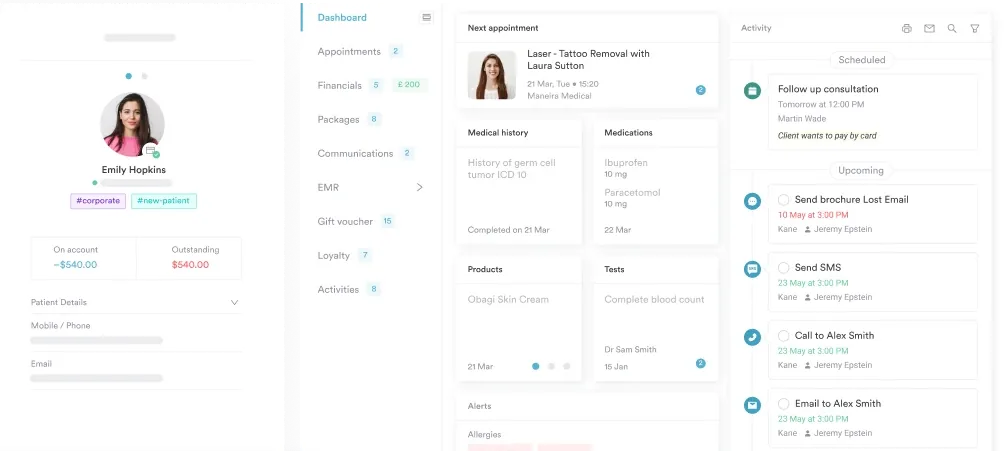
Practices looking for broader operational support can explore how healthcare CRM software integrates patient data across the care journey.
For practices already managing rheumatology billing.
ICD-10 Code M35.1 is the correct code for other overlap syndromes including mixed connective tissue disease and Sharp syndrome, and it requires specific physician documentation to use accurately. The most common failure points are defaulting to M35.9 when M35.1 is supported, missing Code Also requirements, and misapplying the code to undifferentiated CTD presentations.
Pabau’s integrated clinical records and claims management tools help rheumatology practices keep documentation and billing aligned, so complex codes like M35.1 stay accurate from the consultation note to the submitted claim. Book a demo to see how Pabau supports rheumatology and autoimmune specialty coding workflows.

Coding an abdominal mass on physical exam? Periumbilic mass coding guide covers R19.05, the code for an abnormal mass found near the umbilicus on exam or imaging.
Coding an involuntary tremor instead? Tremor coding guide covers the four ICD-10-CM tremor codes and how chapter choice depends on whether the type is specified.
Coding musculoskeletal conditions elsewhere in Chapter 13? M92.9 follows the same specificity standard for juvenile osteochondrosis diagnoses.
ICD-10 Code M35.1 is a billable ICD-10-CM diagnosis code used to document other overlap syndromes, primarily mixed connective tissue disease (MCTD) and Sharp syndrome, where a patient presents with features of two or more connective tissue diseases that do not fully classify under a single specific CTD code. It sits within the M35 block under Chapter 13 of the ICD-10-CM tabular list and is valid for FY2026.
Yes, M35.1 is a billable ICD-10-CM diagnosis code valid for claim submission in FY2026, effective October 1, 2025. It is accepted by Medicare, Medicaid, and most commercial payers as a primary or secondary diagnosis code for other overlap syndromes.
Yes. Mixed connective tissue disease (MCTD) is the official Applicable To inclusion term for M35.1 in the ICD-10-CM tabular list. Sharp syndrome is a historical synonym for MCTD rather than a separately listed term. The physician must document the MCTD or overlap diagnosis in the record; the coder assigns M35.1 based on that documented diagnosis.
M35.1 (other overlap syndromes) applies when the physician documents a specific overlap syndrome such as MCTD, Sharp syndrome, or a named multi-CTD overlap. M35.9 (unspecified systemic involvement of connective tissue) is used only when the documentation lacks specificity for any other M35.x code. If the record contains a term covered by Applicable To under M35.1, use M35.1; never default to M35.9 when M35.1 is supportable.
Sharp syndrome maps to ICD-10 Code M35.1. It is a historical synonym for mixed connective tissue disease (MCTD), the code’s official Applicable To inclusion term, rather than a separately listed entry. Ensure the physician’s note uses the term “Sharp syndrome” or documents the equivalent MCTD overlap features, then assign M35.1 as the primary diagnosis code.
Undifferentiated connective tissue disease (UCTD) is a distinct clinical entity where patients have CTD features but have not evolved into a defined CTD or overlap syndrome. UCTD does not automatically map to M35.1. An overlap syndrome (M35.1) requires physician documentation of two or more coexisting named CTDs. Coders should verify current AHA Coding Clinic guidance for the appropriate code assignment for UCTD before using M35.1.