CPT code 57283: Uterosacral ligament suspension billing guide
CPT code 57283: official descriptor and procedure overview CPT code 57283 descri...

Last Updated: Oct 15, 2026
85060 is the CPT code for blood smear, peripheral, interpretation by physician with written report. It covers a pathologist's or hematologist's microscopic review of a stained slide and the signed report that follows. Automated counts and technician-only differentials use other codes.
Medicare pays the interpretation only for an abnormal smear interpreted for a hospital inpatient. Other denials usually trace to an unsigned report, an unaccepted ICD-10 code, or a bundling conflict with a manual differential (85007) on the same specimen.
Let Pabau's smart automation suggest the right codes, reduce claim denials, and keep your practice compliant—effortlessly.
Automate repetitive tasks and focus on what matters most—your patients.
Reduce coding errors and ensure compliance with the latest regulations.
Clean claims, fewer denials, and faster reimbursements.
Powerful insights and reporting to help your practice thrive.
HIPAA compliant SOC 2 certified GDPR-compliant Trusted by 4,000+ clinics worldwide

CPT code 85060 covers a peripheral blood smear that a physician reviews, interprets, and documents in a signed written report.
Without the interpreting physician’s signed report in the chart, 85060 is not billable.
Medicare pays 85060 under the Physician Fee Schedule, about $19 nationally in 2026, and only for abnormal smears interpreted for hospital inpatients.
NCCI edits change quarterly, so billing 85060 with an automated CBC (85025) needs a separate, documented reason for the smear.
Pabau’s claims management software pre-fills claims from the patient record and submits them through Claim.MD.
CPT code 85060 is defined by the American Medical Association as “Blood smear, peripheral, interpretation by physician with written report.” It sits in the Hematology and Coagulation subsection (85002-85999) of the Pathology and Laboratory section.
The code pays for professional judgment. A technician prepares and stains the slide, then a pathologist or hematologist reviews it under a microscope. That physician writes and signs a report on what they saw. If either step is missing from the chart, payers deny the claim.
A peripheral smear under CPT 85060 evaluates three cell lines at once. The physician’s written report has to describe each one, or the claim won’t hold up in a medical necessity review.
The split between automated and manual review matters for coding. A hematology analyzer produces a differential electronically. A smear needs a trained eye on a stained slide. Payers treat these as separate procedures, so a CBC run on the same draw doesn’t automatically absorb 85060.
Payers want a documented clinical reason for a physician-read smear. An abnormal automated CBC usually justifies the order, while a routine wellness panel usually doesn’t. The Centers for Medicare and Medicaid Services (CMS) expects the ordering note to state the clinical question the smear should answer.
The diagnosis on the claim must match the indication documented in the chart. Most accepted pairings fall into four ICD-10-CM groups.
Payer policies vary. Some Medicaid plans and Medicare Advantage contracts accept only specific primary diagnoses, so check the payer’s local coverage determination (LCD) or medical policy first.
A specific code also carries more weight than an unspecified one. For a suspected immune thrombocytopenia workup, D69.3 explains the order far better than D64.9.
Mixing up 85060 and 85007 is the most common coding error in smear billing. Both involve a manual look at the slide, yet they pay for different work. 85060 pays a physician to interpret and report, while 85007 pays the lab for a manual differential count.
An automated CBC and a physician smear review can share a date of service. Bill 85025 for the CBC and 85060 for the smear when the smear was ordered separately, for a clinically distinct reason.
The National Correct Coding Initiative (NCCI) edits for hematology codes change quarterly. Verify the current edit pairs on the CMS NCCI edits page before you assume the codes are unbundled for your payer.
Flag claims that combine 85060 with 85007 on the same date during your pre-bill scrub. Most clearinghouses will pass them through, but payers will deny on adjudication. Build a coding rule in your billing software to alert coders when both codes appear on the same encounter.
CPT 85060 is priced under the Medicare Physician Fee Schedule, with PC/TC indicator 8. Medicare pays the interpretation only for an abnormal smear interpreted for a hospital inpatient. For hospital outpatients and non-hospital patients, Medicare pays nothing for 85060.
There is no technical component billing for this code either. Payment for the underlying lab test goes to the hospital, so the interpreting physician is the only party who bills 85060.
Where the code is payable, the 2026 national rate is about $19. That figure is 0.57 non-facility RVUs multiplied by the $33.4009 conversion factor, before the locality adjustment. Check your local figure in the CMS Physician Fee Schedule lookup tool. In practice, three checks decide whether a Medicare claim for 85060 pays at all.
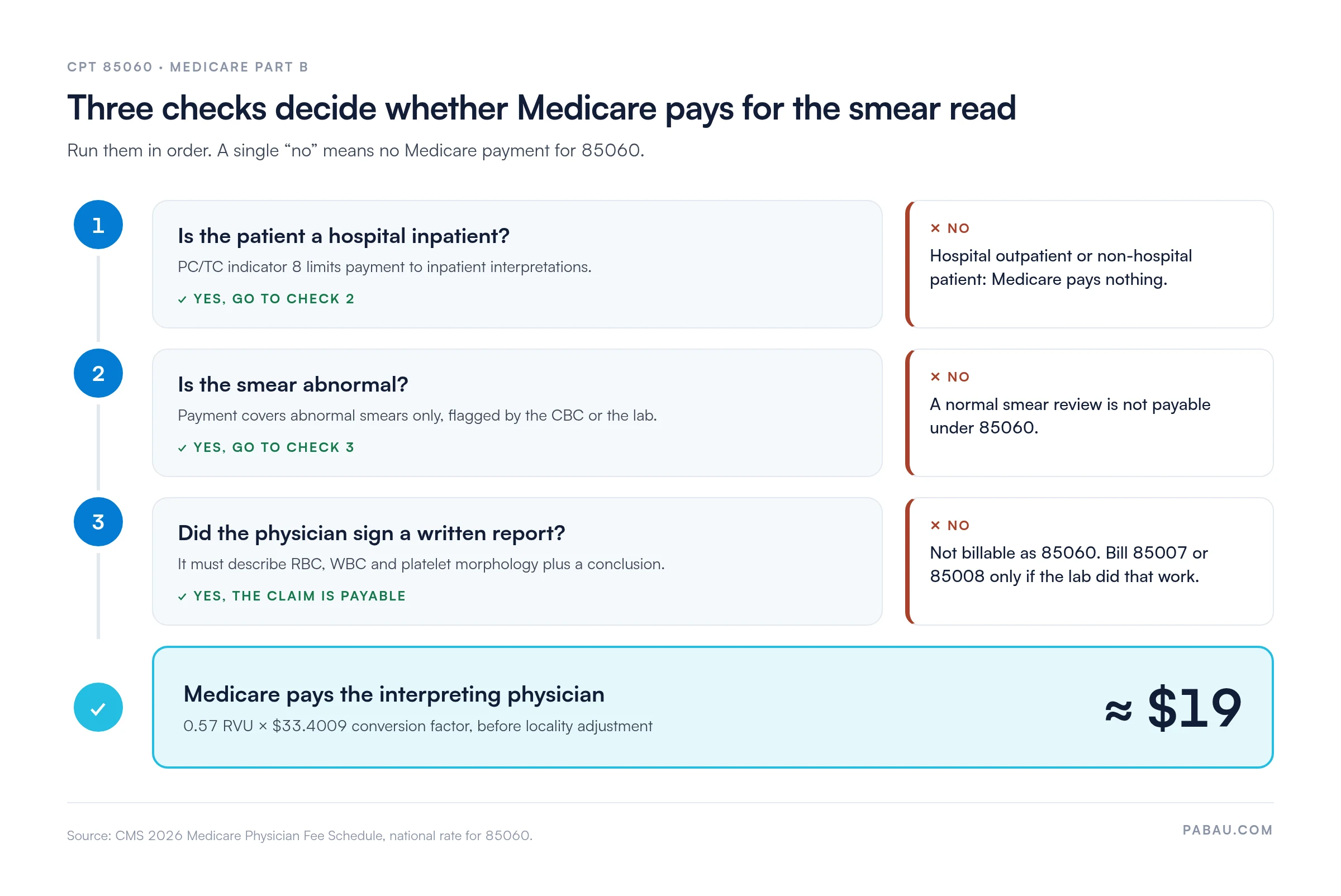
Commercial and Medicaid plans set their own rules, and some may pay 85060 in outpatient settings. Read the contract before you apply Medicare’s limits to every payer.
Documentation for 85060 has two audiences, the lab’s internal QA process and the payer’s medical necessity reviewer. Failing the payer review is the more expensive problem. Clean claim submission for 85060 depends on four elements being in the chart before the claim leaves.
Medicare does not generally require prior authorization for CPT 85060, but Medicare Advantage plans vary.
Commonwealth Care Alliance, for example, publishes a laboratory and pathology payment policy for its Medicare plans. Check each plan’s published laboratory policy before ordering, particularly for elective hematology workups.
If Medicare may not cover the smear for a specific patient, issue an Advance Beneficiary Notice (ABN) before the test. A signed ABN protects the practice from non-payment and lets the patient choose to pay out of pocket.
Keep in mind that outside hospital inpatients, Medicare pays nothing for 85060, so an ABN is only relevant where that applies.
Denial patterns for 85060 are predictable. Most come from missing paperwork or the wrong setting, not from coverage exclusions. These six scenarios cover nearly every denial you’ll see on this code.
Review your hematology billing rules at least quarterly. Payer smear policies change often, and a sudden run of denials usually traces back to a policy update months earlier. When a denial does land, match its reason code against our list of denial code fixes before you appeal or resubmit.
Run a quarterly audit of all 85060 claims submitted in the prior 90 days. Filter for CO-4 (modifier mismatch), CO-5 (procedure code inconsistent with the place of service), and CO-50 (not medically necessary). Each group of denials usually points to one workflow step you can fix.
Any physician or advanced practice provider with ordering privileges can request a peripheral blood smear, and they don’t need to be the interpreting physician.
Billing works differently. The entity billing 85060 must be the one that employs or contracts the interpreting physician, not simply the one that ordered the test.
Group practices with in-house pathologists should confirm two details. The lab’s CLIA certificate must cover smear preparation, and the interpreting physician’s credentials must be current with each payer. A lapsed credential makes 85060 claims deny at the provider level, even when the coding is correct.
When you train new billing staff, the AAPC CPT code reference lists the full 85000-series descriptor set.
Following one smear through the billing cycle shows where claims stall. Here is the usual path for a hospital inpatient whose CBC comes back abnormal.
Steps three and four are where most claims slip. A report signed after the claim is built, or a setting nobody checked, turns a payable read into a denial.
In many practices, someone keys the smear charge into a claim form by hand from the pathology report. Denials then come back on paper or through a payer portal, and they get matched to patients days later.
Pabau, the practice management platform we build, includes claims management software that pre-fills claims from the patient record. Before a claim is sent, it checks that required fields such as membership and authorization numbers are complete.
Pabau’s Claim.MD integration submits US claims electronically, checks eligibility, and returns electronic remittance advice. Those ERA files post back against the claim, so 85060 denials surface within days rather than weeks.
The superbill documentation attached to each lab encounter also exports to CMS-1500 format for submission.

Pabau’s claims management software pre-fills CPT and ICD-10 codes from the patient record, checks claim-required fields, and submits through Claim.MD. Book a demo to see the billing workflow.

The hardest part of billing 85060 is knowing when it won’t pay. For Medicare, a normal smear, an outpatient, or an unsigned report each means no payment, however clean the coding is.
So put the checks at the order stage rather than the appeal stage. Confirm the setting and the abnormal finding when the smear is ordered, and get the report signed before the claim is built. That keeps the roughly $19 Medicare pays per eligible read from disappearing into rework.
Pabau’s Claim.MD clearinghouse integration pre-fills the CPT and ICD-10 codes from the record, checks claim-required fields, and returns ERA denials automatically. Book a demo to see how it handles hematology lab claims from order to remittance.

Need to understand how lab claims move through a clearinghouse? How medical claims clearinghouses work explains the 837P file path from practice to payer and back.
Want a complete overview of the claim lifecycle? Revenue cycle management fundamentals covers each stage from eligibility check to payment posting.
Getting repeated CO-50 denials on lab claims? Denial codes in medical billing maps the most common CARC codes to their corrective actions.
Billing the CBC that came before the smear? CPT code 85027: CBC automated billing guide covers the automated count without a differential.
Is the smear part of an anemia workup? ICD-10 code D50.0 for iron deficiency anemia explains when chronic blood loss drives the diagnosis.
About $19 nationally in 2026 under the Physician Fee Schedule, adjusted for locality. Medicare pays only when a physician interprets an abnormal smear for a hospital inpatient. Interpretations for hospital outpatients and non-hospital patients receive no Medicare payment.
Yes. 85060 can go with 85025 on the same date when the smear was ordered separately because the automated differential flagged abnormal morphology. Verify NCCI edit pairs quarterly, as bundling rules change. Pairing 85060 with 85007 on the same specimen is almost always denied.
A clinical pathology consultation (80500 or 80502) answers a specific question another clinician asks the pathologist about a test result. 80502 adds a review of the patient’s history and records. 85060 covers the interpretation of a peripheral smear. Code the service that matches the request and the report.
A smear with a special stain for parasites such as malaria usually bills as 87207. Use 85060 only when a physician interprets the peripheral smear’s cell morphology and writes a report.