CCSD Code M2510: Ureterocele excision billing guide
CCSD Code M2510: Definition and clinical scope CCSD Code M2510 is the Clinical C...

Last Updated: Nov 3, 2026
84460 is the CPT code for transferase; alanine amino (ALT) (SGPT). It reports a single quantitative test of alanine aminotransferase in serum or plasma, used to check for liver cell damage and to monitor liver-toxic drugs.
Coders often confuse it with CPT 84450, which reports AST (SGOT), a different aminotransferase. Both codes can be billed on the same date when each is ordered. 84460 is not billed separately when a comprehensive metabolic panel (80053) or hepatic function panel (80076) is on the same claim. Both panels already include ALT.
Let Pabau's smart automation suggest the right codes, reduce claim denials, and keep your practice compliant—effortlessly.
Automate repetitive tasks and focus on what matters most—your patients.
Reduce coding errors and ensure compliance with the latest regulations.
Clean claims, fewer denials, and faster reimbursements.
Powerful insights and reporting to help your practice thrive.
HIPAA compliant SOC 2 certified GDPR-compliant Trusted by 4,000+ clinics worldwide

CPT code 84460 reports a quantitative ALT (SGPT) test on serum or plasma, distinct from the AST test reported under CPT 84450.
84460 bundles into the CMP (80053) and the hepatic function panel (80076), so billing it separately on the same claim is unbundling under NCCI edits.
Common denial causes include missing ICD-10 medical-necessity codes, no ABN on file for Medicare patients, and modifier errors on repeat same-day testing.
Pabau’s claims management software scrubs each 84460 claim for missing or invalid details, submits it through the Claim.MD clearinghouse, and auto-posts the ERA.
CPT code 84460 is the lab code for a single alanine aminotransferase (ALT) test. It sits in the Chemistry subsection (82009-84999) of the AMA’s Pathology and Laboratory section.
The official AMA descriptor reads Transferase; alanine amino (ALT) (SGPT). It covers one quantitative enzymatic assay of ALT activity in serum or plasma. Clinicians order it to check liver function or to watch for drug-induced liver damage.
ALT and its older synonym SGPT refer to the same analyte. Both terms appear in the AMA’s CPT code set, and either is acceptable in lab order documentation. The test is most often ordered as part of a liver workup, medication monitoring (statins, antiepileptics, antituberculars), or metabolic screening.
ALT is a liver-specific enzyme that catalyzes the transfer of an amino group from alanine to alpha-ketoglutarate. Elevated serum ALT levels indicate hepatocyte damage because the enzyme leaks from injured liver cells into the bloodstream. It is more liver-specific than AST (CPT 84450), which is also elevated in muscle injury and hemolysis.
Clinicians order CPT code 84460 in several common scenarios.
The Medicare Clinical Laboratory Fee Schedule (CLFS), maintained by the Centers for Medicare and Medicaid Services (CMS), sets the national rate for CPT code 84460. Always verify the current CLFS rate in the CMS downloadable file before you submit, because the table below gives no 2026 figure.
Lab codes like 84460 are paid from the CLFS, not the physician fee schedule, so an RVU lookup won’t show their payment rate. Check the CLFS file directly.
If your practice builds a superbill for each visit, list the CLFS rate beside the CPT code. Billing staff can then flag a mismatch at entry instead of after adjudication.
CPT 84450 (AST/SGOT) and CPT code 84460 (ALT/SGPT) measure different aminotransferases. Both can be billed on the same date of service when independently ordered and clinically indicated. No NCCI column I/II edit bundles the two codes against each other. The confusion arises because they are frequently ordered together in a liver workup and their numeric codes sit adjacent in the chemistry range.
When ordering both 84460 and 84450 on the same date, document the distinct clinical reason for each enzyme in the lab order narrative. Some payers audit same-DOS ALT/AST claims and may deny one without clear medical-necessity language linking each test to a specific clinical question.
The National Correct Coding Initiative (NCCI) bundles CPT code 84460 into two panels billed on the same claim. They are the comprehensive metabolic panel 80053 and the hepatic function panel 80076. Billing 84460 separately alongside either panel on the same date of service is unbundling and triggers a CO-97 denial. The Office of Inspector General (OIG) actively monitors unbundling of lab panel components as a fraudulent billing pattern.
The flow below puts those rules in the order a biller checks them on a live claim.
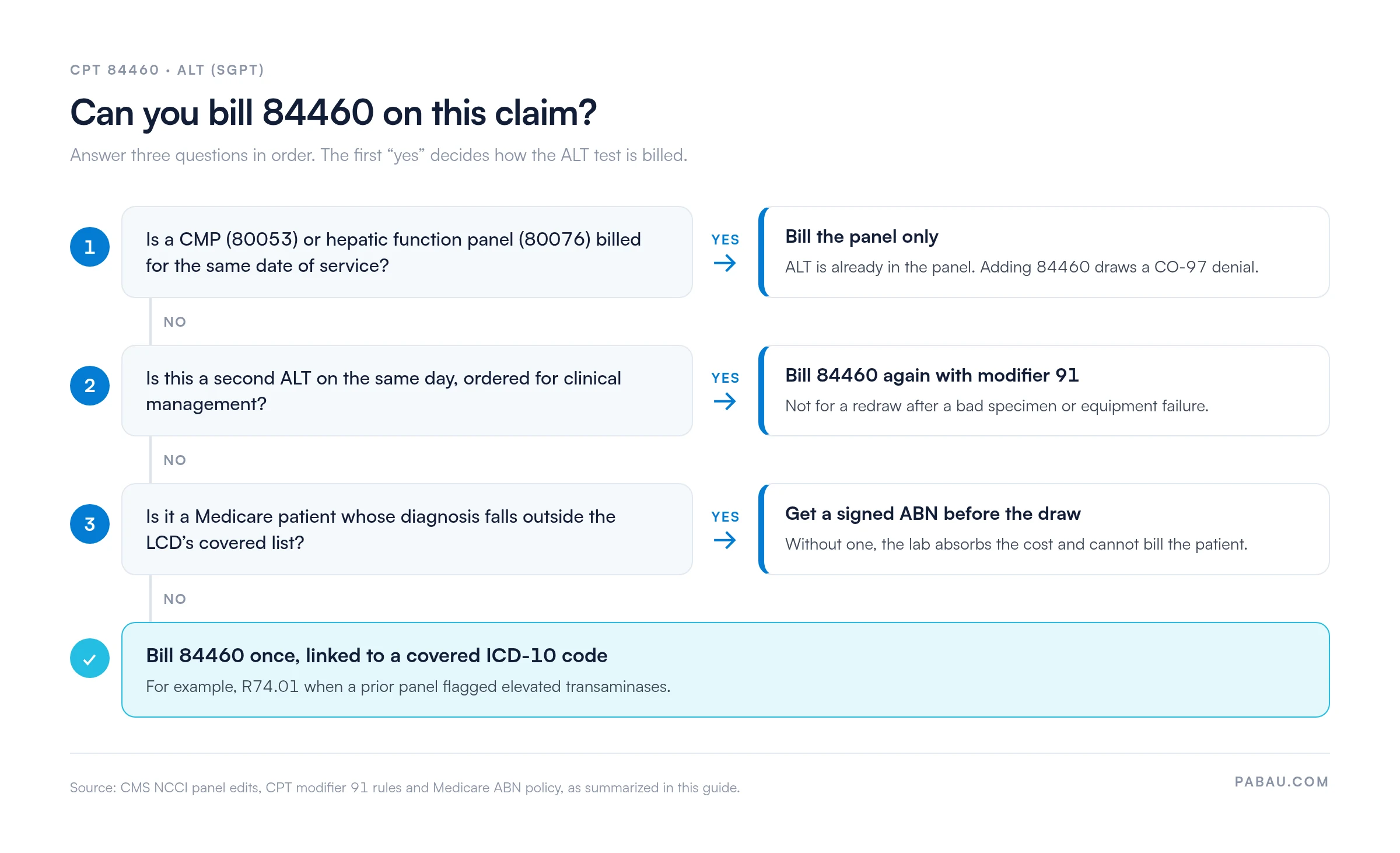
Every claim for CPT code 84460 must link to an ICD-10-CM diagnosis code that justifies the test. Payers use Local Coverage Determinations (LCDs) and National Coverage Determinations (NCDs) to define which diagnoses establish medical necessity. The codes below are commonly accepted. Covered diagnoses vary by payer and change over time, so verify your MAC’s current LCD before you submit. Use the CDC/NCHS ICD-10-CM tool to confirm each code remains active in the current fiscal year.
A diagnosis of “abnormal liver enzymes” or “elevated LFTs” without a specific ICD-10 code is a common documentation shortcut that payers reject. Use R74.01 when a prior panel flagged elevated transaminases and the standalone ALT is a follow-up measurement.
A complete chart supports both the claim and any post-payment audit. The ordering provider’s notes, not just the lab requisition, must show why the ALT test was clinically indicated on this date of service. Documentation for CPT code 84460 needs each of the following elements.
An Advance Beneficiary Notice of Noncoverage (ABN) must be signed before CPT code 84460 is performed for some Medicare patients. It applies when the lab expects the test may not meet Medicare’s medical-necessity criteria for that diagnosis. This commonly applies to routine wellness or screening orders where no documented condition supports the test.
An ABN is not required for every Medicare ALT order. It is required when the specific clinical scenario falls outside covered diagnoses in the applicable LCD. Without a signed ABN on file, the lab absorbs the cost if Medicare denies on medical-necessity grounds. It cannot bill the patient.
Most CPT code 84460 denials trace back to five claim adjustment reason codes (CARCs). A structured denial management workflow resolves each one differently. The table below maps each code to its root cause and the corrective action. For the full list, see our guide to medical billing denial codes.
Run a pre-submission audit on every 84460 claim line. Confirm no panel code (80053 or 80076) appears on the same claim. Verify the ICD-10 code is on the MAC’s current LCD covered-diagnosis list, and check the ordering provider NPI is valid in NPPES. These three checks catch the most common preventable 84460 denials before a claim reaches the payer.
Lab chemistry codes like CPT code 84460 use modifiers sparingly. Two modifiers come up in repeat-testing scenarios. Picking the wrong one, or using either when the panel is the right code, is a leading cause of CO-4 denials.
Modifier 91 is appropriate when a clinician orders a second ALT on the same date of service to obtain a subsequent result for treatment-management purposes. For example, a patient with suspected acute hepatitis has ALT measured at 8:00 AM. The clinician orders a repeat at 2:00 PM to track the enzyme trajectory over six hours.
Modifier 91 is not permitted when the repeat is ordered because the first specimen was compromised, the equipment malfunctioned, or a testing error occurred. It applies only to clinically motivated repeats.
Modifier 59 is sometimes erroneously appended to CPT code 84460 in an attempt to override the NCCI bundling edit with CMP (80053). This does not work. The NCCI edit bundling 84460 into 80053 is a “column I/II” edit type that modifier 59 cannot override. Applying modifier 59 in this context triggers a CO-4 denial and, if audited, can support a finding of improper billing. Reserve modifier 59 for distinct procedural services whose NCCI edit carries a modifier indicator of 1.
A clean claim for CPT code 84460 moves through adjudication without manual intervention. Building a clean claim for a lab chemistry code means getting six fields right. Automated edits check them before a human reviewer sees the claim. Submit CPT code 84460 claims electronically as an 837P. Pabau submits claims electronically to thousands of US payers through the Claim.MD clearinghouse.
Several chemistry codes in the 82xxx-84xxx range are frequently ordered alongside CPT code 84460 in a liver workup. Each needs its own claim line when ordered as a standalone, and each has its own panel-bundling rules.
Use the AAPC Codify CPT lookup to confirm panel inclusion for any chemistry code before billing it alongside 84460.
Most 84460 denials start before submission, with a panel code on the same claim or a missing ordering NPI. Many practices only find the error when the remittance comes back days later.
Pabau’s claims management software scrubs every claim for missing or invalid details before it leaves your system. Clean claims then go out electronically through the Claim.MD clearinghouse.
When the payer responds, the electronic remittance advice (ERA/835) is auto-posted against the claim. A denied 84460 line arrives with its CARC code attached, so your team can correct and resubmit it inside the timely-filing window.

Pabau’s claim validation flags missing or invalid details on every lab claim, then submits it through Claim.MD and auto-posts the ERA. Your team spends less time reworking denied lines.

CPT code 84460 is simple to bill once three details line up. The claim needs a covered ICD-10 code, no CMP or hepatic panel on the same date, and the ordering provider’s NPI. Check those before submission and most 84460 denials never happen.
If your team still finds these errors only after the remittance arrives, move the checks earlier in the workflow. The cost of one missed panel conflict is a full resubmission cycle on a low-value lab line. Book a demo to see how Pabau’s claim validation catches those errors before 84460 claims go out.

Need a full primer on how claims move from order to payment? What is revenue cycle management walks through each stage of the billing cycle for labs and physician practices.
Unsure which clearinghouse to use for lab claims? Medical claims clearinghouse guide explains how clearinghouses check claims before they reach the payer.
Want to stop denials before the test is drawn? Insurance eligibility verification covers the payer checks that prevent same-day lab denials at the point of order.
Billing the full liver panel instead? CPT code 80076 covers the hepatic function panel that already includes ALT.
Coding the diagnosis behind a follow-up ALT? ICD-10 code R74.01 covers elevated liver transaminase levels, the most direct medical-necessity code for 84460.
CPT code 84460 is the lab billing code for a quantitative alanine aminotransferase (ALT/SGPT) assay performed on serum or plasma. It measures liver enzyme activity by an enzymatic method. Clinicians use it to detect liver cell damage, monitor drug-induced hepatotoxicity, and support the diagnosis of liver disease.
CPT 84460 measures ALT (SGPT), which is liver-specific. CPT 84450 measures AST (SGOT), which also rises with muscle damage. Both can be billed on the same date of service when each is independently ordered and clinically indicated. No NCCI edit prohibits billing them together, but each needs its own documented clinical indication.
No. NCCI edits bundle CPT code 84460 into the CMP (80053) and the hepatic function panel (80076). Billing 84460 separately alongside either panel on the same claim is unbundling and will be denied under CO-97. Bill the panel code only, or bill 84460 alone when no panel was performed.
Commonly accepted codes include R74.01 (elevation of liver transaminase levels), K76.0 (fatty liver disease), and B18.1-B18.2 (chronic viral hepatitis B and C). Z79.899 (long-term drug therapy) and K70.10 (alcoholic hepatitis) are also common. Verify the current covered-diagnosis list in your MAC’s applicable LCD before submitting.
Yes. SGPT (serum glutamic pyruvic transaminase) and ALT (alanine aminotransferase) are the same analyte. The AMA CPT descriptor for 84460 explicitly includes both terms: “Transferase; alanine amino (ALT) (SGPT).” Either abbreviation is acceptable in the lab order and clinical documentation.
Modifier 91 applies when a clinician orders a second ALT on the same date for clinical management, such as tracking enzyme trajectory in acute hepatitis. It cannot be used when the repeat is due to equipment failure or specimen compromise. Modifier 59 does not override NCCI panel bundling edits, so never apply it to 84460 billed against a CMP or hepatic panel.
An ABN is required when the lab has reason to believe Medicare may deny the 84460 claim on medical-necessity grounds for that patient. That typically happens when the diagnosis falls outside the MAC’s covered-diagnosis list for ALT testing. The ABN must be signed before the service. Without one, the lab cannot bill the patient if Medicare denies.