

CCSD code G5100: Bypass of duodenum billing guide
CCSD code G5100 bills a bypass that leaves the duodenum in place CCSD code G5100...

Last Updated: Oct 16, 2026
80076 is the CPT code for a hepatic function panel. It reports seven measurements: albumin (82040), direct bilirubin (82248), total bilirubin (82247), alkaline phosphatase (84075), total protein (84155), ALT (84460), and AST (84450).
Three checks decide whether the claim is paid. The record has to carry the ordering provider's clinical indication. The diagnosis code on the claim has to support the panel. The component codes must never appear alongside 80076, because that combination triggers an NCCI bundling edit. Local coverage article A57802 retired on December 18, 2025, so confirm your MAC's current coverage policy.
Let Pabau's smart automation suggest the right codes, reduce claim denials, and keep your practice compliant—effortlessly.
Automate repetitive tasks and focus on what matters most—your patients.
Reduce coding errors and ensure compliance with the latest regulations.
Clean claims, fewer denials, and faster reimbursements.
Powerful insights and reporting to help your practice thrive.
HIPAA compliant SOC 2 certified GDPR-compliant Trusted by 4,000+ clinics worldwide

CPT 80076 covers a seven-test hepatic function panel: albumin, total and direct bilirubin, alkaline phosphatase, ALT, AST, and total protein.
Medicare pays only on a supporting diagnosis, and article A57802 retired on December 18, 2025, so check your MAC’s list.
Billing a component code such as 82040 next to the panel is unbundling, and NCCI edits will deny it.
The 2026 Medicare rate is roughly $8.17, set nationally, so locality makes no difference to what you collect.
Practice management software like Pabau pre-fills lab claims from the patient record and flags missing required fields.
CPT code 80076 is the hepatic function panel, a single laboratory code covering seven liver measurements performed on one specimen. The American Medical Association maintains it inside the Organ or Disease Oriented Panels section, codes 80047 to 80081.
Providers order it to investigate suspected liver disease, monitor a drug known to stress the liver, or follow up abnormal enzymes from an earlier draw. One order produces one code and one claim line, not seven.
The panel sits on the Clinical Laboratory Fee Schedule (CLFS) rather than the Physician Fee Schedule. That placement decides how the rate is set, and it is the reason a locality lookup returns the same figure everywhere.
Run fewer than seven and CPT 80076 no longer applies. The individual component codes get billed instead, and there is no partial version of the panel. Here is what the seven cover and what each one tells the ordering provider.
Which code goes on the claim comes down to two questions, and both are answered by the lab report rather than the order. The chart below walks through them.
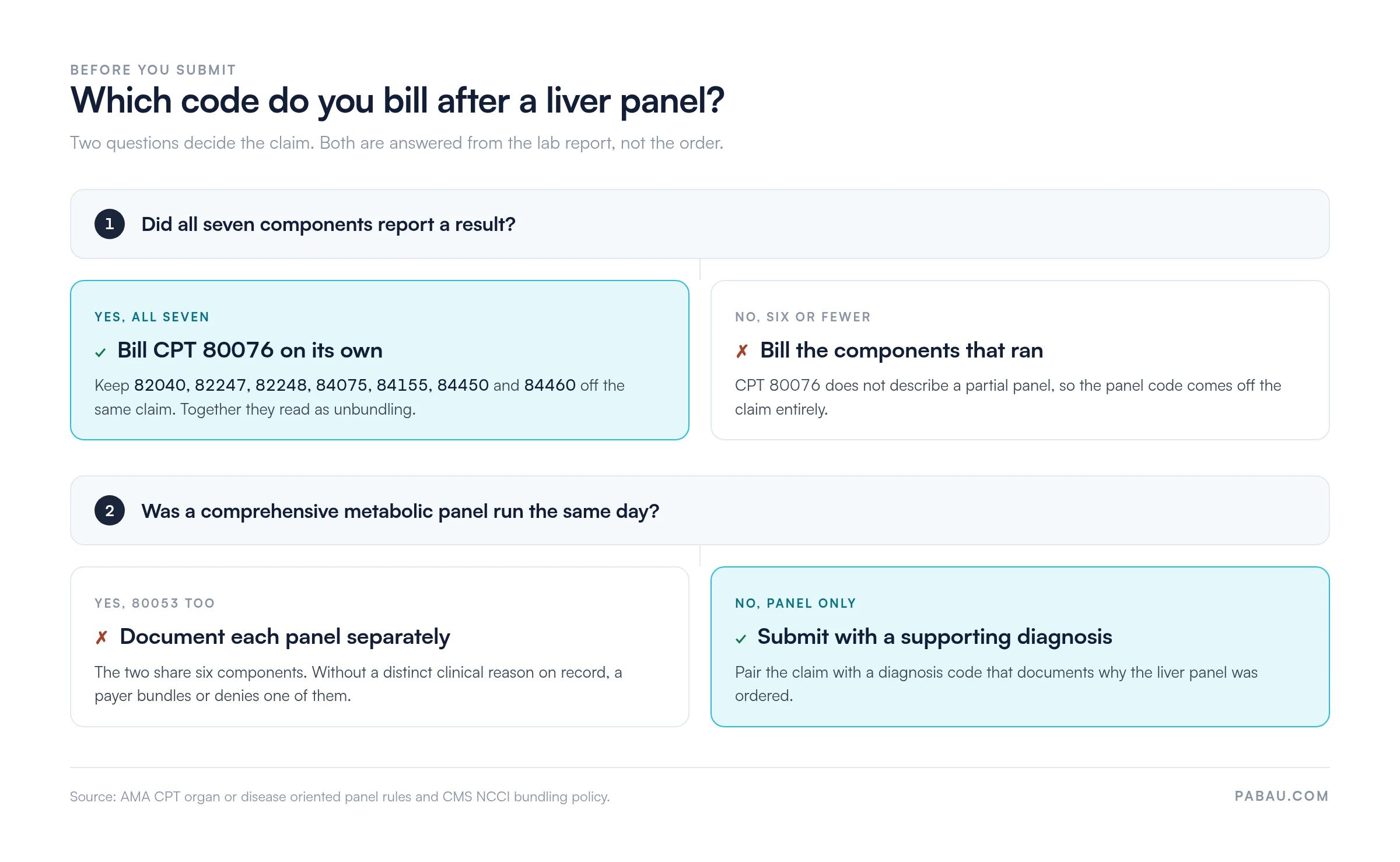
Medicare covers CPT 80076 under the Clinical Laboratory Fee Schedule when the claim carries a diagnosis that documents a medical reason for the test. Coverage is never automatic, and a liver panel ordered as part of a routine wellness visit will not clear the medical necessity screen.
Coverage for this panel used to run through local coverage article A57802 and its parent policy, LCD L33907. Both retired on December 18, 2025, and no replacement has been named for that jurisdiction. Check your own Medicare Administrative Contractor’s current coverage policy rather than working from the retired list.
Five criteria decide the outcome once the claim reaches review:
The diagnosis code is the most preventable denial cause on this panel. Choose it from the chart, not from a drop-down at claim entry.
The codes below are the ones payers accept most often for liver testing, sourced against the CDC ICD-10-CM tool. Treat them as a starting point and confirm each against your MAC’s live policy.
With A57802 withdrawn, the covered diagnosis list for your jurisdiction now lives wherever your MAC has moved it. Re-check that list at least once a quarter. A diagnosis that was accepted at the time of service and is not accepted now still gets denied.
Medicare pays roughly $8.17 for CPT 80076 on the 2026 Clinical Laboratory Fee Schedule. The CLFS carries one national amount per code, with no geographic adjustment, so a practice in Miami collects what a practice in Boise collects.
That single detail trips up a lot of fee-schedule guidance, which borrows the locality logic of the Physician Fee Schedule and applies it here. The physician schedule adjusts by region. The lab schedule does not, so a locality lookup on this code returns the same number every time.
Commercial payers tend to pay more, often somewhere between $18 and $35 depending on the contract. Reference laboratories such as Quest Diagnostics and Labcorp negotiate their own rates, which sit apart from what an in-office lab collects for the same panel.
Now put that $8.17 next to the cost of getting the claim wrong. Reworking a denied claim runs 30 to 40 minutes of staff time. One denial on this panel therefore costs the practice more than the panel ever pays. That economics is what makes pre-submission accuracy worth the effort on a code this small.
Compare your top three commercial contracts against the $8.17 CLFS rate once a year. Any contract paying below the Medicare amount for a routine panel is worth reopening at renewal, because volume will not make up the difference.
Five items in the record decide whether a CPT 80076 claim survives review. Missing one of them is the fastest route to a medical review request or a post-payment audit.
One more line is worth adding when the full panel was chosen over individual tests. A short note on why the comprehensive workup was needed closes that question before a reviewer has to ask it.
Five handoffs sit between the provider’s order and the remittance. Each one has a point where the claim stalls, and knowing which is which saves you guessing later.
Steps one and four cause most of the trouble. Both happen inside the practice, which means both are fixable without an appeal.
Thirty seconds at charge entry is cheaper than 40 minutes of rework. Before a hepatic panel claim goes out, confirm the following.
Four errors account for the bulk of hepatic panel denials, and all four repeat. The medical billing denial codes reference explains the remittance codes each one produces.
Audit 90 days of CPT 80076 remittances by denial reason code. CO-97 is the fingerprint of an NCCI bundling conflict between the panel and a component code. CO-50 points at a diagnosis that failed medical necessity. The split tells you which fix to make first.
Six of the hepatic panel’s seven components also appear in the comprehensive metabolic panel. Direct bilirubin (82248) is the one exception, and that single test is what separates the two codes.
So the billing rule is short. If the provider needs the conjugated bilirubin fraction, the hepatic panel is the right code. If the workup also needs glucose, electrolytes and renal markers, CPT 80053 is the one to bill.
Ordering both on the same date is allowed, but it invites scrutiny. The claim needs a documented clinical rationale for each panel, written at the time of the order rather than reconstructed during an appeal.
Most denials on this panel are workflow failures rather than knowledge failures. A biller who knows the rule still ships a bad claim when the diagnosis comes from a stale drop-down. The same happens when two departments enter the panel and its components separately.
Practice management software like Pabau builds the claim out of the encounter instead. Patient and payer details pre-fill from the patient record, so nobody retypes them. Diagnosis and procedure codes come from a built-in ICD-10 and CPT lookup library. A completeness check then holds the claim back while a required field is still blank.
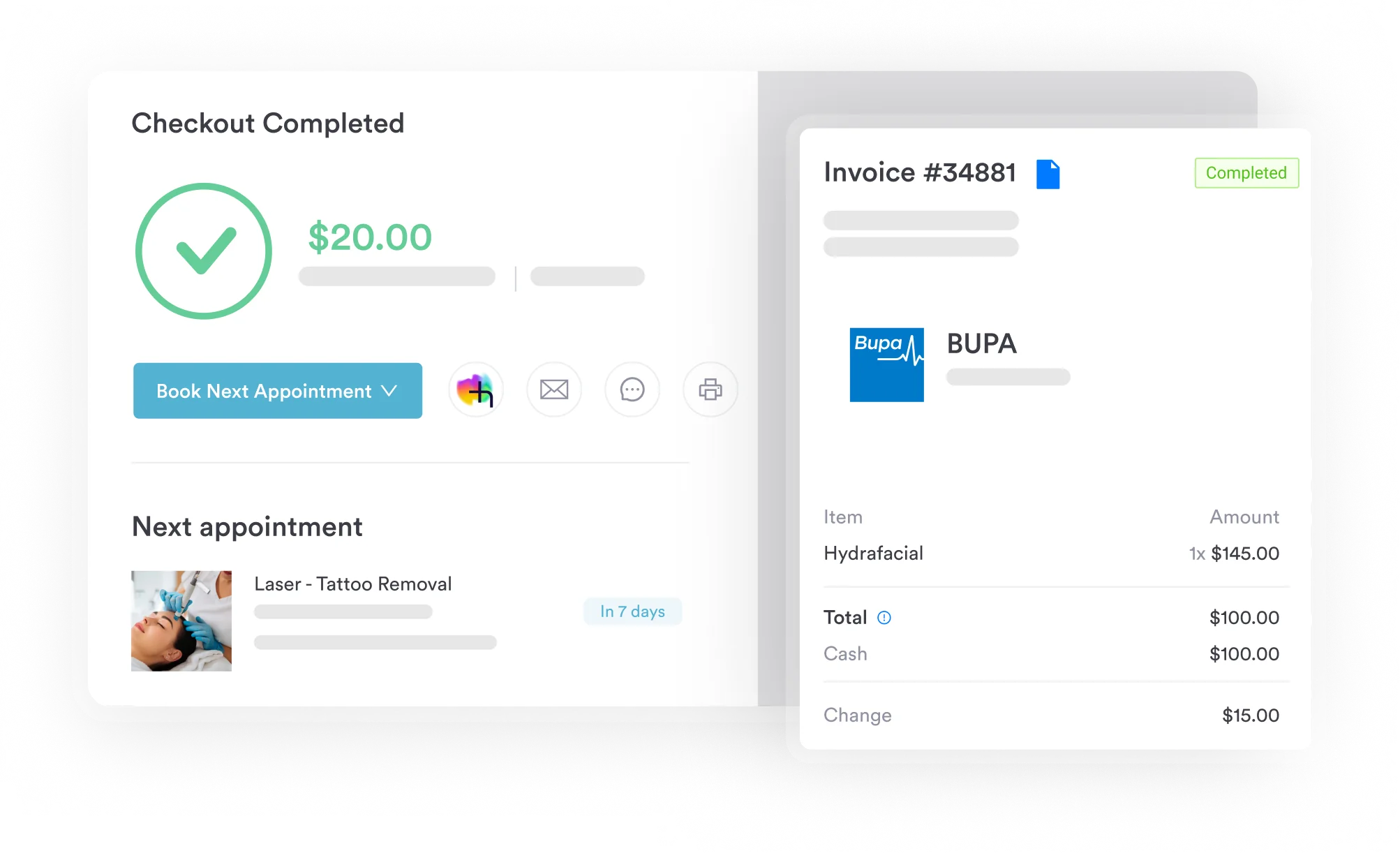
Claims then leave through Claim.MD, our US clearinghouse, which also runs real-time eligibility checks before the visit. Remittance advice comes back into the same record with structured denial reason codes. A run of CO-97 denials on this panel becomes visible without anyone opening a paper explanation of benefits.
The outcome is fewer claims sitting in the rework queue, which is the whole job of claims software for billers. On a code paying $8.17, that is the difference between a profitable lab line and a break-even one.

Pabau pre-fills lab claims from the patient record and pulls codes from a built-in ICD-10 and CPT library. Required-field checks run before the claim leaves for the Claim.MD clearinghouse. See how it handles CPT 80076 for your practice.

CPT 80076 is easy to code and easy to lose money on. Three problems account for almost every denial. The diagnosis does not support the panel. Component codes ride alongside it. Or the chart carries no documented reason for the order.
None of those need an appeal to fix. They need the claim assembled correctly the first time. What decides that is how the order reaches the biller, long before anyone types a code. At $8.17 a claim, the second attempt is already unprofitable.
If your liver panel denials keep landing in the same bucket, the fix usually sits upstream of the billing team. Book a demo to see how Pabau assembles lab claims from the patient record and sends them through Claim.MD.

Want to understand how clearinghouse submissions work? Medical claims clearinghouse guide explains the end-to-end submission path from practice to payer.
Need to resolve a CPT 80076 denial? Denial management in healthcare covers appeal workflows and recoupment prevention.
Want the claim right the first time? Clean claim submission sets out what a payer needs before it will pay on the first pass.
Worried about a lab billing audit? Medical billing compliance walks through the documentation rules that reviewers apply.
Billing lab panels across multiple payers? Best medical billing software compares platforms for multi-payer lab claim management.
Not always. Providers use “liver function test” loosely, for anything from a single ALT to a full panel. CPT 80076 applies only when all seven listed components are performed and reported. A two-test order is billed with its individual codes.
Usually not. Modifier 91 applies when the panel is repeated the same day for a second reportable result. It never applies to a repeat caused by a lab error. Append modifier GA when you expect a medical necessity denial and the patient has signed an ABN.
Yes. CPT panel rules do not limit what else the lab runs. Bill 80076 for the seven components, then report any extra test, such as GGT, under its own code on the same claim.
The panel code no longer describes the work performed. Bill the individual codes for the measurements that produced a reportable result, and leave 80076 off the claim. A recollection on another day is a separate date of service.
A licensed practitioner treating the patient has to order it, and that order belongs in the record before the specimen goes out. A standing lab protocol still needs the treating practitioner’s documented intent behind it.



