CCSD Code J5520: Total pancreatectomy billing guide
CCSD Code J5520: Definition and procedure scope CCSD Code J5520 describes a tota...

Last Updated: Oct 20, 2026
CPT code 84146 is the billing code for a quantitative prolactin (PRL) assay on serum or plasma. It sits in the chemistry section of the AMA’s CPT code set. One unit covers one prolactin result, and Medicare pays it under the Clinical Laboratory Fee Schedule (CLFS).
Claims on 84146 usually fail on the supporting details rather than the code itself. The usual causes are a missing ICD-10 link, a payer frequency limit already reached, or an ordering provider who isn’t enrolled with the payer.
This reference covers the covered diagnoses, Medicare rates, medical necessity rules, companion codes and the denial patterns that come up most often on 84146.

CPT 84146 is the only code for a quantitative prolactin assay on serum or plasma, because CPT has no separate fractionated prolactin code.
Covered indications include hyperprolactinemia (E22.1), amenorrhea, galactorrhea, infertility workups and pituitary adenoma monitoring.
Medicare pays 84146 under the Clinical Laboratory Fee Schedule, and the lab that runs the assay bills it, not the office that draws blood.
Medi-Cal updated its ICD-10 diagnosis code range for prolactin level testing, so covered-code lists from before 2024 may no longer reflect current policy.
In Pabau’s claims software, 84146 claims go out electronically through Claim.MD after an eligibility check, so coverage problems surface before submission.
Before building any claim line, confirm these identifiers match your practice’s lab order and payer contract.
CPT 84146 covers a single quantitative measurement of prolactin (PRL) from a serum or plasma specimen. One unit of 84146 corresponds to one prolactin result reported by the performing lab.
CPT has no separate code for fractionated prolactin, so a macroprolactin reflex by PEG precipitation is also reported under 84146. The code doesn’t apply when prolactin is reported inside a panel code that already includes it.
According to the American Medical Association’s CPT code set, the official descriptor is simply “Prolactin.” That brief label covers every quantitative immunoassay method labs use. The clinical indications covered under this single code include:
The prolactin CPT code is ordered when a clinician suspects abnormal PRL production is driving a patient’s symptoms. The payer’s question is always the same: Does the clinical picture justify this test on this date? Documentation must answer that question before the claim goes out.
In practices that run hormonal panels, prolactin is a standard first-line test in reproductive evaluation. Common ordering scenarios by specialty include:
Repeat testing during prolactinoma treatment is clinically appropriate and separately billable, but requires distinct documentation for each encounter. Payers differ on how often they will pay for repeat assays, typically from quarterly to annually depending on the plan.
A non-covered or missing ICD-10 code is the most common reason 84146 claims are rejected. The table below lists the ICD-10-CM codes Medicare and commercial payers most often accept as medical necessity support for prolactin testing.
Coverage varies by MAC jurisdiction and commercial plan, so check your payer’s LCD before billing. Our ICD-10-CM code library has the full descriptor for each code below.
Medi-Cal updated its ICD-10 diagnosis code range for prolactin level testing, per a XIFIN Billing Beat notice. Practices billing California Medicaid should check their covered-code list against the current policy. Some previously covered codes may have been removed and new ones added.
CPT 84146 has no national coverage determination (NCD) from CMS. Coverage is governed by Local Coverage Determinations (LCDs) issued by the Medicare Administrative Contractors (MACs) in each jurisdiction. No single LCD applies nationwide, which means a code covered under Noridian’s LCD may not appear on Novitas’s list, and vice versa.
Running insurance eligibility verification before ordering prolactin testing lowers the risk of a test your payer won’t cover on that date. Key documentation requirements across most payers include:
Prior authorization is not routinely required for CPT 84146 under traditional Medicare fee-for-service, but Medicare Advantage plans vary widely. Commercial payers may require prior auth for repeat testing beyond a defined interval, particularly for prolactinoma monitoring. Verify at the plan level, not the product level.
CPT 84146 is reimbursed under the CMS Clinical Laboratory Fee Schedule (CLFS), not the Physician Fee Schedule (PFS). That applies when an independent or hospital outpatient laboratory performs the test, and practices billing as the performing lab should reference the annual CLFS update.
Physician offices that collect the specimen but send it to a reference lab typically don’t bill 84146 directly. They bill the blood draw under CPT 36415 instead.
Use the CMS Clinical Laboratory Fee Schedule files to find the current national limitation amount for 84146. Rates update each January 1, so check the latest file before billing or contracting.
Commercial payers typically reimburse prolactin testing at 80 to 150 percent of the Medicare CLFS rate, with wide variation by contract tier and region.
Pabau, the practice management platform we build, sends claims for lab chemistry codes like 84146 electronically through Claim.MD, its US clearinghouse partner. The same connection runs 270/271 eligibility checks and tracks claim status.
Clean claims for 84146 need four elements in order before submission: The clinical note, the ICD-10 linkage, the place of service and the performing-lab identification. Missing any one of them produces a denial that someone has to rework by hand.
Follow these steps when building a clean claim for a prolactin assay:
Steps 3 and 4 come down to one question: Who performs the assay? The flow below starts with the coverage check from step 6, then maps each answer to the right billing entity and place of service.
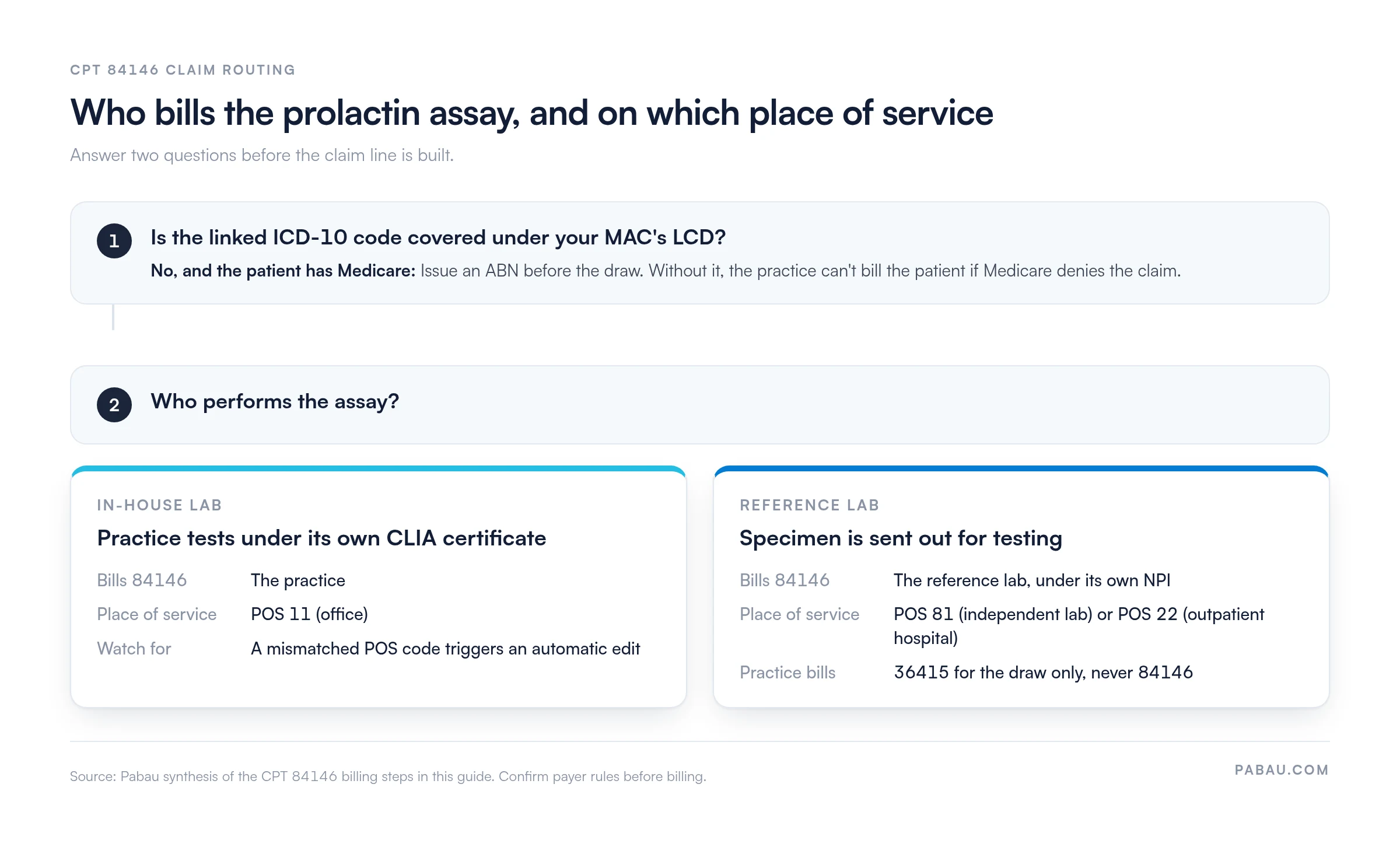
Flag prolactin orders against your MAC’s active LCD before submission. Many claim scrubbers check code validity but not LCD coverage by MAC jurisdiction. A manual LCD review step catches a non-covered diagnosis before the claim leaves your system.
The prolactin CPT code is occasionally mis-selected when coders search by test name rather than by confirmed AMA descriptor. The following table distinguishes 84146 from adjacent chemistry codes that generate upcoding or undercoding errors.
Prolactin testing rarely appears alone on a claim. Endocrine and reproductive evaluations routinely include several chemistry codes ordered together. The AAPC CPT code reference and the NCCI Policy Manual treat the codes below as separately payable alongside 84146. Each test needs its own indication and documentation.
No NCCI edits pair these codes as mutually exclusive when each has an independent clinical indication. Document each test’s rationale separately in the ordering note to support multiple chemistry codes on the same claim. For TSH on the same claim, our guide to CPT 84443 covers its ICD-10 linkage and rates.
Most 84146 denials fall into five categories, and each is preventable with the right front-end workflow. Clear denial management workflows cut the rework when one does slip through. These are the patterns billing teams see most often:
Run a quarterly audit of your 84146 denials by denial reason code. Watch for repeats of CO-4 (procedure code inconsistent with modifier) or CO-6/CO-7 (procedure inconsistent with patient age or sex). Those point to a problem at order entry, so fix the template or requisition form as well as the denied claim.
Billing CPT 84146 runs from order entry to ERA posting, and an error at any step costs time and revenue. Purpose-built claims management software keeps those steps in one system, so billers aren’t catching every error by hand.
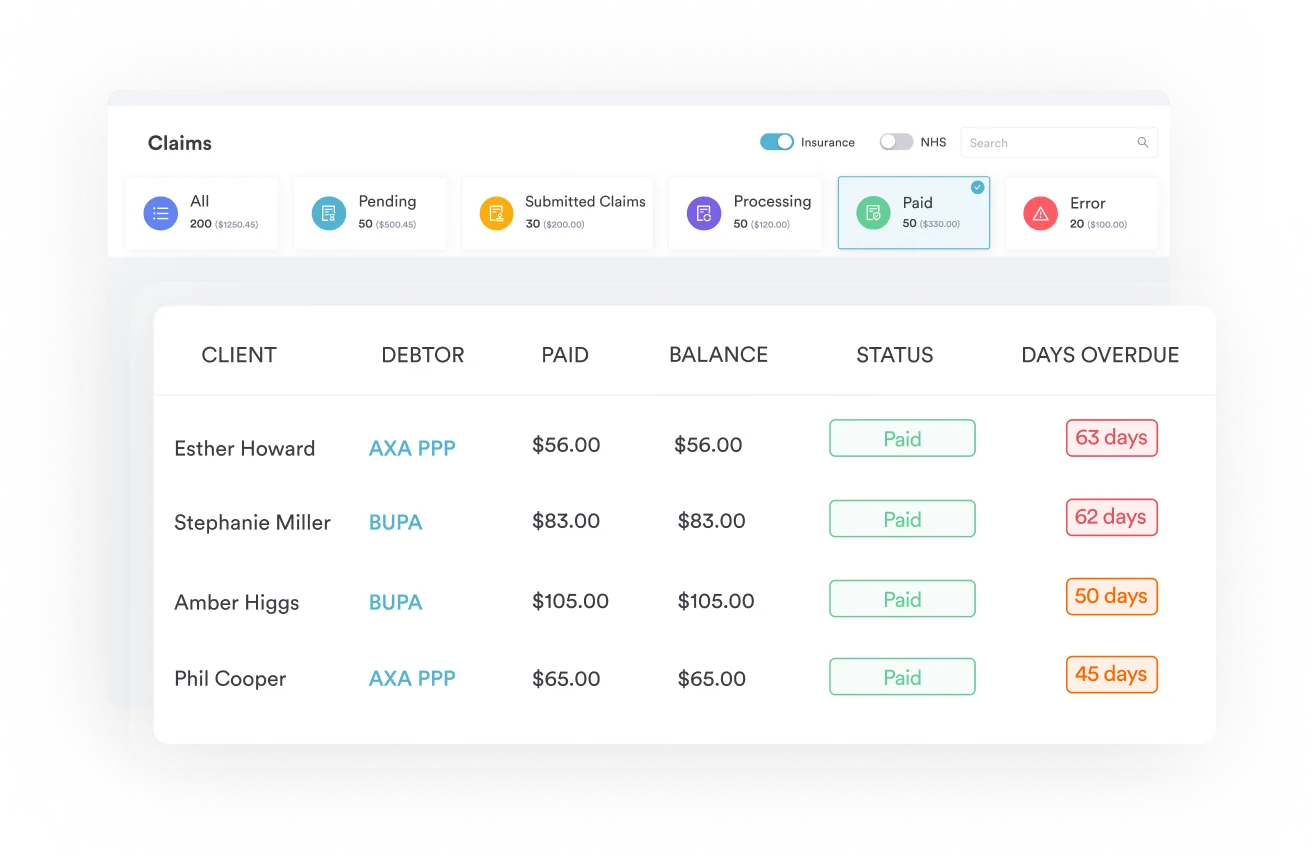
Without that connection, a practice checks coverage by phone, keys claims into a payer portal and matches paper EOBs to each test. In Pabau, eligibility checks run through Claim.MD before the visit, so a coverage problem shows up before the prolactin test is ordered.
Claims then go out electronically, and claim status stays visible until the payer responds. When the electronic remittance advice comes back, our guide to electronic remittance advice explains how to read it and post it.
Endocrinology, reproductive health and functional medicine practices often bill FSH, LH, estradiol and TSH on the same date as 84146. Keeping those orders, diagnosis links and claims in one system lets your billing team review each line in one place before submission.

Pabau checks eligibility through Claim.MD before the visit, sends lab claims electronically and tracks their status, so your billing team spends less time on rework.

CPT 84146 is a simple code to choose and an easy one to lose money on. The protection happens before the specimen leaves the room. Confirm the diagnosis is covered under your MAC’s LCD, check the payer’s frequency limit and settle who bills the assay.
Practices that build those checks into ordering stop treating 84146 denials as a billing problem. The trade-off is a minute more at order entry, which costs far less than reworking a denied claim weeks later.
Book a demo to see how Pabau handles eligibility checks, electronic claims and claim tracking for your lab orders.

Want to know what a clearinghouse does before a claim reaches the payer? Pabau’s Claim.MD clearinghouse guide walks through electronic claims, eligibility checks and claim status tracking.
Need to understand denial reason codes on your ERAs? Denial codes in medical billing covers CARC and RARC codes so your team can act on remittance data faster.
Ordering progesterone in the same fertility workup? CPT code 84144 covers progesterone billing, ICD-10 linkage and the current rate.
Running a gonadal axis panel alongside prolactin? CPT code 83002 covers luteinizing hormone billing and the codes it pairs with.
Billing for other reproductive lab codes? IVF CPT codes reference covers the reproductive medicine code set that often appears on the same claim date as 84146.
CPT code 84146 is the AMA’s designated billing code for a quantitative prolactin (PRL) assay performed on serum or plasma. It is used to diagnose hyperprolactinemia, evaluate amenorrhea and galactorrhea, support infertility workups, and monitor prolactinoma treatment response.
Commonly covered ICD-10 codes include E22.1 (hyperprolactinemia) and D35.2 (benign neoplasm of pituitary gland). Others are N91.0 and N91.1 (primary and secondary amenorrhea), N64.3 (galactorrhea) and N97.0 (female infertility with anovulation). Coverage varies by MAC jurisdiction and commercial plan, so verify against the applicable LCD before billing.
CPT 84146 is paid under the CMS Clinical Laboratory Fee Schedule rather than the Physician Fee Schedule. The CMS CLFS files list the current national limitation amount for 84146. Check the latest file before contracting or billing, as rates update each January 1.
The most common denial reasons are a missing or non-covered ICD-10 link and a frequency limit already reached for the benefit period. Others include a missing ABN when Medicare coverage is uncertain and the wrong place of service for a reference-lab test. An ordering provider who isn’t enrolled with the payer also triggers denials.
Yes, CPT 84146 and CPT 84443 can be billed on the same date of service when each test has an independent clinical indication. Hypothyroidism can cause elevated prolactin, making concurrent TSH and prolactin testing clinically appropriate in amenorrhea evaluations. No NCCI edit pairs them as mutually exclusive.
Prior authorization is not routinely required under traditional Medicare fee-for-service for CPT 84146. Medicare Advantage and commercial plans vary, with some requiring prior auth for repeat testing beyond a defined frequency. Verify at the individual plan level before scheduling repeat prolactin assays.