HCPCS Code G0163: Skilled nursing observation and assessment
What is HCPCS Code G0163? HCPCS Code G0163 is a deleted Level II code for skille...

Last Updated: Oct 15, 2026
83002 is the CPT code for gonadotropin; luteinizing hormone (LH). It reports a quantitative LH assay on serum or plasma, ordered to evaluate hypogonadism, infertility, menstrual disorders, precocious puberty, and pituitary dysfunction.
The code sits in the Chemistry subsection of CPT (82009-84999), within the Pathology and Laboratory section. Medicare pays it under the Clinical Laboratory Fee Schedule, and payers accept it only with a covered diagnosis such as E28.2 or N97.0.
Let Pabau's smart automation suggest the right codes, reduce claim denials, and keep your practice compliant—effortlessly.
Automate repetitive tasks and focus on what matters most—your patients.
Reduce coding errors and ensure compliance with the latest regulations.
Clean claims, fewer denials, and faster reimbursements.
Powerful insights and reporting to help your practice thrive.
HIPAA compliant SOC 2 certified GDPR-compliant Trusted by 4,000+ clinics worldwide

CPT code 83002 reports the gonadotropin luteinizing hormone (LH) test on serum or plasma, and it sits in the CPT Chemistry subsection (82009-84999).
Covered diagnoses include hypogonadism (E23.x, E28.x, E29.x), infertility (N97.x), and menstrual disorders (N91.x). A non-covered diagnosis is the top denial cause.
83001 (FSH) and 83002 (LH) can be billed on the same date when both are clinically indicated, because NCCI edits do not currently bundle them.
A CARC 50 or CARC 11 on an LH claim usually signals a non-covered diagnosis, while a CARC 4 flags a procedure and modifier mismatch.
Practice management software like Pabau links ICD-10 codes to CPT lab orders at the point of documentation, which cuts 83002 denials before claims go out.
CPT code 83002 describes a “Gonadotropin; luteinizing hormone (LH)” assay, as defined by the American Medical Association’s CPT code set. The test measures serum or plasma levels of LH, a pituitary glycoprotein hormone that triggers ovulation in females and stimulates testosterone production in males.
Laboratories report the result as mIU/mL (or IU/L), using immunoassay methodology. The specimen type is serum or plasma collected in a red-top or gold-top SST tube. Most reference labs require the specimen to be centrifuged and refrigerated within two hours of collection.
Clinicians order LH testing when a patient presents with signs of hormonal imbalance that require pituitary-gonadal axis evaluation. Each indication must be documented in the clinical record and linked to a covered ICD-10 code before billing. Payers routinely audit LH claims for medical necessity, so the chart must carry the ordering provider’s documented rationale.
Fertility practices bill this code often, because LH is a core part of both infertility workups and ovulation monitoring. Endocrinology and men’s health practices use it just as often for hypogonadism evaluations.
Payers accept LH testing only when the claim carries a diagnosis code that establishes medical necessity. Medicare Administrative Contractors (MACs) publish Local Coverage Determinations (LCDs) listing accepted diagnoses.
The CMS ICD-10 codes page provides current FY update files. The table below lists the most widely accepted ICD-10-CM codes across Medicare, Medicaid, and major commercial payers. Note that Medi-Cal (California Medicaid) applies additional restrictions discussed in the prior authorization section below.
Always verify the specific LCD applicable to your MAC jurisdiction. Billing a covered diagnosis code that doesn’t match the documented clinical scenario is as risky as using a non-covered code. Use the most specific code available, and avoid “unspecified” codes when documentation supports a more precise diagnosis.
CPT 83001 (FSH) and CPT 83002 (LH) are sibling gonadotropin codes that cover different analytes, so neither one substitutes for the other. Each code needs its own medical necessity documentation, including a diagnosis code that supports the specific test ordered.
NCCI edit status changes annually. Verify the current edit table via AAPC Codify before assuming 83001 and 83002 can always be billed together. When a payer’s LCD restricts frequency, billing both on the same date for routine monitoring (rather than initial evaluation) may still trigger a denial.
LH is rarely the only test ordered in a hormonal workup, so coders managing reproductive endocrinology panels need the full companion code set. When the workup is part of an assisted reproduction encounter, these codes appear alongside the IVF CPT codes for that cycle.
Each panel code requires its own diagnostic justification on the claim. Bundling all codes under a single diagnosis without supporting documentation for each analyte is a frequent audit finding.
CPT code 83002 is reimbursed under the CMS Clinical Laboratory Fee Schedule (CLFS), not the Physician Fee Schedule. Laboratory tests have a single national allowable with no facility/non-facility split. Practices submitting claims electronically through Claim.MD can check CLFS rates and payer eligibility before submission.
Reimbursement rates change each calendar year. Always pull the current CLFS file from CMS rather than relying on prior-year data. Some MAC jurisdictions publish articles clarifying frequency limits for repeat LH testing, which can affect the expected annual reimbursement per patient.
A clean LH claim needs documentation that supports every element a payer auditor would check. Missing any one of the following commonly triggers an automated denial. A clearinghouse that scrubs claims before submission catches many of these issues before they cost a payment cycle.
The same documentation standard applies across Chemistry codes. The EHR note should record the clinical question the test is intended to answer, not just the test name.
Flag repeat LH orders in your EHR with a frequency counter. Once a patient has had two or more LH draws in a calendar year, require a provider attestation of clinical necessity. Get it before submitting the next claim. This step alone prevents the most common frequency-exceeded denials on serial monitoring orders.
Most payers do not require prior authorization (PA) for a routine LH test. However, frequency limits work as a soft prior authorization. The claim passes without PA, but repeat orders beyond the covered frequency are denied retrospectively.
Medi-Cal (California Medicaid) is a notable exception. Quest Diagnostics’ published Medi-Cal policy documents specify that LH and FSH testing is covered only for a restricted set of diagnosis codes. Requests outside those codes may be denied regardless of clinical documentation.
California DHCS’s position is that LH testing for general wellness or weight management is non-covered. The diagnosis must specifically indicate a reproductive endocrine disorder or pituitary pathology.
LH claims face a predictable set of denial patterns. Understanding each one supports targeted prevention and faster appeals. Knowing which denial type hits your practice most often tells you which workflow fix to build first. The table below summarizes the most frequent 83002 denial scenarios.
Check the CARC (Claim Adjustment Reason Code) on each electronic remittance advice (ERA) against a list of denial codes for billers. That tells the billing team which correction workflow each denial belongs in.
A CARC 50 (not medically necessary) or CARC 11 (diagnosis inconsistent with the procedure) on an LH claim almost always points to a non-covered diagnosis. A CARC 4 means the procedure code is inconsistent with the modifier used, so the fix is a modifier correction. Each denial in the table above has a matching check earlier in the workflow.
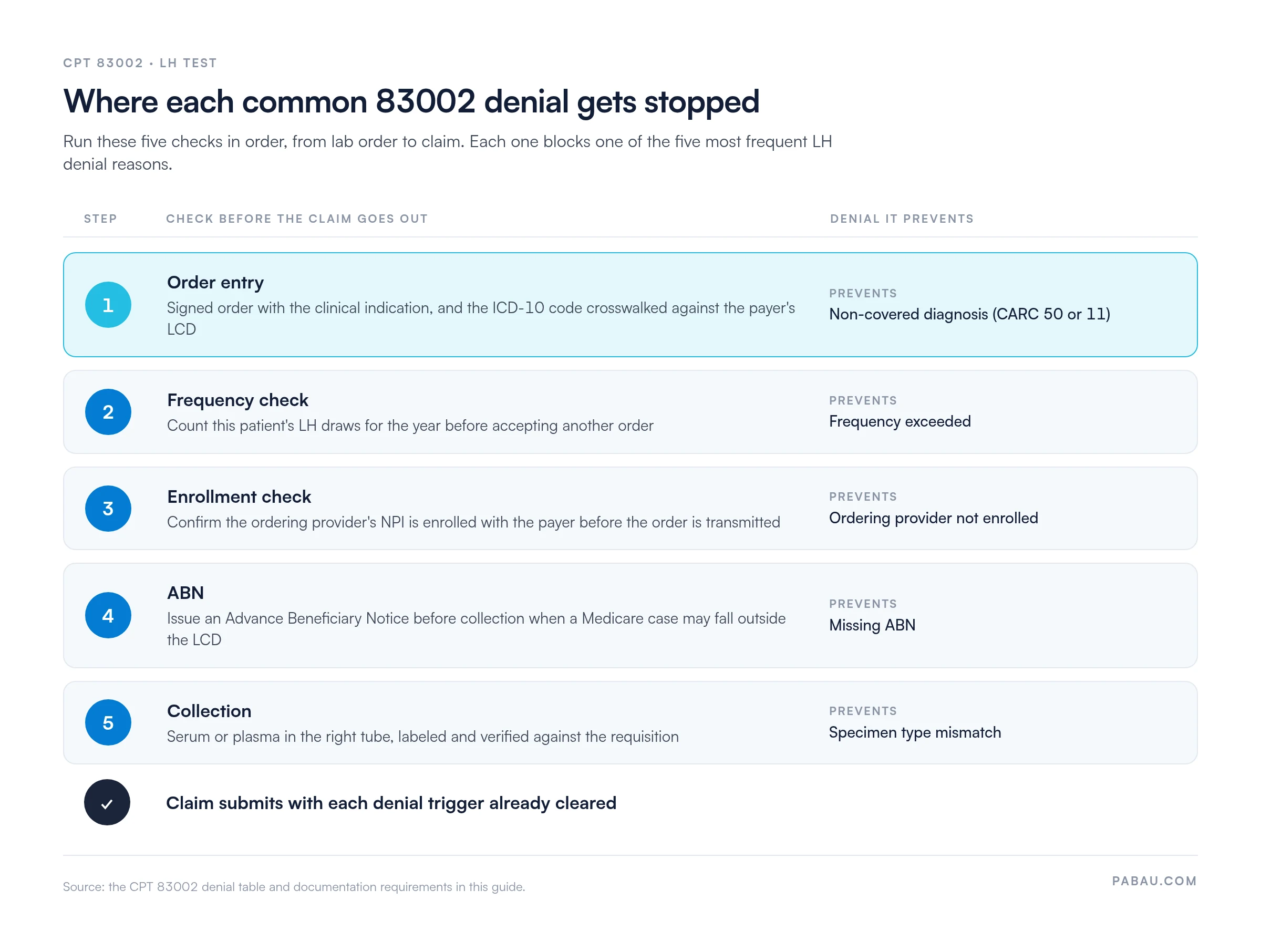
Pull a 90-day denial report filtered to CPT 83002 and sort by denial reason code. If CARC 50 or CARC 11 (non-covered diagnosis) represents more than 30% of denials, your ICD-10 assignment workflow needs a crosswalk check at order entry. If CARC 119 (benefit maximum) dominates, you need a frequency tracker by patient.
Specimen handling affects claim validity as well as the lab result. A rejected specimen requires recollection. If the recollection happens on a different date, a payer’s claims system may read the second billing event as a frequency violation.
Practices ordering LH tests through in-office lab workflows or reference lab requisitions need billing software that connects the clinical order to the claim without re-entry. Practice management software like Pabau includes claims software for practices that maps ICD-10 codes to CPT lab orders at the point of documentation. The diagnosis is captured before the specimen leaves the practice.
Pabau connects to Claim.MD, its US clearinghouse partner, so claims are scrubbed against payer rules before transmission. The scrub catches non-covered diagnosis mismatches and missing provider enrollment flags.
Fertility, HRT, and reproductive endocrinology practices bill high volumes of hormonal panels. For them, the automated scrub replaces a manual pre-submission review that otherwise costs two to three minutes per claim.
Pabau also processes electronic remittance advice, so ERA denial codes map back to the original claim without manual matching. When a CARC 50 hits a CPT 83002 claim, the billing team sees the denial in the same workflow where they manage the original order.

Pabau links ICD-10 codes to lab orders at the point of documentation, flags missing medical necessity, and submits clean claims through our clearinghouse integration. See how it works for hormonal testing workflows.

Most CPT 83002 denials trace back to decisions made before the specimen is drawn. The diagnosis code, the draw count, and the ABN are all settled at order entry, so that is where your billing checks belong.
The trade-off is a slightly slower order screen in exchange for fewer appeals and less rework. For practices running LH alongside FSH, estradiol, and testosterone, that trade pays off across every code in the panel.
Book a demo to see how Pabau checks diagnosis codes and draw frequency at order entry, so your LH claims go out clean.

Need to understand how clearinghouse claim scrubbing works? What makes a clean claim explains the pre-submission checks that prevent Chemistry code denials before they reach the payer.
Managing insurance eligibility verification before ordering labs? Insurance eligibility verification covers payer checks that confirm coverage before the specimen is collected.
Looking for structured guidance on the superbill for hormonal panels? How to build a superbill walks through capturing all companion lab codes in a single billable encounter.
Building a denial workflow from your remittance data? Denial management in healthcare shows how to sort, route, and appeal denials by root cause.
Want denials matched back to the original claim? Electronic remittance advice explains how ERA files feed payment posting and denial follow-up.
CPT code 83002 covers a laboratory assay for gonadotropin; luteinizing hormone (LH), performed on a serum or plasma specimen using immunoassay methodology. It is billed when a clinician orders a quantitative LH test to evaluate conditions such as hypogonadism, infertility, menstrual disorders, precocious puberty, or pituitary dysfunction. The code falls in the Chemistry subsection of CPT (82009-84999).
CPT 83001 covers follicle stimulating hormone (FSH) and CPT 83002 covers luteinizing hormone (LH). They are distinct analytes in the same gonadotropin family. FSH is used to evaluate ovarian reserve, menopause, and male spermatogenesis. LH is used for ovulation timing, hypogonadism classification, and PCOS evaluation. Neither code is a substitute for the other, and both may be billed on the same date when clinically indicated without a modifier.
Commonly accepted ICD-10-CM codes include E29.1 (testicular hypofunction), E28.2 (polycystic ovarian syndrome), and E28.39 (other primary ovarian failure). Others are N97.0 (female infertility with anovulation), N91.0 (primary amenorrhea), E23.0 (hypopituitarism), and Z31.41 (encounter for fertility testing). Accepted diagnosis lists vary by MAC LCD and payer, so always verify against the applicable Local Coverage Determination before billing.
Medicare pays CPT 83002 under the Clinical Laboratory Fee Schedule (CLFS), not the Physician Fee Schedule. The national allowable is approximately $18-22, though rates change annually. There is no facility/non-facility differential for CLFS codes. Verify the current rate using the CMS CLFS search tool, as prior-year figures become inaccurate after each January update.
The top denial reason is a non-covered diagnosis, meaning an ICD-10 code not on the payer’s LCD. Next comes frequency exceeded, when LH draws pass the yearly limit. Missing Advance Beneficiary Notices for Medicare patients and ordering providers not enrolled with the payer follow close behind. Specimen type mismatch is less common but does occur when the wrong tube type is used at collection.
No, most payers do not require prior authorization for CPT 83002. Medicare and most commercial plans process it as a routine lab claim subject to LCD coverage criteria. Medi-Cal (California Medicaid) does not require PA but restricts covered diagnoses more narrowly than Medicare. Some managed care plans require PA for specialty endocrine panels. Verify with the specific plan before ordering for high-cost panel combinations.
Yes, 83001 (FSH) and 83002 (LH) can be billed on the same date when both are clinically indicated. Current NCCI edits do not bundle these two codes. No modifier is required. Each code needs its own supporting diagnosis and documentation. Verify the current NCCI edit table before billing, as edit status can change with annual updates.