CCSD code XR940: Foreign body retrieval billing guide
CCSD code XR940 is the UK private healthcare code for retrieval of a foreign bod...

Last Updated: Nov 26, 2026
Billable Code
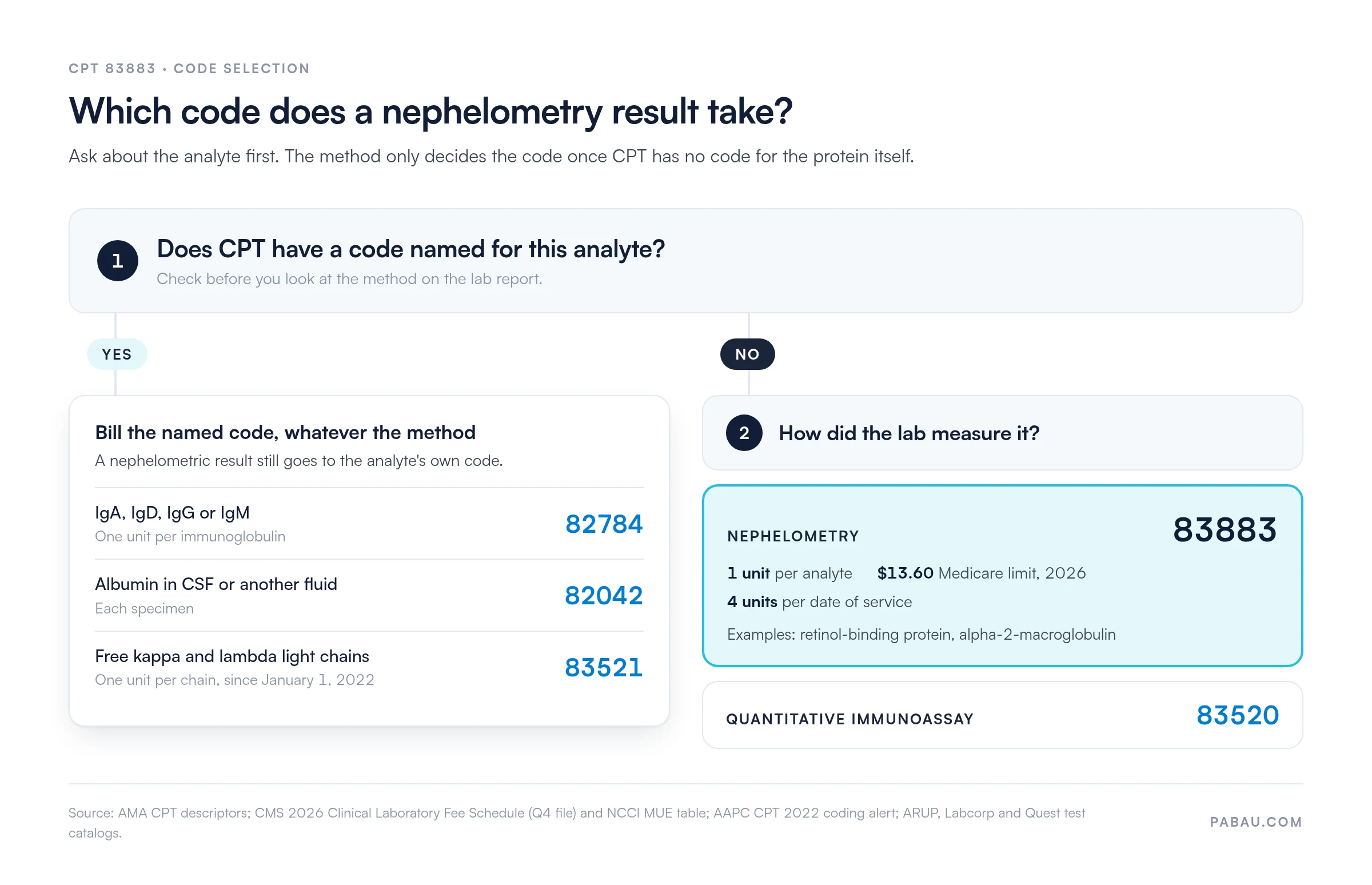
83883 is the CPT code for nephelometry, each analyte not elsewhere specified. It reports a quantitative result, measured by nephelometry, for an analyte with no CPT code of its own. Retinol-binding protein and alpha-2-macroglobulin are two common examples.
Bill one unit per analyte. When an analyte has a named code, that code wins over 83883, whatever the method. Free kappa and lambda light chains are the common error. Since January 1, 2022, they have been reported with 83521, one unit for each chain.
Let Pabau's smart automation suggest the right codes, reduce claim denials, and keep your practice compliant—effortlessly.
Automate repetitive tasks and focus on what matters most—your patients.
Reduce coding errors and ensure compliance with the latest regulations.
Clean claims, fewer denials, and faster reimbursements.
Powerful insights and reporting to help your practice thrive.
HIPAA compliant SOC 2 certified GDPR-compliant Trusted by 4,000+ clinics worldwide

CPT code 83883 reports one nephelometry result for an analyte that has no CPT code of its own, billed one unit per analyte.
An analyte with a named code takes that code whatever the method, so nephelometric IgG goes to 82784 and CSF albumin to 82042.
Free kappa and lambda light chains have been reported with 83521, usually as two units, since January 1, 2022, not with 83883.
Medicare pays 83883 under the Clinical Laboratory Fee Schedule, with a 2026 national limit of $13.60 per unit and a 4-unit daily edit.
Pabau, a practice management platform, lets US practices order Quest tests from the patient record, sync Labcorp results back and send claims through Claim.MD.
CPT code 83883 reports a quantitative test performed by nephelometry on an analyte that has no more specific CPT code. The official descriptor, “Nephelometry, each analyte not elsewhere specified,” appears in the CMS 2026 Clinical Laboratory Fee Schedule file. The code sits in the Chemistry subsection (82009-84999) of the Pathology and Laboratory section.
Nephelometry is a measurement method. The analyzer passes light through the specimen and measures how much of it is scattered by antigen-antibody complexes. The amount of scatter tracks the concentration of the protein being measured.
Two phrases in the descriptor do most of the work. “Each analyte” makes 83883 a per-analyte code, so two analytes on one specimen are two units. “Not elsewhere specified” means the code applies only when CPT has no code for the analyte itself.
CPT names many proteins individually, and a named code always takes priority over 83883. The method on the lab report does not change that. A nephelometric IgG result is still CPT 82784, and CSF albumin measured by nephelometry is still 82042. Quest Diagnostics runs its CSF albumin test on nephelometry and bills it as 82042.
That leaves 83883 for proteins CPT never named. Reference lab catalogs show which analytes land there:
A lab may measure the same unnamed analyte by immunoassay instead, which moves it to CPT 83520. Check the performing lab’s catalog entry before you build a charge code, because the method and the code travel together. Two questions, asked in this order, settle the code for any nephelometry result.
Free kappa and lambda light chain testing has had its own code since January 1, 2022. CPT 83521 carries the descriptor “Immunoglobulin light chains (ie, kappa, lambda), free, each,” with no method named. The AAPC CPT 2022 coding alert tells labs to report 83521 x2 when both chains are tested.
Before 2022, labs had no analyte code for these assays and used method codes. Immunoassays went to 83520, and some nephelometric assays went to 83883. Mayo Clinic Laboratories, for example, moved its spinal fluid kappa free light chain test from 83883 to 83521 on January 1, 2022.
The kappa/lambda ratio has no CPT code of its own. CPT’s chemistry guidelines treat a mathematically calculated result as part of the test, so the ratio is never billed separately. Diagnoses such as multiple myeloma (C90.00), monoclonal gammopathy (D47.2) and AL amyloidosis (E85.81) support the 83521 claim, not 83883.
Search your chargemaster and order sets for any free light chain test still mapped to 83883 or 83520. That legacy mapping sends a 2026 claim out under a code the analyte outgrew in 2022. Billed as 83883 x2, the pair would also price at $27.20, against $34.54 for 83521 x2 on the 2026 Medicare schedule.
These are the codes most often confused with 83883. Several of them, such as 86334, sit on the same plasma protein workup, which is where the mix-ups start.
83880 appears here only because older references paired it with 83883 as a light chain code. It reports natriuretic peptide, a cardiac marker, and plays no part in plasma protein testing.
Report one unit of 83883 for each analyte measured. A serum specimen tested for retinol-binding protein and alpha-2-macroglobulin is 83883 x2. CPT’s chemistry guidelines add one rule: an analyte measured in specimens from different sources, or collected at different times, is reported once per specimen.
Medicare’s medically unlikely edit (MUE) for 83883 is 4 units per date of service on practitioner claims. It is a date-of-service edit (MUE adjudication indicator 3), so units above 4 deny on the claim line. Records showing why each extra analyte was needed support an appeal.
Some payers want each analyte on its own line rather than one line with several units. Check the payer’s billing guide before you change your default.
The diagnosis has to justify the analyte that was measured. Because 83883 covers unrelated proteins, no single diagnosis list fits it. The pairs below follow the clinical uses Labcorp publishes for retinol-binding protein and alpha-2-macroglobulin.
Code the condition the ordering note documents, at its most specific level. Use an unspecified code like E46 only when the record supports no more precise one. A note that mentions parenteral nutrition monitoring without a nutritional diagnosis leaves the payer with no diagnosis to match.
Medicare pays 83883 under the Clinical Laboratory Fee Schedule (CLFS), which sets one national payment limit per code. The 2026 national limit is $13.60 per unit, per the CMS fourth-quarter 2026 CLFS file. CLFS rates come from the weighted median of private payer rates reported under PAMA.
Patients usually pay nothing for Medicare-covered diagnostic lab tests, according to Medicare.gov. The Part B deductible and 20% coinsurance do not apply, which matters when your front desk quotes costs.
Commercial payers set their own lab rates, and many contracts price them as a percentage of the CLFS. Check each contract rather than assuming the Medicare figure.
Because 83883 names no analyte, the record has to. A payer reviewing the claim sees only “nephelometry,” so the order and the report carry the detail.
Most 83883 denials trace back to code selection. The table pairs each pattern with its fix. For the remittance codes that come back with them, see this guide to medical billing denial codes.
Each of these can be caught before submission. A clean claim check that compares the code, units and diagnosis against the lab report clears most of them.
In many practices, a lab test is ordered in one system, resulted by a reference lab and billed from a third. The analyte name and the diagnosis get retyped along the way. That is how an RBP order turns into a light chain claim, or a diagnosis drops off.
Pabau keeps those steps in one patient record, with lab ordering built into the platform. US practices that switch on labs order Quest tests from the record, and Labcorp results sync back from Labcorp Link.
When the practice bills a test itself, Pabau’s claims management software sends the claim through Claim.MD, with eligibility checks before submission and ERA remittances after.
When a reference lab performs the test, the lab bills 83883 and your practice supplies the order and the diagnosis. Either way, the order, the result and the diagnosis sit in one record, so the claim matches the note.

Pabau links lab orders, results and insurance claims in the patient record. Your team sends US claims through Claim.MD and tracks each one to payment.

Treat 83883 as a last resort. Look for a code named for the analyte first, confirm the lab ran the test by nephelometry, then count one unit per analyte. A free light chain claim still mapped to 83883 is the clearest sign that a chargemaster needs an audit.
Each unit pays $13.60 under the 2026 Medicare schedule, so an 83883 denial rarely justifies the cost of an appeal. The first submission has to be the right one.
Book a demo to see how Pabau keeps lab orders, results and claims in one patient record.

Need to understand how claims reach payers? Medical claims clearinghouse guide explains how 837P transactions are checked and routed before a payer sees them.
Want to measure your lab denial rate? Revenue cycle management overview covers the KPIs that show when one lab code is driving denials.
Billing several lab tests on one encounter? Superbill guide walks through listing multiple codes and diagnoses on one compliant superbill.
CPT code 83883 covers a quantitative test performed by nephelometry on an analyte that has no more specific CPT code. The official descriptor is “Nephelometry, each analyte not elsewhere specified.” Report one unit for each analyte measured.
No. Free kappa and lambda light chains are reported with CPT 83521, usually as two units, one for each chain. That code took effect on January 1, 2022. Before then, some labs reported nephelometric free light chain assays under 83883.
No. The ratio is calculated from the two free light chain results, and CPT treats a calculated result as part of the test. Report 83521 for each chain measured and do not bill the ratio separately.
CPT 83883 is a nephelometry method code for analytes without their own code. CPT 83880 reports natriuretic peptide, a heart failure marker such as BNP or NT-proBNP. The two codes are unrelated, and neither one reports free light chains.
Bill one unit per analyte, and one per specimen when the same analyte is measured in specimens from different sources or times. Medicare’s medically unlikely edit allows 4 units per date of service on practitioner claims.
Medicare pays CPT 83883 under the Clinical Laboratory Fee Schedule. The 2026 national limit is $13.60 per unit. Patients usually pay no deductible or coinsurance for Medicare-approved clinical lab tests.
Lab catalogs bill retinol-binding protein and alpha-2-macroglobulin under 83883 when they are measured by nephelometry. An analyte with its own CPT code, such as an immunoglobulin or CSF albumin, takes that code instead, whatever the method.