HCPCS Code G0163: Skilled nursing observation and assessment
What is HCPCS Code G0163? HCPCS Code G0163 is a deleted Level II code for skille...

Last Updated: Oct 15, 2026
82784 is the CPT code for the quantitative measurement of gammaglobulin (immunoglobulin), covering IgA, IgD, IgG, and IgM. Each immunoglobulin class ordered is billed as its own unit of the code. It sits under Chemistry Procedures in the Pathology and Laboratory section of the AMA's CPT code set.
An IgA, IgG, and IgM panel drawn on one date of service is therefore three units of 82784, not one. Medicare prices those units on the Clinical Laboratory Fee Schedule, at a flat national rate of roughly $9.30 each. A diagnosis code that supports medical necessity has to sit on the claim beside them.
Let Pabau's smart automation suggest the right codes, reduce claim denials, and keep your practice compliant—effortlessly.
Automate repetitive tasks and focus on what matters most—your patients.
Reduce coding errors and ensure compliance with the latest regulations.
Clean claims, fewer denials, and faster reimbursements.
Powerful insights and reporting to help your practice thrive.
HIPAA compliant SOC 2 certified GDPR-compliant Trusted by 4,000+ clinics worldwide

CPT code 82784 covers quantitative IgA, IgD, IgG, and IgM testing, while IgE is reported under CPT 82785.
Each immunoglobulin class counts as one unit, so an IgA, IgG, and IgM panel bills three units of 82784.
Medicare prices 82784 on the Clinical Laboratory Fee Schedule at about $9.30 per unit, with no locality adjustment.
An ICD-10-CM code from the D80-D89 range, or another covered indication, must support medical necessity on every claim.
Practice management software like Pabau links lab orders to claims and flags missing ICD-10 codes before submission.
CPT code 82784 describes the quantitative measurement of gammaglobulin (immunoglobulin), including IgA, IgD, IgG, or IgM, each. The test runs on a serum specimen. The word “each” in the descriptor carries the billing rule. Every immunoglobulin class ordered is counted and reported as a separate unit.
The same word sets the unit on other lab codes. The descriptor for CPT code 82172 is apolipoprotein, each, so Apo A-I and Apo B on one date bill two units.
The code belongs to the Chemistry Procedures subsection within the Pathology and Laboratory section of the CPT code set, maintained by the American Medical Association. Two neighboring codes are the ones coders reach for by mistake. CPT 82785 reports IgE, and CPT 82787 reports immunoglobulin subclasses. Neither one is interchangeable with 82784.
The four immunoglobulin classes covered by this code have distinct clinical roles:
Physicians order the test to evaluate immune function, or to work up a condition involving too little or too much immunoglobulin. The indication decides which diagnosis code goes on the claim. Pairing the two at the point of order is what protects the payment later.
Common clinical indications include:
The test is not appropriate as a routine screening tool without a clinical indication. Payers, including Medicare Administrative Contractors (MACs), will deny claims where medical necessity is not clearly documented in the patient’s record.
Every CPT 82784 claim needs an ICD-10-CM diagnosis code that justifies the test. Covered indications are set by each Medicare Administrative Contractor (MAC) in its own local coverage determination. Check the active LCD for your jurisdiction in the CMS Medicare Coverage Database. The D80-D89 chapter, disorders involving the immune mechanism, holds the codes paired with this test most often.
Covered code lists differ between MAC regions, so a diagnosis one contractor accepts may need extra documentation under another. Our ICD-10-CM code library carries the full official descriptor behind each of the codes above. Confirm the patient’s coverage before the specimen is drawn, rather than after the claim comes back denied.
Medicare pays CPT code 82784 from the Clinical Laboratory Fee Schedule (CLFS), not from the physician fee schedule. The CMS Clinical Laboratory Fee Schedule file is the authoritative source for the amount. For 2026 the code pays roughly $9.30 per unit.
That figure is one flat national rate. There is no facility versus non-facility split, no RVU calculation, and no geographic adjustment by MAC region. An RVU lookup is the wrong instrument for a clinical chemistry code. Never use a figure it returns to check a lab payment.
Because the rate is per unit, the size of the panel decides the payment. The chart below runs the arithmetic for the combinations ordered most often.
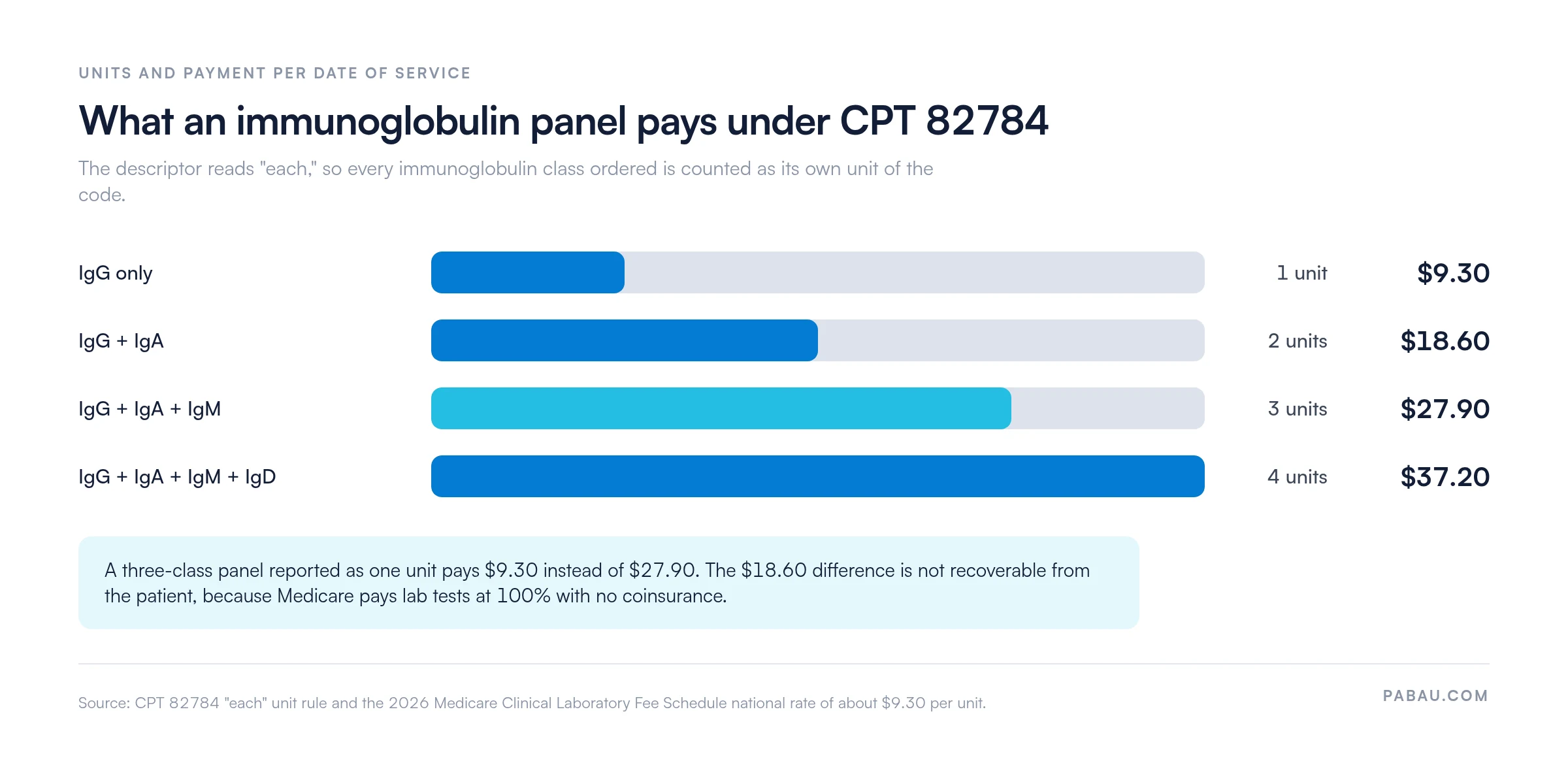
Clinical diagnostic laboratory tests are also paid on an assignment-related basis. Medicare pays 100% of the schedule amount, and neither the Part B deductible nor the 20% coinsurance applies. No balance is left to bill the patient, so a unit count that comes in low is revenue the practice never recovers.
CLFS amounts are built from the private-payer rates laboratories report to CMS under the Protecting Access to Medicare Act (PAMA). CMS takes the weighted median of those reported rates and publishes it as the national payment amount for the code. Updated files are posted on the CMS CLFS page, so pull the current one instead of carrying last year’s figure forward.
Because 82784 is a laboratory chemistry code, the specimen usually goes to an independent or reference laboratory. That laboratory bills the code under its own NPI, and the ordering physician does not bill it at all. The rate matters most to practices running immunoglobulin testing in house.
The unit structure in the official descriptor decides whether this code is billed correctly. A practice that reports 82784 as a single unit, whatever the panel size, under-bills every immunology order it sends out. The unit count belongs in the order workflow, not in a correction at claim submission.
A physician who orders IgA, IgG, and IgM on one date of service generates three units. Report CPT 82784 with three units, one per class. Some practice management systems default to a unit of 1 regardless of how many classes are ordered, which creates systematic under-reimbursement on every immunology panel.
Some payers require separate line items rather than a single line with multiple units. Check payer-specific billing manuals before submission. Modifier 59 (distinct procedural service) may be appropriate when payer edits flag multiple units of one code. Apply it only where the services are genuinely distinct. Verify applicable modifier rules with the specific MAC or commercial payer.
Audit your lab orders for the past 90 days. For each date of service, compare the number of immunoglobulin classes ordered against the units billed on CPT 82784. A date with three classes ordered and one unit billed is a correctable underpayment. Resubmit it within the payer’s timely filing window.
After incorrect units, thin documentation is the next most common reason an 82784 claim is denied. Medicare expects a clear trail from the clinical indication through to the ordered specimen. The diagnosis code on the claim has to be supported by what is written in the chart.
Required documentation elements:
Verifying benefits before the encounter also shows whether the plan requires prior authorization for immunoglobulin panels, which some commercial payers do. A missed prior authorization cannot be recovered on appeal.
Picking the wrong code from the immunoglobulin and serum protein family is a steady source of rejections. The table below sets out the neighbors of 82784 and the clinical question each one answers.
CPT 82785 covers IgE only, while CPT 82784 covers IgA, IgD, IgG, and IgM. The clinical contexts do not overlap: 82785 supports allergy and atopy workups, whereas 82784 supports immune deficiency, autoimmune disease, and plasma cell disorder evaluation. Reporting 82785 when IgE is ordered alongside an IgG/IgA/IgM panel requires both codes on the same claim, each with one unit. Using 82784 to report IgE is incorrect and will be denied on audit.
Denials on this code cluster around four root causes, and each one is preventable at the point of order rather than at appeal. A working denial management process for lab codes lets billing teams build upstream edits instead of chasing reversals.
Building an 82784 audit into the monthly billing review keeps the same denials from recurring. Sort denied claims by reason code, find the cause upstream, and fix the workflow rather than appealing each claim on its own.
The errors above share one cause. Lab orders, clinical notes, and claim submission sit in separate systems. A practice that orders labs in its EHR, documents in another platform, and bills through a standalone clearinghouse has three handoffs. The class count, the diagnosis link, or the signed order can fall out of step at any one of them.
Practice management software like Pabau keeps the order, the note, and the claim on one patient record. Pabau’s connected claims management software carries each immunoglobulin class ordered onto the claim as its own line. The biller sees the unit count before the claim is released. Diagnosis codes recorded against the visit are carried through to the claim form, which removes a manual re-entry step. Your coding team still decides which codes belong on the claim.
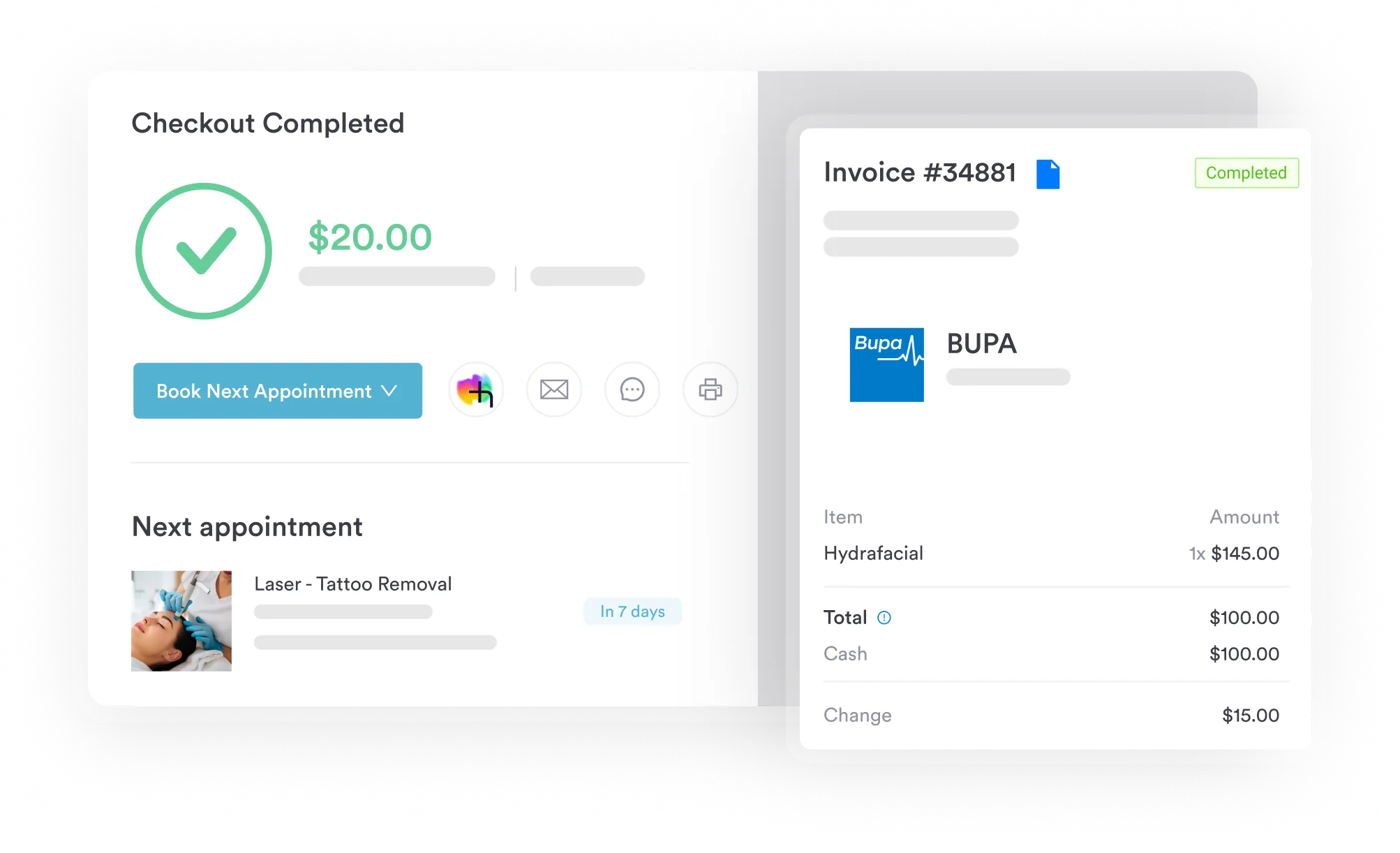
For electronic submission, Pabau connects to Claim.MD, our US clearinghouse partner, which reaches thousands of US payers. The integration supports CMS-1500 and 837P claims, eligibility checks, and electronic remittance advice. Denial reason codes come back into the same workflow as the original claim. Seeing them there is what makes it practical to act on a pattern.
Practices running immunoglobulin testing in house can track specimen collection, result receipt, and billing status inside that same record. When the requisition, the result, and the claim sit together, a missing-order denial has an answer attached to it rather than a paper chase.
Run an 82784 claim audit every quarter. Pull every claim where the code appears with one unit, then compare each against the original lab order. An order covering two or more immunoglobulin classes against a single billed unit is an underpayment. Total the revenue impact and fix the order workflow, rather than appealing each claim one at a time.

Pabau holds the lab order, the clinical note, and the claim in a single patient record. Your team can check 82784 unit counts and diagnosis links before the claim goes out.

Most of what goes wrong with this code is settled before the claim is built. The unit count follows the order, the diagnosis link follows the chart, and the signed requisition either exists or it does not. A billing team that inherits those three things clean has very little left to get wrong.
Start with an audit of last quarter’s 82784 claims against the orders behind them. Single units billed against multi-class panels show what the current workflow costs. That figure usually justifies fixing the order step rather than the claim step. Book a demo to see how Pabau keeps lab orders, notes, and claims on one record.

Need to understand how medical billing flows from order to payment? What is medical billing walks through each stage of the billing cycle for practice teams new to the process.
Dealing with repeated lab claim rejections? Denial management in healthcare covers how to build a systematic response to payer rejections across code types.
Looking for clearinghouse options for electronic claim submission? Claim.MD clearinghouse overview explains how the integration works for US practices billing Medicare and commercial payers.
CPT code 82784 covers the quantitative measurement of gammaglobulin (immunoglobulin) including IgA, IgD, IgG, or IgM, with each immunoglobulin class billed as a separate unit. It does not cover IgE, which is reported under the separate code CPT 82785.
Yes. CPT 82784 is billed once per immunoglobulin class ordered on a given date of service. If IgA, IgG, and IgM are all ordered, the correct billing is three units of 82784. Some payers require separate line items rather than a single line with multiple units; verify the specific payer’s requirements before submission.
Required documentation includes a signed physician order naming each immunoglobulin class being tested. The chart must also carry a documented clinical indication, an ICD-10-CM code supported by that documentation, and the specimen type, which is serum as standard. Missing any of these elements is sufficient grounds for denial under Medicare and most commercial payer policies.
Medicare prices CPT 82784 on the Clinical Laboratory Fee Schedule, at roughly $9.30 per unit in 2026. One national rate applies, so there is no facility or non-facility split and no locality adjustment. Each immunoglobulin class ordered is a separate unit, so a three-class panel pays three times that rate. Confirm the current amount in the CMS Clinical Laboratory Fee Schedule file.