HCPCS Code G0163: Skilled nursing observation and assessment
What is HCPCS Code G0163? HCPCS Code G0163 is a deleted Level II code for skille...

Last Updated: Oct 15, 2026
CPT code 83520 is the quantitative immunoassay code for measuring a specific analyte. It applies only when no more precise CPT code exists for that substance. It sits within the Chemistry Procedures subsection of Pathology and Laboratory in the AMA’s CPT code set. Medicare pays it under the Clinical Laboratory Fee Schedule at a flat national amount, with no physician-schedule payment attached.
The “not otherwise specified” label makes 83520 a catch-all within its category. Used correctly it is precise, and payers treat it as an audit trigger when it stands in for a more specific code. This reference covers the descriptor, clinical indications, and 2026 Medicare payment for CPT code 83520. It also covers modifiers, ICD-10 diagnosis pairings, CCI edit rules, and documentation requirements.

CPT code 83520 describes a quantitative immunoassay for any analyte other than infectious agent antibodies or antigens. Use it only when no more specific CPT code covers the analyte tested.
CPT 83520 is paid only under the Clinical Laboratory Fee Schedule, at a flat national amount of roughly $15 to $25 in 2026. The code is statutorily excluded from the Physician Fee Schedule, so the same rate applies no matter who performs the test.
Using 83520 when a more specific code exists is the leading cause of claim denial and compliance risk. Cyclosporine levels belong on 80158, and a qualitative result belongs on 83518 or 83516.
Pabau’s claims management software helps practices review NOS codes like 83520 before the claim goes out. Submission then runs electronically through the Claim.MD clearinghouse.
CPT code 83520 is the billable procedure code for an immunoassay that measures a specific analyte quantitatively. It applies when no more precise CPT code is available for that substance. The American Medical Association ‘s descriptor reads: Immunoassay for analyte other than infectious agent antibody or antigen, quantitative, not otherwise specified.
Two elements of that descriptor define its scope exactly. First, the exclusion: infectious agent antibodies and antigens have their own code family, so 83520 does not apply to serological or infectious disease panels. Second, the “quantitative” qualifier sets it apart from qualitative immunoassays, which report a yes/no or positive/negative result rather than a measured level.
Within the CPT system, 83520 sits in the Chemistry Procedures subsection of the broader Pathology and Laboratory section. The code range 83500-83529 covers immunoassay procedures, and 83520 is the NOS catch-all within it. Reach for 83520 only when nothing more specific fits.
Neighboring codes describe either a specific method or a specific analyte. CPT 83519, for instance, is the quantitative assay done by radioimmunoassay (RIA). Qualitative and semiquantitative work sits on 83518 and 83516.
CPT code 83520 is appropriate when a laboratory performs a quantitative immunoassay for a specific analyte and no analyte-specific CPT code exists for that substance. This is the core NOS principle in AMA coding. Always assign the most specific code available, and default to NOS only when nothing more specific exists.
Common clinical scenarios where 83520 is the correct code include:
One discipline prevents most errors on this code. Before submitting 83520, check that no more specific code applies. The AMA lists codes for hundreds of analytes within the 80000-89999 pathology range. Billing 83520 when a more specific code such as 80158 for cyclosporine or 83518 for a qualitative single-step method applies instead is a top audit flag. Check a current AAPC CPT code lookup or the AMA codebook before defaulting to the NOS option.
Hormones follow the same rule. Parathyroid hormone is measured by quantitative immunoassay, but it has its own analyte-specific code at 83970, so 83520 does not apply.
The same check applies outside hormone testing. A serum lipase assay carries its own code at 83690, so 83520 should never stand in for it.
Selecting the wrong code within the 83500-83529 immunoassay range is one of the most common billing errors for lab procedures. This table summarizes the adjacent codes and when each applies.
Two distinctions drive most selection errors here, and they are easy to mix up. The first is result type. Review the lab report before coding. If the instrument produces a numeric concentration, the result is quantitative and 83520 applies. If the result is a tier or a category such as positive/negative, the qualitative and semiquantitative codes apply instead. Use 83518 for a single-step method and 83516 for a multiple-step method.
The second distinction is method. CPT 83519 is also quantitative, so it is not the qualitative counterpart to 83520. It is reserved for a quantitative assay done by radioimmunoassay. Use 83520 only when the assay is quantitative, the method is not RIA, and no analyte-specific code exists. The four checks below run in the order a coder should apply them.
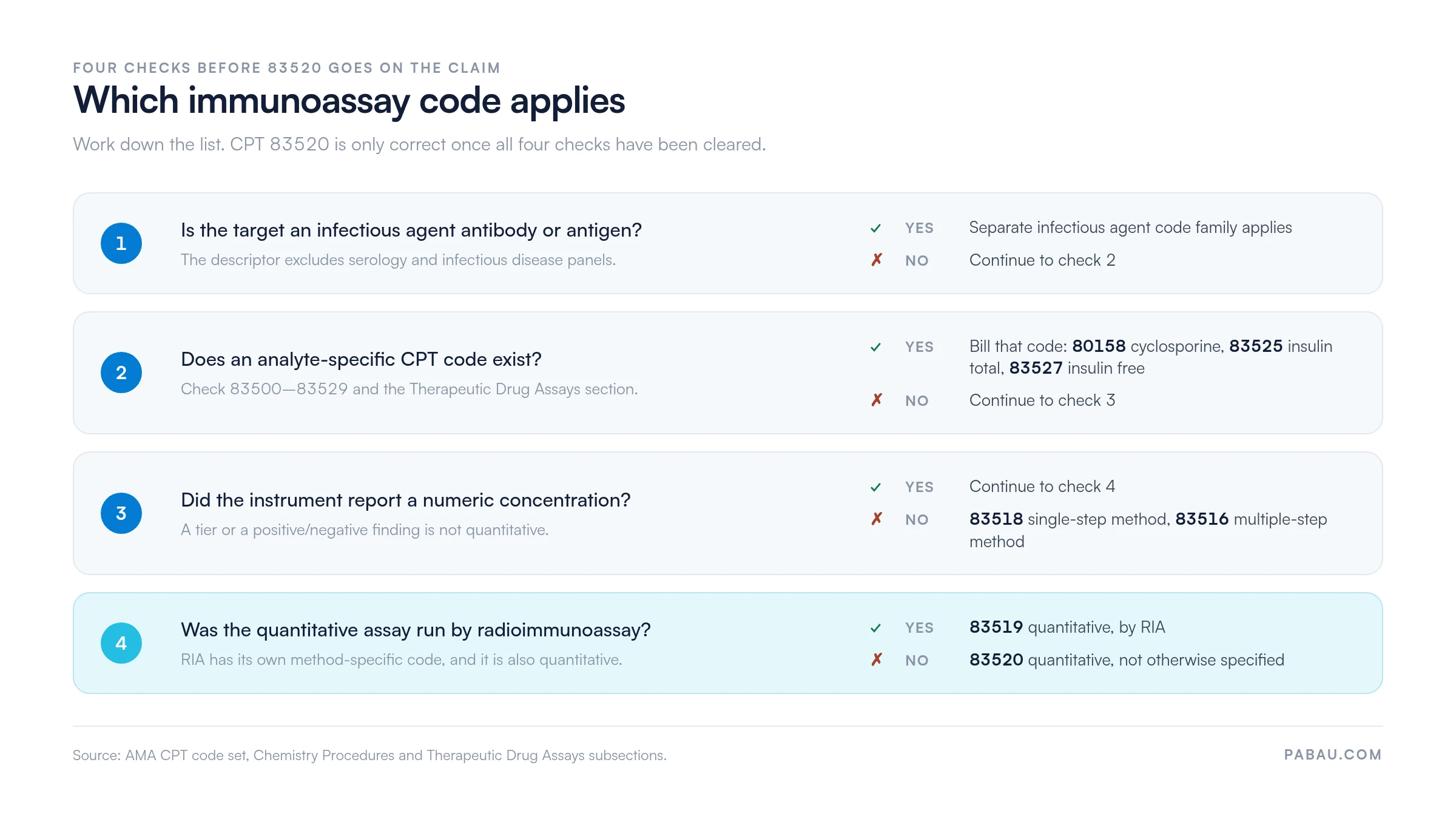
Before filing 83520, search the analyte name in the AMA codebook. Hormones such as TSH, cortisol and estradiol carry their own codes, and so do proteins such as prealbumin and ferritin. Most commonly monitored drugs sit in the Therapeutic Drug Assays section. Treat the NOS code as the last resort.
A covered ICD-10 diagnosis code must support medical necessity for CPT code 83520. Medicare Administrative Contractors (MACs) issue Local Coverage Determinations (LCDs) that specify which diagnoses qualify, and these vary by region. The table below shows commonly paired ICD-10 codes, though billers must check their own MAC’s LCD before assuming coverage.
Two important caveats apply. First, the ICD-10 code must reflect the clinical indication documented in the medical record. A code that merely appears on the coverage list is not enough. Second, MAC LCDs for immunoassay testing often list the specific analytes that qualify. Using 83520 for an analyte that is not on that list will likely generate a denial, whatever ICD-10 code you select.
Confirm the descriptor of each diagnosis before it goes on the claim, since a truncated or non-billable code gets rejected on its own. Our ICD-10-CM code index lists the full descriptors, and the current LCD for your MAC settles coverage.
Modifier selection and CCI bundling rules affect whether CPT code 83520 claims pay the first time or generate denials. The modifiers below apply in specific clinical situations.
CCI edits: CMS administers the National Correct Coding Initiative (NCCI), which establishes code pairs that need a modifier before you can bill them together. CCI edits for 83520 typically involve other chemistry or immunoassay codes billed on the same date. CMS updates the full NCCI edit table quarterly, so billers should check current edit pairs directly in the CMS NCCI files. Modifier 59 may unbundle certain pairs when the clinical situation supports it, and incorrect use of modifier 59 is itself an audit trigger.
For repeat testing under modifier 91, documentation must state why repeat measurement was clinically necessary on the same date. A dosage adjustment requiring a follow-up trough level is one example. “Confirmatory testing” does not meet the threshold unless the record justifies it medically.
CPT code 83520 has one payment pathway, and it does not change with who performs the test. The code is a clinical laboratory test, and CMS assigns it status indicator X on the Physician Fee Schedule. Status X means statutory exclusion, so 83520 never gets paid on its own under the MPFS. That holds for an independent lab, a reference lab, and a physician-owned in-office lab alike.
Payment comes from the Clinical Laboratory Fee Schedule (CLFS), which CMS issues annually. Practices that expect an in-office lab to draw a higher physician-schedule payment for this code are budgeting against a schedule that does not pay it.
CLFS amounts are flat national rates. Since PAMA took effect, CMS has set them from reported private-payer data rather than from relative value units. No locality or GPCI adjustment is applied on top. The published amount for 83520 sits in the region of $15 to $25 for 2026. Read the current figure straight from the CMS Clinical Laboratory Fee Schedule file before quoting the expected payment.
Treat that published amount as what Medicare will allow, with no upside for running the test in-house. Practice management software like Pabau connects to the Claim.MD clearinghouse, so 83520 claims go to Medicare and commercial payers electronically rather than on paper.
There is no RVU calculation to run for 83520. Work, practice expense and malpractice RVUs drive payment on the Physician Fee Schedule, and the Physician Fee Schedule excludes this code entirely. The CLFS assigns a single dollar amount per code instead. The table below summarizes what that means when you are estimating payment or checking a remittance.
Because the CLFS amount is fixed and uniform, a payment that comes back lower than expected is almost never a rate question. The electronic remittance advice (ERA) you receive after adjudication shows the allowed amount, any adjustments, and the reason code for partial or denied payment. Reading those reason codes tells billing staff whether an 83520 underpayment came from the rate or from the coding.
Solid documentation is what separates a payable 83520 claim from one that triggers a medical records request or denial. Payers audit lab codes specifically because billers frequently misuse or incompletely document NOS codes like 83520. The record must support three things. The record must show a clinician ordered the test, someone did it as described, and a covered reason justified it.
Required elements for medical billing compliance with CPT code 83520:
A superbill workflow can capture analyte identity and the linked diagnosis at the point of ordering, rather than while filing the claim. The analyte and the diagnosis are then already in the record when the claim is built. Make that link between order, result, and diagnosis part of your lab ordering process, not your billing queue.
CPT code 83520 has a predictable failure pattern in billing. The NOS label makes it look like a safe fallback, but payers treat it as a red flag. These are the errors that generate the most denial work for billing teams.
Each of these errors has a documented fix. For NOS code misuse, a code check against the analyte name before filing resolves it. For pairing errors, an audit of the current MAC LCDs tells you which diagnoses are covered. Denial reason codes will also show which of these error types is driving a practice’s 83520 denial rate.
Most 83520 billing errors share a root cause. Billers make the decision about which code to use too late, while filing the claim, rather than at the point of ordering. By then the record is already missing the analyte name or the linked diagnosis, and the denial follows. Practice management software addresses this by moving the coding decision upstream.
Pabau’s claims management software automates several steps that practices currently handle manually for lab codes:
How specific a code is stays a human judgment. No billing system knows whether the AMA has a code for the analyte your lab measured, so write the check into the workflow. Before 83520 is filed, one person searches the analyte name in the codebook and records what they found.
Catching a wrong code choice before you file costs nothing. Correcting it after denial costs 10-15 minutes of billing staff time per claim, including appeal preparation and resubmission. That cost compounds across every 83520 claim that reaches a payer incorrectly coded.
When you set up lab order workflows in your practice management system, add a required field for analyte name. It should apply to any order that generates a 83520 code. The analyte is then named in the record before anyone builds the claim, which is what an auditor asks for first.

Pabau’s claims management tools check claim details such as membership and authorization numbers before anything is submitted. Claims then go out electronically through Claim.MD, so an 83520 claim reaches the payer without a re-key.

CPT code 83520 is a precise tool that becomes a liability when used as a shortcut. The code belongs on a claim only after ruling out every analyte-specific alternative. The documentation also has to identify the analyte, support the diagnosis, and meet CLIA requirements for the lab that ran the test.
Those conditions hold consistently when the billing decision is part of the order workflow, not an afterthought while filing the claim. Pabau handles the clearinghouse connectivity, so an 83520 claim goes out electronically and the remittance lands against the same record. Book a demo to see how lab orders, documentation and claims sit together for your practice.

Need to understand what qualifies as a clean lab claim? Submitting a clean lab claim breaks down the elements payers check before processing – useful alongside any NOS code submission checklist.
Tracking denials but unsure where to start? Revenue cycle management fundamentals explains how denial rates feed into overall practice financial health and where 83520 denials typically surface in the cycle.
Want a broader billing compliance framework? Medical billing compliance guidance covers audit risk management, documentation standards, and the compliance checks most relevant to lab and pathology coding.
CPT code 83520 covers a quantitative immunoassay test for any specific analyte that is not an infectious agent antibody or antigen. It applies only when no more specific CPT code exists for that analyte. Clinicians use it for therapeutic drug monitoring, hormone level quantification, protein measurement, and similar laboratory testing. The result must be a measured numeric concentration rather than a positive/negative finding.
Only the Clinical Laboratory Fee Schedule (CLFS) pays CPT 83520, and the 2026 published amount is in the region of $15 to $25. The CLFS sets one national amount per code, so the rate does not vary by locality and does not change with who performs the test. The code carries status indicator X on the Physician Fee Schedule, which means it never gets paid on its own there. Read the current amount from the CMS CLFS file before you quote a payment.
Use CPT 83520 only after confirming that no analyte-specific CPT code exists for the substance being measured. Check the AMA codebook and the 83500-83529 range first, where 83525 covers total insulin and 83527 covers free insulin. Then check the Therapeutic Drug Assays section, which sits outside that range and holds the drug-level codes such as 80158 for cyclosporine. The NOS label means last resort, not general purpose.
NOS (not otherwise specified) means the code applies when no more precise code exists for the specific service done. In CPT coding, NOS codes are catch-alls within a procedure family. Using an NOS code when a specific code exists is a coding error, because payers expect the most specific code available. NOS codes also draw more audit attention, since billers frequently misuse them.