HCPCS Code G0163: Skilled nursing observation and assessment
What is HCPCS Code G0163? HCPCS Code G0163 is a deleted Level II code for skille...

Last Updated: Oct 15, 2026
83516 is the CPT code for immunoassay for analyte other than infectious agent antibody or antigen; qualitative or semiquantitative, multiple step method. Coders reach for it when the laboratory uses an ELISA or similar multi-step technique on a non-infectious analyte. The result is reported as positive/negative or in titered ranges, not as a precise numeric concentration.
The code sits in the Chemistry Procedures subsection of CPT's Pathology and Laboratory section. It is an "analyte not otherwise specified" code, so payers examine it closely. Three problems sink most 83516 claims. The methodology is wrong, the ICD-10 pairing is missing, or the analyte already has its own specific CPT code.
Let Pabau's smart automation suggest the right codes, reduce claim denials, and keep your practice compliant—effortlessly.
Automate repetitive tasks and focus on what matters most—your patients.
Reduce coding errors and ensure compliance with the latest regulations.
Clean claims, fewer denials, and faster reimbursements.
Powerful insights and reporting to help your practice thrive.
HIPAA compliant SOC 2 certified GDPR-compliant Trusted by 4,000+ clinics worldwide

CPT code 83516 covers qualitative or semiquantitative immunoassay by a multiple step method, for non-infectious analytes.
CPT 83519 is quantitative by radioimmunoassay and 83520 is quantitative by any other method, so the result type and the method drive code selection.
Medicare covers 83516 under LCD L33261 for allergy testing. Weak ICD-10 specificity is the top denial trigger.
Pabau’s claims management software submits 83516 claims through Claim.MD and tracks every payer response in one queue.
The American Medical Association’s CPT code set defines 83516. The official descriptor reads: Immunoassay for analyte other than infectious agent antibody or antigen; qualitative or semiquantitative, multiple step method. Each clause in that descriptor narrows the code, so read all four before you assign it.
The code belongs to CPT’s Chemistry Procedures subsection within Pathology and Laboratory. It sits in the 83516-83520 family of immunoassay codes written for an analyte not otherwise specified. There is no CPT 83517. The codes beside 83516 are 83518, 83519 and 83520, and each one turns on the result type or the method.
CPT 83516 applies when the performing laboratory uses a multi-step method to detect a non-infectious analyte and reports the result qualitatively or semiquantitatively. The most common clinical scenarios billed under this code are:
Mayo Clinic Laboratories lists CPT 83516 in its test catalog for several multi-step immunoassay panels, which shows how reference labs apply it. Confirm with the performing laboratory that no more specific CPT code exists before you select 83516.
Lipoprotein(a) shows why that check matters. The analyte has its own quantitative code, 83695, so 83516 does not apply to an Lp(a) measurement.
Because 83516 is a catchall code, its boundaries matter as much as what it covers. Use a more specific code whenever one exists for the analyte being tested.
Parathyroid hormone is one of those analytes. CPT assigns the parathormone assay its own code, 83970, and the lab bills that instead. Serum lipase is another such analyte, since the codebook reserves 83690 for that assay.
NOS codes like 83516 are misapplied most often when a more specific analyte code already exists. The lab report settles both the method and the result type, so read it before the code is assigned.
These three codes are a common source of coding errors in laboratory billing. Two facts decide which one applies. The first is the type of result the laboratory reported. The second is the method it used to get there.
Start with the lab report. If the result is a class score, a titer, or positive/negative, and the method is multi-step, CPT code 83516 applies. If the result is a precise numeric value, the method decides between 83519 and 83520. The chart below runs the same two questions in order.
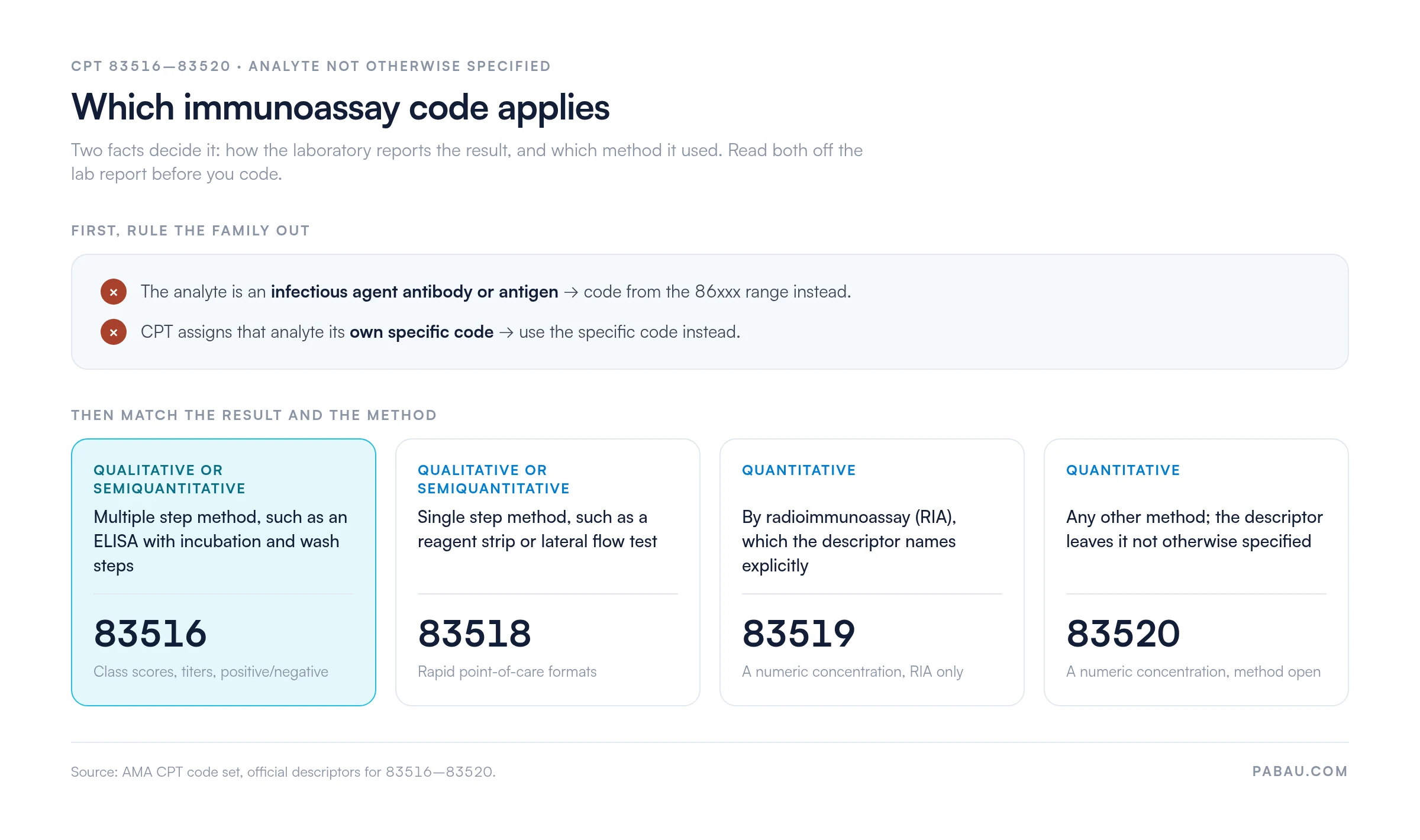
Not every immunoassay format meets the multiple step requirement. The lab report has to document the methodology explicitly for the claim to survive audit.
A typical multi-step immunoassay sequence proceeds as follows:
For the claim to be defensible, the lab report has to state four elements:
Missing any one of them is enough for a payer reviewer to downcode or deny the claim. Build a lab-report check into the pre-billing review step so the omission is caught before submission.
Request the full laboratory methodology report, not just the results page, before finalizing a CPT code 83516 claim. Many lab portals separate the result from the methodology section. A clean claim requires both the analyte name and a multi-step method statement in the documentation on file before submission.
For Medicare patients, CPT code 83516 is governed mainly by CMS Local Coverage Determination L33261. That LCD covers allergy testing, including immunoassay-based allergen-specific IgE testing. Coverage is not automatic. The test must be ordered for a patient with a documented allergic condition, and the ordering physician’s notes have to support the specific analyte panel.
Payer coverage for 83516 varies considerably outside Medicare. These are the policy distinctions to verify with each payer before submission:
The same rule applies here as to any other laboratory test. The diagnosis code on the claim must match the clinical indication in the ordering note, rather than the most convenient code for the analyte category.
ICD-10 codes paired with 83516 must reflect the clinical indication documented in the ordering note. Weak or generic ICD-10 pairing is the most common reason CPT code 83516 claims are denied on medical necessity grounds.
D89.9 is a high-denial pairing because payers read it as thin justification for an NOS immunoassay. Code to the highest specificity the documentation supports, and check the wording in the ICD-10-CM code set before the claim goes out.
CPT code 83516 is reimbursed under the Medicare Clinical Laboratory Fee Schedule (CLFS), not the Physician Fee Schedule. The CLFS rate is set annually by CMS and applies nationally, though individual Medicare Administrative Contractors (MACs) may apply local coverage edits.
For current 2026 allowed amounts, use the CMS Clinical Laboratory Fee Schedule page and the annual rate table it publishes. CLFS rates are not built from RVUs, so an RVU lookup tool cannot answer this question. The files are updated each January 1.
Commercial payer rates typically exceed Medicare CLFS rates for laboratory codes. Some plans still use Medicare as their reference rate for NOS codes, so confirm contracted rates directly with each payer.
Two points shape what 83516 actually pays in 2026. The CLFS rate applies per test, per analyte, per date of service. If a panel of allergens runs in a single multi-analyte ELISA, read the laboratory’s methodology report. It decides whether multiple units of 83516 are reportable, or whether a panel code applies instead.
The NOS designation invites payer scrutiny, so 83516 claims are reviewed more closely than codes that name their analyte. Each denial reason below pairs with an action billing staff can take before submission.
Pre-submission review earns its time on 83516, because the NOS status means no payer approves the claim on the code alone. Strong denial management workflows flag it for a second look before the batch goes out.
An Advance Beneficiary Notice (ABN) goes to the Medicare patient before the 83516 test is ordered. That applies whenever there is reason to believe Medicare will not cover the service. Without a signed ABN on file, the practice absorbs the cost if the claim is denied, and the patient cannot be billed.
Issue an ABN for 83516 when any of the following conditions apply:
The ABN has to be delivered before the test is ordered, not after the denial. CMS Form CMS-R-131 is the required document format. Retain the signed original with the patient’s billing record. Store it in the same system as the lab order and the claim, so an audit finds all three.
Billing staff can run this checklist before submitting any CPT code 83516 claim. Each item addresses a known denial trigger identified in payer policy and coding guidance.
Teams that run this check on every 83516 claim catch the two errors behind most of the rework. Those are a method mismatch and a diagnosis code that is too broad. Both are cheap to fix before submission and expensive to appeal afterwards.
Build an 83516 mini-audit into your lab billing queue. Filter the queue by this code and check the lab report’s methodology field before the batch is submitted. It takes about 30 seconds per claim, and it catches the method mismatches that are hardest to argue after a denial.
Most practices track lab claims in two places at once. The codes sit in the laboratory’s portal and the claim sits in the billing system. The methodology detail that supports 83516 then never travels with the claim, so the person writing the appeal starts by hunting for it.
Pabau is practice management software for medical and aesthetic practices, and it includes claims software for billers who handle laboratory codes. Claims are submitted electronically through Claim.MD, and every payer response comes back into the same queue. Billing staff see which 83516 claims were paid and which were denied, with the CARC reason code the payer returned.
The outcome is a shorter appeal cycle. When a denial arrives, the claim, the diagnosis code and the patient record are already in one place. Nobody has to rebuild the file before writing the appeal.

Pabau submits your 83516 claims through Claim.MD and brings every payer response back into the same queue. Denials arrive with their CARC reason code, next to the patient record the claim came from.

Coding 83516 correctly is mostly a documentation habit. Read the methodology line and the result line on the lab report before the code is assigned, every time. A coder who does that rarely reaches for 83516 when 83518, 83519 or 83520 was the right answer.
The trade-off worth remembering is that an NOS code buys coverage breadth at the cost of scrutiny. Because the descriptor names no analyte, the ICD-10 pairing and the ordering note carry the whole medical necessity argument. Weak documentation costs more on 83516 than on a code that names its analyte.
Pabau’s claims tools submit these claims and track every payer response in one queue. Book a demo to see how lab billing runs end to end in a single system.

Need to understand how clearinghouse validation works for lab claims? Medical claims clearinghouse guide explains how payer-level edits catch code errors before submission.
Want to reduce denial rates across all claim types? Revenue cycle management fundamentals covers the pre-billing review steps that prevent 83516-style NOS denials.
Need to verify CPT codes against CMS eligibility before ordering? Insurance eligibility verification outlines the real-time check that confirms coverage status before a lab test is ordered.
CPT code 83516 covers an immunoassay for an analyte other than an infectious agent antibody or antigen. The result is qualitative or semiquantitative, and the method is multiple step. Common uses include allergen-specific IgE class scoring panels and autoimmune marker detection, such as ANCA immunofluorescence assays. It applies only where no more specific CPT code exists for the analyte.
The 2026 Medicare Clinical Laboratory Fee Schedule allowed amount for CPT 83516 is published annually by CMS. Current rates are in the CLFS annual rate table download on cms.gov. The CLFS is not built from RVUs, so an RVU lookup tool will not answer this question. Contact your MAC for the local edits that apply to your billing location.
Four reasons account for most 83516 denials. The lab result was quantitative, so 83519 or 83520 should have been used. The ICD-10 diagnosis code was too nonspecific to support medical necessity. A more specific CPT code existed for the analyte. Or prior authorization was missing, on a payer that requires it for NOS immunoassay codes.
An ABN is required before ordering the test for a Medicare patient in three situations. The indication may not meet LCD L33261 criteria. The analyte may not be on the covered analyte list. Or frequency limits may have been reached. Without a signed ABN on file, the practice cannot bill the patient if Medicare denies the claim.