CCSD code L6530: Revision femoral bypass graft
CCSD code L6530: Definition and clinical scope CCSD code L6530 carries the offic...

Last Updated: Nov 13, 2026
83037 is the CPT code for hemoglobin; glycosylated (A1c), by device cleared by FDA for home use. It covers an A1c test run on a home-use test system, whether the patient runs it at home or staff run it in the office.
The device's FDA clearance decides the code. A professional-use analyzer, including CLIA-waived ones such as the Afinion AS100, bills as 83036 with modifier QW. Medicare pays both codes the same $9.71 national rate.
Let Pabau's smart automation suggest the right codes, reduce claim denials, and keep your practice compliant—effortlessly.
Automate repetitive tasks and focus on what matters most—your patients.
Reduce coding errors and ensure compliance with the latest regulations.
Clean claims, fewer denials, and faster reimbursements.
Powerful insights and reporting to help your practice thrive.
HIPAA compliant SOC 2 certified GDPR-compliant Trusted by 4,000+ clinics worldwide

CPT code 83037 covers a hemoglobin A1c test run on an FDA-cleared home-use device, whether the patient or your staff runs it.
Professional-use analyzers such as the Afinion AS100 and DCA Vantage bill as 83036 with modifier QW, even when the test runs in your office.
Medicare pays 83037 the same $9.71 national Clinical Laboratory Fee Schedule rate as 83036 (CY2026 Q4), with no locality adjustment.
Under NCD 190.21, Medicare treats A1c testing more often than every three months as unnecessary for a patient with controlled diabetes.
Pabau, the practice management platform we build, submits A1c claims to US payers through the Claim.MD clearinghouse.
CPT code 83037 is defined by the American Medical Association as: Hemoglobin; glycosylated (A1c), by device cleared by FDA for home use.
The test runs on a fingerstick sample, either by the patient at home or by office staff on the same device. The device’s FDA clearance for home use is what qualifies the test, wherever it is performed.
The test measures the percentage of hemoglobin carrying attached glucose, which reflects average blood glucose over the preceding 90 days. It is the main monitoring test for Type 1 and Type 2 diabetes. Results of 5.7% to 6.4% indicate prediabetes, and 6.5% or above indicates diabetes. When the clinician diagnoses prediabetes from that result, the claim carries R73.03.
The difference between CPT 83036 and CPT 83037 is the FDA clearance of the test system. Bill CPT code 83037 when the device is cleared for home use.
Bill 83036 for every other A1c method, including a professional-use analyzer in your office. When that analyzer is CLIA-waived, the line goes out as 83036QW.
The mis-coding runs both directions. Practices with an in-office analyzer often assume any point-of-care result is 83037. The CMS waived test list places the Afinion AS100 and DCA Vantage under 83036QW, so that assumption bills the wrong code.
The reverse error happens when a coder sees a fingerstick result from a home-use device and reports 83036 out of habit.
Both mistakes come from the same missing fact: what the test system is cleared for. The decision chart below starts from that question.
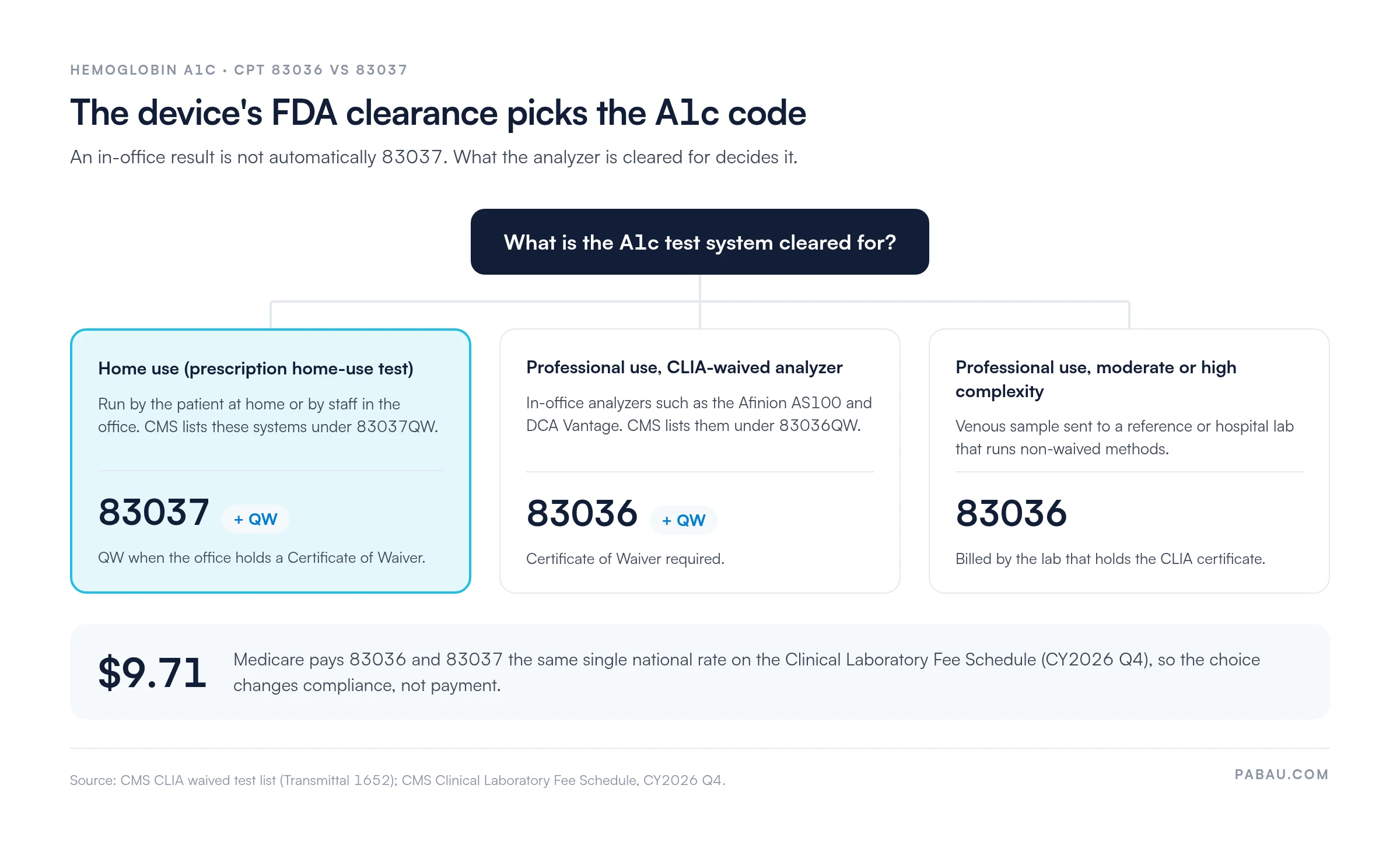
To bill CPT code 83037, the test system must be cleared by the FDA for home use. CMS lists prescription home-use A1c tests under 83037QW on its waived test list.
Professional-use analyzers, including the Afinion AS100 and the Siemens DCA Vantage, appear under 83036QW instead. Clearance and waiver listings change, so check the current entry before you bill.
An office needs a CLIA Certificate of Waiver before it bills CPT code 83037 to Medicare and most commercial payers. Tests cleared by the FDA for home use are waived under CLIA, so this lowest level of certification covers them. The certificate still has to be active and on file. Keeping it current is part of medical billing compliance.
A complete chart note supporting a CPT code 83037 claim includes six elements. Missing any one of them is enough for a payer to deny or audit the claim. Building these fields into your EHR template is the most reliable route to clean claim submission on the first pass.
Audit 10 consecutive CPT code 83037 claims each quarter. Check whether all six documentation elements appear in the chart note before the claim was submitted. The fixes are usually small: a template field for the CLIA number and one for the test system.
Every CPT code 83037 claim needs an ICD-10 diagnosis code that establishes medical necessity. Medicare checks it against the covered code list in NCD 190.21, the national coverage determination for glycated hemoglobin testing. The AAPC code lookup helps confirm accepted pairings for commercial payers.
Codes that do not support medical necessity draw automatic denials. Z00.00 (routine exam) submitted as the only diagnosis is a common example. The CrossCoder crosswalk tool shows which diagnosis codes link to 83037.
Medicare Part B covers CPT code 83037 under NCD 190.21, the national coverage determination for glycated hemoglobin testing.
CMS added 83037 to that policy through coverage decision CAG-00373N, so the same national rules apply as for 83036. The test must be medically necessary to manage diabetes or to assess hyperglycemia. When the provider documents hyperglycemia without a diabetes diagnosis, the claim usually carries code R73.9.
Payment for 83037 is set on the Clinical Laboratory Fee Schedule (CLFS), which CMS publishes as quarterly files. That is where to check the current rate.
Medicare pays $9.71 for CPT code 83037 on the CY2026 Q4 Clinical Laboratory Fee Schedule, the same rate as 83036. Since April 2008, CMS has crosswalked 83037 and 83037QW to the 83036 payment amount. The home-use device therefore earns no premium.
The CLFS sets one national rate, with no adjustment for MAC locality. CMS updates it each January and republishes it in quarterly files. Commercial payers set their own allowables, which may sit above or below the Medicare rate.
Most CPT code 83037 denials are preventable, and the five patterns below cover the usual causes. Denial management workflows catch them before submission by running edits on every lab claim. The reason codes in the table are explained one by one in our guide to claim denial codes.
When appealing a frequency denial, attach the most recent A1c result and the treating provider’s reason for retesting. Include any medication change notes as well. The first Medicare appeal level is a redetermination by the MAC.
CPT code 83037 is separately billable on the same date of service as an E/M code (99213 to 99215). For diabetic patients, the result usually informs the treatment decisions made during the visit. Document both the purpose of the test and the clinical response to the result in the encounter note.
Billing both lines cleanly is easier when the visit and the test sit on one encounter. Software that manages claims from that encounter puts the E/M code and 83037 on the same CMS-1500 claim.
Category II performance measure codes supplement CPT code 83037 in diabetes quality reporting, including HEDIS and MIPS.
They carry no payment, but they affect quality scores that drive value-based bonuses and penalties. If Category II codes are new to your billing team, start with medical billing fundamentals before adding them to lab claims.
Report the matching Category II code on the same claim as the E/M or the 83037 lab line. HEDIS and MIPS use these codes to confirm that the practice measured and recorded the A1c outcome. Leaving the code off loses quality measure credit toward the MIPS score.
Set up an EHR result template that fills in the Category II code from the numeric A1c result staff enter. Under 7.0% maps to 3044F, 7.0% to 7.9% to 3051F, 8.0% to 9.0% to 3052F, and above 9.0% to 3046F. That removes the manual look-up on every 83037 encounter.
An 83037 denial usually starts before the claim exists. The test system’s name sits on a kit box, the CLIA number lives in a binder, and the coder sees neither one.
Pabau, the practice management platform we build, keeps the encounter, the forms and the claim in one patient record. A custom form in the note can hold the test system, its lot and the CLIA number, so the coder reads them from the chart.
US claims go out through the Claim.MD clearinghouse as CMS-1500 or 837P claims, with eligibility checks before the visit. Electronic remittance advice comes back against the same record. A CO-4 for a missing QW then surfaces while the visit is still fresh in everyone’s mind.

Pabau keeps device, CLIA and visit details in the patient record and submits CMS-1500 claims through Claim.MD. See how it handles in-office lab billing.

Bill 83037 only when the test system’s FDA clearance says home use. For every professional-use analyzer, waived or not, the code is 83036, with QW in the office. Medicare pays $9.71 either way, so the wrong choice buys a denial and no extra revenue.
Make the device decision once, when the analyzer or kit arrives, and write it into the note template. Book a demo to see how Pabau keeps CLIA numbers, device details and A1c claims in one patient record.

Need to understand how claims move from submission to payment? What is revenue cycle management walks through the end-to-end billing workflow that every in-office lab code feeds into.
Getting A1c claims denied on the electronic claim format? 837 file billing guide explains how the 837P transaction standard carries CPT codes, modifiers, and diagnosis pairings to your MAC.
Want to reduce rework on all your lab claims? Superbill creation and management covers how to build a compliant superbill that captures the device details and CLIA information CPT 83037 requires.
CPT code 83037 bills a hemoglobin A1c test run on an FDA-cleared home-use device, by the patient or by office staff. A professional-use analyzer bills as 83036 instead, with QW when it is CLIA-waived.
The difference is the device’s FDA clearance. CPT 83037 applies to a test system cleared for home use. CPT 83036 covers every other A1c method, including reference labs and professional-use waived analyzers in the office. Medicare pays both codes the same rate.
Yes. Medicare Part B covers CPT code 83037 under NCD 190.21 when the test is medically necessary for diabetes management. The office also needs an active CLIA Certificate of Waiver. Testing more often than every three months is not covered for a patient with controlled diabetes.
Yes. An office needs an active CLIA Certificate of Waiver, and Medicare requires the QW modifier on the 83037 line. Billing without a current waiver leads to denial and possible recoupment if an audit finds it.
The most widely accepted diagnoses are E10.x (Type 1 diabetes), E11.x (Type 2 diabetes), E13.x (other specified diabetes), R73.03 (prediabetes) and Z79.4 (long-term insulin use). Accepted codes vary by payer, so check the current coverage policy before submitting.
Yes. CPT 83037 is separately billable on the same date of service as an E/M code (99213 to 99215). No -25 modifier is required on the E/M code, because lab codes are not bundled with standard office visit codes under NCCI edits. Document the purpose of the test in the encounter note.