CCSD code Q1802: Hysteroscopic fibroid resection billing guide
What CCSD code Q1802 covers CCSD code Q1802 is the UK private-practice code for ...

Last Updated: Nov 13, 2026
81400 is the CPT code for molecular pathology procedure, Level 1. Its descriptor example is identification of a single germline variant, such as a SNP, by restriction enzyme digestion or melt curve analysis. Labs report it only for the variants named in its AMA list, such as ACADM K304E or F5 HR2.
Coders often misfile better-known variants here. F5 Leiden (81241), F2 20210G>A (81240), HFE C282Y/H63D (81256) and SERPINA1 *S/*Z (81332) each have their own Tier 1 code. Medicare pays 81400 at $63.96 on the 2026 Clinical Laboratory Fee Schedule.
Let Pabau's smart automation suggest the right codes, reduce claim denials, and keep your practice compliant—effortlessly.
Automate repetitive tasks and focus on what matters most—your patients.
Reduce coding errors and ensure compliance with the latest regulations.
Clean claims, fewer denials, and faster reimbursements.
Powerful insights and reporting to help your practice thrive.
HIPAA compliant SOC 2 certified GDPR-compliant Trusted by 4,000+ clinics worldwide

CPT Code 81400 is the Tier 2, Level 1 code for single germline variants in its AMA list, such as ACADM K304E or F5 HR2.
Genes with their own Tier 1 code never go under 81400. F5 Leiden is 81241, F2 20210G>A is 81240 and HFE C282Y/H63D is 81256.
SERPINA1 *S/*Z is 81332, GJB2 is 81252 or 81253, and BCKDHB common variants are 81205.
Medicare pays 81400 at $63.96 on the 2026 Clinical Laboratory Fee Schedule. MolDX contractors also require a DEX Z-Code on the claim.
Pabau’s claims management software checks each claim for missing details, then sends it to the payer through Claim.MD.
CPT Code 81400 is the American Medical Association (AMA) code for a Tier 2, Level 1 molecular pathology procedure. Labs report it only for the single-variant analyses printed in its list, such as ACADM K304E or F5 HR2.
The official descriptor reads “Molecular pathology procedure, Level 1”. Its parenthetical example is “identification of single germline variant [eg, SNP] by techniques such as restriction enzyme digestion or melt curve analysis”.
The descriptor names those two techniques as examples only. The listed gene and variant decide the code, whatever method the lab uses.
Molecular pathology codes come in two tiers. Tier 1 codes (81105-81383) each name one gene and one analysis. Tier 2 codes (81400-81408) group less common analyses into nine levels of technical effort. They run from one germline variant at Level 1 to sequencing of more than 50 exons at Level 9. That top level is CPT code 81408, used for full sequencing of one large listed gene such as NF1 or DMD.
Rates are the national limitation amounts in the CMS Clinical Laboratory Fee Schedule 2026 file. Gene examples come from the AMA descriptors printed in the same file.
CPT Code 81400 covers 23 named analyses in the 2026 code set, each a single germline variant in one gene. A lab assigns 81400 only when its exact gene and variant appear on that list.
Examples from the current AMA list, with the condition the descriptor names for each:
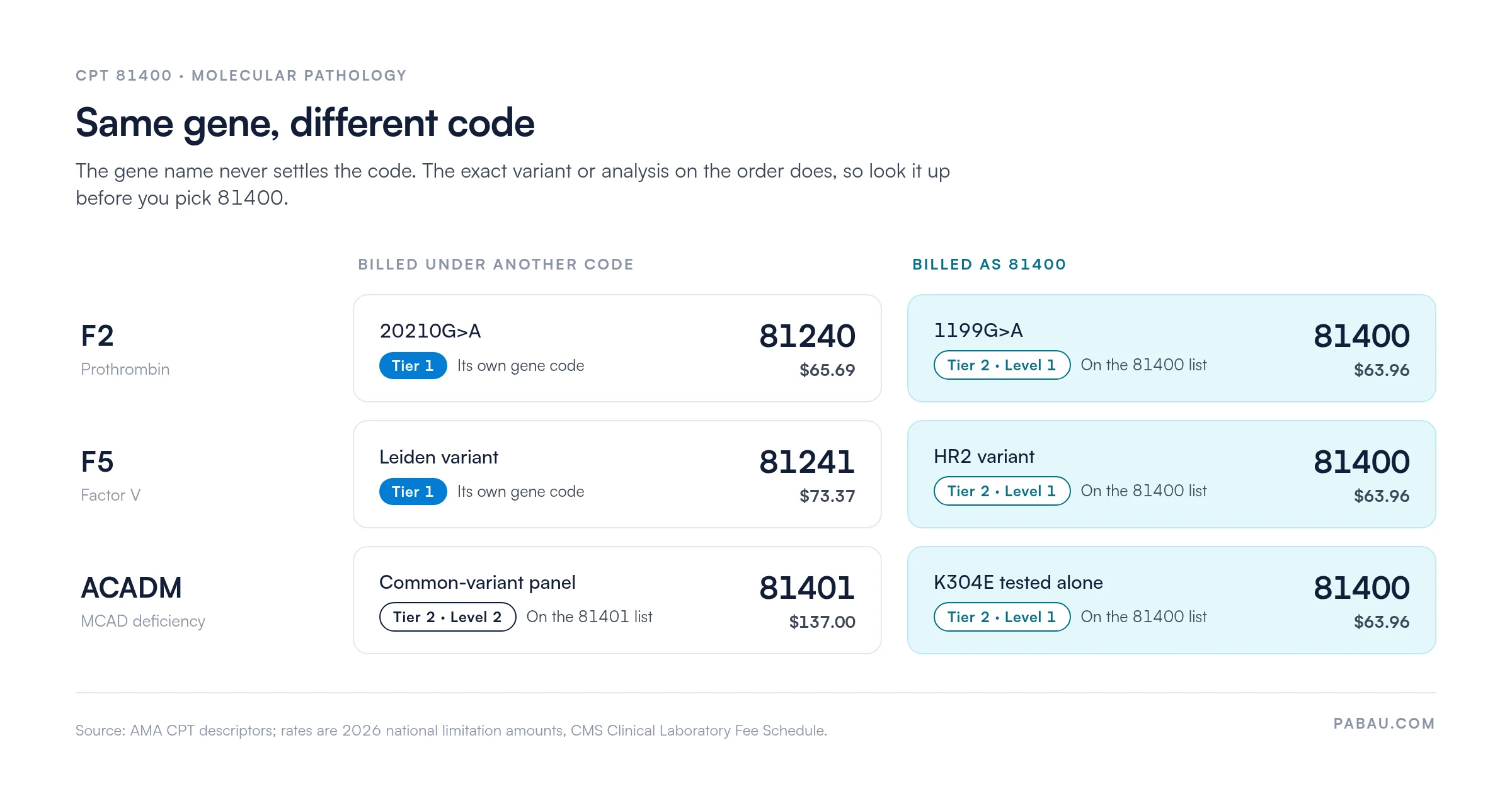
Each entry pairs a gene with one exact variant. The F2 and F5 entries show why that matters. F2 1199G>A and F5 HR2 are 81400, while the far more common F2 20210G>A and F5 Leiden tests each have a Tier 1 code.
What 81400 does not cover: multi-variant panels, gene sequencing, or any analysis missing from its list. Those move to a higher Tier 2 level, a Tier 1 code, or 81479.
A gene and analysis with its own Tier 1 code is never billed under a Tier 2 level. Older guides still place several of them under 81400, so check the Tier 1 range (81105-81383) first.
Platelet antigen and IL28B genotyping sat under 81400 in older payer lists, including a MolDX approved-gene list keyed to 2016 CPT codes. Both now have Tier 1 codes, so read any older list against the current code set.
The analysis type also decides the code within one gene. ACADM K304E tested alone is 81400, while the ACADM common-variant panel is CPT 81401. The chart below sets F2, F5 and ACADM side by side.
Prothrombin 20210G>A has its own guide, CPT Code 81240, and so does HFE, CPT Code 81256.
The correct code is the one whose AMA list names the exact gene and analysis. Choosing a level from a view of assay complexity is how most misassignments start. Check Tier 1 first, then the Tier 2 levels in order.
When no code names the analysis, the unlisted molecular pathology code CPT 81479 is the correct fallback. Attach a written test description and medical necessity documentation to that claim.
Medicare pays CPT Code 81400 under the Clinical Laboratory Fee Schedule (CLFS), not the Physician Fee Schedule. The 2026 national limitation amount is $63.96. CMS sets CLFS rates from private-payer data collected under the Protecting Access to Medicare Act (PAMA).
Pull the current quarterly file from the CMS CLFS page before quoting reimbursement, since CMS can revise rates each quarter. Misfiling a Tier 1 test as 81400 costs money as well. F5 Leiden pays $73.37 under 81241, and the wrong code draws a denial anyway.
Check your 81400 rate against the CMS CLFS file at the start of each calendar year and each quarter. Rates can change on those dates, so build the check into your billing calendar before the first claims of the period go out.
Medicare coverage for CPT Code 81400 is local, so the rules depend on your Medicare Administrative Contractor (MAC). Each contractor’s policy is listed in the CMS Medicare Coverage Database. Insurance eligibility verification before the test is ordered is the most reliable way to avoid a post-service denial.
In MolDX jurisdictions (Palmetto GBA, Noridian, WPS and CGS), labs register each test in the DEX registry first. The Z-Code from that registration goes on every 81400 claim line.
The ICD-10-CM code on an 81400 claim must reflect the clinical reason for the specific variant analysis. It must also meet your MAC’s covered-indication criteria. Every code in the table is checked against the FY2026 ICD-10-CM code set.
A confirmed Factor V Leiden or prothrombin 20210G>A result has its own diagnosis code, D68.51 or D68.52. The tests behind those codes bill as 81241 and 81240, never as 81400.
Link the ICD-10 code to the 81400 line itself, not only the claim header. Check the diagnosis against your MAC’s current coverage article before billing. A valid code missing from that list still draws a CO-50 denial.
Payer audits for 81400 claims look at three places: the physician’s order, the clinical record, and the lab report. All three must tell a consistent story about why this test was ordered for this patient.
The record must contain:
Most MAC policies also expect the record to show how the result will change patient management. Generic wording like “to rule out condition X” rarely meets that bar.
Audit a random sample of 81400 orders each quarter. Check whether the ordering physician names the gene, the variant and the clinical rationale. Fixing an incomplete order before submission is cheaper than working denials after the remittance arrives.
CPT Code 81400 claims face a predictable set of denials, and front-end edits prevent most of them. Strong denial management workflows catch these before they age past the timely filing limit.
A Tier 1 analysis billed as 81400, such as F5 Leiden, draws a denial whichever reason code the payer uses. Rebill it under its Tier 1 code as a corrected claim.
For Medicare, file a redetermination within 120 days of the initial determination. If that fails, request reconsideration by the Qualified Independent Contractor (QIC) within 180 days of the redetermination decision. See the full list of medical billing denial codes for CARC and RARC definitions.
National Correct Coding Initiative (NCCI) edits govern which molecular pathology codes can be billed together on one date of service. The most common error in this family is billing one analysis twice under two codes.
ACADM shows how it happens. The 81401 common-variant panel already includes K304E, so adding 81400 for K304E on the same specimen bills that variant twice. Report the one code that matches the full analysis performed.
Thrombophilia orders show the opposite case. F5 Leiden (81241), F2 20210G>A (81240) and F5 HR2 (81400) are distinct listed analyses. Each can appear on one claim when each was ordered, performed and documented, subject to the NCCI edits for that pair.
Molecular pathology claims fail at predictable points: a code picked from the gene name, a missing authorization, an unlinked diagnosis, a remittance left unworked. A billing workflow built for lab claims covers each one:
Pabau’s claims management software runs validation checks every time you go to send a claim. If a required detail is missing, the Send button stays disabled until the claim is complete.
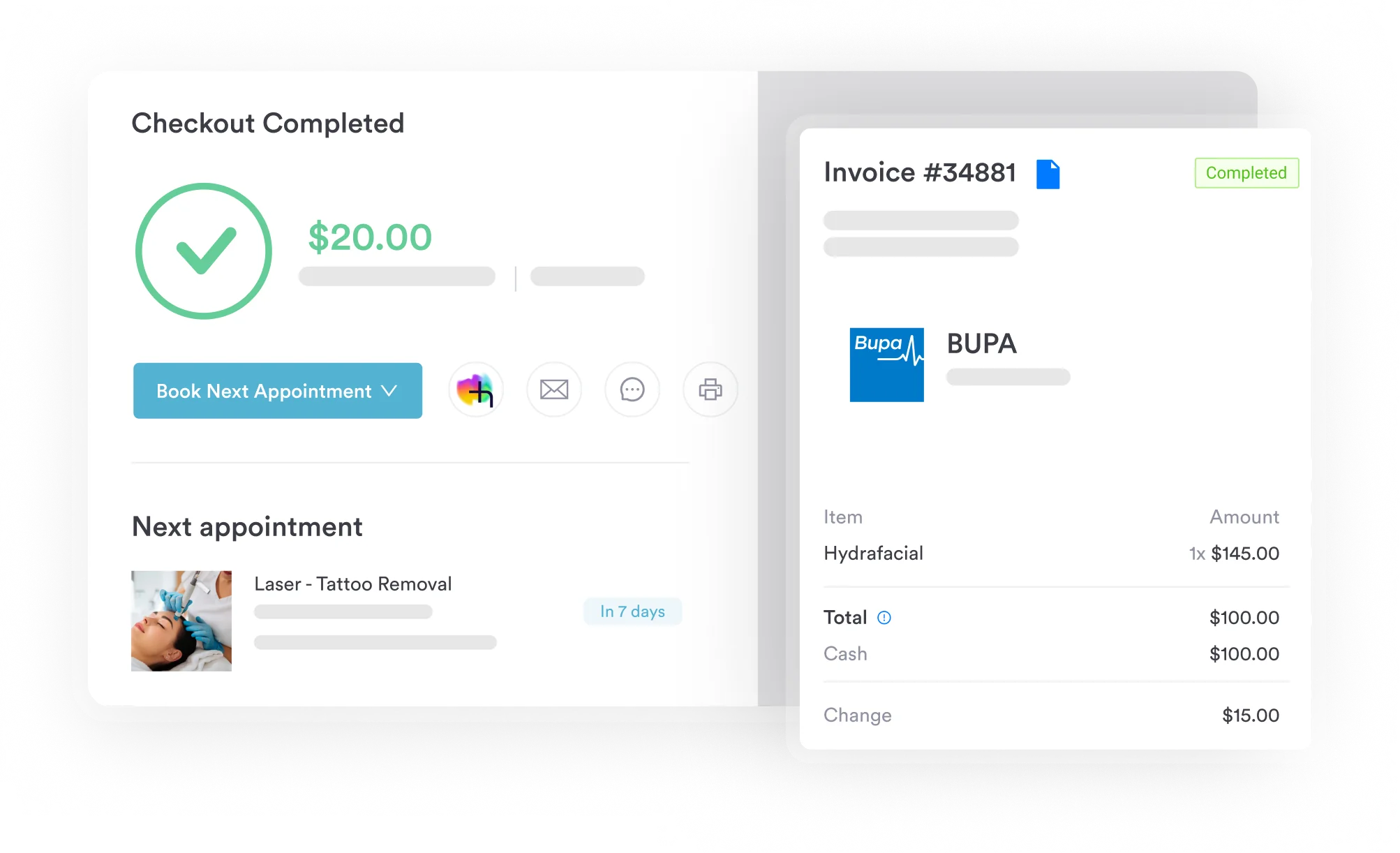
Claims then go to thousands of US payers through the Claim.MD clearinghouse, with eligibility checks and claim status tracked in Pabau. Remittances flow back into the same workflow, so a denied 81400 line reaches follow-up the day it posts.

Pabau checks every claim for missing details before it goes out, submits it through Claim.MD, and tracks status and remittances in one place. See how it cuts 81400 denials.

Most 81400 errors start when someone picks the code from the gene name alone. F2 and F5 are the clearest case. The variants clinicians order most often bill as 81240 and 81241, while the rarer 1199G>A and HR2 variants sit under 81400.
So check Tier 1 first, then the Level 1 list for the exact variant, and pair it with a diagnosis your MAC accepts. Add a DEX Z-Code in MolDX states and an ABN signed before the test. Book a demo to see how Pabau catches missing claim details before your molecular pathology claims reach the payer.

Submitting claims electronically for the first time? Claim.MD clearinghouse guide explains how the 837P transaction reaches payers and what happens during the acknowledgment loop.
Want to understand the full revenue cycle behind molecular lab billing? Revenue cycle management explained covers every stage from order receipt to final payment posting.
CPT Code 81400 covers Tier 2, Level 1 molecular pathology: a single germline variant named in its AMA list. Examples include ACADM K304E, F5 HR2, F2 1199G>A, SERPINE1 4G and TOR1A 907_909delGAG. Genes with their own Tier 1 code are excluded. Examples are F5 Leiden (81241), F2 20210G>A (81240), HFE (81256), SERPINA1 (81332), GJB2 (81252, 81253) and BCKDHB (81205).
Each code covers only the analyses named in its own AMA list. CPT 81400 lists single germline variants, such as ACADM K304E or F5 HR2. CPT 81401 is Level 2 and lists analyses such as ABL1 T315I or the ACADM common-variant panel. Look up the exact gene and analysis rather than judging assay complexity.
Medicare pays CPT 81400 at $63.96 nationally under the 2026 Clinical Laboratory Fee Schedule (CLFS). It is not paid under the Physician Fee Schedule, and CLFS rates carry no geographic adjustment. CMS can revise CLFS rates each quarter, so confirm the current file before billing.
Yes, when the indication meets your MAC’s local coverage policy. Coverage is tied to the analyte: F5 HR2 or SERPINE1 4G testing, for example, needs a documented thrombophilia work-up. MolDX contractors also require a DEX Z-Code on the claim. Screening without a qualifying clinical indication is typically non-covered.
CPT 81479 (unlisted molecular pathology) applies when no Tier 1 or Tier 2 code describes the analysis performed. If the gene and variant are on the 81400 list, use 81400. Using 81479 when 81400 applies delays payment and invites a medical review request.
The diagnosis follows the analyte tested. ACADM K304E pairs with E71.311 (MCAD deficiency), BCKDHA Y438N with E71.0 (maple syrup urine disease) and TOR1A with G24.1 (genetic torsion dystonia). Thrombophilia analyses such as F5 HR2 pair with D68.59 or D68.69. A valid code missing from the MAC’s covered list still draws a CO-50 denial.
Restriction enzyme digestion (RFLP analysis) amplifies the target DNA region, then cuts it with an enzyme at a site present only with a specific variant. The fragments are separated by gel electrophoresis and sized to show whether the variant is absent, heterozygous or homozygous. The AMA names it, with melt curve analysis, as an example Level 1 technique. Whatever method the lab uses, the listed variant decides the code.