CCSD Code Q0750: Subtotal abdominal hysterectomy
CCSD Code Q0750: definition and official descriptor CCSD Code Q0750 covers ̶...

Last Updated: Nov 10, 2026
81408 is the CPT code for molecular pathology procedure, Level 9 (eg, analysis of >50 exons in a single gene by DNA sequence analysis). It sits at the top of the AMA's nine-level Tier 2 ladder, which runs from 81400 to 81408.
Labs report it for full sequencing of one large gene the AMA names at Level 9, such as NF1 or DMD. Exome sequencing, multi-gene panels and genes named at a lower Tier 2 level take other codes.
Let Pabau's smart automation suggest the right codes, reduce claim denials, and keep your practice compliant—effortlessly.
Automate repetitive tasks and focus on what matters most—your patients.
Reduce coding errors and ensure compliance with the latest regulations.
Clean claims, fewer denials, and faster reimbursements.
Powerful insights and reporting to help your practice thrive.
HIPAA compliant SOC 2 certified GDPR-compliant Trusted by 4,000+ clinics worldwide

CPT code 81408 covers DNA sequence analysis of more than 50 exons in a single gene. Multi-gene panels, exome sequencing and genome sequencing take other codes.
Genes the AMA names at Level 9 include NF1, DMD, RYR1 and RYR2. BRCA1 and BRCA2 testing has its own codes and never uses 81408.
Most commercial payers require prior authorization before the specimen is collected, and a missing authorization is one of the most preventable 81408 denials.
Pabau, the practice management platform we build, tracks prior authorization on the patient’s insurance case and warns when it is missing.
CPT code 81408 is the highest-complexity code in the AMA Tier 2 molecular pathology series. It covers DNA sequence analysis of more than 50 exons in a single gene.
The American Medical Association’s CPT code set organizes molecular pathology into two tiers, with nine complexity levels in Tier 2 (codes 81400 through 81408). Level 9 is the ceiling, reserved for the most demanding single-gene sequencing a CLIA-certified laboratory performs.
The descriptor’s “eg” signals that its example is illustrative rather than a complete list. A single gene whose full sequence analysis spans more than 50 exons may qualify when the clinical documentation supports it. The AMA gene list must not name it at a lower level.
The defining criterion is exon count within a single gene, not diagnostic category. A lab applies 81408 when one assay sequences more than 50 coding exons of one gene. The table below lists genes the AMA names at Level 9, with their approximate exon counts and the conditions they are tested for.
Genes move between levels when the AMA updates the list, so confirm each gene against the current Tier 2 list before billing. A common coding error is applying 81408 to BRCA1 or BRCA2 full sequencing. BRCA1 has about 24 exons and BRCA2 about 27, so neither meets the more-than-50-exon threshold. BRCA testing is reported with its own Tier 1 codes.
Several test types look similar to 81408 but fall outside its scope. Picking the wrong code in either direction risks underpayment or an upcoding finding.
The Tier 2 ladder sorts molecular pathology codes by analytical complexity, and exon count separates the sequence-analysis levels. The chart below shows where each exon band sits, with 81408 at the top.
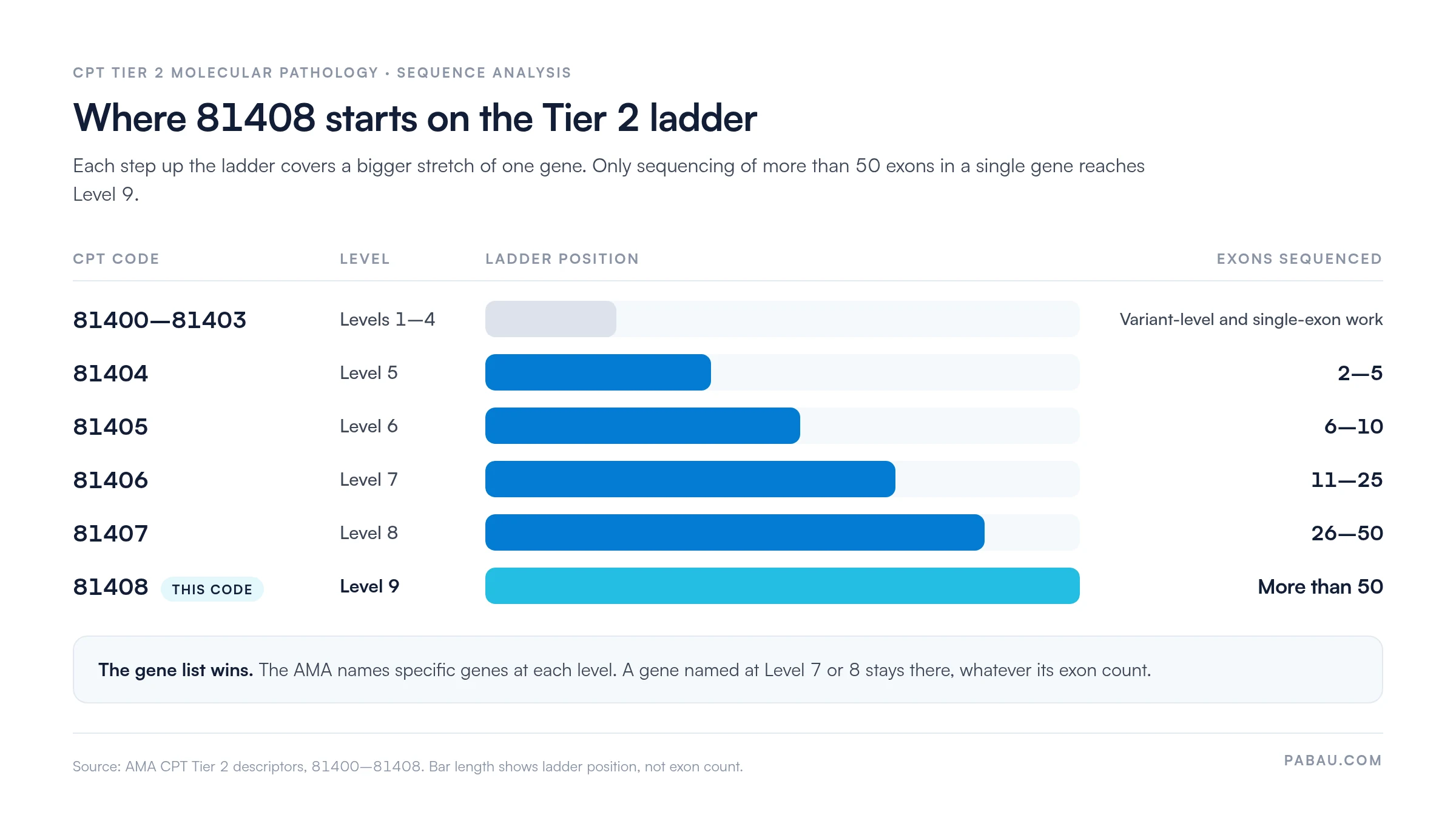
The table maps the full ladder from 81400 to 81408, plus the unlisted code, so coders can confirm a selection before submitting.
Exon count is the default rule, but the AMA gene list overrides it at every sequencing level. A gene the list names at 81406 or 81407 is billed there, even when its sequenced exon count is higher. Check the current CPT codebook’s Tier 2 gene list before defaulting to 81408.
Before billing 81408, confirm the gene is not listed at a lower Tier 2 level in the current AMA codebook. Billing 81408 for a gene named at a lower level is an upcoding error, even when the exon count exceeds 50.
Payers audit 81408 claims against the laboratory report. The report must show, not simply assert, that more than 50 exons were sequenced. These documentation elements decide whether a claim survives audit or is recouped.
Clean claim submission for 81408 starts when the test is ordered, not when it is billed. When the ordering provider’s record captures the clinical indication at that point, the lab’s claim package can carry it forward.
Medicare covers CPT code 81408 under the Clinical Laboratory Fee Schedule (CLFS), administered by the Centers for Medicare and Medicaid Services. Coverage is not automatic. The claim must satisfy the Local Coverage Determination (LCD) of the laboratory’s Medicare Administrative Contractor (MAC).
LCDs specify which clinical indications Medicare covers for molecular pathology codes in a jurisdiction. The controlling LCD depends on where the laboratory is located, not where the patient lives. To find it, search the MAC’s coverage database with CPT code 81408 as the filter.
Palmetto GBA’s MolDX program manages molecular diagnostic LCDs for several MACs. It publishes clinical indication requirements that go beyond the AMA descriptor. Claims that meet the CPT definition but fall outside the LCD’s accepted indications are denied on medical necessity grounds.
Most commercial payers and many Medicare Advantage plans require prior authorization for genetic testing. Requirements vary by payer and plan year, so the guidance below reflects common patterns rather than universal rules.
Prepare these documents before you submit the prior authorization request:
Pairing CPT code 81408 with the wrong ICD-10 code is a frequent denial cause. The ICD-10 code must reflect the clinical indication that makes large-gene sequencing medically necessary. Avoid a general family history code when a more specific hereditary syndrome code exists.
Always cross-reference ICD-10 pairings against the controlling LCD for your jurisdiction. An ICD-10 code that is clinically appropriate may still be rejected if it is not on the LCD’s covered-indication list.
As a high-value code on the Clinical Laboratory Fee Schedule, 81408 draws frequent audits. The most common denial codes for molecular pathology cluster around a predictable set of documentation and eligibility failures. The table below maps each denial pattern to its corrective action.
Run a pre-submission audit on every 81408 claim. Confirm the lab report names the gene and an exon count above 50. Check that the ICD-10 code is on your MAC’s LCD list and that authorization predates collection. These four checks catch many preventable denials before they happen.
Many 81408 denials start at the ordering practice, not the lab. The lab bills the code, but it depends on the indication, ICD-10 code and authorization the practice recorded before collection. Strong denial management workflows connect the ordering provider, the laboratory and the billing team before the sample ships.
Pabau keeps those inputs on the patient record. Practices that switch on labs can order Quest tests from the record, and Labcorp orders placed in Labcorp Link sync results back automatically. Prior authorization sits on the patient’s insurance case with its code, dates and sessions, and Pabau warns when one is missing.
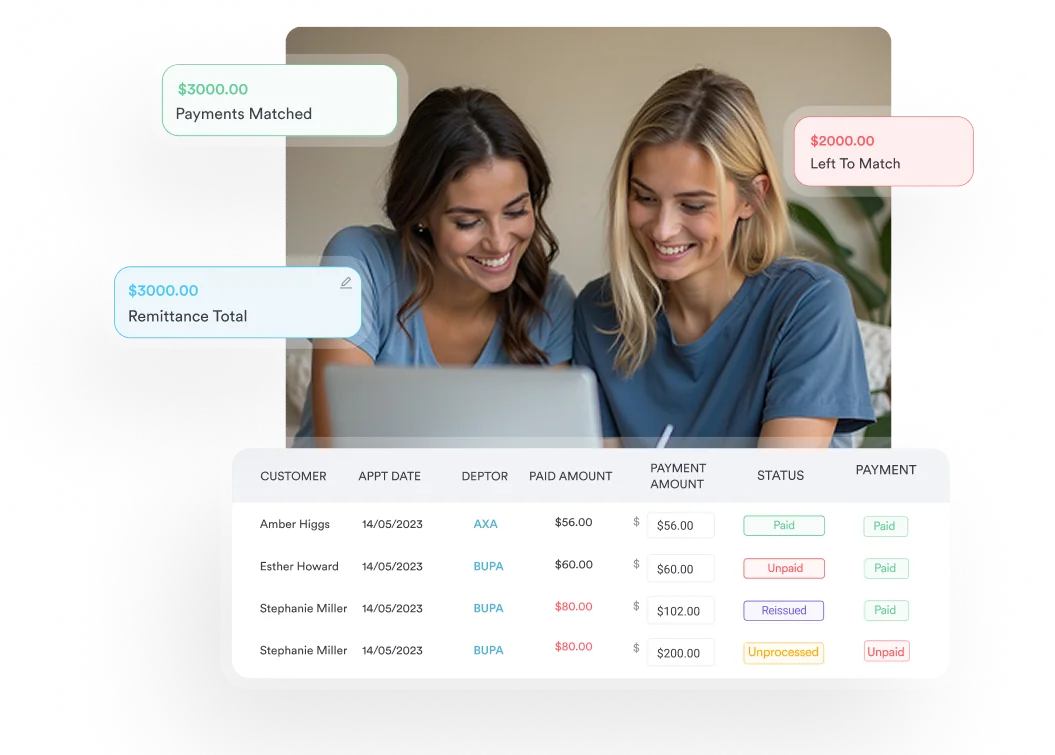
For the practice’s own insurance claims, Pabau’s claims software built for practices sends CMS-1500/837P claims through the Claim.MD clearinghouse. Claim.MD also supports eligibility checks before the visit. ERA remittances post back against the claim, so the medical billing compliance trail stays in one place.

Pabau tracks prior authorization on each patient’s insurance case and warns when one is missing. See how it works for your practice.

CPT code 81408 rewards discipline before submission more than most laboratory codes. The exon threshold, the AMA gene list and the LCD’s accepted indications settle most outcomes before a claim is built.
That puts the work at the order desk. Confirm the gene and its Tier 2 level, pair the most specific ICD-10 code, and secure authorization before collection. A slower order costs far less than a recouped high-value claim.
If your team is new to insurance claims, medical billing fundamentals walks through how a claim moves from order to payment. To see how Pabau tracks prior authorization and claims for your practice, book a demo.

Need help managing claim denials systematically? What is revenue cycle management explains how to structure your end-to-end billing workflow to reduce denial rates across all code types.
Want to understand clearinghouse claim processing? Medical claims clearinghouse guide covers how clearinghouses validate, route, and track claims before payer adjudication.
Looking to understand remittance and ERA reconciliation? Electronic remittance advice (ERA) explains how 835 files work and how to automate payment posting after molecular pathology claims are paid.
CPT code 81408 covers DNA sequence analysis of more than 50 exons in a single gene. It is a Tier 2 Level 9 code, the highest complexity level in the AMA’s molecular pathology series. Genes named at this level include NF1, DMD, RYR1 and RYR2. BRCA1 and BRCA2 testing has its own codes and never uses 81408.
Use 81408 when the gene sequenced has more than 50 exons and no lower Tier 2 code names it. Use 81479 (unlisted molecular pathology) when no specific Tier 2 code, including 81408, accurately describes the procedure. Never use 81479 to avoid 81408’s requirements, and never use 81408 for a procedure that 81479 captures more accurately.
Yes. Medicare covers CPT code 81408 under the Clinical Laboratory Fee Schedule, subject to the applicable MAC Local Coverage Determination. Coverage depends on the clinical indication meeting the LCD’s criteria for the gene sequenced. CLFS rates follow the PAMA cycle, so verify the current rate in the latest CMS CLFS file.
Common pairings include Q85.01 (neurofibromatosis, type 1) for NF1 and G71.01 (Duchenne or Becker muscular dystrophy) for DMD. G71.29 (other congenital myopathy) supports RYR1 sequencing for central core disease, and I47.29 (other ventricular tachycardia) supports RYR2 sequencing in CPVT. Always verify pairings against the controlling LCD, which lists the ICD-10 codes it accepts.
Yes, in most cases. Commercial payers and Medicare Advantage plans usually require prior authorization for CPT 81408 before the specimen is collected. Traditional Medicare generally does not require prior authorization for lab tests, but it does enforce LCD medical necessity requirements. Medicaid requirements vary by state. Confirm requirements with the payer before collection, because many payers will not authorize a test after the specimen is taken.
CPT 81408 covers sequencing of a single named gene with more than 50 exons. Codes 81415 and 81416 cover clinical exome sequencing, which analyzes all coding regions at once and is used when no specific causal gene is identified. Even if an exome run includes a gene with more than 50 exons, the correct code is 81415 or 81416. The two code families serve different clinical purposes.