CPT code 93503: Swan-Ganz catheter billing and modifiers
CPT code 93503: Official descriptor and procedure overview In the AMA CPT code s...

Last Updated: Oct 23, 2026
81161 is the CPT code for DMD (dystrophin) gene deletion analysis, with duplication analysis included if performed. Labs use it to confirm Duchenne or Becker muscular dystrophy and to test female relatives for carrier status.
It is a Tier 1 molecular pathology code, so neither a Tier 2 level nor the unlisted code 81479 replaces it for this test. The claim pairs it with G71.01, the single ICD-10-CM code for both Duchenne and Becker muscular dystrophy.
Let Pabau's smart automation suggest the right codes, reduce claim denials, and keep your practice compliant—effortlessly.
Automate repetitive tasks and focus on what matters most—your patients.
Reduce coding errors and ensure compliance with the latest regulations.
Clean claims, fewer denials, and faster reimbursements.
Powerful insights and reporting to help your practice thrive.
HIPAA compliant SOC 2 certified GDPR-compliant Trusted by 4,000+ clinics worldwide

CPT code 81161 reports DMD gene deletion analysis, with duplication analysis included when the lab performs it.
81161 is a Tier 1 gene-specific code. Tier 2 levels (81400-81408) apply only where no Tier 1 code exists, such as full DMD sequencing under 81408.
ICD-10-CM G71.01 covers both Duchenne and Becker muscular dystrophy. G71.09 is for other dystrophies, such as distal or oculopharyngeal muscular dystrophy.
Most commercial payers require prior authorization before the specimen is collected, and a missing approval is a common denial cause.
Pabau, the practice management platform we build, submits 81161 claims through Claim.MD and posts remittances back to each charge.
CPT code 81161 is the Tier 1 molecular pathology code for deletion and duplication analysis of the DMD (dystrophin) gene.
Labs use it to confirm or rule out Duchenne and Becker muscular dystrophy, and to test at-risk female relatives for carrier status. The official descriptor in the American Medical Association CPT code set reads:
That wording matters for billing. Deletion analysis is the required element, and duplication analysis is included only if the lab performs it. A deletion-only assay therefore still reports as 81161, and duplications never need a second code.
81161 sits in the molecular pathology section (81105-81479), inside the Tier 1 range of 81105-81383. Tier 1 holds about 100 gene-specific codes, each tied to one gene and one analytic method.
Tier 2 works differently. Codes 81400-81408 are nine resource-based complexity levels, Level 1 to Level 9, used only when no Tier 1 code exists for the analysis.
Exon count sets the level inside Tier 2, but it never moves a gene-specific code like 81161 out of Tier 1. Our guide to medical billing fundamentals covers where lab codes fit in the wider claim process.
CPT code 81161 covers copy number analysis across the whole DMD gene, on any validated platform. The descriptor names no technology. Multiplex Ligation-dependent Probe Amplification (MLPA), exon-level array comparative genomic hybridization (array CGH) and similar quantitative assays all report under the same code.
What 81161 includes:
What 81161 excludes:
Dystrophin gene deletion/duplication analysis measures the copy number of each DMD exon to find missing or extra segments. Most labs run MLPA, which covers all 79 exons with two probe mixes. Array CGH with exon-level probes gives similar resolution and suits some lab workflows.
Deletion and duplication testing usually comes first, because large rearrangements explain most Duchenne and Becker cases. When it finds no deletion or duplication, labs often reflex to full gene sequencing under 81408.
Labs also report whether a deletion keeps or disrupts the reading frame. That finding helps clinicians predict a Duchenne or Becker course, and it informs eligibility for exon-skipping therapies.
CPT 81161 applies whenever the lab analyzes the whole DMD gene for deletions, whatever the platform. Sequencing, known-variant testing and multigene panels each have their own code.
Billing 81479 when 81161 applies sends the claim to manual review and usually delays payment. The reverse, billing 81161 for a multigene panel, misstates the service and can be flagged on audit. The panel below sets the CPT choice next to the ICD-10 choice the same claim needs.
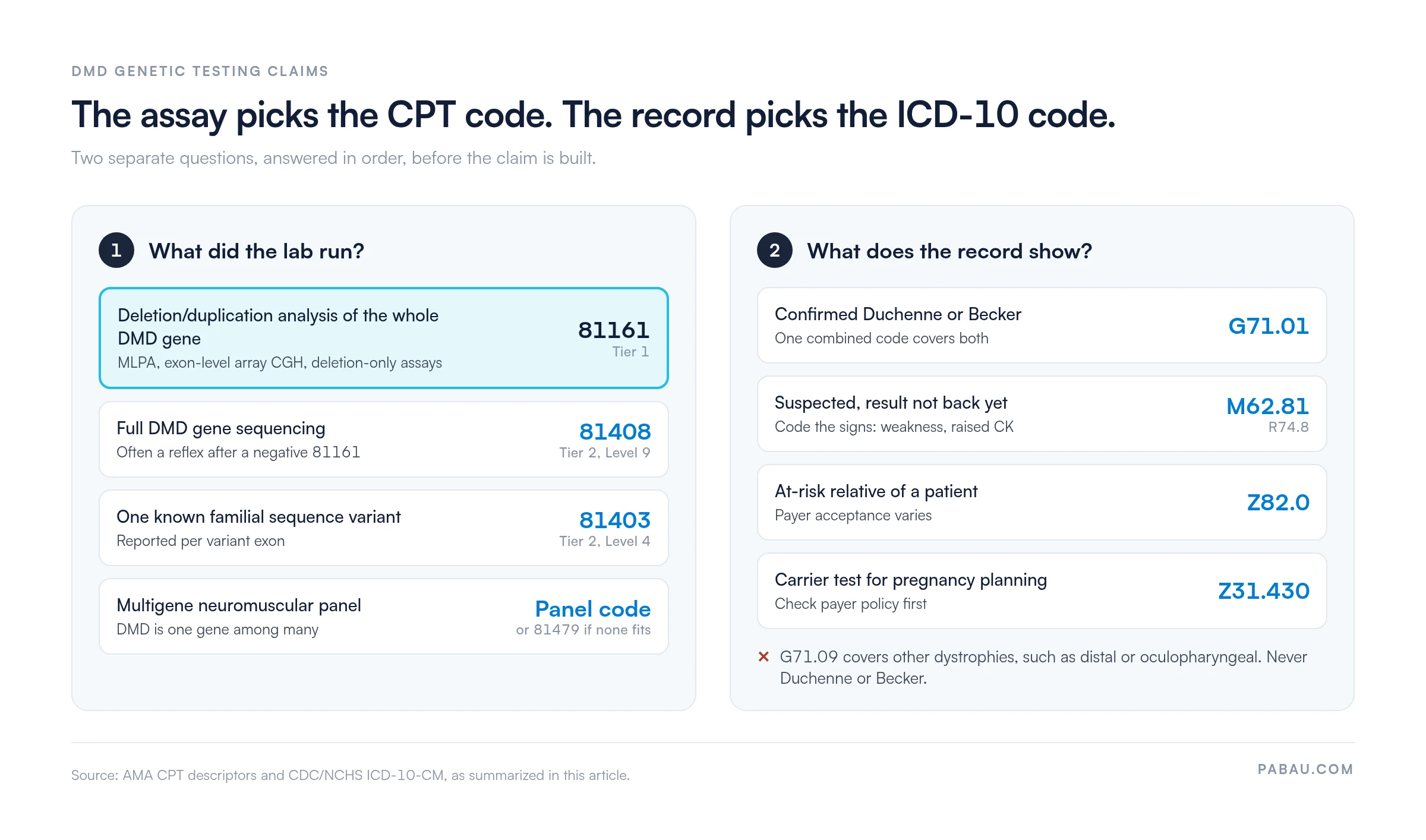
The claim must carry an ICD-10-CM code that supports medical necessity. For a confirmed diagnosis, that code is G71.01, Duchenne or Becker muscular dystrophy. G71.01 is one combined code for both conditions, so a Becker patient takes G71.01 too. Check the CDC/NCHS ICD-10-CM web tool for current definitions and annual updates.
Outpatient coding never reports a suspected diagnosis as confirmed. Until the result is back, code the signs that prompted the test, such as weakness or a raised CK. Confirm the covered diagnosis list in your Medicare Administrative Contractor (MAC) Local Coverage Determination (LCD) before you submit.
Medicare covers CPT code 81161 when the test is reasonable and necessary for a patient with signs of a dystrophinopathy. The rules come from the LCD of the MAC for the lab’s jurisdiction. Medicare does not pay for screening, so carrier testing without symptoms rarely meets its criteria.
Consistent insurance eligibility verification before the order keeps coverage problems off the claim. LCD criteria for DMD testing generally include:
Before you submit, look up the active LCD number and effective date for DMD genetic testing in the CMS Coverage Database. LCD policies differ by MAC region and change over time. Citing the wrong LCD number on an appeal letter delays resolution by weeks.
Prior authorization rules depend on the payer, not on the code. Good medical billing compliance means checking each plan’s policy before the order is placed, not after the specimen is collected.
CPT code 81161 is paid under the CMS Clinical Laboratory Fee Schedule (CLFS), not the Physician Fee Schedule. CLFS rates for established codes are based on private payer data reported under the Protecting Access to Medicare Act (PAMA). Rates update each January 1, so check the current national limitation amount before you set expectations.
Commercial allowables for 81161 depend on each lab’s contract and network status. Out-of-network labs can see steep reductions or outright denials, so confirm contract terms before testing.
CPT code 81161 is a lab code with no professional component, so modifiers 26 and TC do not apply on Medicare claims. A physician’s written interpretation is billed separately with G0452. Three modifiers come up more often.
Documentation for CPT code 81161 has to show medical necessity before the order goes out. The claim record should hold these items:
A report missing the methodology or exon-level detail is a common trigger for records requests. Fix the report template once, and every later claim carries the right detail.
CPT code 81161 claims fail for predictable reasons, and each one has a direct fix. A solid denial management workflow sorts denials by cause as they arrive, so patterns surface before they turn into write-offs.
Knowing the common denial codes in medical billing helps billing teams respond faster. It also shows whether a denial is correctable or needs a policy-level appeal.
G0452 is the HCPCS code for a physician’s interpretation and report of a molecular pathology procedure. The lab bills 81161 for the test itself, and the interpreting physician bills G0452 on a separate claim. Payers expect G0452 only when a physician adds clinical interpretation beyond the standard lab report.
Genetic counseling bills separately under 96041, which replaced 96040 on January 1, 2025. 96041 reports each 30 minutes of total counselor time on the date of the encounter. Pre-test and post-test sessions are common for Duchenne and Becker families, because carrier results affect other relatives.
When 81161 comes back negative and the lab reflexes to sequencing, 81408 goes on the claim as a separate service. Check NCCI edits and the payer’s reflex-testing policy before billing both on one date of service.
Always check the AAPC CPT code reference for current parenthetical notes and bundling guidance before you submit companion codes.
A clean claim for CPT code 81161 depends on action at several points, from the test order to payment posting. Submitting clean claims from the start avoids the rework cycle that denied molecular pathology claims create.
DMD testing splits billing between two parties. The ordering practice holds the clinical notes, CK result and family history. The lab bills 81161, and its claim fails if that evidence never reaches it.
Pabau sends claims electronically through the Claim.MD clearinghouse. Its claims software for practices checks patient eligibility in real time before the order, then tracks each claim after submission. Remittances post back against the original charge, so a denial or underpayment shows up without a separate reconciliation.

The PA number, the lab report and the clinical notes sit in the same patient record. When a payer asks for records, your billing team sends them from one place instead of chasing the ordering practice.

Pabau submits claims through Claim.MD, checks eligibility in real time, and posts remittances back to each charge. Your billing team can follow every 81161 claim without switching systems.

CPT code 81161 is a Tier 1 code with a narrow job: whole-gene deletion analysis of DMD, with duplication analysis if performed. Its costly errors are a Tier 2 or unlisted code in its place, Becker coded to G71.09, and a missing authorization. Settle all three at the order stage, and an 81161 claim rarely needs an appeal.
Pabau keeps eligibility checks, claim submission and remittance posting in one system. A weak 81161 claim gets caught before it costs you a filing window. Book a demo to see how Pabau handles molecular pathology billing from order to payment.

Need to understand how clearinghouse validation works? How a medical claims clearinghouse works explains the role clearinghouses play in CPT and ICD-10 validation before claims reach the payer.
Working through a high denial rate on lab claims? Revenue cycle management fundamentals covers the end-to-end workflow from order to payment that lab billing teams need to minimize write-offs.
Want to understand the 837P claim format for molecular pathology? 837 electronic claim file guide breaks down the 837P transaction structure and how it maps to CMS-1500 fields for lab submissions.
CPT code 81161 covers deletion analysis of the DMD (dystrophin) gene, with duplication analysis included if performed. It is used to diagnose Duchenne and Becker muscular dystrophy and to test female relatives for carrier status. Any validated method qualifies, including MLPA and exon-level array CGH. Full gene sequencing and multigene panels use other codes.
CPT 81161 is the Tier 1 code for DMD deletion and duplication analysis, the specific test it names. CPT 81479 is the unlisted molecular pathology code, used only when no Tier 1 or Tier 2 code describes the test. A neuromuscular panel with no matching panel code is one example. Billing 81479 when 81161 applies invites manual review and slows payment.
Yes, when the patient meets the clinical criteria in the LCD for the lab’s MAC jurisdiction. Typical criteria include progressive weakness or a raised creatine kinase, and a result that will guide care. The claim carries G71.01 for confirmed Duchenne or Becker muscular dystrophy, or the presenting sign codes for a suspected case. Medicare does not cover screening, so check carrier testing against the LCD.
Most commercial payers require prior authorization for molecular tests such as CPT 81161. Traditional Medicare does not usually require it, but the LCD documentation rules still apply. Requirements vary by payer and plan, and they change over time. Verify them through the payer portal before the order is placed, not after specimen collection.
The AMA descriptor names no technology, so any validated deletion and duplication method qualifies. MLPA is the most common, and exon-level array CGH is another option. The assay must analyze the whole DMD gene for deletions. Duplication analysis is part of the code only if performed.
Tier 2 molecular pathology codes are 81400-81408, nine resource-based complexity levels from Level 1 to Level 9. They are used only when no Tier 1 gene-specific code exists for the analysis. Tier 1 runs from 81105 to 81383, with about 100 codes each tied to one gene and method. CPT 81161 is a Tier 1 code. Full DMD gene sequencing has no Tier 1 code, so it reports under Tier 2 Level 9, 81408.