HCPCS Code L0472: Hyperextension TLSO billing guide
HCPCS code L0472: Official descriptor and device definition HCPCS code L0472 des...

Last Updated: Nov 5, 2026
81210 is the CPT code for BRAF (B-Raf proto-oncogene, serine/threonine kinase) (eg, colon cancer, melanoma), gene analysis, V600 variant(s).
It is a Tier 1 molecular pathology code for somatic tumor testing. Results guide targeted therapy in colorectal cancer, melanoma, non-small cell lung cancer and thyroid carcinoma. Medicare pays it on the Clinical Laboratory Fee Schedule. A common cause of denial is a record that does not separate somatic tumor testing from germline hereditary testing. The order should also name the gene and the V600 variants being analyzed.
Let Pabau's smart automation suggest the right codes, reduce claim denials, and keep your practice compliant—effortlessly.
Automate repetitive tasks and focus on what matters most—your patients.
Reduce coding errors and ensure compliance with the latest regulations.
Clean claims, fewer denials, and faster reimbursements.
Powerful insights and reporting to help your practice thrive.
HIPAA compliant SOC 2 certified GDPR-compliant Trusted by 4,000+ clinics worldwide

CPT code 81210 covers somatic BRAF V600 variant analysis (V600E, V600K, V600D, V600R), not germline hereditary cancer testing.
It is a Tier 1 molecular pathology code that Medicare pays on the Clinical Laboratory Fee Schedule.
Medical necessity rests on a treating physician order naming the gene, a pathology report confirming tumor tissue, and a note linking the result to treatment.
In MolDX jurisdictions (Palmetto GBA, Noridian, CGS and WPS), labs complete a technical assessment and use a DEX Z-code where the policy requires one.
Pabau, our practice management platform, keeps the order and rationale note on the encounter record and submits and tracks each 81210 claim electronically.
CPT code 81210 describes BRAF (B-Raf proto-oncogene, serine/threonine kinase) gene analysis for V600 variant(s). Labs bill it for somatic tumor testing in cancers such as colon cancer and melanoma. The American Medical Association’s CPT code set places 81210 in the molecular pathology range as a Tier 1 code. Tier 1 codes (81200-81383) each name one specific gene, while Tier 2 codes (81400-81408) group less common tests by resource level.
Medicare pays 81210 on the Clinical Laboratory Fee Schedule (CLFS). The code covers the whole analytic service for the BRAF V600 analysis. Billing separate codes for PCR runs or sequencing steps on the same gene is unbundling.
CPT 81210 covers single-gene analysis of BRAF for variants at the V600 codon. V600E (Val600Glu) is the most frequently tested variant and accounts for most BRAF mutations across tumor types. The code also covers V600K, V600R and V600D when the method detects them in the same analytic run.
Allele-specific PCR, Sanger sequencing, pyrosequencing and real-time PCR assays designed for the V600 hotspot all fall under the code. Accepted specimens include formalin-fixed paraffin-embedded (FFPE) tissue from resection or biopsy, and fresh or frozen tumor tissue. Cell-free DNA from a liquid biopsy also qualifies when the assay is validated for that matrix.
CPT 81210 is medically necessary when BRAF V600 status directly informs a therapeutic decision, either selecting a targeted agent or ruling one out. NCCN Clinical Practice Guidelines in Oncology recognize four primary tumor types where this applies.
The clinical record must document the tumor stage or extent of disease and the treating physician’s reason for ordering the test. It should also state that the result will shape the treatment plan. The MolDX Molecular Diagnostic Tests LCDs (L36256 and L35160) and the MolDX billing article for FDA-approved BRAF tests (A54418) require that link. A diagnosis without the therapeutic rationale does not meet Medicare coverage.
Payers validate 81210 claims by checking the submitted diagnosis code against their coverage criteria. An unspecified code, or an encounter code without a confirmed malignancy code, is a common cause of automatic denial. Pair 81210 with the primary malignancy code, such as C20 for a rectal tumor, not a screening or family history code.
Z-codes such as Z15.09 (genetic susceptibility to other malignant neoplasm) and encounter-only codes should not be the primary diagnosis on a CPT 81210 claim. Some payers also reject an “unspecified” code when the medical record supports a more specific one.
Run a crosswalk check using the AAPC CPT-to-ICD-10 crosswalk tool before submission. If the payer’s coverage policy lists specific accepted ICD-10 codes, map your submitted code against that list first. A one-character change from C43.9 (unspecified) to C43.5 (trunk) can decide whether the claim pays.
Medicare covers CPT 81210 under the Clinical Laboratory Fee Schedule (CLFS), and CMS updates the rate each January. Check the current figure in the CMS CLFS file rather than relying on a number in a billing guide. Confirm it there before you load a dollar amount into an internal fee schedule.
Medicare molecular testing falls under the MolDX program in the Palmetto GBA, Noridian, CGS and WPS jurisdictions. A lab billing 81210 there completes a MolDX technical assessment and registers the test through DEX, the MolDX Diagnostics Exchange. DEX issues the Z-Code Identifier that goes on the claim where the MolDX policy requires one.
When the technical assessment is missing, claims can deny in bulk. Registering the test clears them faster than appealing claim by claim.
Prior authorization for CPT 81210 is not universal, but many commercial payers require it for outpatient oncology testing. It depends on the payer, the plan type and whether the order comes from an inpatient or outpatient setting. Run insurance eligibility verification and confirm benefits before the lab processes the specimen.
When prior auth is required, the submission package typically needs four items.
For urgent oncology cases, many payers offer an expedited review, often with a 24-to-72-hour turnaround.
Most coding confusion around 81210 involves a handful of adjacent codes. Billing the wrong one, or several codes for one service, creates unbundling exposure and audit risk.
The order settles most of these choices before anyone opens a code book, as the chart below shows. A BRAF assay aimed at variants outside V600 goes to 81479, the unlisted molecular pathology code.
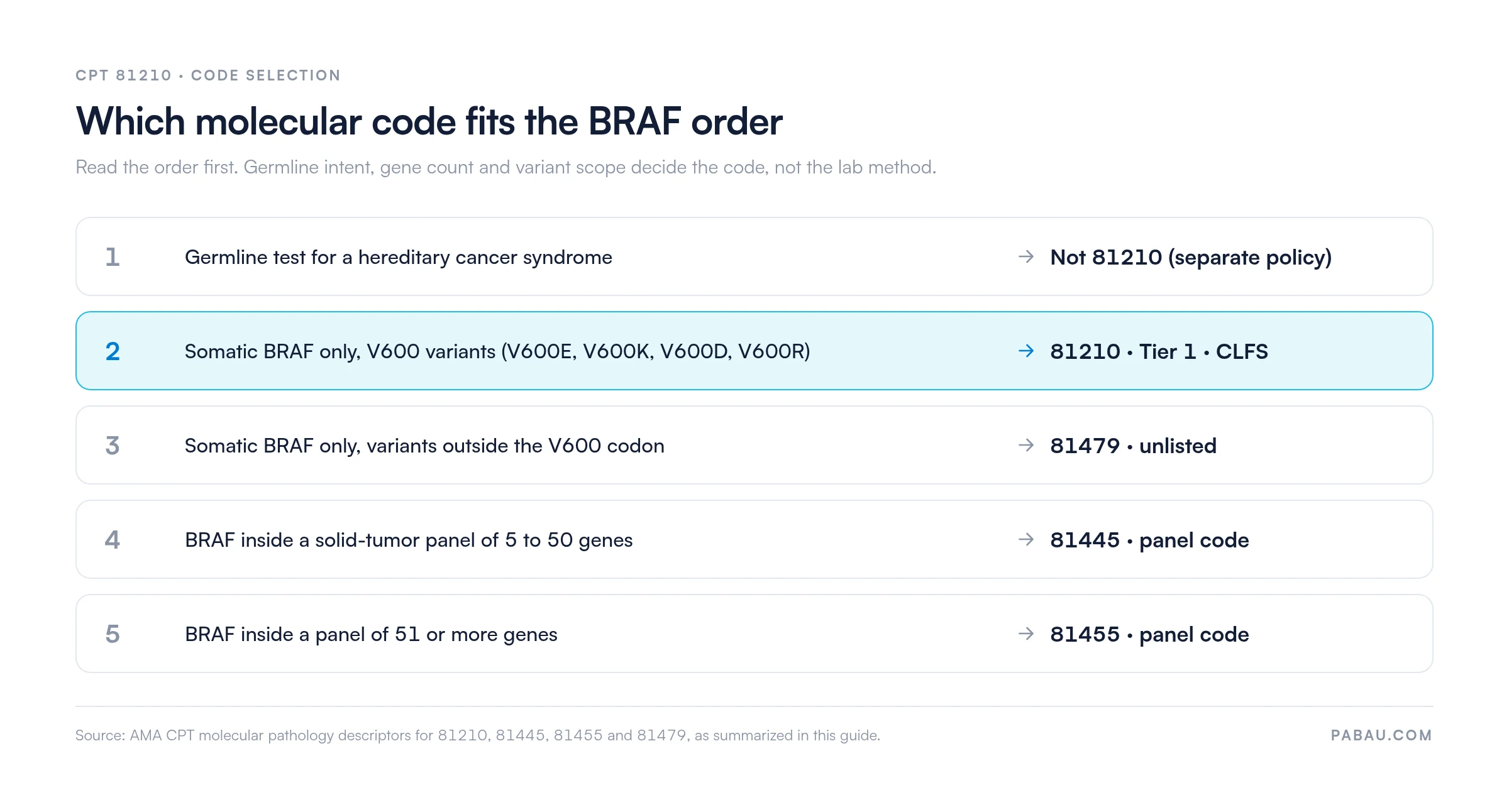
NCCI edits between 81210 and the panel codes, 81445 or 81455 depending on gene count, are updated quarterly. A lab running a solid-organ NGS panel and a standalone BRAF test on the same specimen date must check the current edit table first. The edit may allow both codes with a modifier, or it may allow only the panel code.
Check the AAPC Codify CPT lookup and the CMS NCCI edit files for the current quarter before billing both.
Documentation for 81210 has to line up in two places: the ordering provider’s clinical record and the laboratory’s internal file. A claim backed by one but not the other will fail a medical necessity review. Good medical billing compliance practice is to audit both before submission.
Denials on CPT code 81210 tend to follow five patterns. Read the claim adjustment reason code (CARC) and remark code (RARC) on the remittance before you draft an appeal. The root cause decides the fix.
An NCCI edit conflict usually comes back as CO-97 or CO-236 rather than CO-4. Appeal timeframes typically run 60 to 180 days from the remittance date, depending on the payer. For Medicare, the first-level redetermination request must be filed within 120 days of the initial determination.
Structured denial management workflows track each denial code, its root cause and the appeal due date, so claims do not age past the filing limit. Our guide to denial reason codes maps each CARC code to an appeal strategy.
Before writing an appeal for a CO-96 denial, confirm the lab has completed the MolDX technical assessment for the specific assay. In MolDX jurisdictions the claim also needs a DEX Z-code where the policy requires one. A clinical appeal will not overturn CO-96 while the test is still unregistered.
A BRAF order passes through three handoffs: the ordering visit, specimen receipt at the lab, and the claims queue. A missing somatic-versus-germline note, NCCN citation or prior authorization at any of them can surface as a denial weeks later.
Pabau keeps the treating physician order, the pathology report reference and the therapeutic rationale note on the encounter record. Its claims management software submits and tracks claims electronically, so your team can see where each 81210 claim stands.
When a medical necessity appeal arrives, the supporting documents are already on file. For practices handling revenue cycle management across several oncology providers, that keeps denial deadlines in view.
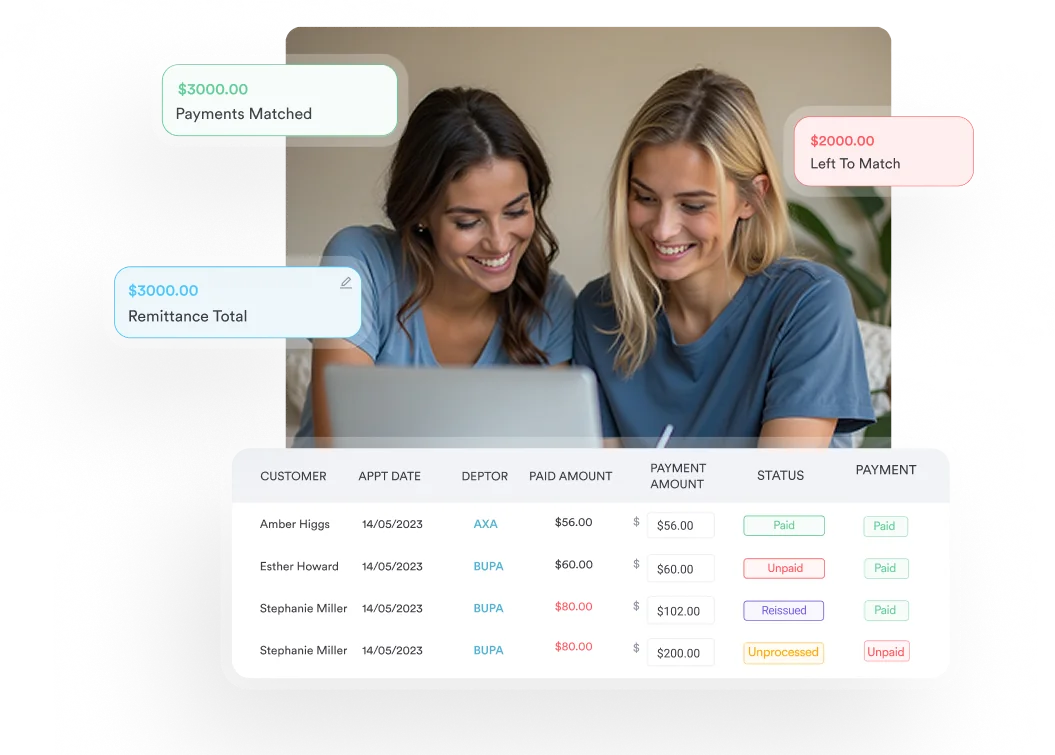

Pabau keeps the BRAF order, pathology reference and rationale note on the encounter record. It submits and tracks each 81210 claim electronically, so an appeal starts from documents already on file.

Bill 81210 only when the order, the pathology report and the clinical note all point to somatic BRAF V600 testing for a treatment decision. If one of the three is missing, fix the record before the claim goes out.
Settle two payer questions before the specimen runs: MolDX registration in MolDX states, and the prior-auth rule in the commercial plan. Both cost less to answer at the order than in an appeal.
Book a demo to see how Pabau keeps BRAF orders, pathology references and claim status together on one encounter record.

Need a clearinghouse for molecular pathology claims? Pabau’s Claim.MD clearinghouse integration explains how claims reach US payers electronically and how their status comes back.
Want to understand what a clean claim looks like before submission? What makes a clean claim walks through the data elements payers validate on every submission.
Looking for the broader context of medical billing for labs? Medical billing fundamentals covers the revenue cycle from order to payment posting.
CPT code 81210 covers single-gene analysis of BRAF for V600 variants, including V600E, V600K, V600R and V600D, on somatic tumor specimens. Allele-specific PCR, Sanger sequencing and pyrosequencing all qualify. Tissue and liquid biopsy specimens both work when the assay is validated for that specimen type.
Medicare pays CPT 81210 on the Clinical Laboratory Fee Schedule (CLFS), and CMS updates the rate each January. Check the current CLFS file on CMS.gov for this year’s figure. In MolDX jurisdictions, also confirm whether the policy requires a DEX Z-code on the claim.
Common primary diagnoses are C18.0-C18.9 (colon), C19 and C20 (rectosigmoid junction and rectum), C43.x (melanoma), C34.x (lung) and C73 (thyroid). Use the most specific site code available. Z-codes and family history codes belong only in secondary positions, never as the primary diagnosis.
CPT 81210 covers BRAF analysis for V600 variants, while CPT 81275 covers KRAS analysis for variants in codons 12 and 13. Both can be billed on the same date of service when both analyses are ordered and clinically indicated. Check the current quarter’s NCCI edits before submitting both on one claim.
CPT 81210 covers the V600 variants of BRAF, not only V600E. V600K, V600R and V600D are in scope when the assay is designed to detect them. BRAF variants outside the V600 codon are not described by 81210. Bill those with CPT 81479, the unlisted molecular pathology code, and send the payer a written description of the test.