CPT code 21011: Excision of soft tissue tumor of the face
CPT code 21011: Official descriptor and procedure overview CPT code 21011, as pu...

Last Updated: Oct 8, 2026
CPT Code 86592 is the billing code for a qualitative syphilis non-treponemal antibody test, covering the VDRL, RPR and ART methods. The result is reported as positive or negative, with no titer. Its quantitative counterpart is 86593, which is the code for a titer.
Below you’ll find the official descriptor, the 86592 versus 86593 split, and the ICD-10 codes payers accept. Medicare coverage under NCD 210.10, documentation requirements, and the four errors behind most denials follow.

CPT Code 86592 covers qualitative non-treponemal syphilis antibody testing, including the VDRL, RPR and ART methods.
Use 86593 for quantitative titer testing ordered to monitor treatment response. Billing both on one date needs documented clinical justification.
Accepted ICD-10 codes include Z11.3 for STI screening, A53.9 for unspecified syphilis, and O98.111 to O98.113 for pregnancy by trimester.
Medicare covers 86592 as a preventive benefit under NCD 210.10 for pregnant patients and adults at increased risk.
Practice management software like Pabau links the diagnosis code and scrubs the claim before submission.
CPT Code 86592 is described by the American Medical Association (AMA) as: Syphilis test, non-treponemal antibody; qualitative (eg, VDRL, RPR, ART). It sits in the Immunology subsection of the Pathology and Laboratory section.
The “qualitative” designation means the result is reported as positive or negative. No titer is calculated. That distinction from 86593 governs which code is appropriate, and whether the two can share a claim.
Non-treponemal tests detect reagin antibodies produced in response to tissue damage caused by Treponema pallidum, the bacterium behind syphilis. They do not detect the organism itself. That is why a positive 86592 result usually needs confirmation with a treponemal test such as 86780.
CPT 86592 covers qualitative screening. CPT 86593 covers quantitative titration. Picking the wrong one of the two is the most common billing error on syphilis claims.
A patient presenting for routine STI screening gets 86592. A patient known to have syphilis, returning for a three-month treatment check, gets 86593 to measure whether the titer has declined. Billing 86592 for a monitoring visit, or 86593 for an initial screen, draws a denial or a medical necessity query.
Co-billing 86592 and 86593 on the same date of service is not prohibited outright. It does need documentation showing a distinct clinical rationale for each test. Most payer policies either bundle the pair or require an appeal with records. Confirm the policy with your Medicare Administrative Contractor (MAC) before submitting both.
CPT Code 86592 rarely stands alone in a syphilis workflow. Two more codes complete the standard testing sequence, and several STI panel codes are commonly co-ordered on the same requisition.
The traditional algorithm runs 86592 first. A reactive result then triggers 86780 for treponemal confirmation. Only after confirmed infection does 86593 become relevant for staging or monitoring. The sequence below shows which code carries the claim at each step, under both algorithms labs use.
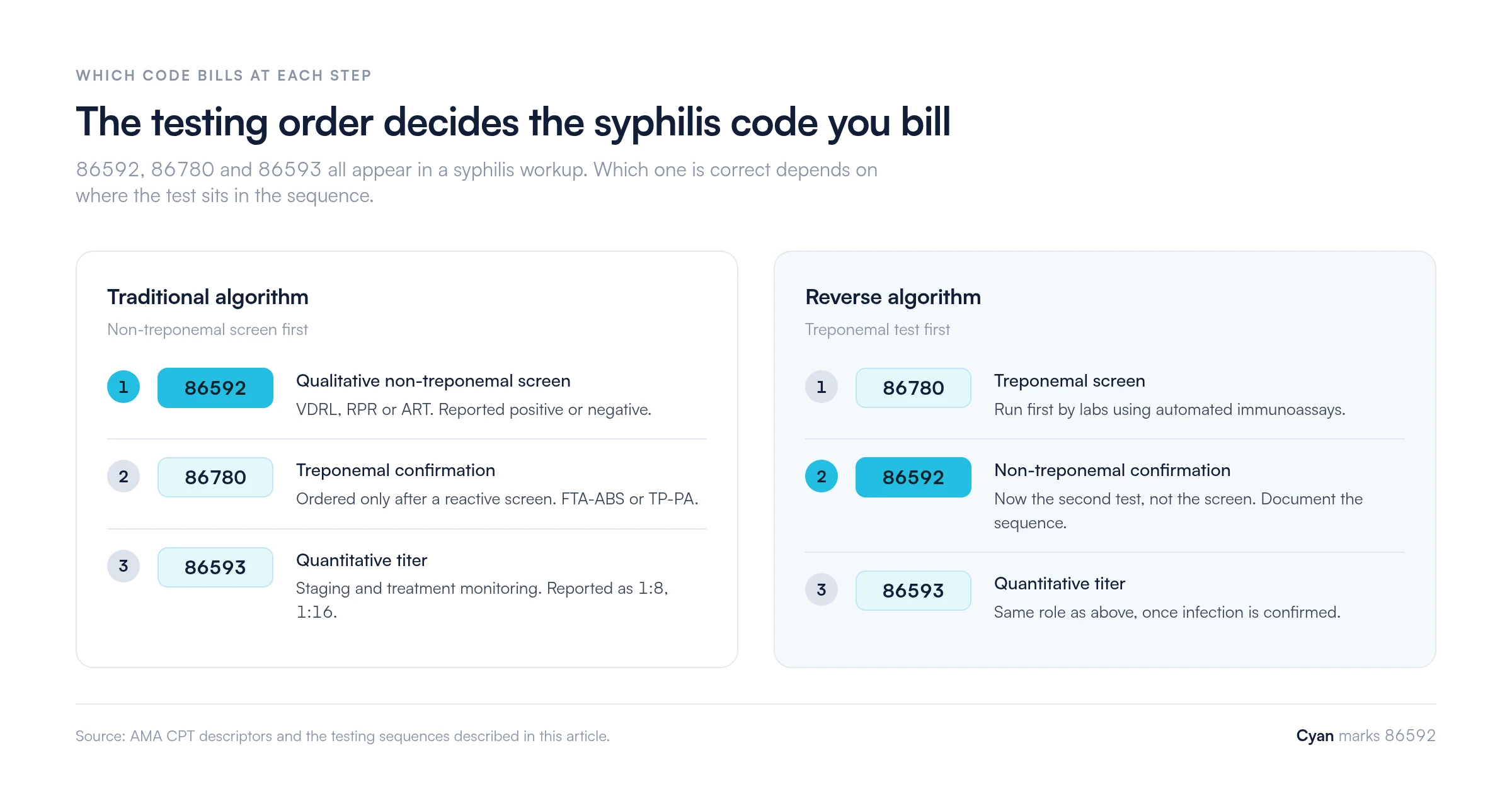
Some labs now use a reverse algorithm, starting with a treponemal test and following a reactive result with 86592. The sequence is clinically valid but raises billing questions. Document the order of the tests and the reason for it, so any payer query has an answer in the record.
CPT Code 86592 is appropriate whenever a qualitative non-treponemal syphilis antibody test is ordered. The CDC’s syphilis clinical guidance points to four main ordering contexts:
Ordering providers include primary care physicians, OB-GYNs, infectious disease specialists, sexual health providers, and emergency medicine clinicians.
Document the clinical indication in the ordering note before the lab requisition is sent. When a payer audits a syphilis claim, they check whether the ordering note supports the ICD-10 code used. A one-line notation such as ‘STI screening, new sexual partner’ makes the claim audit-ready from day one.
Accepted ICD-10-CM diagnosis codes for CPT Code 86592 vary by payer. The codes below are commonly accepted, but verify against your MAC’s local coverage determination (LCD) before submitting. The CDC/NCHS ICD-10-CM lookup tool gives official descriptions and validation.
Z11.3 is the workhorse code for asymptomatic screening. When the ordering note documents a routine STI check with no current diagnosis, Z11.3 is the right primary diagnosis. Payers sometimes question A53.9 without supporting documentation, so reference the clinical presentation in the note.
Watch the pregnancy codes. O98.11 is not itself a trimester code, and O98.12 and O98.13 are not the second and third trimesters. O98.12 covers syphilis complicating childbirth, and O98.13 covers the puerperium.
The trimester lives in the sixth character. O98.111 is the first trimester, O98.112 the second, and O98.113 the third. Use O98.119 when the record does not document a trimester. Our ICD-10-CM index lists each subdivision in full.
Medicare reimburses CPT Code 86592 under the Clinical Laboratory Fee Schedule (CLFS), not the Physician Fee Schedule. Lab codes in the Pathology and Laboratory section carry no work RVU component.
CMS sets the 2026 CLFS rate annually, and it varies slightly by geographic locality. Verify the current rate from the CMS fee schedule lookup or the CLFS download before quoting a figure to your staff.
Claims for CPT Code 86592 can be transmitted electronically through a clearinghouse that connects to CMS and commercial payers. Validating the claim against payer edits at submission catches fee schedule mismatches before they turn into denials.
Medicare covers syphilis screening as a preventive benefit under National Coverage Determination (NCD) 210.10. Its full title is Screening for Sexually Transmitted Infections (STIs) and High-Intensity Behavioral Counseling (HIBC) to Prevent STIs. Coverage applies to:
You will see this policy quoted as NCD 352.1 in coder forums and vendor documents. That number is the CMS coverage database’s internal record id, not the NCD designation. Cite 210.10 in an appeal and the reviewer will find the policy.
Medicare does not cover 86592 for routine low-risk screening outside these populations without medical necessity documentation. When the patient falls outside the NCD criteria, an Advance Beneficiary Notice (ABN) may be required before the test is performed.
Every CPT Code 86592 claim needs the following in the medical record before submission. Missing any one of them is a predictable denial trigger.
CLIA certification is a parallel requirement. The performing laboratory must hold a CLIA certificate at the complexity level for the syphilis method being run. Confirm that in the CMS CLIA database before assuming the lab can bill these tests.
Four errors account for the majority of CPT Code 86592 denials. Each one is avoidable with the right workflow check in place.
Effective denial management workflows catch most of these before submission. A billing platform that scrubs claims against payer-specific ICD-10 lists, and flags a missing ABN, cuts the rework burden on the billing team.
Run a quarterly audit of your 86592 denial report and filter by reason code. CO-4 (procedure inconsistent with the modifier) and CO-50 (not deemed medically necessary) are the two you will see most. CO-4 usually signals a modifier or ICD-10 mismatch, while CO-50 points to a missing ABN or a patient outside NCD 210.10 criteria.
Manual code lookup and re-keying is where transcription errors enter the syphilis billing workflow. A practice that looks the code up in a standalone reference tool, then re-keys it into a separate billing system, invites that error. 86592 and 86593 differ by one digit.
Practice management software like Pabau puts code validation inside the same platform used for scheduling and clinical notes. When a provider orders a syphilis test in Pabau, the code selection, ICD-10 linkage, and claim assembly happen in one workflow.
Our claims management software then transmits the claim and reconciles the 835 remittance when it comes back. So the billing team can see how each 86592 claim was adjudicated without logging into a separate portal.
For a practice running high-volume STI panels, the payoff is fewer claims coming back. CMS fee schedule updates flow in annually, so the expected reimbursement for 86592 stays current without manual work.

Pabau automates CPT code selection, ICD-10 linkage, and claim scrubbing for lab codes including CPT Code 86592. See how practices cut denial rates with one integrated billing workflow.

CPT Code 86592 is a straightforward screening code. The complexity sits in the split with 86593 and in the Medicare coverage rules. Three levers control the denial rate. Get the ICD-10 linkage right, obtain an ABN where NCD 210.10 does not cover the patient, and document the test method.
Fix those three and the code stops generating rework. Leave any one of them to chance and the denial queue grows every month the panel volume does.
Want to see how Pabau handles code validation and claim submission for lab codes like 86592? Book a demo and we’ll walk through the billing workflow with your own claim types.

Need to understand how clearinghouse submission works end-to-end? 837 file submission guide covers how electronic lab claims move from practice system to payer.
Looking for a clean claim checklist before submitting STI panel codes? Clean claim requirements walks through the fields every lab claim must include to avoid front-end rejections.
Want to structure lab charges for first-pass acceptance? Superbill and lab code billing guide covers what belongs on the charge slip before it reaches the biller.
CPT Code 86592 bills a qualitative syphilis non-treponemal antibody test, covering the VDRL, RPR and ART methods. It is used for initial syphilis screening in STI workups, prenatal panels, and preventive visits. The result is positive or negative, not a titer.
CPT 86592 is qualitative and returns a positive or negative result, which makes it the initial screening code. CPT 86593 is quantitative and returns a titer such as 1:8 or 1:16. Bill 86592 for new screens and 86593 for follow-up visits that assess treatment response.
Yes. Medicare covers CPT Code 86592 as a preventive benefit under NCD 210.10, the national coverage determination for STI screening. It applies to pregnant patients at any point in pregnancy, and to adults at increased risk of syphilis. Frequency is once every 12 months for non-pregnant high-risk adults. Patients outside those criteria need an Advance Beneficiary Notice (ABN) before testing.
The most widely accepted codes are Z11.3 for an STI screening encounter and A53.9 for unspecified syphilis. A51.0 and A51.9 cover early syphilis presentations. For pregnancy, use O98.111, O98.112, O98.113 or O98.119 by trimester. O98.12 and O98.13 are not trimester codes, since they cover childbirth and the puerperium. Accepted codes vary by payer, so check your MAC’s local coverage determination first.
It depends on the payer, and it is generally not appropriate without documented clinical justification for both tests. CMS may apply bundling edits. Check your MAC’s local coverage determination before submitting both codes, and make sure the ordering note records a distinct rationale for each.
Four errors cause most denials. A coder uses 86592 when a monitoring visit calls for 86593. A claim goes out with no valid ICD-10 code linked to the test. Both codes appear on one date with no documented justification. An ABN is missing for a Medicare patient outside the NCD 210.10 criteria. Claim scrubbing and a pre-submission checklist prevent each of them.