HCPCS Code G0163: Skilled nursing observation and assessment
What is HCPCS Code G0163? HCPCS Code G0163 is a deleted Level II code for skille...

Last Updated: Oct 15, 2026
78315 is the CPT code for bone and/or joint imaging; 3 phase study.
The three phases are vascular flow, blood pool, and delayed static bone imaging, all acquired in a single encounter. Technique alone determines the code, so the area imaged never decides it. That is why coders confuse 78315 with the whole-body code 78306 and the limited-area code 78300.
Let Pabau's smart automation suggest the right codes, reduce claim denials, and keep your practice compliant—effortlessly.
Automate repetitive tasks and focus on what matters most—your patients.
Reduce coding errors and ensure compliance with the latest regulations.
Clean claims, fewer denials, and faster reimbursements.
Powerful insights and reporting to help your practice thrive.
HIPAA compliant SOC 2 certified GDPR-compliant Trusted by 4,000+ clinics worldwide

CPT 78315 describes bone and/or joint imaging as a three-phase study. Vascular flow, blood pool, and delayed static images must all be performed and documented.
Technique defines 78315, so the area imaged never decides it. The code cannot be billed on the same day as 78306 or 78300.
HCPCS A9503, the Tc-99m medronate tracer, is billed separately from 78315 and never bundled into the procedure code.
A report that omits the injection and acquisition times gets downcoded to 78300 or 78305 on audit.
Pabau’s claims management software supports CPT code entry, ICD-10 linkage, modifier assignment, and separate line-item billing for radiopharmaceuticals.
CPT code 78315 is the American Medical Association code for “Bone and/or joint imaging; 3 phase study.” It covers one targeted area imaged across a vascular flow phase, a blood pool phase, and a delayed static phase.
All three acquisitions happen in a single encounter. The code is reportable by the interpreting physician, the facility, or both, depending on who provides which component.
The three-phase bone scan requires three sequential imaging acquisitions in a single encounter, each capturing different physiological information about the target site.
All three phases must be performed and individually documented for 78315 to be correctly reported. Skipping a phase, or omitting its documentation, is the most common reason a correctly performed scan gets downcoded to 78300 or 78305 on audit.
Each phase has its own clock, and each clock has to appear in the report. The sequence below sets out the three acquisition windows alongside the time point every one of them must record.
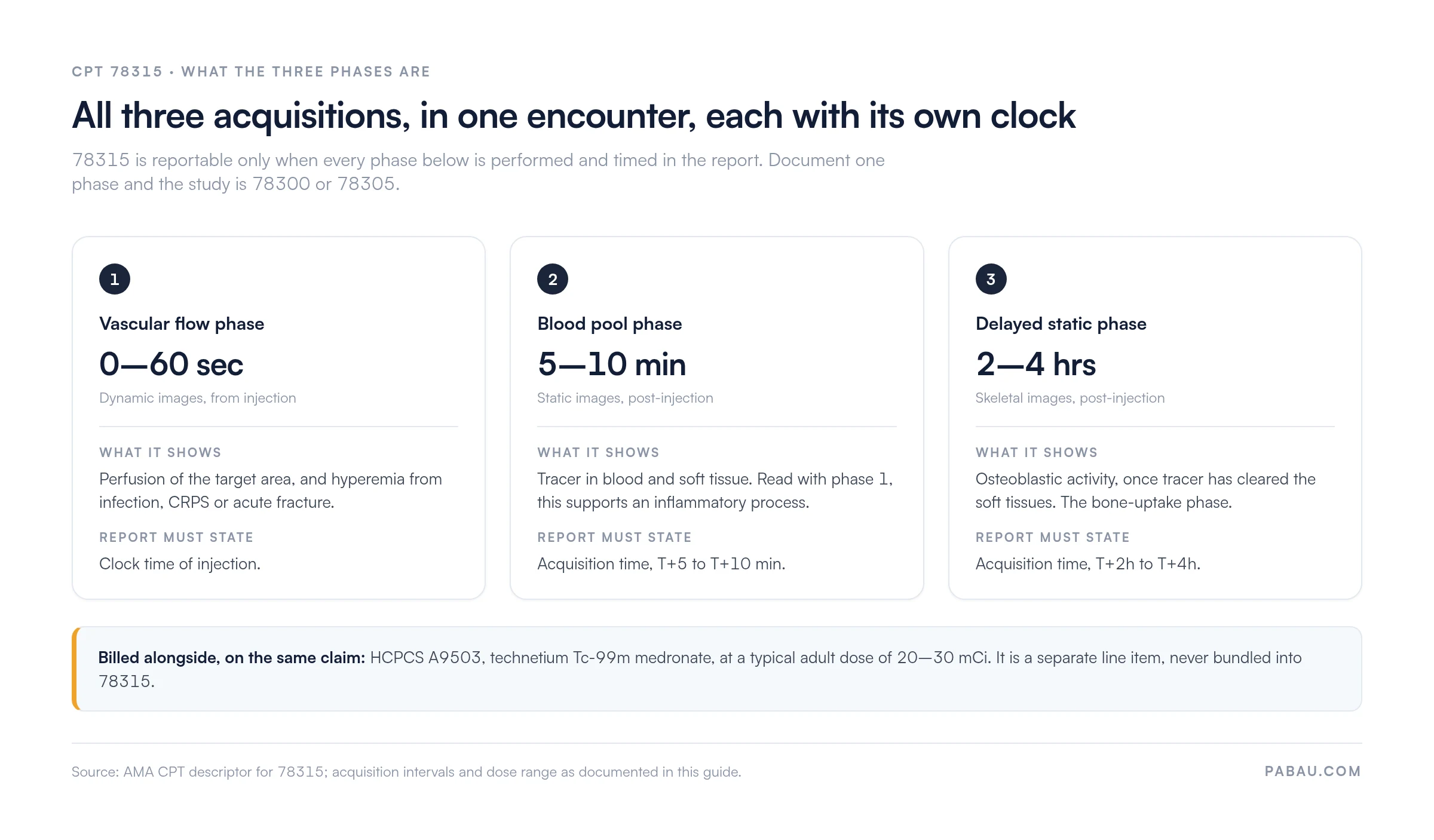
The nuclear medicine report must confirm all three phases were acquired. It must also state the time intervals between injection and each acquisition, and carry the interpreting physician’s attestation.
A report that documents only the delayed phase is technically a single-phase study, which supports 78300 or 78305. That pattern is common in busier departments.
Two variables separate the four bone-scan codes in the 78000 series: the number of phases performed, and the area of the body imaged.
CPT code 78315 turns entirely on its three-phase technique, and it covers a targeted area rather than the whole skeleton. That matters because 78315 and 78306 are mutually exclusive on the same date of service. Billing both constitutes unbundling.
A practical way to hold the distinction is to listen to the ordering clinician’s question. If it is “is there infection, vascular compromise, or complex regional pain?”, the answer needs all three phases, and that is 78315. If it is “where are the metastases?”, a whole-body delayed scan under 78306 is the right report.
Every 78315 claim requires a supporting ICD-10-CM diagnosis code that demonstrates medical necessity. MAC Local Coverage Determinations specify which diagnoses are accepted for nuclear medicine bone imaging.
The table below reflects commonly covered indications, and full descriptors for each entry sit in the ICD-10-CM code library. Covered codes vary by region, so verify against the MAC LCD for your own jurisdiction.
The radiopharmaceutical used in a three-phase bone scan is technetium-99m medronate, also written as Tc-99m MDP. It is billed separately under HCPCS Level II code A9503, and never bundled into CPT code 78315.
Facilities that leave A9503 off the claim collect less than the study earned. Facilities that fold it into the procedure line expose themselves on audit.
Modifier selection for CPT code 78315 depends on who performs and interprets the study, and where the service is provided. Applying the wrong modifier is a consistent trigger for claim rejection. So is omitting one when billing in a split-service setting. The table below sets out the four combinations that cover almost every 78315 claim.
Modifier 52 (reduced services) is sometimes appended when fewer than three phases are completed because the patient could not tolerate the study. Billing 78315-52 in that scenario is incorrect. The right code is 78300 or 78305, chosen on the phases that were performed. Consult the relevant MAC LCD and coding policy before reaching for Modifier 52.
Audit your place-of-service code before submitting 78315 claims. POS 22 (on-campus outpatient hospital) requires the facility to use the TC modifier when the physician bills separately under Modifier 26. Mismatched POS and modifier combinations are a frequent automated rejection trigger that rarely shows up in manual review.
Medicare reimbursement for CPT code 78315 is set under the CMS Physician Fee Schedule (MPFS). For hospital outpatients it is set under the Outpatient Prospective Payment System (OPPS).
The figures below are national averages for 2026, and payment varies by locality through the Geographic Practice Cost Index (GPCI). Verify the current figure before billing, using the CMS MPFS lookup tool or an RVU calculator such as FastRVU.
Private payer rates typically exceed Medicare by 10 to 40 percent, depending on payer and geography. Some commercial contracts reimburse A9503 at cost plus a markup, which makes an accurate dose record worth the minute it takes to write.
Checking eligibility before the study confirms that the patient’s plan covers nuclear medicine imaging at the rate the practice is expecting.
The nuclear medicine report is the single document auditors check when a 78315 claim is questioned. Missing one required element is enough to trigger a downcode. Every imaging report submitted with a 78315 claim should carry all five elements below.
Omitting the time points for the blood pool or flow phase converts a 78315 into a 78300 more often than any other documentation error. Coders should request an amended report before submitting whenever one of the five elements above is missing.
CPT code 78315 denies in a predictable pattern, which makes it a good candidate for front-end claim edits. Each row below names the root cause and the check that catches it before the claim is submitted. Build those checks into the billing workflow and most of this table stops applying to your practice.
Entering CPT code 78315 correctly in a practice management system takes more configuration than a standard E/M code. Two claim lines and one modifier have to be set up: 78315 itself, the A9503 radiopharmaceutical line, and the modifier matching the service split. Practices that treat 78315 as a single-line entry under-collect and carry avoidable audit risk.
Practice management software like Pabau holds all three elements on one screen. Pabau’s claims management software links the ICD-10 diagnosis to the procedure and keeps the modifier tied to the place of service. A9503 sits on its own line. The billing team sees the claim in the shape the payer expects, before it goes out.
Validation against payer edits then catches a missing modifier or an unlinked diagnosis while the claim can still be corrected. On a code like 78315 the money sits across two lines. That check decides whether the claim clears on first pass or comes back for rework.


Pabau helps billing teams attach the right modifier and link the ICD-10 diagnosis. A9503 stays on its own line, and every check runs before the claim reaches the payer.

Two errors cost more on 78315 than all the others put together. One is the downcode that follows a report with no phase times in it. The other is the A9503 line nobody added. Both come from treating a three-phase study as a single-line entry.
The fix sits upstream of the claim, not in the appeal. Agree a report template with the nuclear medicine department that prints the injection time and both acquisition times. Then make the A9503 line mandatory on the claim form. Once both are in place, 78315 stops being a code that needs watching.
Book a demo to see how Pabau keeps the modifier, the diagnosis link, and the radiopharmaceutical line together on a single claim.

Need to understand how clearinghouse claims validation works? Clean claim submission covers the front-end checks that prevent nuclear medicine claims from failing on first pass.
Billing A9503 alongside a procedure code for the first time? Superbill construction explains how to structure multi-line claims including radiopharmaceuticals correctly.
Navigating insurance eligibility before a scan? Insurance eligibility verification walks through how to confirm nuclear medicine coverage before the patient arrives.
CPT code 78315 covers bone and/or joint imaging performed as a three-phase study. The three phases are a vascular flow phase, a blood pool phase, and a delayed static phase, all completed in one encounter. The tracer is Tc-99m medronate, billed separately under HCPCS A9503.
CPT 78306 is a single-phase whole-body bone scan used mainly for metastatic disease staging. CPT 78315 is a three-phase targeted study used for infection, RSD/CRPS, and vascular assessment. The two are mutually exclusive, and billing both on the same date of service constitutes unbundling.
Medicare does not currently require prior authorization for a standard three-phase bone scan. The CMS program that governs advanced diagnostic imaging is the Appropriate Use Criteria (AUC) Program for Advanced Diagnostic Imaging Services. Many commercial payers, including Aetna, UnitedHealthcare, and BCBS plans, do require prior authorization for 78315. Always verify the requirement with the specific payer before scheduling the study.
HCPCS A9503 is the code for technetium Tc-99m medronate, the radiopharmaceutical used in a three-phase bone scan. It is billed per millicurie by the entity that supplies the dose. The line sits on the same claim as CPT 78315 and is never bundled into the procedure code.
No. CPT 78315 already covers imaging of the targeted area across three phases. Billing 78300 on the same date for the same anatomical site constitutes unbundling. If a different site needs a separate limited study that day, check the current NCCI edit tables and consider Modifier 59 with supporting documentation.
Claims are downcoded to 78300 when the nuclear medicine report does not document all three phases. A report describing only the delayed images gives a payer no evidence that three phases were performed. The same is true of a report with no injection or acquisition times. Payers and MAC auditors then recode the claim to the limited-area single-phase code.