HCPCS Code Q4175: Billing, coverage, and documentation guide
HCPCS Code Q4175: Code Description and Product Identity HCPCS Code Q4175 is the ...

Last Updated: Nov 20, 2026
77370 is the CPT code for special medical radiation physics consultation. A qualified medical physicist provides it when the treating radiation oncologist asks for a physics assessment of an unusual or complex case. That request must be written, signed and dated. Typical triggers include re-irradiation, a pregnant patient or an implant with unusual geometry.
The code sits in the Radiology chapter, under Radiation Oncology Treatment, and covers the technical component only. Payers typically allow it once per course of treatment and expect a signed physics report in the record.
Let Pabau's smart automation suggest the right codes, reduce claim denials, and keep your practice compliant—effortlessly.
Automate repetitive tasks and focus on what matters most—your patients.
Reduce coding errors and ensure compliance with the latest regulations.
Clean claims, fewer denials, and faster reimbursements.
Powerful insights and reporting to help your practice thrive.
HIPAA compliant SOC 2 certified GDPR-compliant Trusted by 4,000+ clinics worldwide

CPT code 77370 covers a special, event-driven physics consultation ordered by the radiation oncologist for complex clinical situations, not routine weekly monitoring.
The service needs a signed, dated written request from the physician and a signed physics report from a qualified medical physicist addressing the specific issue.
77370 is not interchangeable with CPT 77336 (continuing medical physics consultation), which is a weekly monitoring service with a different frequency and clinical purpose.
77370 is a technical-component-only code, so modifiers 26 and TC do not apply, and payers typically allow one consult per course of treatment.
Pabau, a practice management platform, supports US insurance claims through Claim.MD, including eligibility checks and ERA posting.
CPT code 77370 describes “Special medical radiation physics consultation.” AAPC’s code reference places it in the Radiology chapter (70010-79999), under Radiation Oncology Treatment (77261-77799), and lists it as technical component only. The American Medical Association (AMA) publishes the descriptor in the annual CPT codebook. It is an event-driven code, billed only when a specific clinical trigger occurs. Payers typically allow it once per course of treatment, so verify each payer’s policy before billing.
The clinical trigger is a signed, dated written request from the treating radiation oncologist. It asks a physics expert to evaluate a situation that falls outside routine treatment planning. Examples include radiation to a pregnant patient, unusual anatomy, a complex dose constraint, or re-irradiation of a treated field. A novel technique needing independent physics validation also qualifies. The consultation ends in a written report of the physicist’s findings and recommendations.
CPT code 77370 covers situations where the treating oncologist identifies a clinically complex problem that needs dedicated physics analysis and a formal written opinion. General physics involvement in treatment planning does not qualify.
Covered scenarios include:
Excluded services include:
Billing 77370 for work already included in a planning code is a bundling violation, which brings claim denials and audit risk. The decision panel below maps each trigger to the code that fits it.
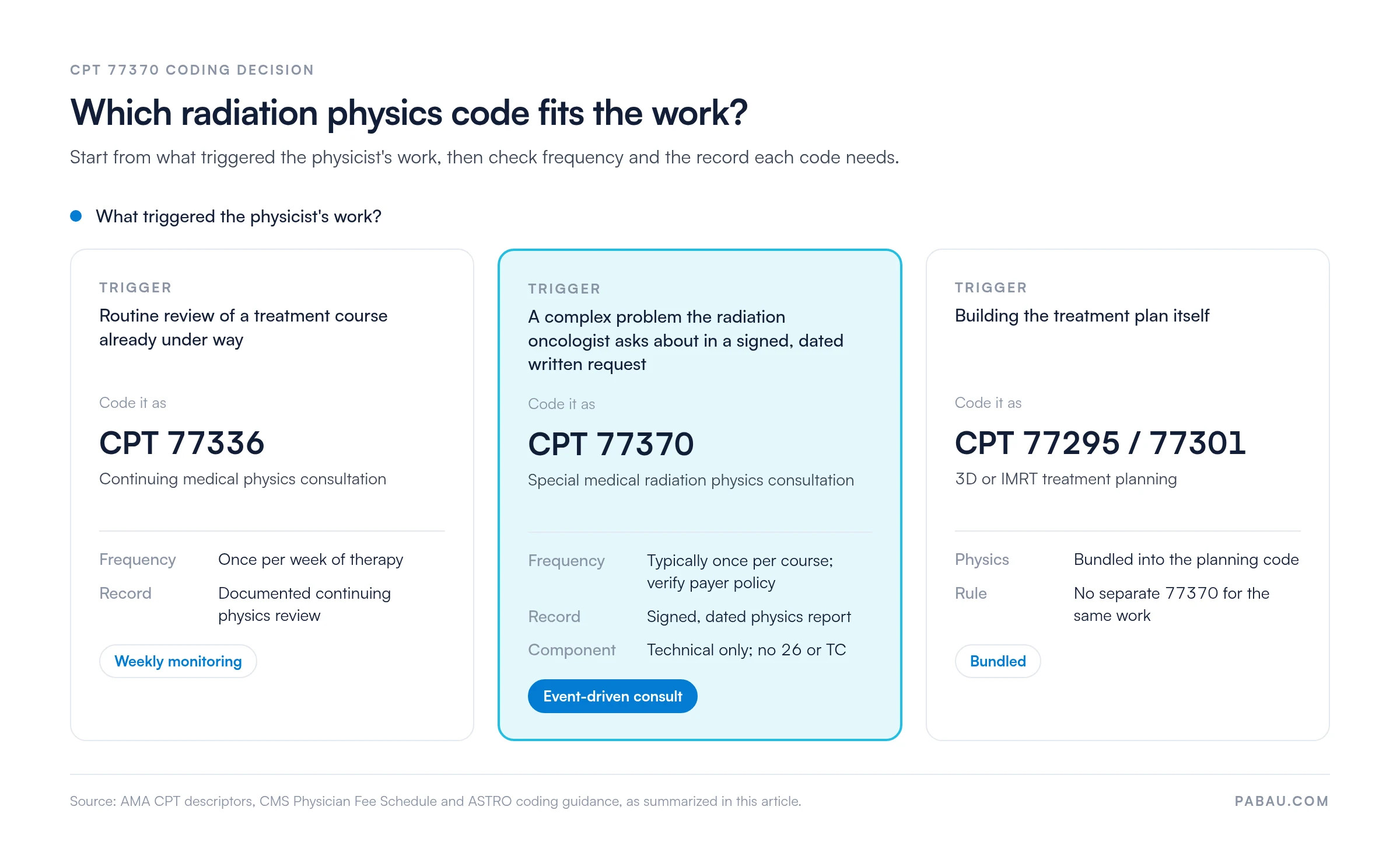
CPT 77370 and CPT 77336 describe two distinct physics consultation services. They are often confused because both involve a qualified medical physicist reviewing a radiation treatment. 77336 is a routine service billed every week of therapy. 77370 is a special consultation triggered by a specific event and requested in writing.
Whether 77370 and 77336 can be billed on the same date of service without a modifier depends on current Correct Coding Initiative (CCI) edits. CCI edit status changes annually. Verify it with your Medicare Administrative Contractor (MAC) or in the current CCI table before billing both codes on the same date.
Run a CCI edit check on the 77370/77336 pair before each billing cycle update. The edit status can shift between fiscal years. Billing both on the same date without checking it is a reliable path to a denial.
CPT code 77370 is a consultation code, and that matters for bundling. The 77xxx series includes treatment planning codes with physics work bundled into their values. Billing 77370 on top of those codes for the same clinical work is a bundling violation.
The American Society for Radiation Oncology (ASTRO) publishes coding guidance on these distinctions. A practice billing 77370 alongside 77295 or 77301 for the same encounter should document why the consultation addressed a distinct clinical question. The planning code must not already cover that question.
Audits of 77370 claims turn on documentation. The record must show the service was medically necessary and that a qualified physicist performed it. It must also show a complex clinical situation, not routine physics support. Maintaining medical billing compliance for radiation oncology takes a documentation checklist at the point of service.
CPT code 77370 is a technical-component-only service under the CMS Physician Fee Schedule (PC/TC indicator 3). It has no professional component, so modifiers 26 and TC do not apply. The modifier question for 77370 is usually whether 59 is needed.
Do not append 26 or TC to 77370. Medicare pays the code only where the technical component is payable. Verify the current PC/TC indicator on the CMS Physician Fee Schedule lookup before billing, because the indicator can change with annual updates.
Medicare reimbursement for CPT code 77370 is calculated using the CMS Physician Fee Schedule. It assigns relative value units (RVUs) to each code. The annual conversion factor and a geographic practice cost index (GPCI) for the billing locality are then applied. Payment rates change each calendar year and vary by region. For current 2026 figures, use the CMS Physician Fee Schedule lookup tool or the FastRVU 2026 RVU lookup and filter by your MAC locality.
Because 77370 is a technical-only code with no professional component, it carries no physician work RVU. Medicare payment rests on the practice expense (technical) RVU. Check the current work and PE values on the CMS lookup before you model revenue. Practices tracking revenue cycle management should monitor 77370 separately from planning codes to spot payer-specific shortfalls.
Commercial payer rates for 77370 vary significantly from Medicare. Some commercial contracts pay a percentage of Medicare, while others use fee schedules negotiated independently. Never assume Medicare rates apply to commercial claims without verifying the contractual terms. For claim submission and payment posting, Pabau’s claims management supports US insurance claims through Claim.MD, including eligibility checks and electronic remittance advice (ERA) posting.
Prior authorization rules for CPT 77370 come from individual payers, so check each one before the service date. Commercial payers and some Medicaid programs may require prior authorization for radiation physics consultation codes. Radiology benefit managers (RBMs) used by some commercial insurers may review 77370 as part of a broader radiation oncology authorization.
Verify prior authorization requirements for each payer before the service is rendered, not after. Prior authorization denials are not always reversible through appeal, and a failed retro-authorization is costly to fix.
The ICD-10-CM diagnosis code paired with CPT 77370 must reflect the underlying malignancy or clinical condition that necessitated the special physics consultation. MACs publish Local Coverage Determinations (LCDs) listing the diagnosis codes they accept as medically necessary for radiation oncology services. The accepted codes vary by MAC region, so consult the LCD for your jurisdiction.
Commonly paired diagnosis categories for 77370 include primary malignancies of the brain, head and neck, breast, lung, prostate, and cervix. Re-irradiation cases may pair 77370 with a secondary malignancy code or a recurrence code, depending on the clinical scenario. Benign conditions treated with radiation, such as arteriovenous malformations or acoustic neuromas, can also support 77370 when the consultation is medically necessary.
A diagnosis code missing from the MAC’s covered list for 77370 brings a medical necessity denial, however well the documentation supports the consultation. Verify the applicable LCD before billing, and document why the chosen diagnosis code reflects the patient’s condition. The AAPC Codify CPT lookup includes crosswalk data linking CPT codes to commonly paired ICD-10 codes, which can assist in pre-claim verification.
Reading denial codes in medical billing for radiation oncology starts with knowing why 77370 draws audits. Effective denial management workflows for 77370 need pre-claim documentation checks and a structured appeal process.
A pre-claim documentation check paired with clean claim habits at submission reduces the 77370 denials that need manual rework.
Audit your 77370 claims monthly against your top three payers. Filter by denial reason code (CO-50 for medical necessity, CO-97 for bundling). One or two documentation patterns often drive the majority of denials. Fixing them at the source is faster than appealing individual claims.
CPT code 77370 may be billed only by or under the direction of a qualified medical physicist. CMS and AAPM guidance align on this, though state rules on what counts as “qualified” vary. The most widely accepted credential is board certification by the American Board of Radiology (or ABMP) in therapeutic medical physics, or equivalent state licensure. Some MACs set additional credential requirements in their LCDs, so verify the LCD for your jurisdiction.
Supervision level requirements differ between settings. In hospital outpatient departments (HOPDs), radiation oncology services are generally provided under general supervision of a physician. In freestanding radiation oncology centers, direct supervision rules may apply. CMS supervision rules for therapeutic radiology have changed through rulemaking, so confirm the current requirements for your setting before billing. The medical billing fundamentals of other specialties do not always carry over to radiation physics, where supervision rules carry compliance consequences.
Radiation oncology billing teams often track the physician’s request, the physicist’s report and each payer’s rules in separate systems. A missing authorization or an unchecked eligibility response then shows up only as a denial.
Pabau brings the claim side of that work into one place. Its claims management software submits US insurance claims through Claim.MD as CMS-1500/837P claims, runs eligibility checks and posts ERA remittances. Prior authorization codes, dates and sessions are tracked on the patient’s case, with a warning when one is missing.

The result is fewer surprises after submission. Your team confirms coverage and authorization before the 77370 claim goes out, then sees the remittance posted against it when payment comes back.

Pabau’s claims management sends US insurance claims through Claim.MD, with eligibility checks and ERA posting. Prior authorizations are tracked on each patient’s case, so a missing one is flagged before you bill.

Treat CPT code 77370 as an exception you document, never a routine billing line. Bill it when the oncologist’s signed, dated request names a complex problem and the physicist signs a report answering it. No planning code should already cover the work.
Keep 26 and TC off the claim, expect one consult per course, and check the payer’s authorization rules first. Those three habits head off the denials this code attracts.
Pabau’s claims management supports US insurance claims through Claim.MD, including eligibility checks and ERA posting. Book a demo to see how it keeps radiation oncology claims moving from eligibility check to remittance.

Billing the weekly physics review instead? CPT code 77336 covers the continuing medical physics consultation billed per week of therapy.
Coding the 3D plan itself? CPT code 77295 explains 3D conformal treatment planning and the physics work bundled into it.
Need the dosimetry calculation code? CPT code 77300 covers basic radiation dosimetry calculation in the same code group as 77370.
Choosing a clearinghouse for radiation oncology claims? Claim.MD clearinghouse guide explains how a clearinghouse cuts first-pass rejections.
Want to understand the 837 file format? 837 electronic claim file guide breaks down the transaction set used for professional claim submission.
CPT code 77370 covers a special medical radiation physics consultation by a qualified medical physicist. The treating radiation oncologist requests it in writing when a complex or unusual case needs physics expertise beyond routine planning support. The service must end in a signed written report addressing the specific issue.
CPT 77370 is a special consultation the radiation oncologist requests in writing for a specific complex situation. CPT 77336 (continuing medical physics consultation) is a monitoring service billed once per week throughout the treatment course. 77370 is typically allowed once per course of treatment, so verify payer policy. Using one code for a situation that warranted the other is a coding error that payers and auditors flag routinely.
The record needs a signed, dated written request from the radiation oncologist and a signed, dated physics consultation report. The report names the complex issue evaluated and the physicist’s recommendations. The chart must also explain why the situation was complex and show the physicist’s credentials. A note reading only “physics review performed” is insufficient for payer review.
Medicare payment for CPT 77370 is the code’s total RVUs times the annual conversion factor. The geographic practice cost index then adjusts it for the billing locality. As a technical-only code, 77370 carries no physician work RVU, so payment rests on its practice expense RVU. Rates change annually and vary by region. Use the CMS Physician Fee Schedule lookup tool or FastRVU for current locality-specific figures.
Sometimes, depending on current CCI edit status. CCI edits between 77370 and 77336 can change between fiscal years. If both codes are appropriate on the same date and the documentation supports distinct services, modifier 59 may allow billing both. Verify the current edit status with your MAC or in the CCI table first, and document the distinct services thoroughly.
CPT 77370 may be billed by or under the direction of a qualified medical physicist. The most widely accepted credential is board certification by the American Board of Radiology (or ABMP) in therapeutic medical physics, or equivalent state licensure. The treating radiation oncologist must request the service in writing. Hospital outpatient departments typically operate under general physician supervision, while freestanding centers may require direct supervision. Confirm your MAC’s LCD for jurisdiction-specific credential requirements.