



CCSD code G5100: Bypass of duodenum billing guide
CCSD code G5100 bills a bypass that leaves the duodenum in place CCSD code G5100...

Last Updated: Oct 16, 2026

CPT code 76937 is an add-on code for ultrasound guidance during vascular access, so it always follows a primary access code.
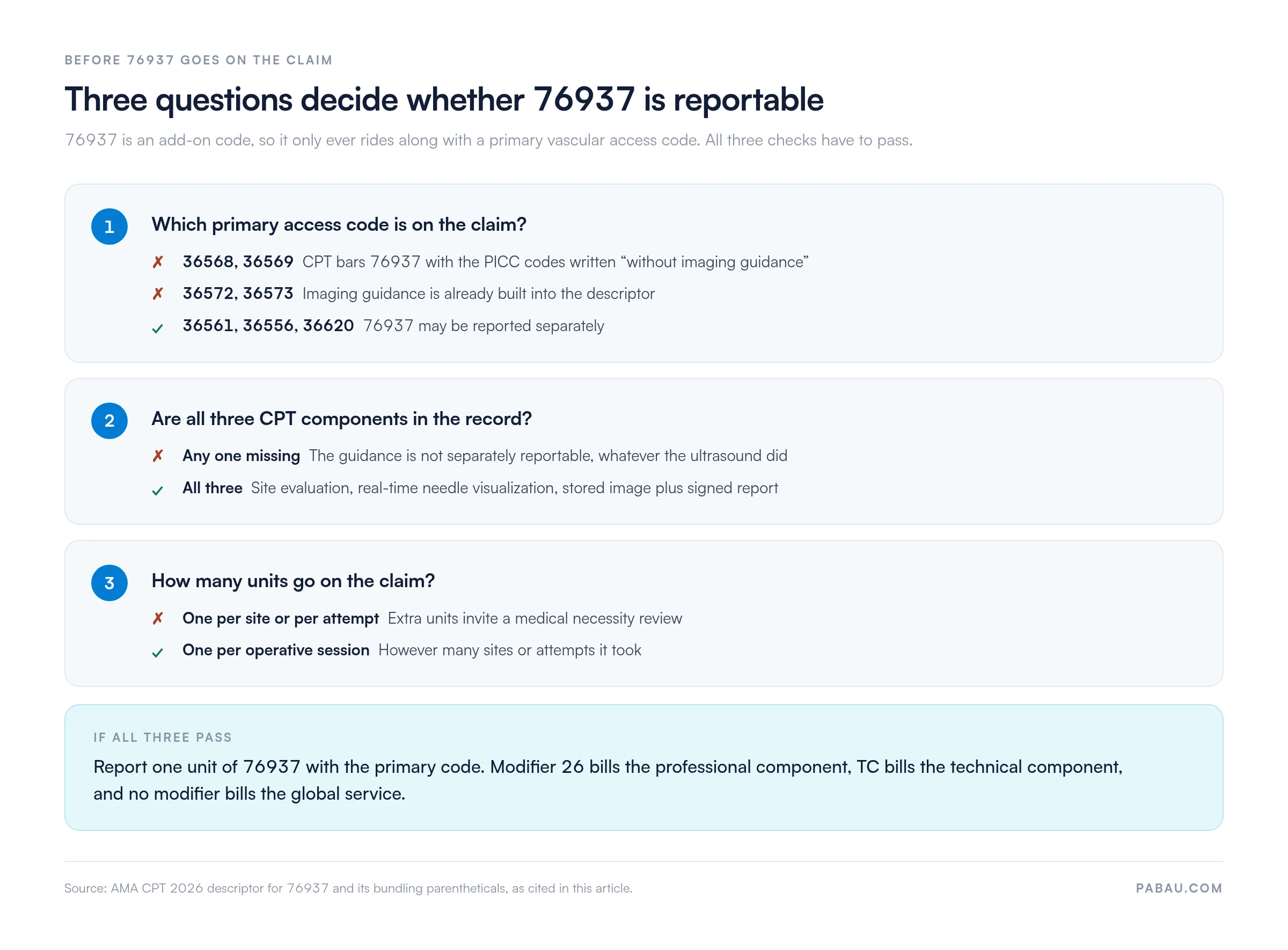
The record has to show three things: site evaluation, real-time needle visualization, and a stored image with a signed report.
Medicare’s 2026 national average payment is $40.42, and it is the same in a facility or a non-facility setting.
Report 76937 once per operative session, however many access sites or attempts the procedure took.
Practice management software like Pabau pre-fills the claim from the record, checks required fields, and submits electronically through Claim.MD.
CPT code 76937 reports ultrasound guidance for vascular access. It is an add-on code, so it never goes out on a claim alone. Most denials on it trace back to the record, not to the code choice.
The record has to carry three elements before the guidance is billable, and the stored image is the one that usually goes missing. That is a $40.42 line gone from a claim that was otherwise correct. Start with the descriptor, because a single parenthetical in it decides most of what follows.
The American Medical Association (AMA) CPT code set defines 76937 as ultrasound guidance for vascular access.
Its descriptor spells out three required actions, then closes with the clause that decides how you bill it. That clause reads: (List separately in addition to code for primary procedure).
That parenthetical makes 76937 an add-on code. It is never billable on its own, and it has to accompany a primary vascular access procedure code such as 36561. Submit it by itself and the payer rejects the line before anyone reads the note.
The code travels across specialties. Interventional radiology, emergency medicine, vascular surgery, and critical care all report it. Any provider who uses real-time ultrasound to guide a needle into a vessel can bill 76937.
The target can be a central line, a PICC, or a peripheral IV in a hard-stick patient.
Ultrasound work that no listed CPT code describes falls to 76999, the unlisted ultrasound code. It carries no national Medicare rate, so a payer prices each claim from the special report attached to it.
One more rule sits underneath all three. Report 76937 once per operative session, whatever the site count. Two failed attempts in the left internal jugular vein, then a success on the right, still yields one unit.
76937 carries a professional and a technical component, so who owns the equipment decides how you bill it. Append modifier 26 when your physician interprets the imaging but the facility owns the ultrasound machine.
Append TC when the practice owns the equipment and someone else reads it. Bill the code with no modifier when you performed and interpreted the whole service in your own office.
The modifier is the easy part. Documentation is what payers actually audit.
Incomplete documentation drives most 76937 denials. Auditing the note before the claim leaves is cheaper than appealing it afterward. A procedure note that records the access without the three elements below will not hold up on audit.
A formal report is not optional here. It means a dated, signed interpretation, not a procedure note mentioning that an ultrasound sat in the room.
Practices running a templated addendum that captures all three elements resolve audits faster. They also reach a clean claim on the first pass more often.
National Correct Coding Initiative (NCCI) bundling for 76937 has shifted. CMS removed the code from the NCCI Policy Manual, a change the American College of Radiology pushed for. Separate reporting is now appropriate whenever the full descriptor is met, rather than blocked by policy default.
The manual is not the edit file, though. NCCI edit pairs still apply at the code level, and the tables refresh quarterly. Check the current file through AAPC Codify before each billing cycle.
Most 76937 claims ride along with a vascular access procedure code. Four of those codes rule the guidance out entirely, so read the descriptor of whatever you are pairing it with.
The test for every pairing is the same. Did the guidance independently meet all three elements of the descriptor? If the imaging happened but nothing reached the chart, the guidance is not separately reportable, whatever the policy manual now says. Run the three checks below in order before the claim goes out.
The 2026 Medicare Physician Fee Schedule puts the national average payment for 76937 at $40.42. That figure is the same in a facility and in a non-facility setting, so place of service does not move it. For this add-on code there is no office-versus-hospital split to model.
Locality does move it. Rates vary by Medicare Administrative Contractor (MAC), and the national average sits before geographic adjustment.
Run your own locality through the CMS fee schedule lookup tool before quoting an expected payment to anyone.
Three relative value unit (RVU) components and the conversion factor produce that number. The 2026 MPFS final rule is the source.
FastRVU is a quick way to confirm the current values before you use them in contract modeling.
A $40.42 line rarely justifies a manual appeal. Once you add the biller’s time to pull the note, write the letter, and track the resubmission, the rework costs more than the payment. That is the argument for catching 76937 problems before submission rather than after.
Run a 90-day 76937 denial report and sort it by the primary access code on the same claim. If 36568 and 36569 lines dominate the denials, the problem is code selection at the point of order, not documentation. Fixing the order set fixes the denials.
76937 errors cluster into a short list. The denial codes that come back on ultrasound guidance lines almost always point at one of these five.
Six questions, asked in this order, catch nearly all of it.
Local Coverage Determinations, or LCDs, govern Medicare coverage for 76937, and each MAC writes its own.
What counts as adequate medical necessity documentation in one region may not satisfy another contractor’s language. Practices billing across several MACs need the applicable LCD for each one.
Commercial policies move faster than Medicare’s and vary far more. A plan that paid 76937 separately last year may have rewritten its clinical policy for the current benefit year.
The table below sorts the main coverage considerations by payer type.
Build the policy check into contract renewal rather than assuming continuity. On a high-volume account, one quiet policy change can run up months of denials before anyone connects them.
Most practices catch 76937 problems in a manual pre-submission review. A biller opens the note, checks the three elements and the primary code, then keys the claim by hand. Keying errors follow the volume.
Practice management software like Pabau removes the keying step. Its claims management software pre-fills the claim from the record.
The CPT code attached to the service lands on the charge line, and the ICD-10 slots seed from the patient’s problem list. It checks required fields before the send button unlocks, then files electronically through Claim.MD.
It will not make the coding decision for you, though. Pabau does not flag that 36569 bars 76937, and it does not pick your modifier. It carries CPT and ICD-10 lookup libraries instead, refreshed with each official release.
The coder confirms the pairing, and the software handles the paperwork.
Practices placing central lines or PICCs daily feel this most. Consistency still starts in the note, because the claim side can only carry what the record holds.

Pabau pre-fills each claim from the patient record, checks the required fields before submission, and files electronically through Claim.MD. Your billers stop retyping and start reviewing.

76937 is a simple code wrapped in a demanding record. Three components, all required, all captured at the point of care, and one unit per operative session. Get those right and the code pays without an argument.
Two habits carry most of the value here. Look at the primary access code before you add the guidance line, because 36568 and 36569 close the door on their own. Then confirm the image actually landed in the chart, because that is the element that goes missing.
Neither habit needs software to work. What software changes is how much a biller has to hold in their head on a busy day. Book a demo to see how Pabau pre-fills and validates a claim before it reaches the clearinghouse.

Need to know what happens after a 76937 line is denied? Denial management in healthcare walks through tracking, appealing, and preventing repeat denials across billing codes.
Want to see how a clearinghouse validates a claim first? Claim.MD clearinghouse overview explains what gets checked before a payer ever sees the file.
Tracking revenue across high-volume procedure codes? What is revenue cycle management connects documentation, coding, and payment into one trackable process.
Building the paperwork that supports a charge? What a superbill includes covers the fields a payer expects to see behind each billed line.
Curious what the electronic claim file looks like? The 837 claim file explained breaks down the format your practice management system actually transmits.
76937 covers ultrasound guidance for vascular access. 76942 covers ultrasound guidance for needle placement outside a vessel, such as a biopsy, an aspiration, or an injection. The two are not reported together for the same needle. Pick the one that matches what the needle was aiming at.
77001 is the fluoroscopic version. It covers fluoroscopic guidance for placing, replacing, or removing a central venous access device, including images of the final catheter position. Report the code matching the imaging modality you actually used. Neither one may be reported with 36568 or 36569.
No. The CPT parenthetical bars 76937 with 36568 and 36569 outright, so a modifier will not unbundle it. When ultrasound guidance was used for the PICC, the correct primary code is 36572 or 36573, and the guidance is already inside that descriptor.
Yes, when the vein is genuinely hard to access and all three components are documented. Difficult peripheral access is a recognized indication. Payers will not accept routine ultrasound use on a straightforward stick, so record the failed attempts or the reason imaging was needed.



