HCPCS Code G0163: Skilled nursing observation and assessment
What is HCPCS Code G0163? HCPCS Code G0163 is a deleted Level II code for skille...

Last Updated: Oct 15, 2026
76999 is the CPT code for an unlisted ultrasound procedure, diagnostic or interventional, that no other CPT ultrasound code describes. Coders use it only for a procedure that is new or falls outside every named ultrasound code. The first step is always to rule out a specific code.
76999 has no national Medicare fee schedule rate, and payers price each claim by report after manual review. Denials usually trace back to a missing special report, no prior authorization, or a specific code that should have been billed instead.
Let Pabau's smart automation suggest the right codes, reduce claim denials, and keep your practice compliant—effortlessly.
Automate repetitive tasks and focus on what matters most—your patients.
Reduce coding errors and ensure compliance with the latest regulations.
Clean claims, fewer denials, and faster reimbursements.
Powerful insights and reporting to help your practice thrive.
HIPAA compliant SOC 2 certified GDPR-compliant Trusted by 4,000+ clinics worldwide

CPT Code 76999 applies only when no specific ultrasound CPT code describes the procedure performed.
Ultrasound needle guidance has its own code, 76942, so 76999 never stands in for fluoroscopic codes 77002 or 77003.
Medicare has no national fee schedule rate for 76999, so Medicare contractors price each claim by report.
A special report describing the procedure and its medical necessity should travel with every 76999 claim.
Practice management software like Pabau keeps the records behind a 76999 claim on one patient record, then submits and tracks the claim.
CPT Code 76999 is the radiology section’s catch-all code for unlisted ultrasound procedures. Specifically, it covers diagnostic and interventional scans that no other CPT ultrasound code describes. The American Medical Association’s CPT code set defines 76999’s official descriptor as “Unlisted ultrasound procedure, eg, diagnostic, interventional.” Those two qualifiers are examples. Any ultrasound procedure without a matching specific code falls here.
76999 is the last code in the diagnostic ultrasound range (76506-76999). It closes the Other Diagnostic Ultrasound Procedures subsection (76975-76999), which follows the ultrasonic guidance codes (76932-76965). That position reflects its job as a backstop, billed only after every specific code has been ruled out.
Radiology carries a second unlisted code for non-ultrasound work. An unlisted diagnostic radiographic procedure belongs under 76499 instead.
CPT Code 76999 covers any ultrasound procedure for which no specific code exists. Two scenarios usually justify it. The first is a new imaging protocol that has no dedicated code yet. The second is a specialized interventional technique, such as experimental intraoperative guidance, that no guidance code describes. The test never changes. If a specific CPT ultrasound code already describes the procedure, bill that code instead.
What 76999 doesn’t cover matters just as much. Coders sometimes use it when documentation is thin and a specific code would take more work to justify. As a result, that approach fails at payer review and can trigger audits.
The most reliable way to avoid a 76999 denial is to check every neighboring code before filing. Coders most often reach for 76999 when one of the following specific codes applies.
Imaging guidance causes the most mix-ups. Codes 77002 and 77003 describe fluoroscopy only, so ultrasound-guided needle placement is reported with 76942. Ultrasound-guided paravertebral facet injections have their own Category III codes, 0213T-0218T. The decision path below shows the order to check them in.
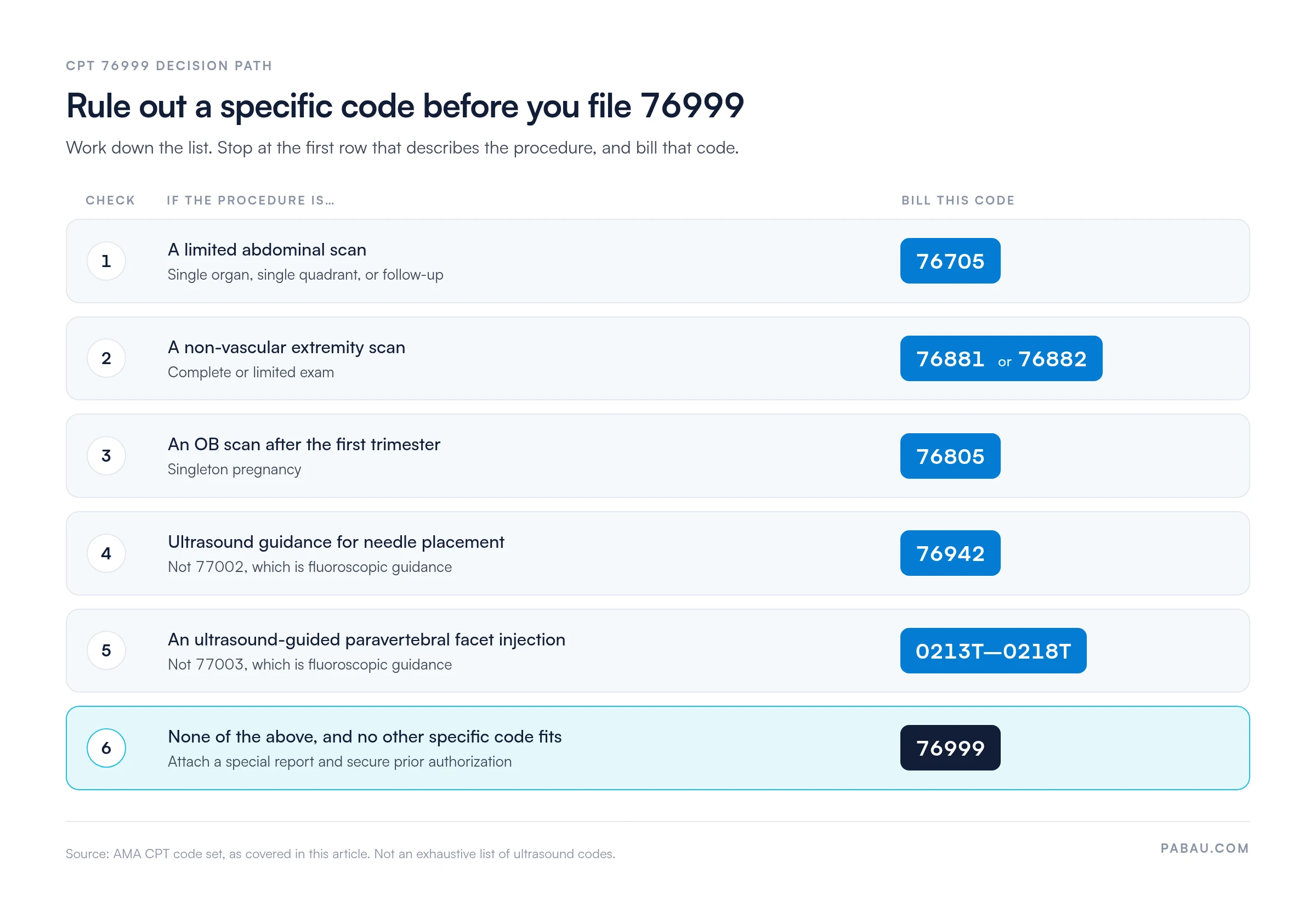
Before filing 76999, run a keyword search of the CPT radiology section using the anatomic site and procedure type. AAPC’s code lookup and the AMA’s CPT database both allow descriptor-based searches. Finding a specific code at this stage costs minutes; a denied 76999 claim costs weeks of follow-up.
Unlisted procedure codes require more supporting documentation than any named CPT code. The AMA CPT guidelines call for a special report with unlisted codes, and payers treat that report as a prerequisite for adjudication. Without it, most payers deny the claim outright.
Therefore, send the special report with the initial claim as a supporting attachment. Waiting until a denial arrives adds weeks to the payment cycle. Capturing each required element at the time of service makes the report far easier to write.
Some payers also require a cover letter explaining the procedure’s novelty or clinical necessity beyond the operative note itself. Check payer-specific billing manuals before submitting.
Billing 76999 correctly requires more pre-submission work than most CPT codes. The steps below mirror the workflow radiology billing teams use to get unlisted procedure claims through manual review on the first pass.
A clean claim with the special report attached on day one is the most effective way to shorten 76999 turnaround. Each missing element sends the claim back for another review cycle.
Standard CPT modifiers apply to 76999, though their acceptance varies by payer. Verify individual payer rules before assuming a modifier combination will process without manual review.
In particular, stacking several modifiers on an unlisted code can draw extra scrutiny at some payers. When -59 is added alongside -26, include the special report and a cover letter explaining both the component billing and the distinct service rationale. Check current CMS Physician Fee Schedule guidance and your MAC’s billing policies for modifier-specific instructions on unlisted radiology codes.
Medicare does not publish a national fee schedule rate for CPT Code 76999. The Centers for Medicare and Medicaid Services assigns no national relative value units (RVUs) to unlisted procedure codes. The procedures they describe are, by definition, not standardized. Instead, each Medicare Administrative Contractor (MAC) prices 76999 individually based on the clinical circumstances described in the special report. Check your own MAC’s policies, which can differ meaningfully across jurisdictions.
Commercial payers handle 76999 in one of three ways:
Eligibility verification before the visit should include a benefits check for unlisted procedure coverage. Some plans exclude all unlisted codes.
CPT Code 76999 has no published 2026 national fee schedule rate. Because it is an unlisted code, the CMS relative value files list no work, practice expense, or malpractice RVUs for it. Reimbursement is priced by report instead. The MAC or commercial payer reviews your special report and sets a payment based on the closest comparable CPT code.
Payment can therefore land anywhere from the level of a limited ultrasound (76705) to a complex interventional guidance code. Where it lands depends on how well the special report documents the procedure’s complexity.
So name the comparator yourself. Have the billing team pick the most analogous specific CPT code and cite it in the special report, which anchors the payer’s pricing decision. Then read each remittance advice to see which comparator the MAC used, and reuse that language in future reports.
The same comparator step applies outside radiology. CPT 53899 covers unlisted urinary procedures, and payers price those claims by report too.
Most commercial payers require prior authorization (PA) for CPT Code 76999. Unlisted codes signal non-standard services by definition, so payer policies usually want PA before the procedure. Skipping it is one of the fastest routes to a 76999 denial that is hard to appeal.
Submit the PA request with the complete special report, the same documentation you will attach to the claim. Payers typically want the procedure description, the ICD-10 diagnosis codes, and the reason no specific code applies. Supporting notes from the ordering physician round out the request. Turnaround for unlisted procedure PA decisions typically runs 5 to 14 business days, depending on payer and whether the request goes to a medical director.
Denials on CPT Code 76999 follow a predictable pattern, and each reason below has a specific corrective action. Fixing the root cause before resubmission is faster than appealing on a technicality. Match the claim adjustment reason code (CARC) on your remittance against these medical billing denial codes before choosing a response.
Hence, a clearinghouse that flags missing attachments before transmission stops a 76999 claim without its special report from reaching the payer. Electronic 837P submissions with attachments also move faster than paper, and they leave a timestamped record for appeals.
Track every 76999 denial by CARC reason code for 90 days. If more than 30% share the same root cause, fix the process upstream instead of appealing claim by claim. Missing special reports are the most common single cause. Make the report a required field before any 76999 claim can be marked ready for submission.
A 76999 claim depends on three documents that often live in three places: the imaging report, the prior authorization number, and the special report. As a result, billing teams lose time rebuilding that file by hand for every unlisted claim.
Practice management software like Pabau keeps treatment notes, forms, and patient details on one patient record. Its claims management software pulls that record data into a pre-filled claim, then submits and tracks it through Claim.MD in the US.
Because of this, your team spends less time hunting for paperwork, and claim status stays visible without a call to the payer.

Pabau keeps the records behind every unlisted procedure claim in one place. Your team spends less time on appeals and more time on patient care.

Treat 76999 as the last answer, never the first. If a specific code such as 76942 or 76705 fits the procedure, bill it, because an unlisted claim costs more time at every stage.
When 76999 is the correct code, the work shifts to the paperwork. Secure prior authorization first, send the special report with the claim, and cite a comparator code so the payer has a price to start from. You trade effort up front for fewer weeks spent on appeals.
Book a demo to see how Pabau keeps the records behind your unlisted ultrasound claims together, from the scan to the remittance.

Billing ultrasound-guided needle placement? CPT code 76942 explains the dedicated guidance code to report instead of 76999.
Need to understand what makes a claim clean before submission? Clean claim submission guide covers the elements every claim must carry before it reaches a payer.
Want to reduce denial rates across your billing workflow? Denial management in healthcare walks through how to track, appeal, and prevent claim denials.
Looking for the right clearinghouse for unlisted procedure submissions? Medical claims clearinghouse guide explains what a clearinghouse checks before a claim reaches the payer.
Sending claims electronically? The 837 file explained breaks down the electronic claim format and how attachments are referenced in it.
CPT Code 76999 is the unlisted ultrasound procedure code. It covers any diagnostic or interventional ultrasound service that no specific CPT code describes. It applies to novel imaging protocols or specialized interventional techniques not yet assigned a dedicated code. It does not apply when a specific code like 76705, 76881, 76882, or 76942 already describes the procedure performed.
Yes, most commercial payers require prior authorization for CPT 76999. Unlisted procedure codes trigger PA requirements at most commercial plans because the service is non-standard. Submit the PA request with the complete special report before the procedure. A missing PA is one of the hardest denials to appeal for this code.
The most common reasons are a missing special report, no prior authorization, and thin medical necessity documentation. Payers also deny claims where a specific code should have been billed instead. NCCI bundling edits (when 76999 is billed alongside an imaging guidance code without a -59 modifier) cause a smaller but consistent share of denials. Addressing the specific CARC denial code on the remittance before resubmitting is faster than filing a generic appeal.
There is no 2026 national fee schedule rate for CPT 76999. CMS publishes no RVU for unlisted codes. Reimbursement is determined individually by the MAC or commercial payer examiner based on the closest comparable specific CPT code identified in your special report. To anchor the payer’s decision, cite the most analogous specific code and its reimbursement rate in the special report narrative.