CPT code 57283: Uterosacral ligament suspension billing guide
CPT code 57283: official descriptor and procedure overview CPT code 57283 descri...

Last Updated: Oct 15, 2026
76820 is the CPT code for Doppler velocimetry of the fetal umbilical artery, reported once per fetus studied. It covers sampling the umbilical artery waveform and interpreting the S/D ratio, resistance index, or pulsatility index in a high-risk pregnancy.
The vessel decides the code. A middle cerebral artery study is CPT 76821, so the Doppler report must name the umbilical artery for 76820 to hold. Pair it with a qualifying diagnosis, such as fetal growth restriction, and a signed interpretation.
Let Pabau's smart automation suggest the right codes, reduce claim denials, and keep your practice compliant—effortlessly.
Automate repetitive tasks and focus on what matters most—your patients.
Reduce coding errors and ensure compliance with the latest regulations.
Clean claims, fewer denials, and faster reimbursements.
Powerful insights and reporting to help your practice thrive.
HIPAA compliant SOC 2 certified GDPR-compliant Trusted by 4,000+ clinics worldwide

CPT 76820 reports Doppler velocimetry of the fetal umbilical artery, once per fetus studied. A middle cerebral artery study is CPT 76821 instead.
Medical necessity rests on a high-risk diagnosis, such as fetal growth restriction, a hypertensive disorder of pregnancy, or post-term pregnancy.
Medicare lists 76820 with a global indicator of XXX, so no global period applies. Modifiers 26 and TC split the professional and technical components.
The 2026 Medicare Physician Fee Schedule gives 76820 a total of 1.35 RVUs, about $45.09 nationally.
Pabau, the practice management and billing platform we build, pre-fills each claim from the patient record and checks required fields before submission.
CPT code 76820 reports Doppler velocimetry of the fetal umbilical artery. The sonographer samples blood flow in a free loop of cord and records the waveform. From it, the interpreting physician derives the systolic-to-diastolic (S/D) ratio, resistance index (RI), and pulsatility index (PI).
Absent or reversed end-diastolic flow points to high placental resistance and possible fetal compromise. Because that finding can change delivery timing, payers expect a clear indication and a signed interpretation behind every claim.
The table below sums up the code’s billing attributes, as maintained by the American Medical Association (AMA) and reflected in the Medicare Physician Fee Schedule.
The code covers acquiring the waveform and interpreting it. It does not cover:
A biophysical profile has its own code: 76818 when it includes the NST, and 76819 when it does not. The two coding errors to watch for are billing 76820 after a general OB scan alone, and billing it for an MCA study.
Medical necessity for CPT 76820 requires a documented high-risk condition that justifies umbilical artery surveillance.
Common indications include fetal growth restriction (FGR, also called IUGR), hypertensive disorders of pregnancy, and other conditions that affect placental perfusion. ACOG and SMFM guidance on antepartum fetal surveillance gives the strongest support to its use in growth restriction.
Coverage for specific indications varies by payer. Before billing, check the payer’s medical policy and any Local Coverage Determination (LCD) from your Medicare Administrative Contractor (MAC).
ICD-10-CM codes update every October 1, so review this list each year. Codes in the O36 and O41 categories need a 7th character. Use 0 for a single gestation, and 1 through 9 to identify the affected fetus in a multiple gestation.
A clean claim for CPT 76820 depends on a Doppler report that shows what payers expect to see. The sonographer finds the umbilical artery with color flow mapping and places the Doppler sample gate in a free loop of cord. Spectral waveforms are then recorded and measured.
Payers reviewing the claim look for a report that shows:
Post-payment audits look for waveform measurements and a signed physician interpretation. Without a separate interpretive report, a claim for the professional component (modifier 26) has nothing to stand on.
CPT 76820 covers Doppler velocimetry of the umbilical artery, and CPT 76821 covers the middle cerebral artery (MCA). The vessel studied decides the code, so the two are never interchangeable. A mismatch between the report and the billed code is a common OB Doppler error, and payer audits flag it.
When both vessels are assessed in one session, as in many growth restriction workups, report 76820 and 76821 as separate codes. Each needs its own measurements in the report. Add modifier 59 only if an active NCCI edit pairs the two codes, so check the current quarterly table first.
Antepartum surveillance visits often combine several studies. Knowing which codes can sit beside CPT 76820 prevents both underbilling and NCCI edit denials.
NCCI edits update quarterly, so check the current table before assuming a pair is allowed. That matters most for BPP codes billed alongside 76820.
Run a monthly same-day audit on your 76820 claims. Pull each claim where 76816, 76818, 76819 or 76821 shares the date of service. Where a pair hits an active NCCI edit and the claim lacks the modifier that edit allows, correct it before you resubmit.
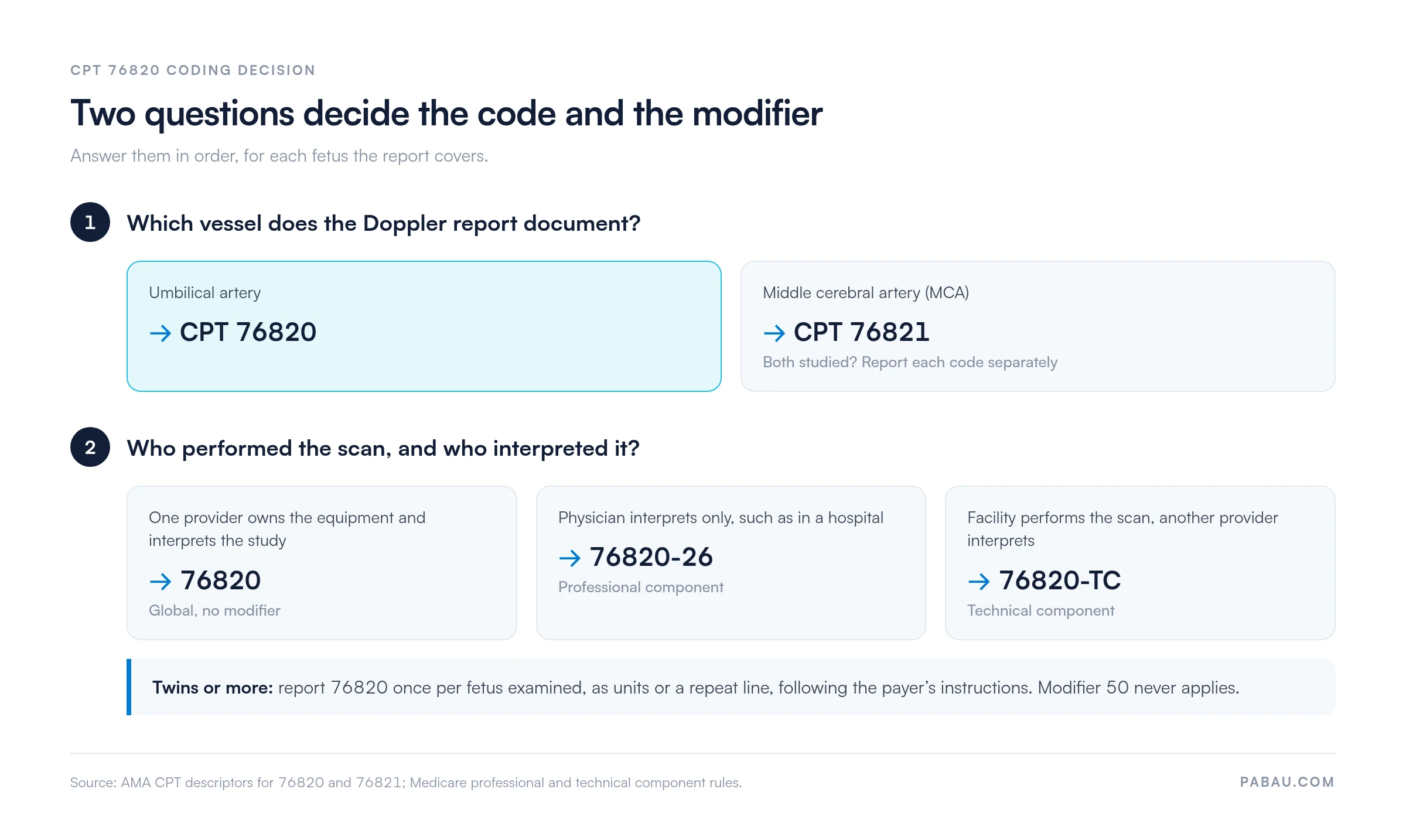
Modifier choice for 76820 follows standard radiology component billing. It turns on two facts: who owns the equipment, and who reads the study. The diagram below maps both decisions, from vessel to modifier.
Global period: Medicare lists 76820 with a global indicator of XXX, meaning the global surgery concept does not apply. Each Doppler study is billed on the date it is performed, backed by its own indication and report.
Multiple gestations: modifier 50 does not apply, because the code describes a study per fetus, not a side of the body. In a twin or higher-order pregnancy, report 76820 once per fetus examined. Some payers want units and others want a repeat line with a modifier, so follow the payer’s instructions.
At 32 weeks, twin B of a dichorionic twin pregnancy shows growth restriction. The physician orders umbilical artery Doppler on both fetuses and documents separate measurements for each.
The claim reports 76820 for each fetus, as units or a repeat line, depending on the payer. Twin B’s line links to O36.5932, poor fetal growth in the third trimester for fetus 2. Twin A’s line links to O30.043, dichorionic/diamniotic twin pregnancy in the third trimester. Confirm the payer accepts that code as an indication for twin A.
The CMS Physician Fee Schedule sets the Medicare payment benchmark for CPT 76820. The table below shows 2026 national values at the $33.4009 conversion factor. Check local rates with the FastRVU 2026 RVU lookup before quoting a payer figure.
For global 76820, the facility and non-facility totals are the same, so the setting does not change the Medicare rate. What changes in a hospital outpatient department is who bills each part. The physician reports 76820-26 for the interpretation, and the hospital bills the technical side under its own payment system.
Commercial payer rates vary by contract, so check each contract and any MAC LCD before billing. Then track how each payer reimburses your 76820 volume in your OB/GYN claims software.
Prior authorization for CPT 76820 is not universal, and requirements vary by payer type and plan. Confirm insurance eligibility verification and PA status before you schedule the study.
When a PA is required, include the ICD-10 code, the gestational age, and the clinical rationale, such as FGR with decreased fetal movement. Add any prior ultrasound findings. A denied PA can be appealed with supporting ACOG or SMFM guidance.
Most CPT 76820 denials fall into five categories. Track each one separately in your denial management workflows, so the root cause stays visible instead of disappearing into one overall rate.
If any item fails, hold the claim and fix it first. A clean claim submission means the vessel, diagnosis, modifier, and report agree before the claim leaves the practice. Review the denial codes on 76820 remittances within 48 hours, so corrections go out faster than a monthly audit allows.
In many OB practices, billing staff build each 76820 claim by hand from the Doppler report and the visit note. Codes get keyed twice, and a missing field only surfaces when the payer rejects the claim.
Pabau, the practice management and billing platform we build, pre-fills the claim from the patient record. Built-in ICD-10-CM and CPT lookup libraries let staff find O36.5930 or 76820 without leaving the record. Pabau then validates the required claim fields and submits US claims through Claim.MD.
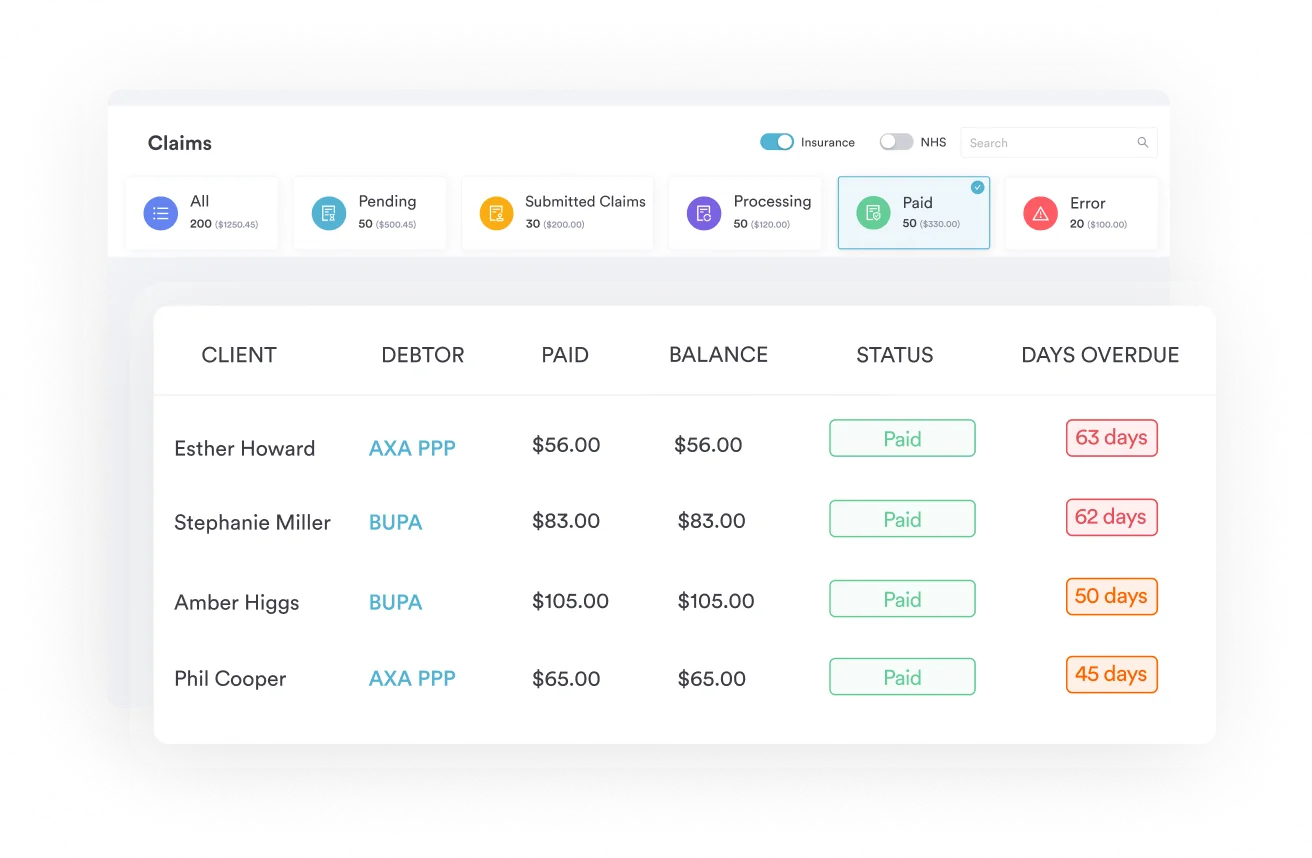
Eligibility checks run before the visit, and electronic remittance advice (ERA) posts payments back against each claim. Your coders still choose the codes and modifiers, but fewer claims come back for missing data.

Pabau pre-fills OB claims from the patient record, validates required fields, and submits US claims through Claim.MD. Eligibility checks and ERA posting keep each 76820 claim moving toward payment.

CPT 76820 rewards precision. Align the vessel, the diagnosis, and the signed interpretation, and the claim pays on the first pass. Miss one, and it comes back for a fix that belonged before submission.
Run the Before you submit checklist on your next ten 76820 claims and note which item fails most often. That pattern tells you whether the fix belongs at the scan, in the report, or at the billing desk.
Book a demo to see how Pabau pre-fills each OB claim from the patient record and flags missing fields before submission.

Need to understand how clearinghouse submission works for OB claims? Medical claims clearinghouse overview explains how claims move from the practice to payers, and where they tend to stall.
Want a framework for managing claim rejections systematically? Revenue cycle management guide covers the end-to-end RCM process, from patient registration to payment posting.
Billing a growth scan at the same visit? CPT code 76816 billing guide covers the follow-up obstetric ultrasound that often sits beside umbilical artery Doppler.
Is a detailed anatomy scan on the plan as well? CPT code 76811 billing guide explains how to code the detailed fetal anatomy scan used in high-risk pregnancies.
CPT code 76820 covers Doppler velocimetry of the fetal umbilical artery, reported once per fetus studied. It measures waveform indices such as the S/D ratio to assess placental resistance. It does not cover MCA Doppler (76821) or a biophysical profile (76818 or 76819).
CPT 76820 covers the umbilical artery, and CPT 76821 covers the middle cerebral artery. The vessel named in the Doppler report decides the code. When both vessels are studied, each one is reported as a separate code.
No. Medicare lists 76820 with a global indicator of XXX, which means the global surgery concept does not apply. Each study is billed on its own date of service.
CPT sets no fixed frequency for 76820. Payers judge each study on medical necessity, so serial scans need a current indication and a signed report every time. Some commercial plans require prior authorization for repeat studies.
Doppler of the fetal heart has its own codes: 76827 for a complete study and 76828 for a follow-up or repeat study. Report them only when a fetal heart Doppler was performed and documented.
No. The sonographer performs the scan, but the interpreting physician bills the professional component or the global code. A hospital bills the technical component when it owns the equipment.