

CCSD code G5100: Bypass of duodenum billing guide
CCSD code G5100 bills a bypass that leaves the duodenum in place CCSD code G5100...

Last Updated: Oct 16, 2026
CPT 47600 is the code for open cholecystectomy (gallbladder removal through an open incision) without intraoperative cholangiography. Laparoscopic cholecystectomy is reported with 47562.
If the surgeon performs a cholangiogram during the open procedure, report 47605 instead. A laparoscopic case that converts to open is coded as 47600, because the code follows the approach used to finish the procedure.
Let Pabau's smart automation suggest the right codes, reduce claim denials, and keep your practice compliant—effortlessly.
Automate repetitive tasks and focus on what matters most—your patients.
Reduce coding errors and ensure compliance with the latest regulations.
Clean claims, fewer denials, and faster reimbursements.
Powerful insights and reporting to help your practice thrive.
HIPAA compliant SOC 2 certified GDPR-compliant Trusted by 4,000+ clinics worldwide

CPT 47600 covers open cholecystectomy without cholangiography. Laparoscopic cases use 47562, or 47563 when a cholangiogram is done.
Payers expect the operative note to state the open approach, confirm gallbladder excision, and describe how the cystic duct and artery were handled.
47600 carries a 90-day global surgery period, so related visits in that window need the right modifier before they can be billed separately.
Pabau, the practice management platform we build, submits CMS-1500 and 837P claims through its Claim.MD clearinghouse integration and tracks each claim’s status.
CPT Code 47600 is the billable procedure code for cholecystectomy performed via an open surgical approach, without concurrent intraoperative cholangiography. It falls within the AMA’s CPT code set under the Excision Procedures on the Biliary Tract section (range 47600-47715).
Clinically, the open approach means the surgeon makes a conventional incision, typically a right subcostal (Kocher) or upper midline incision, to access the gallbladder directly. The surgeon ligates and divides the cystic duct and cystic artery, then dissects the gallbladder free from the liver bed before removal. Surgeons choose the open approach when laparoscopic entry is contraindicated or a laparoscopic case converts intraoperatively. In addition, dense adhesions or complex anatomy that call for direct visualization justify the open approach.
The code descriptor specifies no cholangiography. If the surgeon performs intraoperative cholangiography during an open cholecystectomy, CPT 47605 applies instead. Therefore, understanding this distinction early prevents one of the most frequent unbundling denials on biliary tract claims. A reliable medical billing process for general surgery starts with matching the code to both the surgical approach and the concurrent procedures actually performed.
Approach and cholangiography status together determine which cholecystectomy code applies. The table below maps the four primary codes across those two axes.
A common error is billing 47562 or 47563 for a laparoscopic case that converted to open. You report the completed open procedure as 47600, or 47605 with cholangiography. The code follows the approach used when the gallbladder came out, not the approach planned at the start, as the grid below shows.
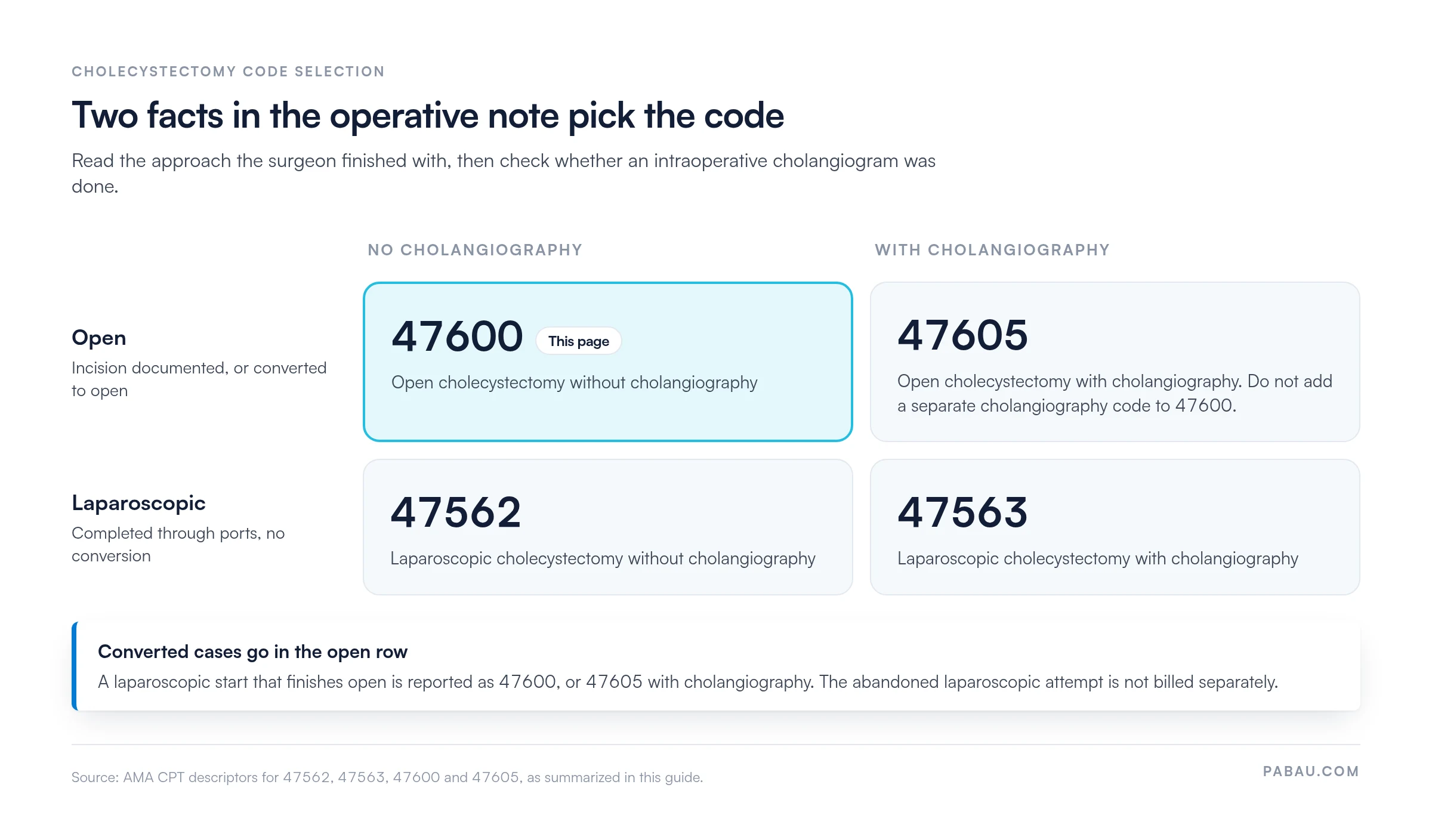
Use 47600 when all three of the following are true: the surgeon removed the gallbladder, used an open approach, and performed no concurrent intraoperative cholangiography.
The operative report is the single document that determines whether a 47600 claim survives audit. Payers and auditors read the operative note for approach-specific language when they review surgical coding. In contrast, missing language is the fastest path to a denial or a post-payment audit finding.
Payers expect the operative note to include the elements below to support 47600.
Place of service also matters. CPT 47600 is a hospital procedure, typically billed for a hospital inpatient stay. Medicare lists it as inpatient-only under the outpatient payment system, and it is not on the Medicare ASC covered procedures list. However, commercial payers set their own site-of-service rules, so confirm billing compliance requirements with each payer.
Modifiers change how a claim is processed without changing the underlying procedure code. For 47600, the modifiers below cover the most frequently encountered clinical and billing scenarios.
Modifier misuse is a frequent audit trigger. Some payers require documentation thresholds for modifier -22 that exceed standard AMA guidelines. For that reason, always verify current modifier policies with individual payers before submission.
Medicare calculates reimbursement for 47600 from the Relative Value Units (RVUs) that CMS publishes in the annual CMS Physician Fee Schedule. In addition, its own Geographic Practice Cost Index (GPCI) adjusts each RVU component for the provider’s locality. The payment equals (wRVU × work GPCI + PE RVU × PE GPCI + MP RVU × MP GPCI) × conversion factor.
For 2026, CMS publishes two conversion factors. CMS pays qualifying APM participants $33.5675 and every other clinician $33.4009.
CPT 47600 carries a 90-day global surgery period. In other words, Medicare bundles all related preoperative and postoperative care within 90 days of the procedure into the single 47600 payment. You generally cannot bill separate E/M visits during that window unless modifier -24 (unrelated evaluation and management) applies.
Your locality’s GPCIs move the dollar figure up or down, so check the CMS lookup for your Medicare locality. In contrast, commercial payer rates differ from Medicare because each payer negotiates them individually.
The ICD-10-CM diagnosis code linked to the claim establishes medical necessity. A CPT 47600 claim without a clinically supported ICD-10 code is a top denial trigger. The following codes are most frequently paired with open cholecystectomy.
Linking an ICD-10 code to 47600 implies medical necessity for the procedure. Only list diagnosis codes that the documentation in the patient’s chart clinically supports. However, no ICD-10 pairing guarantees reimbursement; payers cross-reference claims against their Local Coverage Determinations (LCDs).
Medicare does not require prior authorization for CPT 47600 under standard fee-for-service coverage. By contrast, commercial insurers and Medicaid managed care plans vary widely. Many require preauthorization for elective open cholecystectomy, and some require it for any inpatient surgery regardless of clinical urgency.
Failure to obtain required preauthorization is one of the most preventable denial causes for 47600 claims. For this reason, practices with a consistent revenue cycle management workflow verify authorization status before scheduling the case, not after submitting the claim.
The top denial categories for 47600 are predictable and largely preventable with front-end workflow controls. Consistent denial management workflows catch these before claims age. When a denial does arrive, the remittance carries a reason code, and our guide to denial codes for billers explains each one.
Most 47600 denials start in the handoff between the OR and the billing team. The tips below target the failure points general surgery practices hit most often.
Approach confirmation is the most impactful single intervention. For instance, a standard operative note template with a required checkbox field for “open” vs. “laparoscopic” vs. “converted to open” eliminates the ambiguity that creates wrong-code denials. When building a clean claim workflow for surgical services, approach documentation is the first field coders should verify before any other element.
When a laparoscopic cholecystectomy converts to open, document the conversion reason explicitly in the operative note before the case closes. A phrase like ‘procedure converted to open due to dense adhesions obscuring the critical view of safety’ gives coders the language they need. It supports 47600 without a payer query. Attach a brief addendum if the conversion reasoning was dictated separately.
Many surgical practices still re-key the codes from a paper superbill into a separate clearinghouse portal. As a result, each re-typed code, modifier and diagnosis is another chance for a typo before the claim leaves the office.
With Pabau’s surgical practice claims software, your billing team enters the codes and modifiers the coder selected on the patient’s claim. Pabau then submits it electronically as a CMS-1500 or 837P claim through its Claim.MD clearinghouse integration.
Claim status comes back into Pabau, so your team can see which 47600 claims are still pending and follow up before they age. Meanwhile, code selection stays with the coder who read the operative note.

Pabau submits CMS-1500 and 837P claims through its Claim.MD clearinghouse integration and tracks each claim’s status. See how surgical practices keep 47600 claims moving.

Open cholecystectomy billing hinges on one document: the operative note. When it clearly states the open approach, confirms excision, and addresses concurrent procedures, 47600 claims move cleanly through payers. If it does not, however, the denials are predictable and preventable.
The fix sits upstream of billing. Give surgeons an operative note template that forces the approach, conversion and cholangiography fields. Then have coders read the whole note before they pick a code. Book a demo to see how Pabau submits and tracks 47600 claims for your general surgery practice.

Coding the laparoscopic version instead? CPT code 47562 covers laparoscopic cholecystectomy billing, modifiers and documentation.
Documenting acute-on-chronic gallbladder disease? ICD-10 code K81.2 explains when acute and chronic cholecystitis are coded together.
Need a structured overview of medical billing processes? What is revenue cycle management explains the full claim lifecycle from patient encounter to payment posting.
Setting up electronic claim submission? Claim.MD clearinghouse overview covers how 837P electronic claims reach payers.
Want to reduce denial volume across your surgical practice? Medical billing fundamentals walks through the core process steps where general surgery claims most often break down.
CPT Code 47600 is the AMA-defined procedure code for open cholecystectomy without concurrent intraoperative cholangiography. It describes removing the gallbladder through an open abdominal incision. The code falls within the Excision Procedures on the Biliary Tract range (47600-47715) and is used when the operative approach is open rather than laparoscopic.
Use 47600 when the operative note documents an open abdominal approach; use 47562 when the approach is laparoscopic without cholangiography. The approach documented in the operative note determines the code, not the intended approach at case start. A laparoscopic procedure that converts to open is billed as 47600 for the completed open procedure.
No. CPT 47600 specifically covers open cholecystectomy without cholangiography. If intraoperative cholangiography was performed during an open approach, CPT 47605 is the correct code. Billing 47600 plus a separate cholangiography add-on code creates an unbundling error under NCCI edits and will result in a claim denial.
Both codes describe open cholecystectomy, but 47605 includes concurrent intraoperative cholangiography while 47600 does not. Code selection depends on whether the surgeon performed biliary imaging during the procedure. The operative note must document the cholangiogram if 47605 is billed.



