



CCSD code G5100: Bypass of duodenum billing guide
CCSD code G5100 bills a bypass that leaves the duodenum in place CCSD code G5100...

Last Updated: Oct 16, 2026

CPT Code 74220 covers a single-contrast radiologic examination of the esophagus, the study most teams call an esophagram or barium swallow.
CPT 74221 is the double-contrast version of the same esophagram. CPT 74230 is a different study: swallowing function recorded with cineradiography or videoradiography.
Medicare’s 2026 national average is roughly $94 to $95 for the global code, and about $28 when you bill only the professional component.
Modifier 26 (professional component) and Modifier TC (technical component) are the most common modifiers; incorrect modifier use is a leading cause of claim denial.
Practice management software like Pabau carries the code, modifier, and diagnosis from the patient record into the claim, so radiology billing teams retype less.
CPT Code 74220 covers a single-contrast radiologic examination of the esophagus, the study most teams order as an esophagram or barium swallow. Also, its two closest neighbors are CPT 74221, the double-contrast version of the same exam, and CPT 74230, a cineradiographic study of swallowing function.
Payers audit that distinction, so the signed report has to support the code on the claim. In short, this reference covers the AMA descriptor, clinical indications, 2026 Medicare reimbursement, RVU values, modifiers, ICD-10 codes, NCCI bundling rules, and records.
One point drives most 74220 payment problems. The code carries no site-of-service practice expense split, so the modifier decides what you are paid, not the place of service.
First, CPT Code 74220 is grouped under Diagnostic Radiology (Diagnostic Imaging) in the Radiology section of the AMA CPT code set. It covers a radiologic examination of the esophagus using single contrast, a procedure also known as an esophagram or barium swallow. The code also applies when fluoroscopic imaging is done with barium or another oral contrast agent to check esophageal anatomy and function. It covers no video recording and no second contrast agent.
So, getting the 74220 code right depends on matching the code to what was done and recorded. Also, the report must confirm that a single contrast agent was used.
If the radiologist also gives an effervescent agent with high-density barium, that is a double-contrast esophagram, and the correct code is 74221. If the study instead records swallowing function with cineradiography or videoradiography, the code is 74230.
If the exam carries past the esophagus into the stomach and duodenum with double contrast, the correct code is 74246.
CPT 74220 is ordered when a physician needs a fluoroscopic look at esophageal structure and motility using a single contrast agent. The most common clinical indications include:
So, medical necessity must be backed by the ordering diagnosis. Also, each indication above maps to one or more ICD-10-CM codes. Then, pairing the right diagnosis code to the claim is covered in the ICD-10 section below.
CPT 74220 and CPT 74221 describe the same esophagram, separated only by contrast technique. In contrast, CPT 74230 is a different examination: a cineradiographic or videoradiographic study of swallowing function, which is what most teams order as a modified barium swallow. So, contrast level never decides between 74220 and 74230, and treating 74230 as the multiple-contrast version of 74220 is the highest-risk billing error in esophageal fluoroscopy.
Contrast level does decide the code elsewhere in the GI tract. CPT 74270 is the single-contrast barium enema, and 74280 is the double-contrast study.
The decision rule follows the signed report, not the order. Bill 74220 when the report shows static spot images of the esophagus with one contrast agent. Use 74221 when it shows high-density barium plus an effervescent agent for mucosal detail. Next, reserve 74230 for cineradiography or videoradiography of swallowing function, whatever contrast was used.
The diagram below runs those two questions in order. A study that images the esophagus and also records swallowing function can support more than one code. Then, check the bundling rules below before reporting both.
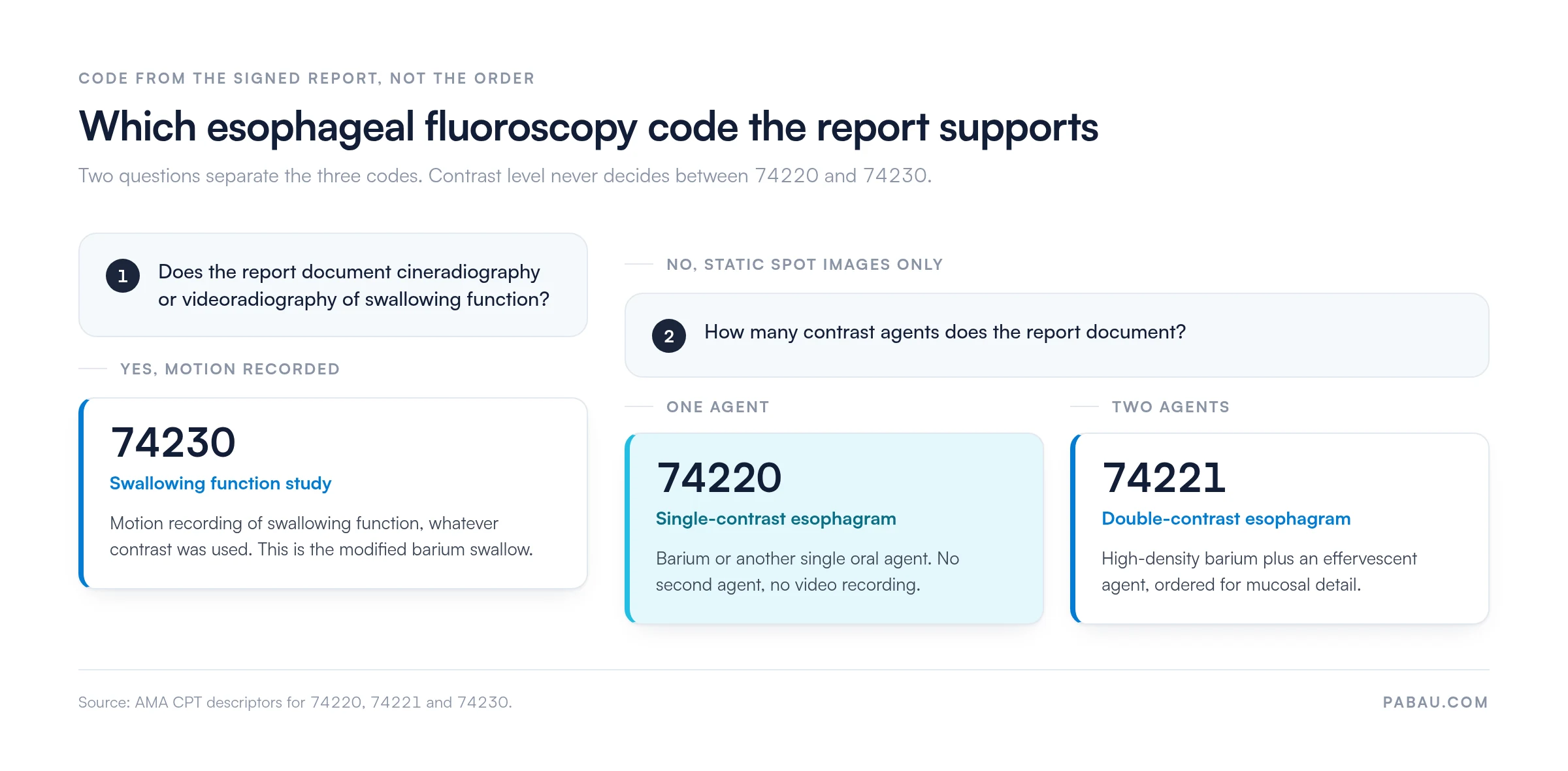
Several nearby codes appear next to CPT Code 74220 in GI radiology and swallowing study workflows. So, knowing where each one applies prevents unbundling errors and missed revenue.
Can 92611 and 74220 be billed together? In fact, for a modified barium swallow, 92611 and 74230 are often billed together. The radiologist bills 74230 for the cineradiographic study, and the speech-language pathologist bills 92611 for the swallowing evaluation. CPT Code 74220 records no motion, so it rarely pairs with 92611. Still, check the current NCCI edit status before billing both.
Relative Value Units decide how Medicare works out payment, and three parts make up the total for CPT Code 74220. Also, the numbers below are the CY2026 values published in the CMS relative value file. Still, pull the current CMS RVU file before you rely on any number for a claim.
Note what the middle column does not do. CPT 74220 has no site-of-service practice expense split, so the facility and non-facility PE RVUs are both 2.19. Still, the total is 2.82 RVUs wherever the study is done.
To work out the Medicare allowable, multiply the total RVU by the Geographic Practice Cost Index (GPCI) adjustment for your MAC region. Then multiply that result by the conversion factor. So, at the non-qualifying factor, 2.82 RVUs works out to roughly $94 before any geographic adjustment.
Also, RVU values and both conversion factors update annually. Check the current numbers through the CMS Physician Fee Schedule before filing claims.
Also, the 2026 national Medicare payment for CPT Code 74220 varies by geographic location and by which component you bill. So, use the CMS Physician Fee Schedule Look-Up Tool to retrieve the exact allowable for your locality code before filing claims. Still, the numbers below are national averages, for reference only.
Because the PE RVU does not change by setting, place of service alone does not move the payment on this code. What moves it is the modifier. Bill the global code and Medicare pays for the reading and the equipment together. Instead, append modifier 26 and Medicare pays for the reading only.
Also, geographic adjustments through Medicare Administrative Contractors (MACs) can shift these rates by 10-20% above or below the national average. High-cost areas such as urban California, New York, and Alaska typically pay more, and rural low-cost areas pay less. So, these adjustments apply to all three RVU parts.
Run a quarterly review of 74220 remittances against the global and modifier 26 allowables you expect. Billing the global code for a study done on hospital equipment creates an overpayment that CMS will reclaim. Confirm the place of service and the modifier on every claim before filing.
Modifier choice for CPT Code 74220 depends on who performs and interprets the procedure, and where it is done. In fact, wrong modifier use is one of the most common causes of underpayment and audit flags on radiology claims. Also, the CMS HCPCS and coding guidance provides the official source for modifier policy updates.
The professional and technical split (Modifier 26 and TC) is required any time the radiologist and the facility bill on their own. Still, billing the global code when the facility owned the equipment is an error that results in overpayment and triggers repayment demands. So, check correct modifier use with your compliance team before starting split-billing processes.
Medical necessity for CPT Code 74220 must be backed by a valid ICD-10-CM diagnosis code. Also, Medicare and commercial payers apply Local Coverage Determinations (LCDs) to radiology codes, and billing without an approved diagnosis code leads to denial.
The codes below are the ones that appear most often on esophagram claims, and the full ICD-10-CM code index covers the rest.
Code specificity matters. The physician’s notes may note a specific cause, such as K22.2 for an esophageal ring. Still, coding R13.10 (unspecified dysphagia) raises the risk of a medical necessity denial. So, always code to the highest level of specificity the records support.
The National Correct Coding Initiative (NCCI) maintains edit pairs that prevent inappropriate unbundling. For CPT Code 74220, the most relevant bundling points are:
Denial management for radiology codes starts with knowing which bundles are absolute, with no override available. Still, others allow a Modifier 59 or an XS/XU/XP/XE override. The CMS NCCI policy manual is updated each quarter, so reference the current quarter’s edits rather than prior-year records.
Correct records are the billing team’s best defense against denial and audit. A CPT 74220 claim needs five elements to withstand payer review.
A clean claim for CPT 74220 means all five elements above are present and consistent before it leaves the practice. So, a mismatch between place of service and modifier is the most common reason for remittance adjustments on esophagram claims.
Flag 74220 claims for a pre-filing modifier check every time the place of service changes. Radiology practices billing the same code across office-based and hospital-based encounters consistently make modifier errors at the setting transition. Build a rule in your billing software to prompt a modifier review when POS differs from the last claim for that patient.
Still, most radiology billing teams build the same claim twice. The contrast technique and the diagnosis sit in the signed report. Then someone retypes the code, the modifier, and the place of service into a separate billing system. So, each retype is another chance to send 74220 when the report describes a double-contrast study.
Also, practice management software like Pabau keeps that information in one record. Your coder still chooses the code, and Pabau carries that code, the modifier, the diagnosis, and the place of service straight into the claim. Claims go out online through our Claim.MD integration, and remittances land back against the same patient record.
So the path from signed report to paid claim gets shorter. You can also see which esophagram claims paid in full and which came back short. When a payer questions the technique you billed, the records and the claim sit side by side.

Pabau carries the CPT code, the modifier, and the diagnosis from the patient record into the claim. Radiology billing teams retype less and chase fewer denials.

CPT Code 74220 is narrow, so the money rides on three checks. Read the signed report for the contrast technique before choosing between 74220, 74221, and 74230. Next, match the modifier to whoever owned the equipment. Then confirm the diagnosis code supports the study.
Get those three right and esophagram denials stop being a monthly line item. Get one wrong and the claim comes back weeks later, when the report is cold and the coder has moved on to another payer.
So, Pabau’s claims tools help radiology and imaging practices build the records-to-filing process that keeps these claims clean. To see how Pabau handles CPT code choice, modifier logic, and clearinghouse filing in one linked system, book a demo.

Need to understand how claims reach the clearinghouse? Medical claims clearinghouse guide explains the full electronic claims pathway from practice to payer.
Want to reduce claim denials before they happen? Denial codes in medical billing covers the most common remittance advice codes and how to respond to each one.
Looking for guidance on electronic remittance? Electronic remittance advice (ERA) guide explains how 835 files work and how to reconcile them against claims.
Want to verify insurance eligibility before imaging? Insurance eligibility verification covers real-time eligibility checks that prevent the billing errors that start before the patient reaches the fluoroscopy table.
CPT Code 74220 is a radiology procedure code for a radiologic examination of the esophagus using single contrast, often called a barium swallow or esophagram. It covers fluoroscopic imaging with a single oral contrast agent, typically barium, to check esophageal anatomy, structure, and motility. The code includes no video recording and no second contrast agent.
CPT Code 74220 is the barium swallow CPT code when a single contrast agent is used. If the study uses high-density barium plus an effervescent agent, it is a double-contrast esophagram and the code is CPT 74221. If it records swallowing function with cineradiography or videoradiography, the code is CPT 74230.
CPT 74220 carries 0.59 work RVUs, 2.19 practice expense RVUs, and 0.04 malpractice RVUs for 2026. The total is 2.82 RVUs. This code has no site-of-service practice expense split, so that total applies in a facility and a non-facility alike. Multiply it by your GPCI-adjusted conversion factor to find the Medicare allowable. The 2026 conversion factors are $33.5675 for qualifying APM participants and $33.4009 for everyone else.
A modified barium swallow study (MBS) is billed with two codes. The speech-language pathologist reports CPT 92611 for the motion fluoroscopic evaluation of swallowing function. The radiologist reports CPT 74230, the cineradiographic or videoradiographic swallowing-function study. CPT 74220 is not the right code for an MBS, because those studies require motion recording.



